

Imagine trying to play a song that feels like it’s vibrating in a frequency your ears aren’t used to. For most Western musicians, that’s exactly what happens when they first try to learn Indian classical music, which uses microtones that don't fit on a standard piano. This friction is the starting point of world music fusion-a movement where artists from Europe and North America step outside their comfortable musical boxes to master traditions from Africa, Asia, and the Middle East.
This isn't just about adding exotic sounds for flavor. It’s a deep, often difficult process of unlearning decades of conditioning. When you grow up listening to equal temperament tuning-the system where every semitone is spaced equally-you develop an ear that expects certain resolutions. Non-Western systems shatter those expectations. The result can be messy, but when it works, it creates some of the most emotionally complex music available today.
The Technical Wall: Why It’s Harder Than You Think
The biggest hurdle isn’t motivation; it’s physics. Western music relies on equal temperament tuning, a system standardized by Johann Sebastian Bach in the early 18th century. It divides the octave into twelve identical steps. This makes transposition easy but sacrifices purity in intervals other than the perfect fifth.
Non-Western systems reject this compromise. Indian classical music, for instance, utilizes shrutis, or 22 distinct intervals within an octave. These microtones allow ragas (melodic frameworks) to express specific emotional states that Western scales simply cannot capture. Similarly, Middle Eastern maqam music incorporates quarter-tones-notes that sit right between the keys on your piano.
Rhythm presents another barrier. African polyrhythms often layer time signatures like 5/4 over 3/4, creating a rhythmic tension that feels unstable to Western ears trained in strict 4/4 meters. A study from the University of Helsinki found that adults acculturated to Western tuning need 150-200 hours of focused listening just to retrain their auditory processing. If you’re over 25, add another 40% to that time. Your brain has literally wired itself to expect Western structures.
Historical Pioneers Who Broke the Mold
We didn’t get here overnight. Several key figures took massive risks to bridge these gaps in the late 20th century.
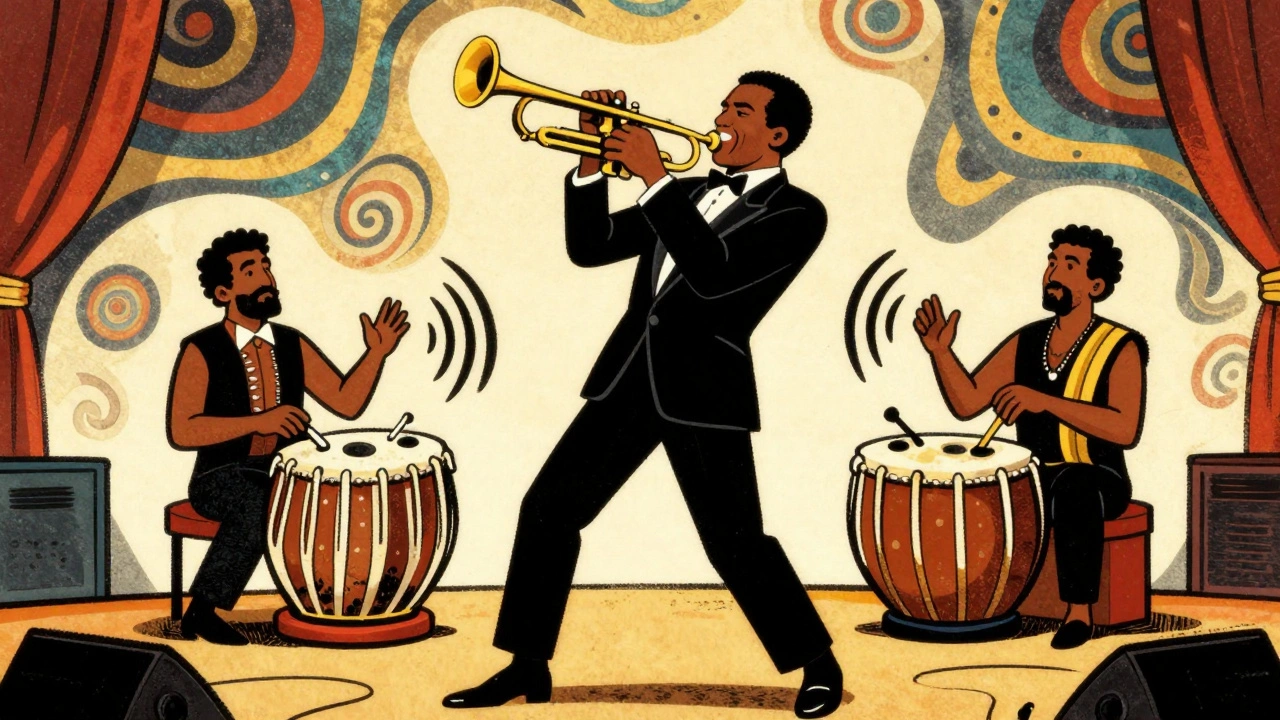
Miles Davis was one of the first jazz giants to integrate non-Western percussion seriously. In 1967, he hired Indian tabla player Badal Roy. By 1969, his album 'In a Silent Way' featured rhythms that felt alien to mainstream jazz audiences at the time. He wasn't just using tabla as a novelty; he was exploring how Indian rhythmic cycles could drive harmonic progression.
Then there was John McLaughlin. After studying under spiritual teacher Sri Chinmoy, he formed the Mahavishnu Orchestra. His 1973 album 'Birds of Fire' didn't just borrow Indian scales; it wove taals (Indian time cycles) into high-speed rock-jazz fusion. Tracks like 'Open Country Joy' required band members to internalize mathematical rhythmic structures that had no equivalent in Western conservatory training.
On the pop side, Paul Simon's 'Graceland' (1986) changed the commercial landscape. By collaborating with South African group Ladysmith Black Mambazo, Simon introduced township jive to millions of Western listeners. The album generated $40 million in its first year and won Album of the Year, proving that authentic cross-cultural collaboration could dominate mainstream charts.
| System | Tuning Structure | Rhythmic Focus | Learning Curve for Westerners |
|---|---|---|---|
| Western Classical | 12-tone Equal Temperament | Meter-based (4/4, 3/4) | Native (for Westerners) |
| Indian Classical | 22 Shruti Microtones | Cyclic Taals | Very High (5-7 years) |
| West African | Pentatonic/Heptatonic | Polyrhythmic Layers | High (Ensemble immersion) |
| Middle Eastern Maqam | Quarter-tones | Iqa'at (Rhythmic Modes) | High (Ear training) |
Where Do You Actually Learn This?
You can’t learn authentic world music fusion from a YouTube tutorial alone. While platforms like MasterClass offer insights from legends like Yo-Yo Ma, true mastery requires immersive pedagogy.
Institutions have started to formalize this. Berklee College of Music offers a Global Jazz concentration requiring 45 credit hours dedicated to non-Western integration. Students spend 300+ hours on Indian theory and 250 hours on African polyrhythms. Faculty include veterans like Bill Summers, who studied African drumming for 23 years before teaching.
For traditional methods, the guru-shishya parampara remains the gold standard for Indian music. This ancient teacher-student model often requires relocating to India for 2-5 years. Tabla legend Zakir Hussain has mentored over 120 Western musicians since 1975, demanding 800-1200 hours of initial technical training before students can perform professionally.
African traditions use a different approach: participatory ensemble learning. Ethnomusicologist Thomas Turino found that Western musicians needed 18 months of weekly ensemble participation (about 312 total hours) to internalize West African polyrhythms sufficiently to contribute meaningfully. You learn by doing, not by reading notation.

The Ethics of Fusion: Respect vs. Appropriation
This is the most critical part of the conversation. Not all fusion is created equal. Ethnomusicologists draw a sharp line between "participatory" engagement and "presentational" commodification.
Thomas Turino’s research suggests that only 34% of Western fusion projects demonstrate genuine cultural respect and deep theoretical engagement. The remaining 66% are often criticized as superficial sonic borrowing. When a Western artist takes a sacred rhythm or scale and strips it of its cultural context to sell records, it’s called cultural appropriation.
Scholar Georgina Born argues that successful fusion requires "intercultural understanding through genuine musical dialogue." This means investing in the history, spirituality, and social function of the music, not just its sound. Bruno Nettl emphasizes "intellectual humility," reminding Western musicians that they are guests in these traditions, not owners.
The financial disparity highlights the problem. Steven Feld documented cases where Western fusion albums sold millions, generating $2-8 million per project, while the original tradition-bearers received minimal compensation. Today, diaspora communities in North America report that 58% of surveyed musicians feel concerned about misrepresentation when outsiders perform their heritage music without context.
Modern Tools and Future Trajectories
Technology is changing the access game. Spotify reported 847 million streams of "world music fusion" tracks in 2023. Artists like Anoushka Shankar (daughter of Ravi Shankar) blend traditional sitar with electronic production, reaching number 1 on Billboard's World Music Chart. Her work shows how second-generation fusion artists can navigate both worlds authentically.
Digital communities are also vital. Reddit’s r/worldmusic and specialized Facebook groups like "Tabla Players Worldwide" provide peer support for learners navigating the steep learning curve. However, the cost remains high. Intensive training with master musicians can cost $15,000-$35,000 annually, including living expenses if you relocate to source countries.
The institutional recognition is growing. Juilliard announced a $4.2 million Global Music Initiative in 2023 to integrate world music into classical training. The Grammy Awards even created a "Best Global Music Fusion" category in 2024, awarded to Joshua Redman for blending Indian, African, and Brazilian elements. These signals suggest that world music fusion is moving from a niche interest to a core component of contemporary musicianship.
How long does it take to learn Indian classical music as a Westerner?
It typically takes 5-7 years of intensive study to develop the necessary microtonal ear sensitivity and raga interpretation skills. Initial technical training often requires 800-1200 hours before independent professional performance is possible.
What is the difference between cultural appreciation and appropriation in music?
Appreciation involves deep study of cultural contexts, spiritual frameworks, and historical traditions, often resulting in collaborative dialogue. Appropriation occurs when sonic elements are extracted for commercial gain without understanding or crediting the source culture, perpetuating structural inequities.
Can I learn world music fusion online?
Online resources like MasterClass and YouTube channels provide excellent introductions and theoretical knowledge. However, mastering complex rhythmic structures like African polyrhythms or Indian ragas usually requires immersive, in-person mentorship due to the nuanced physical techniques involved.
Why is equal temperament tuning a barrier to world music?
Equal temperament divides the octave into 12 equal semitones, which simplifies Western harmony but eliminates microtones. Many non-Western systems, such as Indian shrutis or Middle Eastern quarter-tones, rely on intervals smaller than a semitone, making them impossible to play accurately on standard Western instruments without retuning or specialized technique.
Who are some key figures in modern world music fusion?
Key figures include Anoushka Shankar (sitar/electronic), Yo-Yo Ma (Silk Road Ensemble), Peter Gabriel (pop/African rhythms), and John McLaughlin (jazz/Indian classical). These artists are noted for their deep engagement with source traditions rather than superficial borrowing.


