

Imagine you are standing in front of a wall of cables and modules. You plug one cable into an oscillator, another into a filter, and suddenly, a deep, throbbing bass note fills the room. That raw power comes from one specific component: the Voltage-Controlled Oscillator. Often called the VCO, this circuit is the engine of almost every analog synthesizer. It is where the sound begins before any filtering or amplification happens.
If you want to understand how synthesizers create that iconic "warm" analog tone, you have to start here. This article breaks down exactly what a VCO is, how it works, and why musicians still chase its imperfect, drifting character over perfectly tuned digital alternatives.
What Is a Voltage-Controlled Oscillator?
A Voltage-Controlled Oscillator (VCO) is an electronic circuit that generates a periodic signal whose frequency changes based on an input voltage. In simple terms, if you turn up the voltage going into the module, the pitch goes up. If you lower the voltage, the pitch drops.
This concept seems straightforward, but it revolutionized music technology when Robert Moog and Don Buchla started building modular systems in the 1960s. Before VCOs, changing the pitch of an electronic instrument often meant physically swapping components or using complex mechanical switches. With a VCO, you can slide smoothly between notes or jump instantly by sending different voltages from a keyboard or sequencer.
The key standard for musical VCOs is 1 volt per octave. This means that for every 1 volt increase in the control signal, the oscillator’s frequency doubles, moving up exactly one musical octave. This linear relationship makes it easy for musicians to play melodies because the voltage steps match our understanding of musical intervals. A step of 1/12th of a volt equals one semitone.
The Waveforms: Building Blocks of Timbre
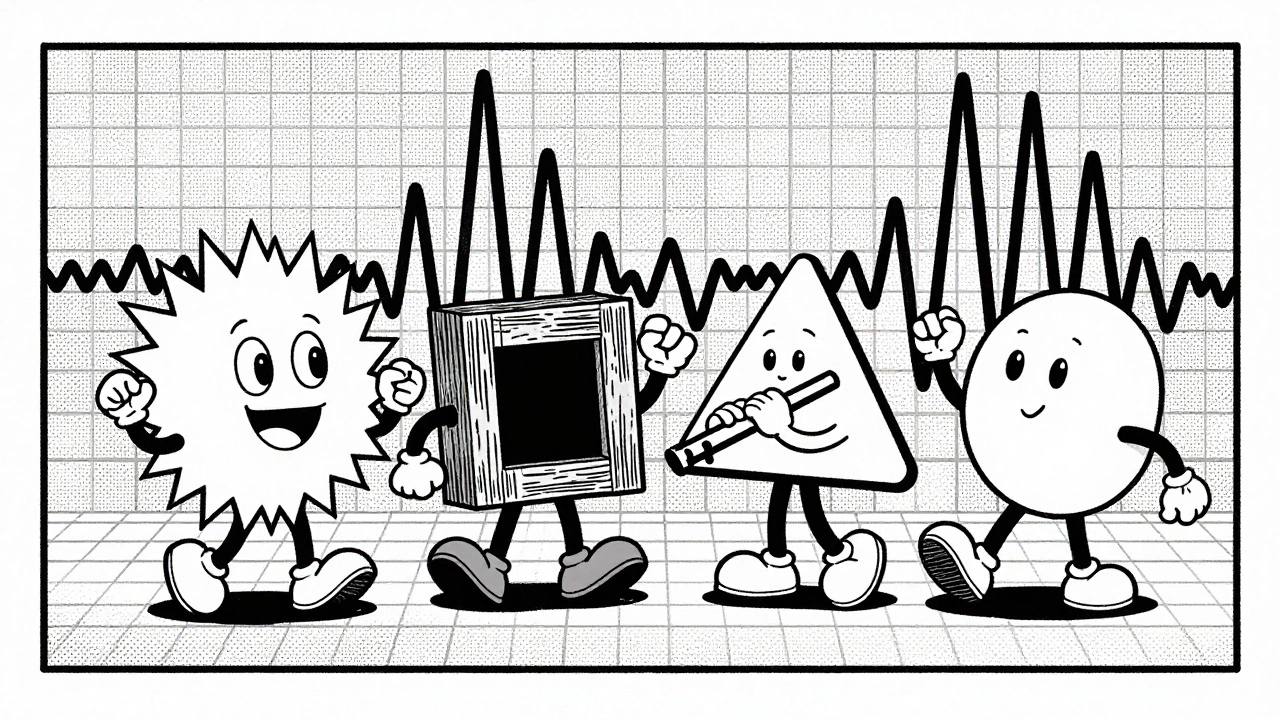
A VCO doesn’t just produce a single sound; it produces a variety of waveforms. Each shape has a unique harmonic structure, which determines the basic color or timbre of the sound before it hits the filter. Most classic analog VCOs offer four main shapes:
- Sawtooth Wave: Bright and buzzy. It contains all integer harmonics, making it ideal for strings and brass sounds.
- Square/Pulse Wave: Hollow and woody. It only contains odd harmonics, resembling a clarinet. By adjusting the pulse width, you can change the balance of these harmonics.
- Triangle Wave: Soft and flute-like. It rolls off higher frequencies quickly, resulting in a pure, mellow tone.
- Sine Wave: Pure and clean. It has no harmonics at all, which is why it is often used for sub-bass or as a carrier for modulation rather than a lead sound.
These waveforms are not generated independently in most circuits. Instead, many VCOs use a core design-often a square-wave generator feeding an integrator-to create a triangle wave, which is then shaped into saws and sines. This shared lineage means that even though the shapes look different on an oscilloscope, they share certain sonic characteristics specific to that hardware.
Analog Warmth vs. Digital Precision
You might wonder why we don’t just use computers to generate these waves. After all, a digital oscillator can be perfectly in tune. The answer lies in the imperfections of analog electronics. A true Analog VCO relies on physical components like capacitors and transistors. These parts react to temperature changes, power supply fluctuations, and manufacturing tolerances.
This leads to drift, where the pitch slowly shifts over time. While this can be frustrating for someone trying to record a precise melody, many sound designers love it. Drift adds movement and life to static patches. Two VCOs detuned slightly against each other will beat and pulsate in ways that feel organic and unpredictable.
In contrast, a Digitally Controlled Oscillator (DCO) uses a digital clock to stabilize the timing. DCOs stay in tune regardless of temperature, but some listeners describe their sound as "cold" or "sterile." Modern hybrid synthesizers often try to bridge this gap by using digital control for stability while keeping the final waveform generation analog to preserve warmth.
| Feature | Analog VCO | DCO | Digital Oscillator |
|---|---|---|---|
| Pitch Control | Continuous Voltage | Digital Clock | Software/Firmware |
| Tuning Stability | Low (Drifts) | High | Perfect |
| Sonic Character | Warm, Organic | Clean, Stable | Versatile, Precise |
| Waveform Variety | Limited (Saw, Square, etc.) | Moderate | Unlimited (Wavetables, FM) |
Modulation: Making the Sound Move
A steady tone is boring. To make a synth patch interesting, you need to modulate the VCO. Modulation means using one signal to change a parameter of another. Here are the most common ways to manipulate a VCO:
- Frequency Modulation (FM): Feeding the output of one oscillator into the pitch input of another. At low rates, this creates vibrato. At audio rates, it creates metallic, bell-like tones with complex sidebands.
- Pulse-Width Modulation (PWM): Changing the duty cycle of a square wave over time. This creates a sweeping, chorusing effect that is famous in 80s pop music.
- Oscillator Sync: Resetting the phase of one oscillator whenever another completes a cycle. Sweeping the pitch of the synced oscillator creates aggressive, rising screams.
- Wavefolding: Pushing the signal beyond its normal limits to create new harmonics. This turns a simple sine wave into a distorted, rich texture.
Most modular synthesizers provide dedicated inputs for these modulations. For example, a linear FM input allows for wide, non-musical pitch deviations, while an exponential FM input keeps the modulation musically relevant to the root note.

Practical Tips for VCO Sound Design
If you are starting with a Eurorack system or a semi-modular synth, here is how to get the most out of your VCOs:
- Start Simple: Patch a single sawtooth wave into a low-pass filter. Adjust the cutoff frequency until you hear the resonance peak. This teaches you how the VCO’s harmonics interact with the filter.
- Detune for Width: Use two VCOs playing the same note but detune one slightly sharp and the other flat. Blend them together for a thick, unison sound.
- Explore the Extremes: Turn the pitch knob past the normal range. Going below the audible spectrum creates sub-bass rumble. Going above 16 kHz can create shimmering textures when mixed with lower frequencies.
- Embrace Drift: If your VCO drifts out of tune, don’t fix it immediately. Try recording a long ambient pad and letting the pitch wander naturally. It can add a haunting quality to your track.
Frequently Asked Questions
What is the difference between a VCO and a DCO?
A VCO (Voltage-Controlled Oscillator) uses analog circuits to determine frequency, which can lead to tuning drift but offers a warm, organic sound. A DCO (Digitally Controlled Oscillator) uses a digital clock to stabilize the timing, resulting in perfect tuning but potentially less character.
Why do VCOs drift out of tune?
VCOs rely on physical components like capacitors and resistors that change value with temperature. As the synth warms up during use, these components shift, causing the pitch to drift. This is a natural characteristic of analog electronics.
What does 1V/octave mean?
1V/octave is a standard where an increase of 1 volt in the control signal raises the oscillator's pitch by one octave. This allows keyboards and sequencers to control analog synths accurately across multiple octaves.
Which waveform is best for bass sounds?
Sawtooth waves are popular for bright, punchy basses due to their rich harmonics. Sine waves are used for deep, clean sub-bass because they lack high-frequency content. Triangle waves offer a middle ground with a softer attack.
Can I use a VCO as an LFO?
Yes. Many VCOs have a switch to extend their range below the audible spectrum (below 20 Hz). In this mode, they function as Low-Frequency Oscillators (LFOs), generating slow control signals for modulation effects like vibrato or filter sweeps.
What is oscillator sync?
Oscillator sync resets the phase of one oscillator (the slave) whenever another oscillator (the master) completes a cycle. Sweeping the slave's pitch creates distinctive, aggressive sounds often used in techno and industrial music.
Do VCOs require maintenance?
Analog VCOs may need occasional recalibration to ensure accurate tracking across the keyboard. Over time, component aging can affect tuning stability, so professional servicing is recommended for vintage gear.
Is a VCO better than a digital oscillator?
It depends on your needs. VCOs excel at traditional subtractive synthesis and organic textures. Digital oscillators offer greater precision, more waveform options, and easier integration with modern software workflows. Many producers use both.
What is PWM?
Pulse-Width Modulation (PWM) varies the duty cycle of a square wave, changing the balance of harmonics. Automating PWM with an LFO creates a sweeping, chorusing effect that adds movement to static patches.
How do I start learning modular synthesis?
Begin with a simple patch: connect a VCO to a VCF (filter) and a VCA (amplifier). Add an envelope generator to control the VCA and filter. Experiment with different waveforms and modulation sources to understand how each element affects the sound.


