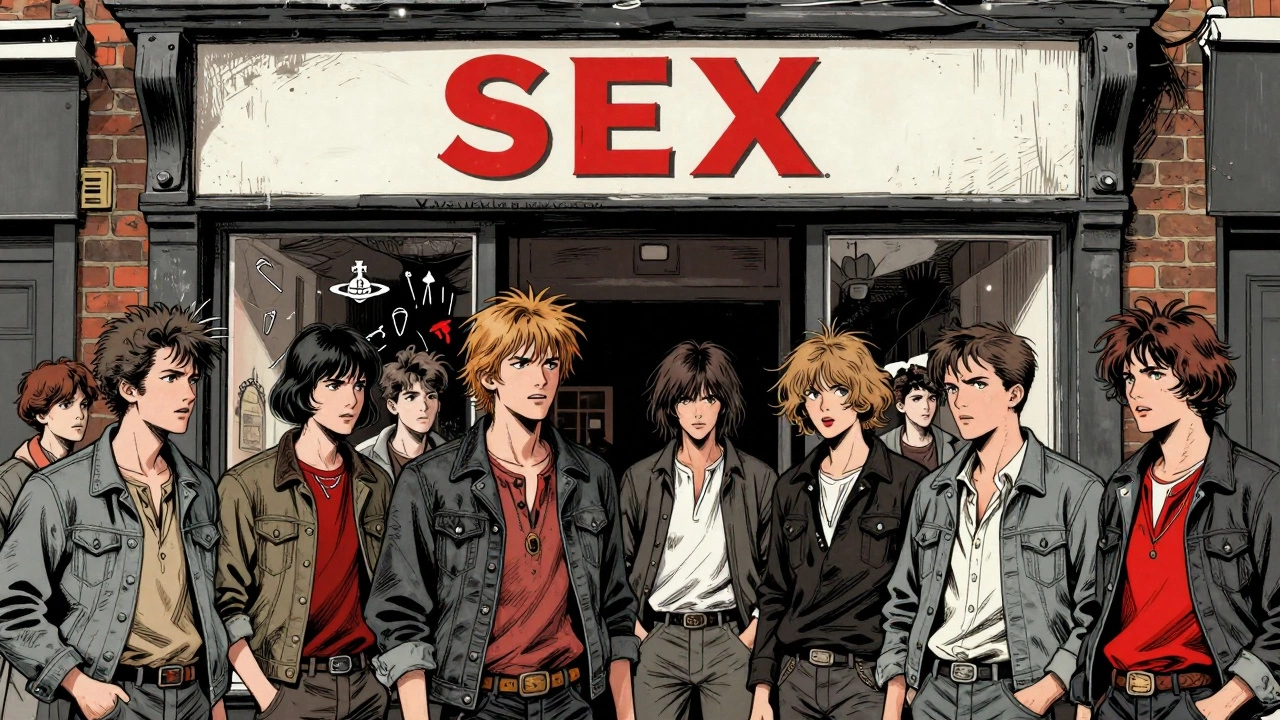

When you think of punk fashion, a visual language defined by rebellion, safety pins, and ripped clothing that emerged in the mid-1970s, one name usually dominates the conversation. That name is Vivienne Westwood, a British fashion designer who codified the punk aesthetic through her boutique at 430 King's Road in London. But here is the thing most people miss: Westwood didn’t just invent punk style in a vacuum. She captured a raw, chaotic energy on the streets and polished it into something wearable-and profitable. The relationship between her high-end designs and the gritty, do-it-yourself (DIY) looks of working-class teens was a messy feedback loop.
To understand how this happened, we have to look at the shop itself. It wasn’t always a punk headquarters. Between 1971 and 1979, the unit at 430 King’s Road went through four distinct personalities, each mirroring a shift in youth culture. First, there was 'Let It Rock' (1971), selling Teddy Boy-inspired suits. Then came 'Too Fast to Live, Too Young to Die' (1972), focusing on motorcycle rockers. By 1974, it had transformed into 'SEX', selling fetish wear like rubber dresses and studded leather. Finally, in 1976, it became 'Seditionaries: Clothes for Heroes'. This evolution shows that Westwood was constantly reacting to what young people were already doing, then amplifying it.
The Anatomy of Seditionaries
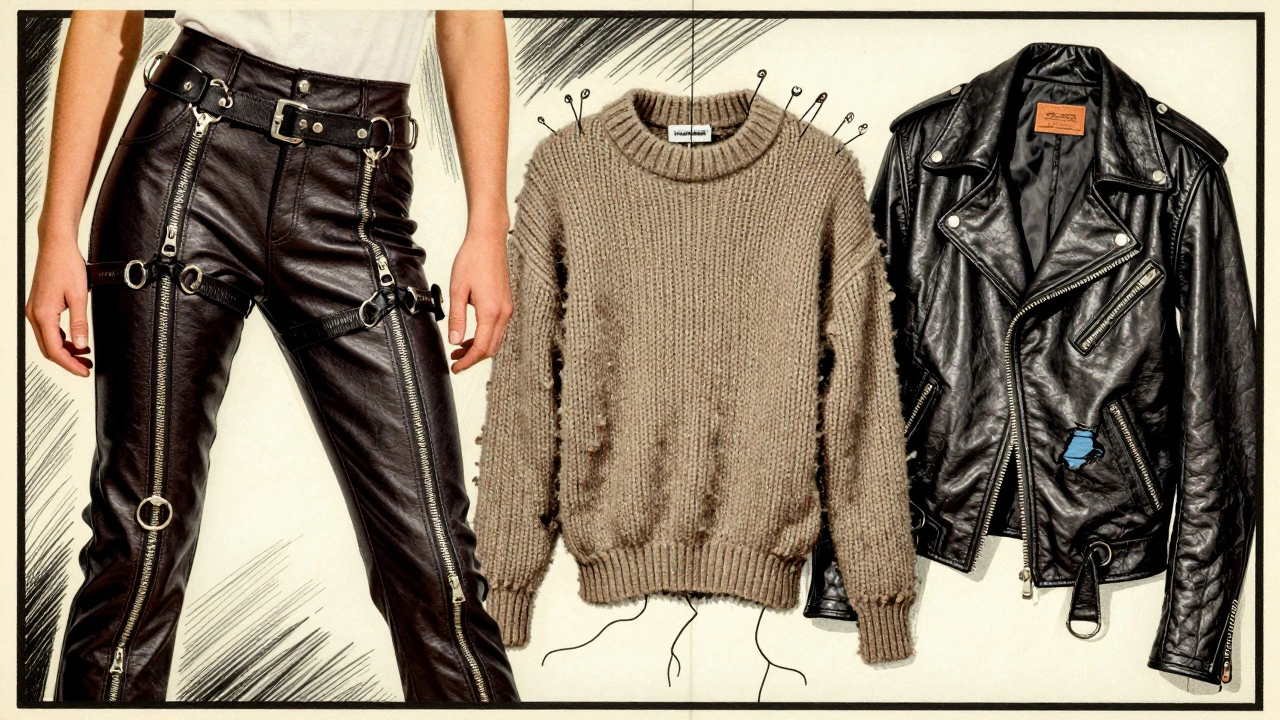
The period known as Seditionaries (1976-1979) is where Westwood’s influence becomes undeniable. She didn’t just sell clothes; she engineered them. Take the iconic bondage trousers. These weren’t just tight jeans with zippers thrown on. According to archives from the Victoria and Albert Museum (V&A), these garments combined elements from army combat trousers, motorcyclist leathers, and fetish gear. They featured zippered seams running under the crotch, removable 'bum flaps,' and hobble straps that restricted movement. The materials were often cotton or wool gabardine, reinforced with metal D-rings and webbing.
Westwood also played with texture and destruction. She designed loose-knit mohair jumpers that deliberately unraveled when worn. She cut dresses to look torn, then weighted them down with chains or pinned them together with safety pins. This turned accidental damage-a hallmark of poverty or neglect-into a constructed design feature. It was postmodern art you could wear. As noted by the Metropolitan Museum of Art, this approach appropriated symbols of authority and decay to critique the social order. It wasn’t just about looking bad; it was about making the viewer uncomfortable.
Shock Tactics and Graphic Imagery
If the cuts were radical, the graphics were explosive. During the Seditionaries era, T-shirts became canvases for political provocation. Westwood and her partner, Malcolm McLaren, the manager of the Sex Pistols and co-owner of the King's Road boutiques, used screen-printing to display images that challenged every taboo in 1970s Britain. You’ll find shirts featuring swastikas, a portrait of Queen Elizabeth II with a safety pin through her lips, bare female breasts printed at chest level, and imagery sourced from gay erotica.
This wasn’t random vandalism. It was calculated shock therapy. Westwood later explained that using the swastika was meant to force people to confront the reality of fascism and "the rotten core of the system." However, this strategy remains controversial. Critics argue that trivializing such potent symbols risked normalizing fascist imagery, especially in a climate where groups like the National Front were active. For many punks, particularly those involved in anti-racist movements like Rock Against Racism, these images were deeply problematic. It highlights a key tension in punk fashion: the line between subversive critique and harmful appropriation is thin.
The DIY Feedback Loop
Here is where the myth of Westwood as the sole creator of punk falls apart. Cultural theorist Dick Hebdige, in his seminal work 'Subculture: The Meaning of Style,' argued that working-class youth were already creating their own aesthetics before they ever stepped into Seditionaries. Teens in London council estates used safety pins-cheap domestic objects costing pennies-as facial piercings and jewelry. They modified school blazers and bin liners into jackets. They learned basic sewing and studding from peers, not designers.
The economic reality supports this. A single Westwood-McLaren T-shirt might cost £8-£12 in 1976. At that time, a typical teenage weekly wage was around £20-£30. Buying one shirt meant sacrificing nearly half your paycheck. Most punks couldn’t afford more than one original piece. So, they bought a graphic tee from SEX and paired it with self-modified charity-shop finds. They added handwritten slogans, patches, and rips. Westwood provided the prototype; the street provided the scale. Her shop acted as a catalyst, but the movement belonged to the kids who customized their own lives.
London vs. New York: Two Punks
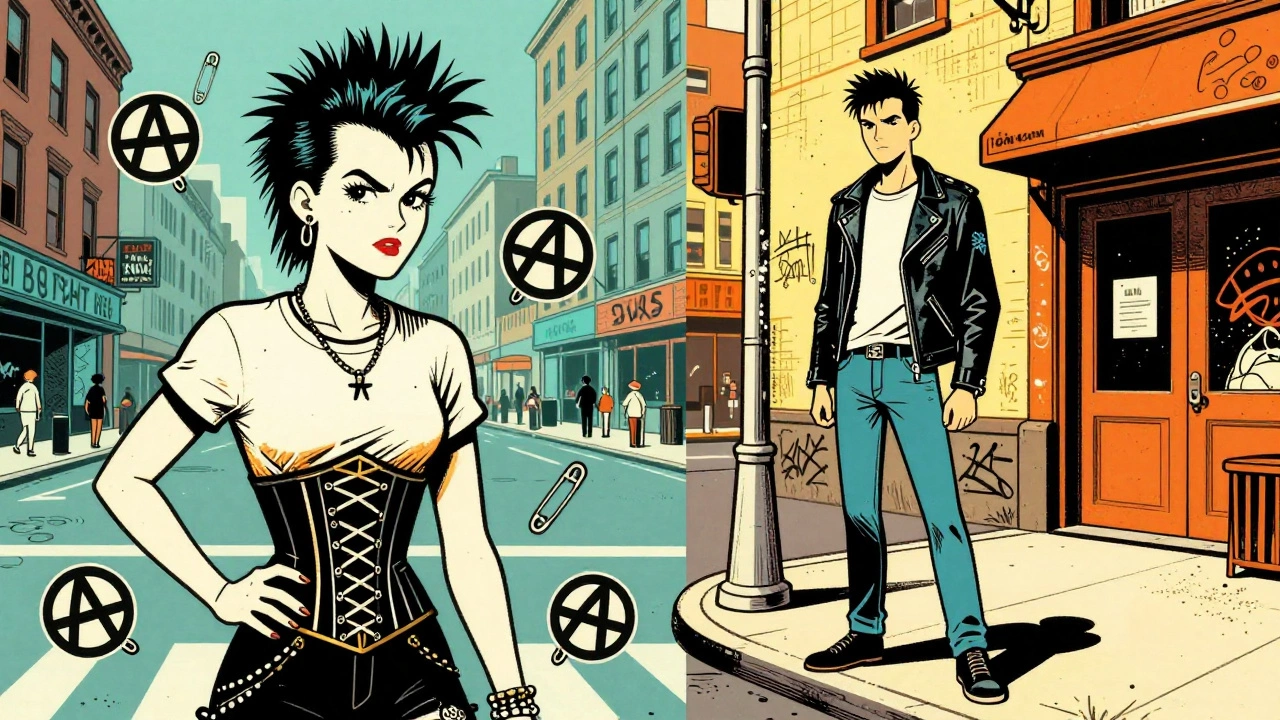
While Westwood dominated the London scene, the punk style evolved differently across the Atlantic. In New York, shops like Trash and Vaudeville (opened 1975 on St. Mark’s Place) catered to the CBGB crowd. Bands like Television and the Ramones developed a stripped-down look: tight jeans, plain T-shirts, and leather jackets. It was functional, minimalist, and less theatrical than the London equivalent.
Westwood’s style was denser and more referential. It drew from 18th-century tailoring, fetish subcultures, and Situationist art theory. While American punk felt like a reaction to mainstream pop music, British punk felt like a reaction to the entire social structure. Yet, the styles crossed over. Photographs of the Sex Pistols wearing Seditionaries gear appeared in US magazines like 'Punk' and 'Creem'. New York punks began copying the look, improvising bondage details with padlocks and dog chains from local hardware stores. The transatlantic exchange proved that while the origins differed, the desire for rebellion was universal.
| Feature | London (Westwood/McLaren) | New York (CBGB Scene) |
|---|---|---|
| Aesthetic Focus | Theatrical, historical references, fetish wear | Minimalist, functional, utilitarian |
| Key Garments | Bondage trousers, corsets, unravelling jumpers | Tight jeans, plain T-shirts, leather jackets |
| Graphic Elements | Provocative prints (royalty, swastikas, erotica) | Band logos, simple slogans, minimal graphics |
| Influences | Situationist theory, Victorian history, BDSM | Glam rock, street utility, garage rock |
| Economic Context | High-cost originals + cheap DIY modifications | Low-cost thrift store finds + second-hand gear |
Gender and Silhouette
Westwood’s impact on gender norms was just as significant as her use of shock tactics. She championed unisex garments, dressing both men and women in the same corsets, bondage trousers, and platform shoes. This directly disrupted binary gender expectations. She promoted 'courting corsets' as outerwear, laced tightly over T-shirts regardless of the wearer’s sex. This approach resonated with the punk ethos of rejecting traditional roles. On the streets of Soho and King’s Road, young men and women adopted similar silhouettes, prioritizing attitude over conformity. This fluidity paved the way for later fashion movements that blurred gender lines, influencing designers like Martin Margiela and Rei Kawakubo decades later.
From Rebellion to Retail
By the 1980s, Westwood moved beyond strict punk. Collections like 'Pirate' (1981-82) and 'Mini-Crini' (1985) incorporated historical references but retained punk techniques like raw edges and exposed underwear. Critics argued she had 'domesticated' punk, turning a working-class rebellion into luxury ready-to-wear. And financially, she succeeded. Today, pieces inspired by her punk era retail for hundreds of dollars, far removed from the low-income teen market of the 1970s.
Yet, the spirit of punk persists in her legacy. After her death in 2022, the brand continues under Andreas Kronthaler, still using tartan, bondage straps, and anarchist graphics. More importantly, Westwood’s later activism-focusing on climate change and consumerism-reframed punk’s oppositional spirit. Her mantra, "buy less, choose well, make it last," aligns with the original DIY ethic of resourcefulness and resistance against mass production. Whether viewed as a commodifier of rebellion or its greatest translator, Vivienne Westwood ensured that punk fashion would never be forgotten.
Did Vivienne Westwood invent punk fashion?
Not entirely. While Westwood and Malcolm McLaren codified and popularized the aesthetic through their shop Seditionaries, the style emerged from a broader working-class DIY culture. Teens were already modifying clothes with safety pins and rips before Westwood sold pre-made versions. She acted as a catalyst and stylist, capturing the energy of the streets rather than creating it from scratch.
What were the key elements of Westwood's punk designs?
Key elements included bondage trousers with zippers and hobble straps, unravelling mohair jumpers, distressed fabrics held together with safety pins, and provocative graphic T-shirts. She also emphasized unisex silhouettes, using corsets and tight trousers for both men and women to challenge gender norms.
Why were Westwood's T-shirt graphics so controversial?
Her T-shirts featured images like swastikas, the Queen with a safety pin through her lips, and explicit pornography. Westwood intended these as anti-fascist critiques and challenges to authority. However, critics argued that using such potent symbols risked trivializing hate speech and causing harm, particularly to Jewish communities and anti-racism activists within the punk scene.
How did punk fashion differ between London and New York?
London punk, influenced by Westwood, was theatrical, historical, and dense with symbolic graphics and fetish wear. New York punk, centered around CBGB, was more minimalist and functional, favoring tight jeans, plain T-shirts, and leather jackets. The London look was about shocking the establishment; the New York look was about practical rebellion.
Could average teenagers afford Vivienne Westwood's clothes in the 1970s?
Generally, no. A single T-shirt could cost £8-£12, which was nearly half of a typical teen’s weekly wage. Most punks bought one original piece and combined it with cheap, self-modified items from charity shops. This created a hybrid style where Westwood’s designs served as status symbols amidst a sea of DIY creations.