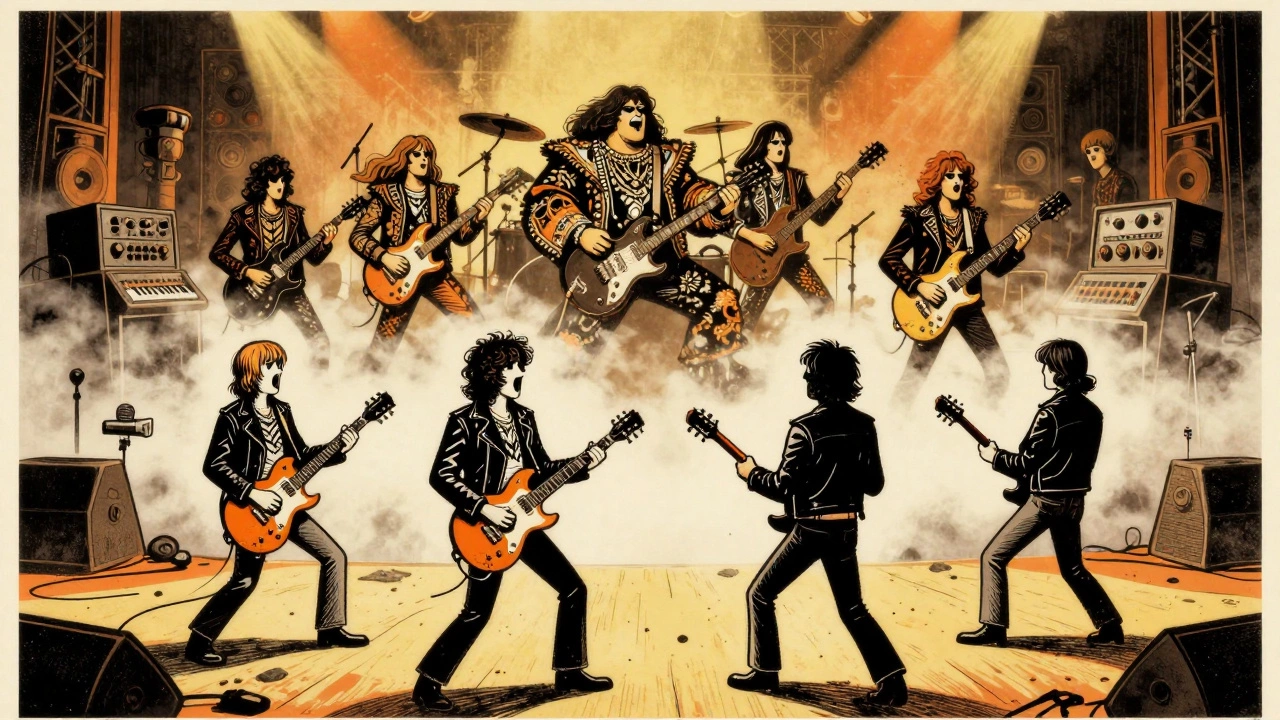

Imagine a world where every rock song lasted ten minutes. Imagine listening to endless guitar solos, complex time signatures, and concept albums that demanded you sit still and study the lyrics like a textbook. That was mainstream rock in the early 1970s. Then came four guys from Queens who decided to strip all of that away. They played fast, they played loud, and they kept it stupidly simple. This wasn’t just a style choice; it was a revolution.
The Ramones is an American punk rock band formed in New York City in 1974 that pioneered a minimalist musical style defined by short songs, three-chord progressions, and high-energy performances. By rejecting the technical virtuosity of their peers, they didn’t just change how music sounded-they changed who could make it. If you’ve ever picked up a guitar and thought, “I can do this,” The Ramones are likely why you felt that way.
The Anti-Rock Revolution
To understand why The Ramones mattered, you have to look at what they were reacting against. In the mid-1970s, rock music had become bloated. Bands like Yes, Genesis, and Emerson, Lake & Palmer were creating progressive rock epics. These songs often ran six to eight minutes long. They featured odd time signatures, keyboard solos, and lyrics about fantasy worlds or philosophical concepts. Arena rock acts like Led Zeppelin and Pink Floyd filled stadiums with polished, expensive productions.
This music required patience. It asked for your attention in a very specific, almost academic way. For many teenagers in New York City, this felt elitist. It felt distant. Enter The Ramones. Formed in Forest Hills, Queens, the band consisted of Joey Ramone (vocals), Johnny Ramone (guitar), Dee Dee Ramone (bass), and Tommy Ramone (drums). They didn’t want to write symphonies. They wanted to capture the raw energy of early 1960s garage rock and Brill Building pop.
Their solution was radical reduction. Instead of building up complexity, they stripped everything down to the bare essentials. A typical Ramones song followed a strict formula: intro, verse, chorus, verse, chorus, bridge, chorus. No solos. No key changes. No dynamic shifts where the music gets quiet and then loud again. Just a consistent, driving tempo from start to finish. This structure became the blueprint for punk rock.
The Formula of Simplicity
Let’s break down exactly what made their sound so distinct. It wasn’t that they couldn’t play better instruments-many members had studied classical music or jazz before forming the band. It was a deliberate aesthetic decision. They chose simplicity as a weapon.
| Feature | Progressive/Arena Rock | The Ramones / Punk Rock |
|---|---|---|
| Average Song Length | 6-10+ minutes | Under 2:30 minutes |
| Guitar Technique | Extended solos, complex scales | Power chords, rapid down-strokes |
| Chord Progressions | Complex, modulating keys | I-IV-V (Three chords) |
| Vocal Style | Operatic, melismatic | Chant-like, nasal, repetitive |
| Production Value | Polished, multi-layered studio effects | Dry, loud, minimal mixing |
| Goal | Technical display, artistic depth | Immediate energy, accessibility |
Johnny Ramone’s guitar playing is the perfect example. He didn’t pick individual strings. He used a flatpick to strike all six strings simultaneously in rapid down-strokes. This created a chugging, aggressive wall of sound. It was physically demanding but technically simple. You didn’t need years of practice to learn the rhythm; you just needed stamina. Dee Dee Ramone’s bass lines mirrored this simplicity, sticking to steady eighth-note patterns that locked in with Tommy Ramone’s four-on-the-floor drum beat.
Joey Ramone’s vocals completed the package. He sang in a high, nasal register that cut through the distortion. His melodies were straightforward and memorable, often relying on repetition rather than variation. Songs like “Blitzkrieg Bop” feature hooks like “Hey! Ho! Let’s go!” that anyone could shout along to immediately. There was no mystery in the melody. It was designed for participation, not contemplation.
The Debut Album as a Manifesto
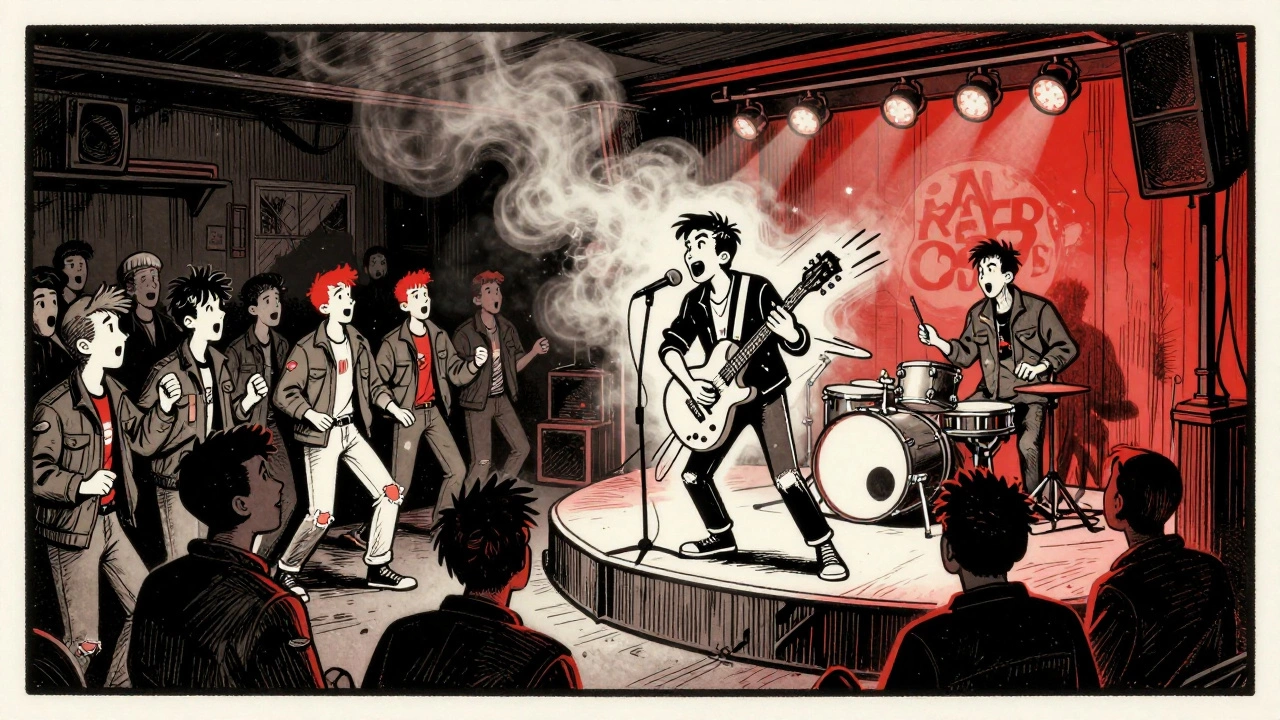
In April 1976, The Ramones released their self-titled debut album on Sire Records. This record is widely considered the first true punk rock album. It clocked in at roughly 29 minutes total, featuring 14 tracks. Almost every song was under two and a half minutes long. Tracks like “Beat on the Brat” and “Judy Is a Punk” rushed by in a blur of noise and energy.
The production was intentionally dry. Guitars were mixed loud and upfront. There were no reverb tanks washing out the drums. No string sections swelling in the background. It sounded like a band playing in a small room, which is exactly where they spent most of their early career: at CBGB, a dingy club on the Bowery in Manhattan. CBGB became the epicenter of the New York punk scene, a place where the elite rock stars of the day would never be seen.
This album proved that you didn’t need a million-dollar studio budget to make an impact. You just needed attitude and a few good riffs. The sonic economy of the record served as a rallying cry. It showed aspiring musicians that a full-length LP could be made with short, fast, simple songs. It rejected the idea that rock music had to be a serious, high-art endeavor. Instead, it embraced fun, immediacy, and physical impact.
Democratizing Music
The most profound effect of The Ramones’ simplicity was social. Before punk, rock music was dominated by virtuosos. To be taken seriously, you had to be able to play like Jimi Hendrix or Jimmy Page. You needed technical skill. This created a barrier to entry. If you weren’t a trained musician, you were an outsider.
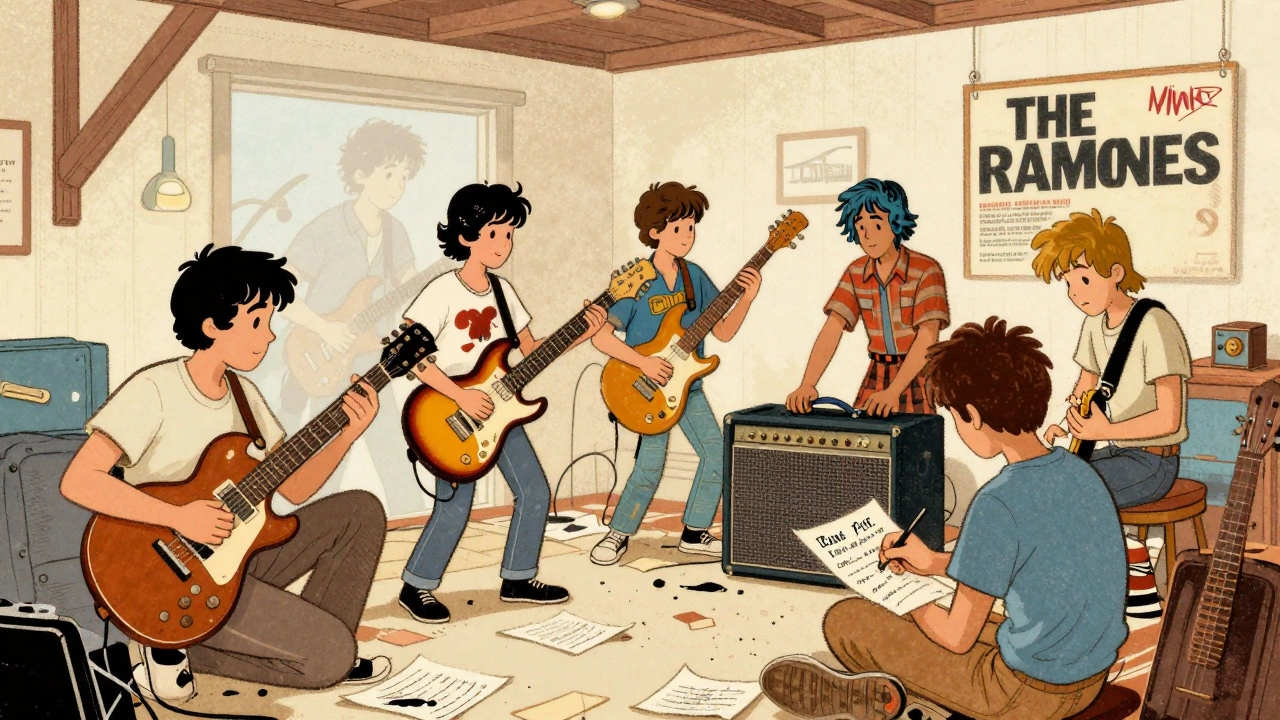
The Ramones tore that door down. Because their songs relied on power chords and basic rhythms, the technical barrier to entry plummeted. You could learn a Ramones song in weeks, not years. You didn’t need expensive gear. A cheap electric guitar, a basic amp, and some determination were enough. This accessibility sparked an explosion of DIY bands in the late 1970s. Thousands of young people realized they didn’t need permission or training to start a band. They could just plug in and play.
This democratization extended beyond music into fashion and attitude. The Ramones wore leather jackets, ripped jeans, and military surplus clothing. They looked like outsiders. Their visual aesthetic mirrored their unadorned songs. It suggested that punk was for everyone, especially those who felt alienated by mainstream culture. It was a rejection of the polished, distant personas of major rock stars. The Ramones presented themselves as regular guys who just happened to be really loud.
Global Impact and Legacy
The ripple effects of this simplicity spread quickly. In 1976 and 1977, The Ramones toured London. British bands like The Sex Pistols and The Clash encountered their music and took the template home. They added political lyrics about unemployment and class struggle, but the musical foundation remained the same: fast, simple, aggressive songs with no solos.
In the United States, the next wave was hardcore punk. Bands like Black Flag, Dead Kennedys, and Minor Threat sped up the Ramones’ two-minute blasts even further. Some hardcore songs condensed into 60 or 90 seconds of pure intensity. Yet, they still relied on similar three-chord patterns and minimal instrumental breaks. The core principle-that emotional impact comes from intensity and repetition, not harmonic sophistication-remained intact.
Even decades later, the influence persists. Pop-punk bands of the 1990s and 2000s, such as Green Day and The Offspring, inherited the Ramones’ approach to songwriting. They combined simple harmonic structures with catchy vocal melodies, updating the production for a new generation while keeping the spirit of rebellion alive. Alternative rock and indie garage revival scenes continue to embrace short songs and lo-fi production as a statement against overproduced commercial music.
The Paradox of Success
Here’s the twist: despite shaping the sound of entire subgenres, The Ramones never achieved massive commercial success during their active career from 1974 to 1996. While classic rock acts sold multi-million-copy albums, Ramones releases often peaked at modest positions on mainstream charts. Radio formats favored either polished pop or the elaborate rock of the era. The Ramones’ raw simplicity operated as a counter-mainstream stance that was difficult to assimilate into the corporate music machine.
However, their legacy is undeniable. They are now canonized as pioneers. Their induction into rock institutions and their continuing presence on lists of the most important albums underscore their historical significance. Critics and historians recognize that their radical simplicity was not anti-art; it was a redefinition of where artistic value resides in rock music. It lies in attitude, concision, and impact. The Ramones proved that constraints can foster creativity. By limiting themselves to three chords and two minutes, they found a unique voice that continues to resonate today.
Why did The Ramones reject musical complexity?
The Ramones rejected complexity as a deliberate aesthetic and ideological choice. They wanted to challenge the self-indulgent, virtuosic rock music of the early-to-mid 1970s, which they viewed as elitist and disconnected from everyday listeners. By stripping rock ’n’ roll to its bare essentials, they aimed to recapture the immediacy and raw energy of early 1960s garage rock and make music accessible to everyone.
What was the typical structure of a Ramones song?
A typical Ramones song followed a minimalist formula: intro, verse, chorus, verse, chorus, bridge, and chorus. These songs usually lasted under two and a half minutes, featured no guitar solos, and maintained a consistent tempo and energy throughout. The structure relied on simple I-IV-V chord progressions and repetitive, chant-like vocal hooks.
How did The Ramones influence other genres?
The Ramones influenced British punk bands like The Sex Pistols and The Clash, American hardcore bands like Black Flag and Minor Threat, and later pop-punk acts like Green Day and The Offspring. Their emphasis on speed, simplicity, and DIY ethos also impacted alternative rock, indie, and garage revival movements, proving that musical complexity is not necessary for expressive depth.
Who were the original members of The Ramones?
The original lineup included Joey Ramone (Jeffrey Hyman) on vocals, Johnny Ramone (John Cummings) on guitar, Dee Dee Ramone (Douglas Colvin) on bass, and Tommy Ramone (Thomas Erdelyi) on drums. They formed in New York City in 1974 and adopted the surname Ramone as a stage name to present a unified, anonymous image.
Why is the 1976 debut album considered significant?
The 1976 debut album is significant because it established the blueprint for punk rock. With 14 tracks totaling only 29 minutes, it demonstrated that a full-length LP could consist entirely of short, fast, simple songs. Its stripped-down production and lack of solos challenged the prevailing norms of rock music and inspired generations of musicians to embrace minimalism and raw energy.


