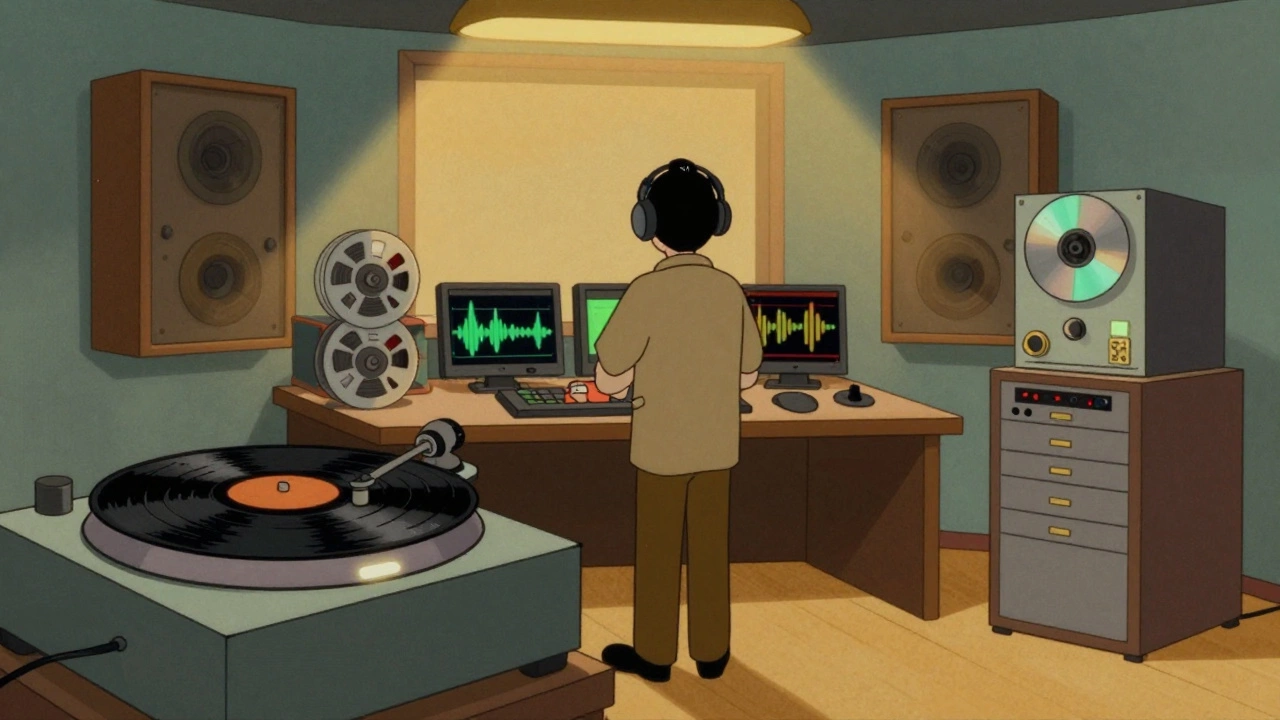

You probably remember the sound of the 1980s even if you were born after the decade ended. It was an era of massive drums, shimmering synthesizers, and vocals that cut through speakers with incredible clarity. That distinct sonic signature didn't just come from mix engineers; it was forged in the mastering suite. The transition during the 1980s represents one of the biggest technological shifts in music production history. Engineers had to navigate the dying days of the vinyl record while welcoming the rise of the compact disc. This tension created a unique pressure cooker for creativity and technical problem-solving.
Audio Mastering is the final stage of audio post-production that prepares recordings for distribution. During the 1980s, this process evolved from a purely mechanical transfer job into a creative discipline. Before this decade, the job was often called "transfer," focused mostly on copying music onto another medium without breaking the physics of the player. But by the time MTV was launching and synths were everywhere, Mastering Engineering became a critical art form.
The Physical Limits of Vinyl
To understand the revolution of the 1980s, you first have to respect the constraints of the format being replaced. For decades, Vinyl Records analog storage media with grooves containing audio information ruled the market. Cutting a master for vinyl wasn't just about making things sound good; it was about making sure the needle could physically track the groove without skipping. If you boosted the low bass frequencies too much, the stylus would jump out of the groove because the physical width of the bass vibration was larger than the space allowed on the record surface.
This limitation forced engineers to apply specific equalization curves. The RIAA curve, standardized in 1954, helped normalize playback across different players, but mastering engineers still had to manually manage frequency balance. Heavy kick drums needed careful taming. Stereo imaging was narrower than we expect today because extreme stereo separation caused tracking issues during fast turns of the record. Every decision regarding loudness, EQ, and dynamics was dictated by the physical properties of the plastic disc and the metal cutter head.
The Arrival of Digital Freedom
Then came the Compact Disc. When Sony and Philips released the standard in the early 1980s, they introduced a completely different set of rules. There were no grooves to skip. There was no stylus to jump. This meant the physical restrictions governing bass frequencies and dynamic range were suddenly gone. You could cut deep bass without fear of skipping, and you could make tracks significantly louder because there was no risk of groove crowding.
| Feature | Vinyl Record | Compact Disc (CD) |
|---|---|---|
| Dynamic Range | Limited by tape hiss and noise floor | High (96 dB theoretical) |
| Bass Handling | Restricted to prevent tracking errors | Unlimited by physical geometry |
| Durability | Scratches cause audible pops/skips | Laser reads data through coating |
| Mastery Complexity | Requires manual cutting expertise | Requires digital file preparation |
However, this freedom came with a new challenge. Without the safety net of physical limitations, engineers began pushing perceived volume. This era marks the beginning of the "loudness wars." Producers wanted their albums to stand out when listeners flipped the channel. A quiet track lost ground to a compressed, loud one. While the CD format theoretically offered huge dynamic ranges (16-bit resolution gave roughly 96 dB of range), many engineers started compressing the signal more aggressively to compete. This shifted the role of the mastering engineer from preserving dynamics to shaping punch and density.
Signature Sounds of the Decade
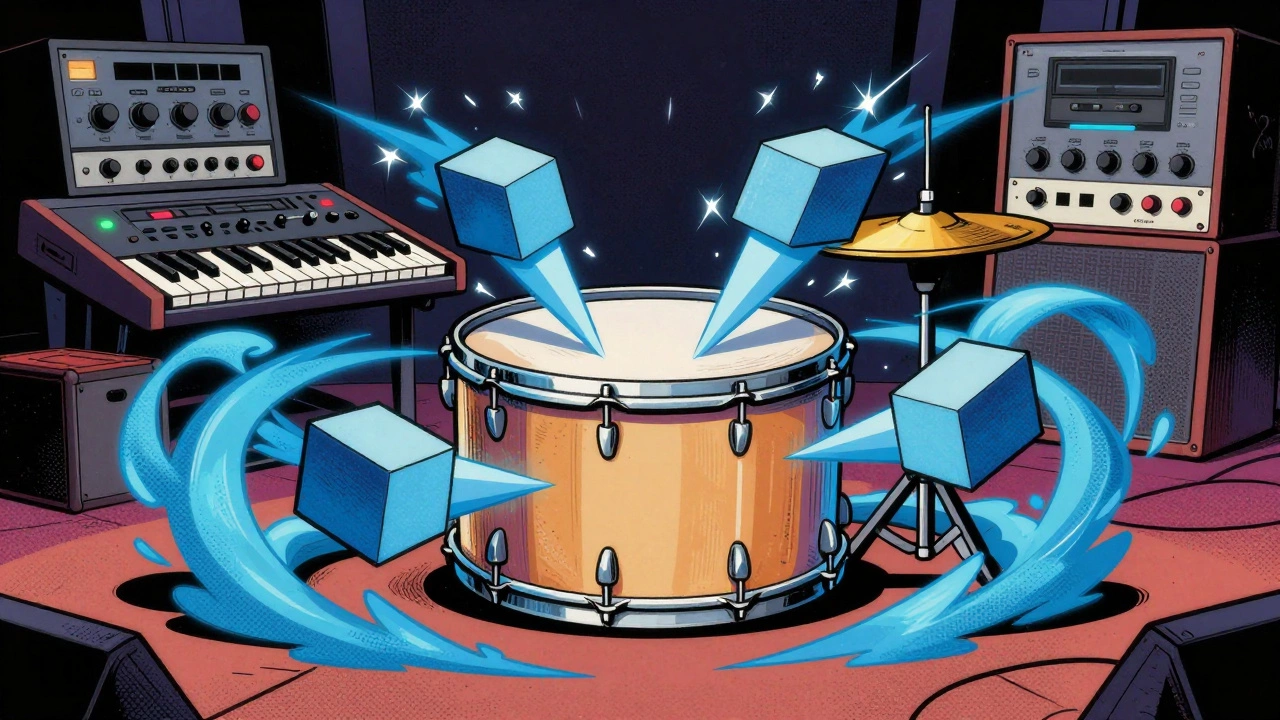
The technology available in 1980s studios created iconic sounds that defined pop, rock, and funk. Gated reverb is perhaps the most famous example. If you listen to Phil Collins' "In the Air Tonight," the snare drum explodes and then cuts off abruptly in mid-air. This effect used a noise gate triggered by the initial hit to stop the reverberation tail instantly.
Gated Reverb an audio effect using a noise gate to sharply cut off reverb tails worked perfectly on digital systems because the timing was precise. In analog days, gating was often messy and unstable. With digital control, engineers could sculpt the exact decay rate. This technique required mastering engineers to ensure the high-frequency energy of the reverb didn't alias or distort during the digital transfer process. The clean, bright top-end became a hallmark of the decade, thanks to the high-frequency capability of early digital hardware.
Synthesizers also played a massive role. Bands like Van Halen blended electric guitars with synth layers, like on the track "Jump." Mastering these dense mixes required balancing the warm, harmonic richness of analog guitar rigs with the sterile precision of digital synthesis. The Linn LM-1 drum machine and the Oberheim OB-8 synthesizer were staples for artists like Prince. These tools produced signals that were inherently cleaner and quieter than live drums, requiring mastering engineers to add weight and excitement through EQ rather than just level adjustments. They had to boost presence so the synths cut through without sounding thin.
The Engineer's Changing Role
By the late 1970s and into the 80s, the title "transfer engineer" began disappearing. Studios realized that mastering could influence the commercial success of a record. Bill Putnam Jr., who had pioneered half-speed mastering techniques earlier, showed that specialized equipment solved studio challenges. As the industry adopted digital technology, figures like the team at Sterling Sound adapted quickly. Sterling Sound became the first studio in the US to cut stereo discs, establishing the precedent that stereo width was a canvas to be painted on, not just captured.
The workflow changed dramatically. Engineers moved from working with magnetic tape reels to handling digital files. Early digital audio workstations (DAWs) weren't powerful enough to run everything, but hardware-based processors were stepping up. Companies began creating DDPs (Disc Description Protocols) for manufacturing plants. This positioned the mastering engineer as the final quality control checkpoint. They ensured compatibility across the chain, knowing that a mistake in a digital file meant a wasted press run. Unlike tape, where you could re-record or splice, digital mistakes were permanent until fixed in code.
Tech Specs and Standards
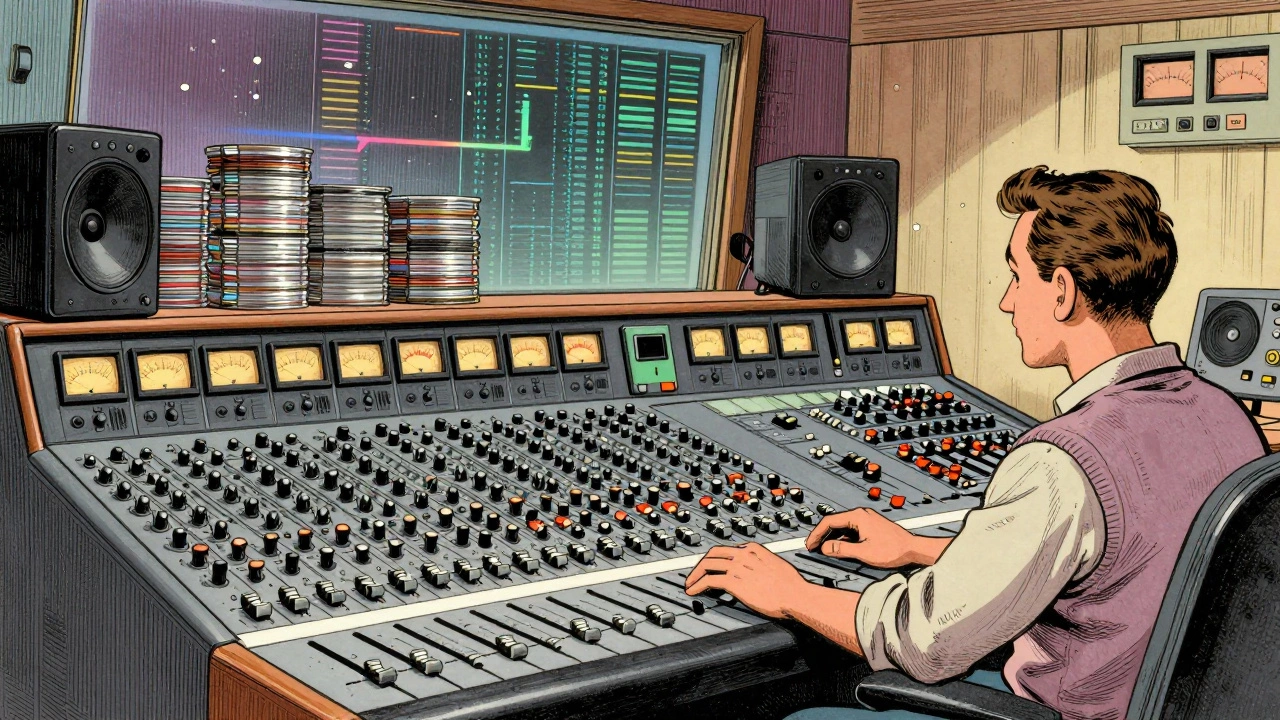
The specifications of the CD set a new bar. The sample rate settled at 44.1 kHz with a bit depth of 16-bit. This standard defined the audio quality for decades. It provided a massive increase in the signal-to-noise ratio compared to cassette tapes. Mastering engineers learned to manipulate these bits. They couldn't just turn knobs on a console anymore; they were manipulating data. The transition required learning how digital clipping worked differently than analog distortion. Pushing levels past 0 VU on a tape machine gave a warm saturation. Pushing past 0 dBFS in digital resulted in harsh, irreversible clipping.
This distinction taught a generation of engineers to respect headroom. Even though digital allowed for loudness, leaving some breathing room preserved transient detail. Many classic 80s remasters from later years suffered because engineers didn't understand the delicate balance of the original digital masters. Understanding the 1980s means understanding why some remasters feel "crunchy" while others feel lifeless. It comes down to whether the original intent of the digital conversion was respected.
Legacy of the Era
We are now looking back at the 1980s from over forty years away. The technology that seemed futuristic then-like MIDI and sampling-is the foundation of modern production. The ability to edit audio non-destructively within a computer stems from the groundwork laid in this decade. The commercial success of CD sales validated investing in high-quality mastering chains. It proved that consumers would pay extra for sound fidelity, driving studios to upgrade their gear.
Today, streaming platforms dominate. Yet, the lessons from the 1980s persist. We still debate loudness versus dynamic range. We still worry about translation across formats. The shift from vinyl to CD established that mastering isn't static. It adapts to the delivery method. Whether you are listening on Spotify, Apple Music, or a vinyl pressing, the mastering decisions determine the experience. The engineers of the 80s set the paradigm that mastering is the bridge between the artist's vision and the listener's reality.
Why did 1980s records sound so loud?
The transition to digital media removed the physical constraints of vinyl, allowing engineers to maximize volume without risking skipped tracks. This competition led to the early stages of the loudness wars.
What is gated reverb?
Gated reverb is an effect where a noise gate cuts off the reverb tail immediately after a trigger, commonly used on 80s drum kits to create dramatic, large-sounding snares.
Did vinyl mastering techniques change in the 1980s?
Yes, vinyl mastering eventually declined as CDs took over. Engineers had to adapt their workflows to handle both formats, often treating them as completely separate projects with different EQ and loudness targets.
How did digital audio workstations develop?
Early computers like the Atari ST were initially used for digital processing, evolving into full Digital Audio Workstations (DAWs) like Pro Tools, shifting mastering from hardware-only to software-based processing.
What were the standard specs for CDs?
The Red Book standard established 16-bit resolution at 44.1 kHz sampling rate as the global standard for consumer audio compact discs in the 1980s.