
Think about the last time you heard a melody that instantly transported you back to a specific moment in your life. For millions of people, that trigger isn’t a pop song from the radio or a film score from a blockbuster movie. It’s the crisp, syncopated beat of Super Mario Bros., the haunting dungeon theme from The Legend of Zelda, or the driving bassline of Dance Dance Revolution's ancestors. These sounds didn’t just accompany gameplay; they defined an era. The 1980s were not just a decade of pixelated graphics and joystick controls-they were the golden age of chiptune music, where technical limitations forced composers to become innovators, creating iconic themes that still influence modern music today.
From Beeps to Symphonies: The Hardware Evolution
To understand why 1980s game music sounds the way it does, you have to look at the hardware. In the early 1980s, arcade games like Rally-X (1980) used Digital-to-Analog Converters (DACs) to produce sampled tones, allowing for looped music over 20 seconds long-a massive leap from single-note beeps. But the real revolution happened when home consoles got dedicated sound chips.
The Commodore 64, released in 1982, featured the SID chip, a 3-voice analog synthesizer that could create polyphonic tracks with filter effects. Meanwhile, the Nintendo Entertainment System (NES), launched in North America in 1985, used the Ricoh 2A03 chip. This chip offered five channels: two pulse waves for melody, one triangle wave for bass, one noise channel for percussion, and one DPCM channel for low-quality samples. Most composers stuck to four channels, leaving the sample channel unused due to memory constraints. This limitation meant every note counted. You couldn’t hide behind layers of reverb or thick harmonies. If the melody wasn’t strong, the player would notice immediately.
| System | Sound Chip | Voice Count | Key Feature |
|---|---|---|---|
| NES | Ricoh 2A03 | 5 Channels | Pulse/Triangle/Noise/DPCM |
| Commodore 64 | SID | 3 Voices + Noise | Analog Filters & Waveforms |
| Arcade (Yamaha) | YM2151 | 8+ Voices | FM Synthesis for Rich Timbres |
Frequency Modulation (FM) synthesis, pioneered by Yamaha, entered the scene via Japanese personal computers like the NEC PC-8801 and later arcade boards. By the mid-1980s, FM systems could produce eight or more simultaneous voices with complex operators, giving arcade soundtracks a richer, stereo-filled sound compared to the raw square waves of home consoles. This technological split created two distinct aesthetic paths: the "raw" geometric sound of 8-bit consoles and the smoother, synthetic textures of FM-driven arcades and PCs.
The Composers Who Defined a Generation
Behind these chips were human beings pushing technology to its absolute limit. Koji Kondo, hired by Nintendo in 1984, is perhaps the most famous figure of this era. He composed the soundtrack for Super Mario Bros., released in September 1985. Kondo didn’t just write notes; he designed sound experiences. He discarded an early, slower version of the main theme after realizing it didn’t match Mario’s constant running. The final track, clocking in at around 100 beats per minute with a swing rhythm, made players feel like they were sprinting through a green field. In 2023, this original recording was added to the US National Recording Registry, cementing its status as culturally significant art.
Other composers also left indelible marks. Nobuo Uematsu brought emotional depth to Final Fantasy (1987), fitting over 20 distinct tracks into tight ROM constraints. His "Prelude" remains one of the most recognizable melodies in gaming history. In Japan, Kōichi Sugiyama legitimized game music as "real music" with his orchestral-style compositions for Dragon Quest (1986). Critics highlighted his classical training and symphonic forms, distinguishing these works from anonymous arcade jingles. Meanwhile, Yuzo Koshiro exploited the FM capabilities of NEC computers, creating multi-layered tracks for games like The Scheme (1988) that showcased the power of digital synthesis.
Chiptune Aesthetics: Beauty in Constraints
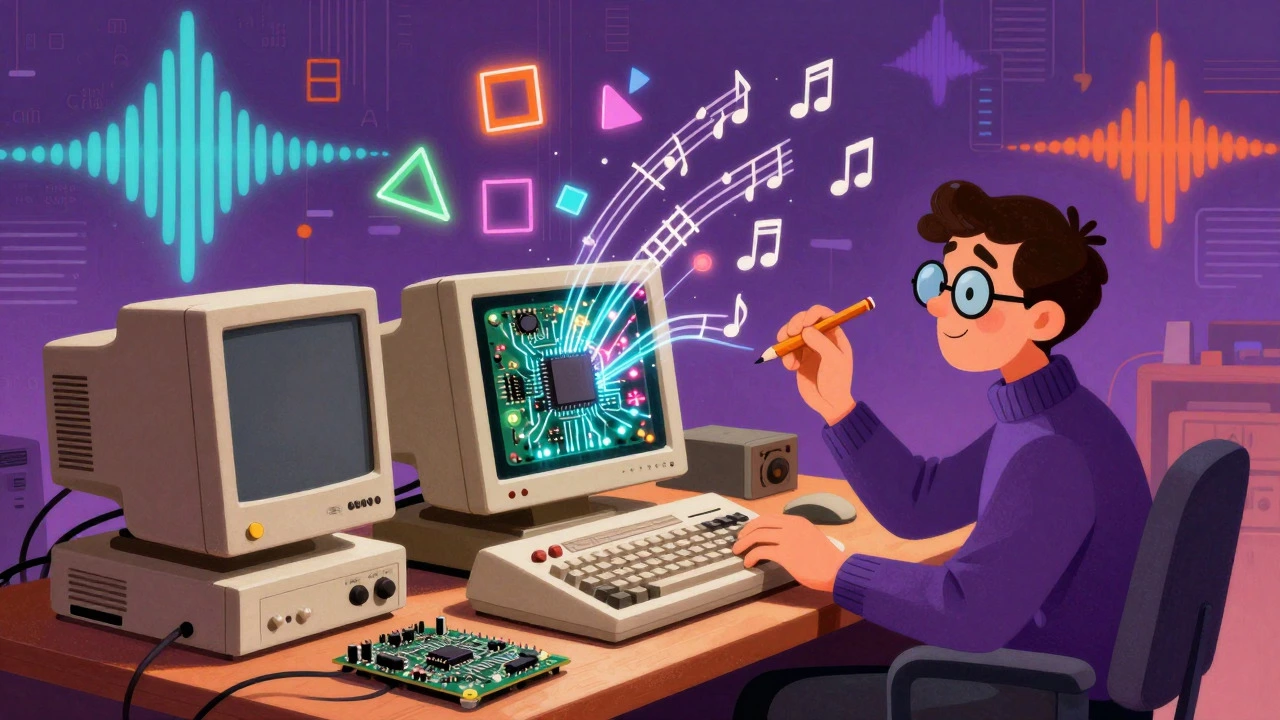
The term "chiptune" refers to music produced directly by sound chips. Its "golden age" spanned roughly from 1985 to 1992. Musicologists describe the 1980s chiptune sound as "raw" and "geometric," built from basic waveforms-square, triangle, sawtooth, and noise-at sample rates tied to CPU clocks. This resulted in crisp, high-pitched timbres that contrasted sharply with the warm analog synthesizers of the 1970s.
Because chips had fewer than 10 total voices, composers prioritized melody and rhythm over harmony. There was no room for subtle effects like long reverbs. This constraint bred creativity. Composers used techniques like "mickey-mousing," where musical gestures mirrored on-screen actions, a tradition borrowed from 1930s cartoon scoring. Tracks were often short loops, 30 to 60 seconds long, designed to play continuously without becoming annoying. The result was a unique aesthetic: bright, syncopated, and incredibly memorable. Even today, artists deliberately limit themselves to 3-5 voices to emulate this sonic character, proving that what started as a necessity became an artistic choice.
From Arcade to Album: Legitimizing Game Music
In the mid-1980s, game music began to step out of the arcade and into the living room as standalone art. Haruomi Hosono, a member of Yellow Magic Orchestra, released Video Game Music in 1984. This LP rearranged Namco arcade tunes into electronic tracks reminiscent of Kraftwerk, linking chiptune timbres to synthpop aesthetics. It was the first dedicated game music album, signaling that there was an audience for listening to these scores outside their interactive context.
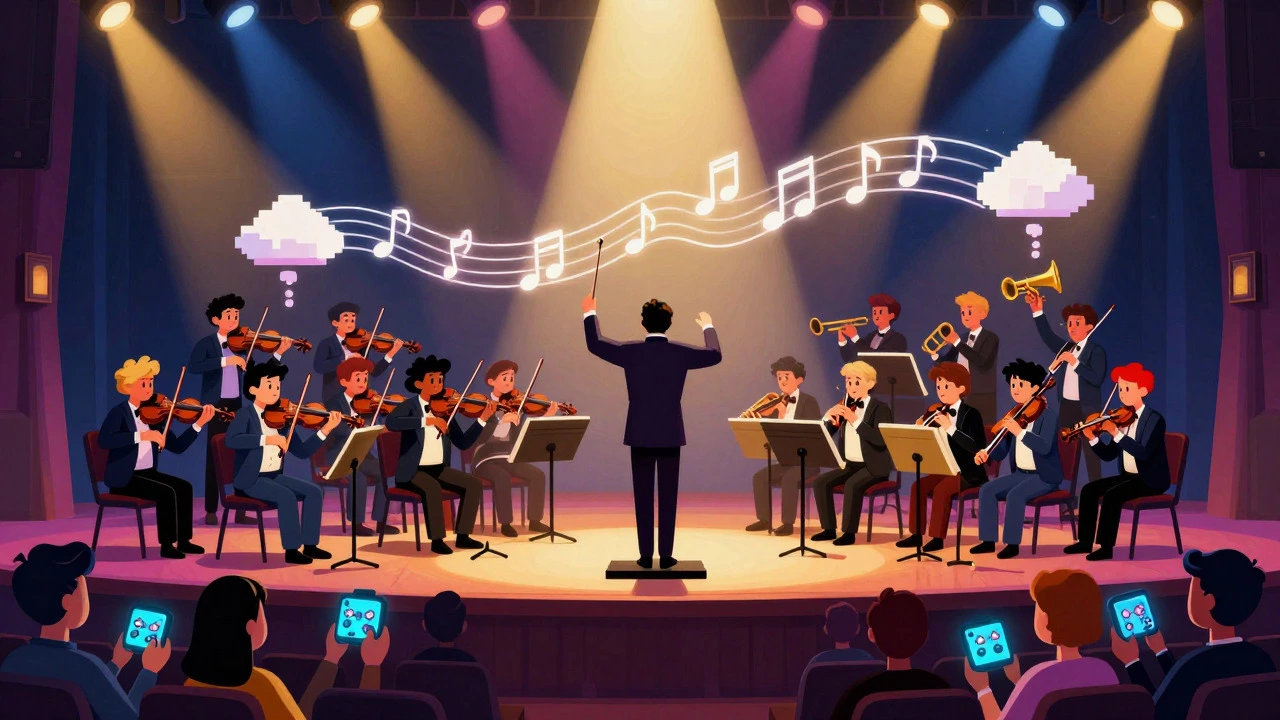
This trend accelerated. By the late 1980s, companies in Japan were sponsoring concerts where orchestras performed suites from 8-bit and 16-bit titles. Programs exceeded 90 minutes, and ticket prices rivaled mainstream classical events. These performances attracted hundreds, if not thousands, of fans. They demonstrated that game music wasn’t just background noise; it was a genre capable of sustaining attention in a concert hall setting. The release of albums featuring tracks longer than the in-game loops (3-5 minutes vs. 20-60 seconds) allowed listeners to appreciate the compositional structure rather than just the functional utility.
Influence on Modern Music and Culture
The impact of 1980s video game soundtracks extends far beyond nostalgia. The rise of genres like synthwave and bitpop owes a direct debt to this era. Artists like Anamanaguchi and Solemn Camel Crew build entire albums around retro game timbres, blending NES sound sets with live guitars and drums. These hybrid tracks often mimic the tempo ranges (90-120 BPM) and limited channel counts of the 1980s, showing how deeply those constraints influenced modern production techniques.
Even hip-hop and electro in the early 1980s incorporated arcade bleeps and sound effects. Buckner & Garcia’s 1982 novelty album Pac-Man Fever used actual game samples as instrumentation, blending 8-bit effects with rock structures. Today, communities like OverClocked ReMix continue this legacy, releasing thousands of arrangements of classic soundtracks in styles ranging from metal to orchestral. The melodies first heard in 1980s games act as catalysts, transporting listeners back to childhood while inspiring new creative expressions. As orchestras increasingly program suites from decades-old games, they attract audiences who grew up with these melodies, bridging the gap between traditional classical music and digital culture.
What makes 1980s video game music so distinctive?
The distinctiveness comes from hardware limitations. Sound chips like the NES's Ricoh 2A03 or Commodore 64's SID had very few channels (usually 3-5) and simple waveforms (square, triangle, noise). Composers couldn't rely on rich harmonies or effects, so they focused on strong, catchy melodies and clear rhythms. This "raw" geometric sound has become an aesthetic hallmark known as chiptune.
Who are the most important composers from the 1980s?
Key figures include Koji Kondo (Super Mario Bros.), Nobuo Uematsu (Final Fantasy), Kōichi Sugiyama (Dragon Quest), and Yuzo Koshiro (PC-88/PC-98 titles). These composers pushed the boundaries of their respective hardware, creating themes that remain globally recognizable decades later.
How did 1980s game music influence modern genres?
It heavily influenced synthwave, bitpop, and even early hip-hop. Modern artists often use emulations of old sound chips to recreate the 8-bit aesthetic. Genres like synthwave specifically evoke the nostalgic feeling of 1980s electronic music, including game soundtracks, by using similar tempos and limited instrumentation.
What was the "Golden Age" of chiptune?
The Golden Age of chiptune is generally considered to be from approximately 1985 to 1992. This period coincided with the peak popularity of machines like the NES, Commodore 64, and Sega Master System, before CD-ROM technology and high-fidelity sampling took over the industry.
Why is Super Mario Bros. music in the National Recording Registry?
In 2023, the original 1985 recording of the Super Mario Bros. Ground Theme was added to the US National Recording Registry because it is culturally, historically, and aesthetically significant. It was the first video game composition to receive this honor, recognizing its impact on popular culture and music history.