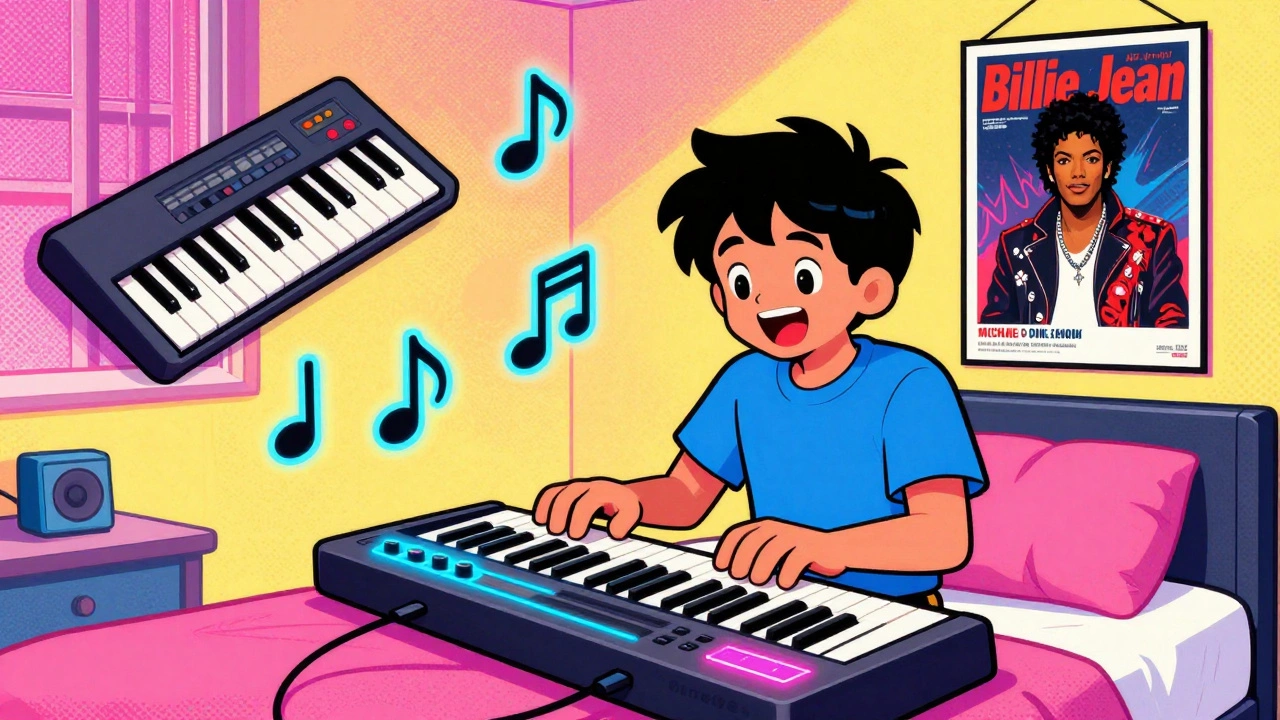

Before the 1980s, if you wanted to hear a synth in a song, you had to be in a studio with expensive gear and a technician who knew how to patch cables. Then everything changed. Synthesizers went from rare, temperamental machines to the backbone of pop, rock, and even metal. By the mid-80s, if a song didn’t have a synth line, it felt outdated.
The Yamaha DX7 Changed Everything
The Yamaha DX7 is a digital synthesizer released in 1983 that used FM synthesis to create bright, metallic, and punchy sounds. It wasn’t the first synth, but it was the first one that regular musicians could actually afford. Priced at around $2,000-less than half the cost of earlier analog synths-it sold over 200,000 units. That’s more than any other synth in history.
Its signature sound? The electric piano. You heard it everywhere. Michael Jackson’s "Billie Jean," Whitney Houston’s "I Wanna Dance with Somebody," even the theme to "Miami Vice." It wasn’t just a keyboard-it became the default sound of the decade. And because it was so easy to use, even musicians who didn’t know how to program synths could grab a preset and make hits.
Depeche Mode and the Rise of Synth-Pop
Depeche Mode is a British band that turned synthesizers into emotional instruments, blending cold electronic tones with human vulnerability. Their 1981 hit "Just Can’t Get Enough" didn’t just use a synth-it built the whole song around it. That music box-like melody? A Roland TR-808 is a drum machine introduced in 1980 that became the heartbeat of 1980s dance and pop music kick, a Roland TB-303 is a bass synthesizer originally designed to accompany drum machines, later became iconic in acid house and synth-pop bassline, and a simple, repeating synth hook that stuck in your head for days.
By 1984, they were playing arenas. No guitars. No live drums. Just synths, samples, and voices. They proved you didn’t need a full band to make music that moved people. That changed how music was made forever.
Rock Bands Didn’t Resist-They Embraced It
People thought rock was safe from synths. Then Rush is a Canadian progressive rock band that fully adopted synthesizers on their 1982 album "Signals," creating their first Top 40 hit with "New World Man". "New World Man" opened with a bubbling synth line that carried the whole song. No guitar solo. No power chords. Just a synth melody that hit harder than any riff.
And then there was Van Halen is a hard rock band led by Eddie Van Halen, who used the Oberheim synthesizer to create the massive 1984 hit "Jump," proving synths could headline rock songs. Eddie, the guitar god, played the lead on "Jump" with an Oberheim OB-X is a polyphonic analog synthesizer popular in the early 1980s, known for its rich, warm tones used in pop and rock. It wasn’t a gimmick-it was the hook. And it hit #1.
ZZ Top is a blues-rock band that reinvented themselves with the 1983 album "Eliminator," replacing live drums with programmed beats and bass synths. "Legs" and "Gimme All Your Lovin’" had no live bass. No snare. Just sequencers, drum machines, and a wah-wah pedal on a synth. They sold over 10 million copies. The world didn’t care that they weren’t "real" rock anymore. They just wanted to dance.
Even Metal Got Synthed
Iron Maiden is a British heavy metal band that initially rejected synthesizers but fully embraced them by 1988’s "Seventh Son of a Seventh Son," using them for atmosphere and melody. Their 1983 album "Piece of Mind" had a sticker that said "No Synthesizers of Ulterior Motives." Three years later, they dropped a whole album of synth-driven soundscapes. "Seventh Son" had eerie, layered synths that created a haunting, cinematic feel. Fans were shocked. Critics were confused. But it went platinum.
They didn’t abandon guitars. They used synths to expand them. The same way a guitarist uses reverb, they used synths for texture. And suddenly, metal didn’t just sound heavy-it sounded futuristic.
The Drum Machine Revolution
It wasn’t just synths. It was the beats. The Roland TR-808 is a drum machine introduced in 1980 that became the heartbeat of 1980s dance and pop music was $1,000. It didn’t even sound realistic. But it had a sound no human drummer could replicate: that deep, booming kick, the crisp snap of the snare, the hiss of the hi-hat. Bands like New Order is a British band that fused post-punk with dance rhythms, using the TR-808 and synthesizers to create hits like "Blue Monday" built entire songs around it. "Blue Monday"-the best-selling 12-inch single of all time-was built on that machine.
And then there was sampling. The Art of Noise is a British avant-garde group that pioneered sampling as a compositional tool, using chopped-up sounds to create music without traditional instruments. Their track "Close (to the Edit)" used snippets of door slams, typewriters, and police sirens. It wasn’t noise-it was composition. And suddenly, music didn’t need to be played. It just needed to be cut and pasted.
The Lasting Impact
By 1989, the synth-pop wave had faded. Radio moved on. But the tools stayed.
Today, every pop song has a synth bass. Every hip-hop beat has a drum machine. Every EDM drop is built on a digital oscillator. The reason? The 1980s didn’t just introduce synths-they made them necessary. They proved you didn’t need a band. You didn’t need a studio. You just needed a keyboard, a sequencer, and an idea.
That’s why, in 2026, a teenager in Portland can make a chart-topping track on a laptop. Because in 1983, a guy in Japan built a machine that changed everything.
What Happened to the Old Sound?
It didn’t disappear. It evolved. Bands like Jethro Tull is a British rock band that abandoned live drums in 1984’s "Under Wraps," replacing them entirely with electronic beats went from acoustic flutes to full electronic backings. Steve Winwood is a British musician who transitioned from soulful rock with Traffic to solo synth-pop hits like "While You See a Chance" in 1980 didn’t lose his voice-he just gave it new backing. The guitars didn’t vanish. They got quieter. The synths got louder.
And that’s the real shift. It wasn’t about replacing instruments. It was about redefining what music could be.


