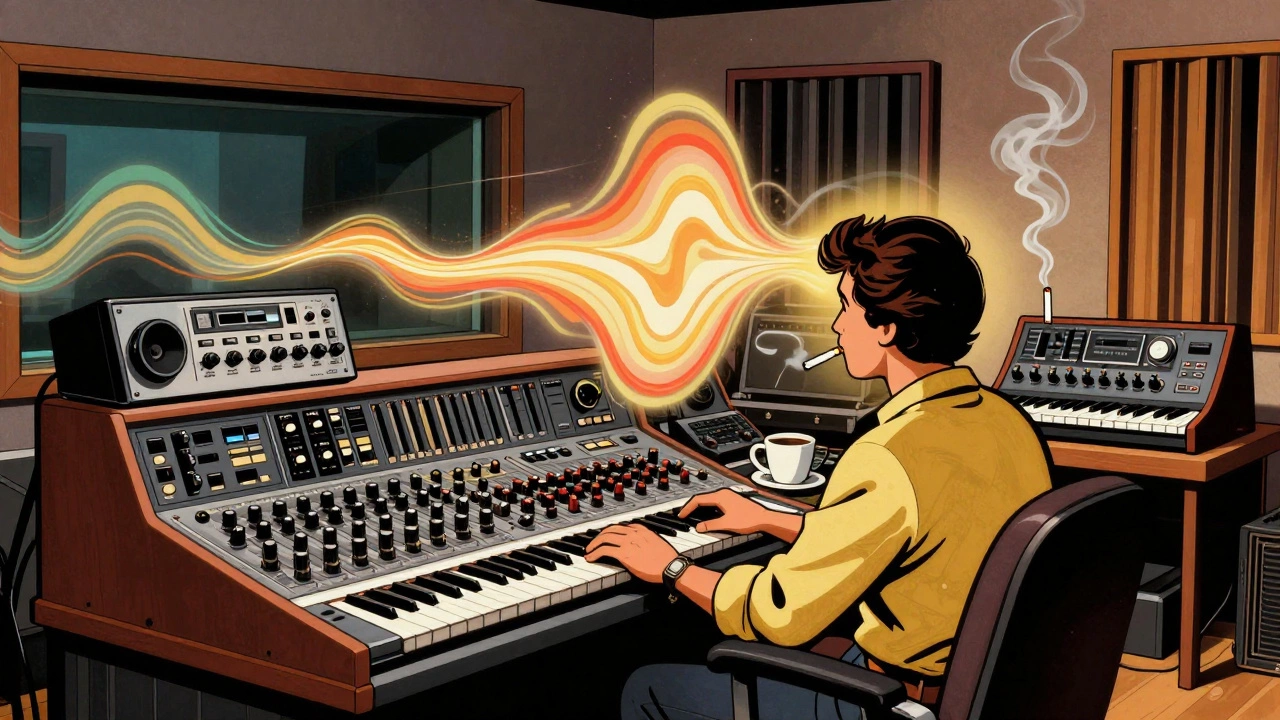

The year is 1983. You walk into a recording studio in Los Angeles or London, and the air smells different. It’s not just coffee and cigarette smoke anymore; it’s the ozone scent of digital circuitry heating up. The warm, drifting pads of the late 70s are still there, but they’re being crowded out by something sharper, cleaner, and infinitely more complex. This was the decade where music production split down the middle. On one side, you had the reliable, tactile warmth of Analog Subtractive Synthesis is a method that starts with rich waveforms and sculpts them using filters and envelopes. On the other, a new digital revolution was taking over, led by FM Synthesis is a technique that modulates frequency to create complex metallic and bell-like tones and the experimental edge of Wavetable Synthesis is a process that scans through tables of single-cycle digital waveforms to create evolving textures.
If you were a producer in the 1980s, choosing your sound source wasn’t just an aesthetic choice; it was a statement about where you stood in the industry. Were you sticking with the proven giants like Roland and Sequential? Or were you betting on Yamaha’s mathematical miracle? Maybe you were spending a fortune on German engineering from PPG. Let’s break down how these three pillars defined the sonic landscape of the era.
The Analog Holdout: Warmth, Drift, and DCOs
Before we talk about the digital takeover, we have to respect the analog kings. In the early 80s, instruments like the Roland Jupiter-8 (released 1981) and the Sequential Circuits Prophet-5 were the gold standard. These machines used voltage-controlled oscillators (VCOs) to generate basic waves-saws, squares, pulses-and then filtered them down. That’s subtractive synthesis in a nutshell: start big, cut away what you don’t need.
But here’s the thing about pure analog: it drifts. Temperature changes could make your synth go out of tune mid-song. By the mid-80s, manufacturers found a clever workaround. They introduced Digitally Controlled Oscillators (DCOs). The Roland Juno-60 (1982) and its successor, the Juno-106 (1984), used DCOs. A digital clock kept the pitch rock-solid, but the signal path remained analog for that characteristic warmth. It was a hybrid approach that saved analog synths from their own instability without losing their soul.
Why did producers love them? Immediacy. If you wanted a fat bass, you turned a knob. No menus, no screens. Bands like Van Halen used the Oberheim OB-Xa for "Jump," and Duran Duran layered Jupiter-8 strings throughout "Rio." But as the decade progressed, analog synths started to look expensive and bulky compared to the sleek black boxes arriving from Japan.
The Digital Disruptor: Yamaha DX7 and FM Synthesis
Then came the Yamaha DX7. Launched in May 1983, this instrument didn’t just sell well; it dominated. With over 200,000 units sold, it remains one of the best-selling synthesizers in history. Why? Because it sounded nothing like anything else.
FM synthesis, developed by John Chowning at Stanford University, works differently. Instead of filtering waves, it uses one oscillator (the modulator) to rapidly change the frequency of another (the carrier). This creates complex sidebands-new frequencies that weren’t there before. The result? Glassy electric pianos, piercing brass, and crystalline bells that cut through any mix.
| Feature | Roland Jupiter-8 (Analog) | Yamaha DX7 (FM) | PPG Wave 2.2 (Wavetable) |
|---|---|---|---|
| Release Year | 1981 | 1983 | 1982 |
| Polyphony | 8 voices | 16 voices | 8 voices |
| Original Price (USD) | $5,295 | $1,995 | ~$10,000+ (system) |
| Sound Character | Warm, lush, stable | Bright, metallic, clean | Evolving, gritty, digital |
| Learning Curve | Low (knob-based) | Very High (menu diving) | High (parameter access) |
The DX7 was cheaper than the flagship analog polys, offering double the polyphony (16 notes vs. 8). But it had a catch: programming it was a nightmare. There were no knobs for filter cutoff or resonance. You navigated through layers of menus to adjust operator ratios and feedback levels. Most users never programmed their own patches; they relied on the famous factory presets like "E.Piano 1" or bought patch cartridges from companies like Korg or Sound Source.
This steep learning curve created a divide. Pop producers loved the ease of use and the bright, modern sound. Synth enthusiasts hated the opacity. Yet, the DX7’s influence was undeniable. It defined the sound of Whitney Houston, Phil Collins, and Brian Eno. It proved that digital synthesis could be commercially viable, pushing analog specialists like ARP into bankruptcy and forcing others to adapt.
The Niche Innovator: PPG and Wavetable Synthesis
While Yamaha fought Roland for market share, a small company in Germany called PPG (Palm Products GmbH) was doing something entirely different. Wolfgang Palm pioneered wavetable synthesis with the PPG Wave 2.0 (1981) and later the Wave 2.2 and 2.3.
Unlike FM, which generates sounds mathematically, wavetable synthesis stores hundreds of single-cycle waveforms in digital memory. The oscillator doesn’t just play one wave; it scans or morphs through the table. This creates sounds that evolve organically, shifting from smooth to harsh as you hold a note. It was perfect for creating eerie atmospheres, industrial clangs, and sweeping leads.
PPG instruments were expensive, fragile, and rare. Only a few thousand were ever made. But their impact was outsized. Depeche Mode used the PPG Wave on albums like *Construction Time Again* and *A Broken Frame*. Trevor Horn produced hits for Art of Noise and Frankie Goes to Hollywood using these distinctive, icy textures. The sound was unmistakable: slightly gritty due to 8-bit resolution, yet incredibly dynamic thanks to the analog filters that processed the digital signal.
Other companies tried to follow suit. Korg released the DW-6000 and DW-8000, which offered multiple sampled waveforms but lacked the smooth morphing capability of true PPG wavetables. Ensoniq’s ESQ-1 combined digital oscillators with analog filters, bridging the gap between FM and wavetable concepts. But PPG remained the king of this niche, influencing future designs like the Waldorf Microwave and eventually modern software like Native Instruments Massive.
Technical Differences: How They Work Under the Hood
To understand why these synths sounded so different, you have to look at their architecture. Analog subtractive synths rely on continuous voltage. The beauty lies in the imperfections-the slight detuning between oscillators, the non-linear response of filters. When you turn up the resonance on a Roland filter, it screams in a way that feels alive.
FM synthesis is purely mathematical. It calculates sine waves in real-time. The purity of the signal means no noise floor, but also no harmonic richness unless you carefully stack operators. The DX7’s six-operator engine allowed for immense complexity, but getting there required understanding Bessel functions and modulation indices-a barrier for most musicians.
Wavetable synthesis sits in the middle. It uses digital storage for precision but often routes the output through analog filters for character. The PPG Wave’s 8-bit wavetables gave it a lo-fi, quantized texture that many modern producers chase today. It’s a hybrid approach that captures the best of both worlds: the stability of digital and the warmth of analog.
The MIDI Revolution: Connecting It All
You can’t talk about 80s synths without mentioning MIDI. Introduced in 1983, the Musical Instrument Digital Interface standardized communication between devices. Before MIDI, you’d need cables for every control voltage. After MIDI, one cable could sync a sequencer, a drum machine, and three different synths.
This changed everything. Producers could layer a DX7 piano over a Juno-106 pad and sequence them together with a Roland MC-4. The integration of MIDI made complex setups manageable. It also accelerated the shift toward digital. Since MIDI data is digital, it paired naturally with FM and wavetable engines. Analog synths had to be retrofitted with MIDI adapters or redesigned with digital control layers to stay relevant.
Legacy and Modern Resurgence
Today, all three types are back in style. The 1980s were a transitional period, but each technology left a lasting legacy. Analog synths saw a revival with virtual-analog models like the Nord Lead and later affordable hardware from Korg and Behringer. FM synthesis returned via plugins like Dexed and hardware like the Korg Opsix. Wavetable synthesis became central to EDM, driven by Serum and Ableton’s Wavetable plugin.
Understanding these 80s foundations helps you appreciate why certain sounds work. The warmth of analog provides emotional depth. The brightness of FM cuts through dense mixes. The evolution of wavetables adds movement and interest. Whether you’re producing pop, rock, or electronic music, these tools are still essential parts of the palette.
What is the main difference between FM and wavetable synthesis?
FM synthesis generates sound by modulating the frequency of one oscillator with another, creating complex spectra mathematically. Wavetable synthesis plays back pre-stored single-cycle waveforms and scans through them to create evolving timbres. FM is better for percussive, metallic sounds, while wavetable excels at organic, shifting textures.
Why was the Yamaha DX7 so popular in the 1980s?
The DX7 offered 16-note polyphony, a wide range of realistic acoustic sounds (like electric pianos), and a lower price point ($1,995) compared to analog competitors. Its bright, clean digital tone fit perfectly with the production aesthetics of the mid-80s pop and R&B scenes.
Are analog synths better than digital ones?
It depends on the desired sound. Analog synths provide warmth, character, and immediate tactile control but can suffer from tuning drift. Digital synths like FM and wavetable offer stability, complex spectral control, and unique textures that analog cannot easily replicate. Both have distinct advantages.
What bands used PPG wavetable synthesizers?
Depeche Mode famously used the PPG Wave on albums like *Construction Time Again*. Other notable users include Art of Noise, Thomas Dolby, and artists produced by Trevor Horn such as Frankie Goes to Hollywood and Propaganda.
How did MIDI change synthesizer usage in the 1980s?
MIDI allowed different synthesizers and sequencers to communicate seamlessly. This enabled producers to layer multiple instruments, synchronize timing, and control complex setups from a single interface, making studio production more efficient and creative possibilities nearly limitless.