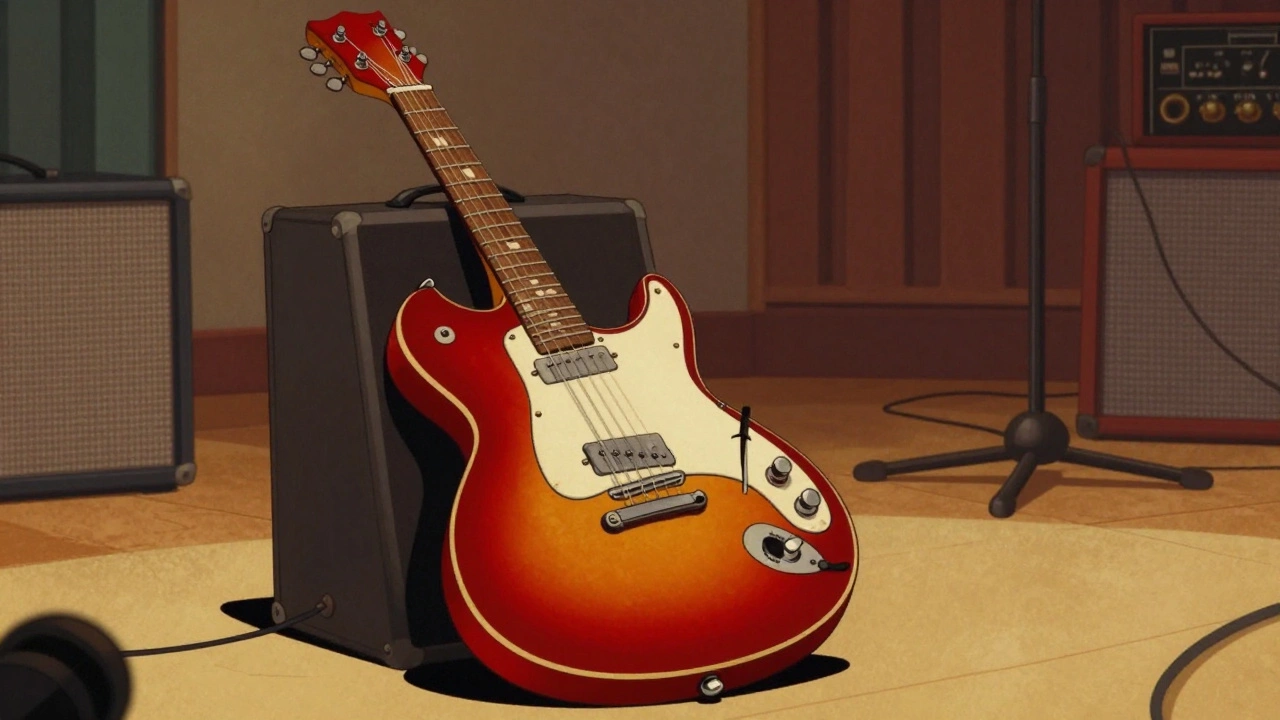

That bright, chiming sound you hear in classic power-pop and indie rock? It’s usually a Rickenbacker 330 is a semi-acoustic electric guitar from the Capri series known for its distinctive jangle tone and crescent moon body shape. While many players associate the brand with George Harrison’s 12-string work in the 1960s, the 330 had a massive second act in the 1980s. This wasn’t just a nostalgia play; it was a specific tool for a specific sonic goal.
If you’re looking at buying one, or just trying to understand why that era matters, you need to look past the glossy finish. The mid-80s Rickenbacker 330 is a distinct beast compared to its earlier siblings. It has different hardware, a different headstock shape, and a finish system that collectors are starting to value highly. Let’s break down what makes this specific era of the guitar special, how to spot it, and why it still holds its ground in 2026.
The Anatomy of the Jangle Sound
Why does the 330 sound so different from a Fender Telecaster or a Gibson ES-335? It comes down to construction choices made by German luthier Roger Rossmeisl when he designed the instrument in 1958. The body uses a "crescent moon" double-cutaway shape. This isn’t just for looks; those sharp, unbound edges change how your arm rests against the neck and how the guitar resonates against your chest.
The real secret sauce, however, is inside the wood. The neck is a three-ply sandwich of maple and walnut, topped with a thick rosewood fretboard finished in clear conversion varnish. This combination gives you a snappy attack-perfect for those quick, arpeggiated chords that define jangle-pop. Unlike solid-body electrics, the 330 has f-holes (or slash holes on some models). These open soundholes allow the hollow chambers to breathe, adding acoustic warmth to the electric signal. But here’s the catch: if you turn the gain up too high, it can feedback. That’s why most 80s players kept it clean or used light overdrive.
Another hidden feature is the dual truss rod system. Most guitars have one rod to adjust neck relief. The 330 has two. This allows for correction of problematic twists and unwanted curvature in ways single-rod guitars can’t match. If you’ve ever struggled with a neck that won’t stay straight through humidity changes, this dual-system design offers a level of stability that keeps your intonation accurate.
The Mid-80s Hardware Shift
Here is where things get tricky for buyers. If you walk into a shop and see a Rickenbacker 330 from 1980, it will look different than one from 1985. Around 1984, Rickenbacker International Corporation made a significant hardware change. They switched from smaller tuning mechanisms to larger sealed tuners.
This wasn’t just a swap-out job. To fit these new, bulkier tuners, they had to physically enlarge the headstock profile. So, if you’re looking at an 80s model, check the headstock size. Pre-1984 models have the slimmer, classic headstock. Post-1984 models have a wider, more substantial headstock. This enlarged profile stayed in production until about 2010, creating a clear visual divider between early and late vintage examples.
| Feature | Pre-1984 Model | Post-1984 Model |
|---|---|---|
| Headstock Shape | Slim, traditional profile | Enlarged, wider profile |
| Tuning Mechanisms | Smaller, open-back tuners | Larger, sealed tuners |
| Finish Type | Nitrocellulose / Cellulose | Cellulose (mid-80s) transitioning later |
| Collector Appeal | High (Classic Era) | Moderate (Transitional Era) |
Why does this matter? Because the larger tuners offer better tuning stability, especially if you use vibrato techniques. However, purists often prefer the aesthetic balance of the original slim headstock. When you’re hunting for an 80s model, knowing which side of 1984 you’re on helps you set expectations for both price and feel.

Finishes and Serial Numbers
During the 1980s, Rickenbacker applied cellulose-based finish systems to their guitars. This is a key detail because the company has since discontinued this method in favor of alternative finishing technologies. If you buy a modern 330, it won’t age or crackle the same way an 80s model will. The cellulose finish breathes with the wood, developing a patina that adds character over decades.
A popular colorway from this era is Fireglo, technically classified as a red sunburst. Documentation from November 1987 shows serial number K0 7268 bearing this finish. You can use the serial number to date your guitar precisely. The "K0" prefix indicates the year 1987, while the following digits indicate the production sequence. This precise dating system supports the collector market, allowing you to verify exactly when a guitar rolled off the line.
Some production runs also featured f-shaped violin sound holes instead of the traditional slash configuration. Both serve the same acoustic function, but the f-holes are often associated with higher-end or specific regional production runs. Check the interior label and the sound hole shape together to confirm the exact variant.
Market Value in 2026
Let’s talk money. As of May 2026, the secondary market for 1980s Rickenbacker 330s is showing strength. According to transaction data from Reverb.com, a 1975-1989 Rickenbacker 330 in Very Good condition sold for $2,400 USD on May 7, 2026. Interestingly, an Excellent condition example sold for $2,250 USD in February 2026. This seems backward-why would worse condition cost more? Often, "Very Good" implies honest wear that doesn’t affect playability, while "Excellent" might imply recent refinishing or parts replacement that devalues it to collectors. Originality trumps pristine condition in this niche.
Looking back to October 15, 2025, a Very Good condition model sold for $2,100 USD. That’s a $300 increase, or roughly 14.3% appreciation, in just seven months. This trajectory suggests continued collector demand. If you own an 80s 330, now is a strong time to sell. If you’re buying, expect prices to remain firm unless the market cools.

How It Compares to the 360
You might wonder why not just buy a Rickenbacker 360? The 360 is the more famous sibling, largely due to the Rick-O-Sound stereo output system. The 330 lacks this feature, using a monaural jack plate configuration instead. This simplifies the signal path. For many studio engineers and live sound techs, the 330’s mono output is easier to manage. You plug it into one amp channel, and you’re done. No Y-cables needed.
The 330 is also generally lighter and slightly less expensive than the 360. Its tonal character is brighter and more articulate in the upper mids, making it ideal for cutting through a dense mix without mud. The 360 tends to be warmer and thicker. If you’re playing fast, clean chords in a band with heavy drums and bass, the 330’s articulation shines.
Playing and Maintaining Your 330
Getting the best out of a 330 requires specific setup adjustments. Because of the hollow body, string gauge matters. Heavier strings can cause excessive tension on the top, leading to buzzing or even structural damage over time. Stick to .010 or .011 sets. Use a strap lock, as the R-shaped trapeze tailpiece can shift weight distribution during aggressive playing.
Cleaning the cellulose finish requires care. Avoid silicone-based polishes, as they can interfere with future repairs. Use a dry microfiber cloth for daily cleaning. If you notice cracks in the finish, don’t panic-it’s normal for cellulose lacquer. Just ensure the crack hasn’t penetrated the wood itself.
Is the Rickenbacker 330 good for beginners?
It can be, but it’s not the easiest first guitar. The narrow neck width is comfortable, but the low action required to prevent feedback can make chord clarity challenging. Plus, the price point ($2,000+) is steep for a beginner who might quit after six months. Consider a modern reissue if you’re just starting out.
What is the difference between the 330 and 360?
The main difference is the output. The 360 has Rick-O-Sound stereo capability, allowing separate signals for rhythm and lead. The 330 has a standard mono output. The 330 is also typically lighter and has a slightly brighter, more articulate tone suitable for jangle-rock styles.
How do I date my Rickenbacker 330?
Check the serial number on the back of the headstock. For 1980s models, the prefix letter indicates the year (e.g., K for 1987). Additionally, look at the headstock size. Slim headstocks predate 1984, while larger headstocks started around 1984 and lasted until 2010.
Are 1980s Rickenbackers worth investing in?
They show steady appreciation. Data from 2025 to 2026 shows a 14% increase in value for Very Good condition models. However, always buy for playability first. Collectible value fluctuates, but a great-sounding guitar retains utility value regardless of market trends.
Can I use high-gain distortion with a Rickenbacker 330?
You can, but it’s difficult. The hollow body and f-holes make it prone to feedback at high volumes and gain levels. Many players use noise gates or lower-volume amps to control the feedback. It’s best suited for clean, chorus-drenched, or lightly overdriven tones.


