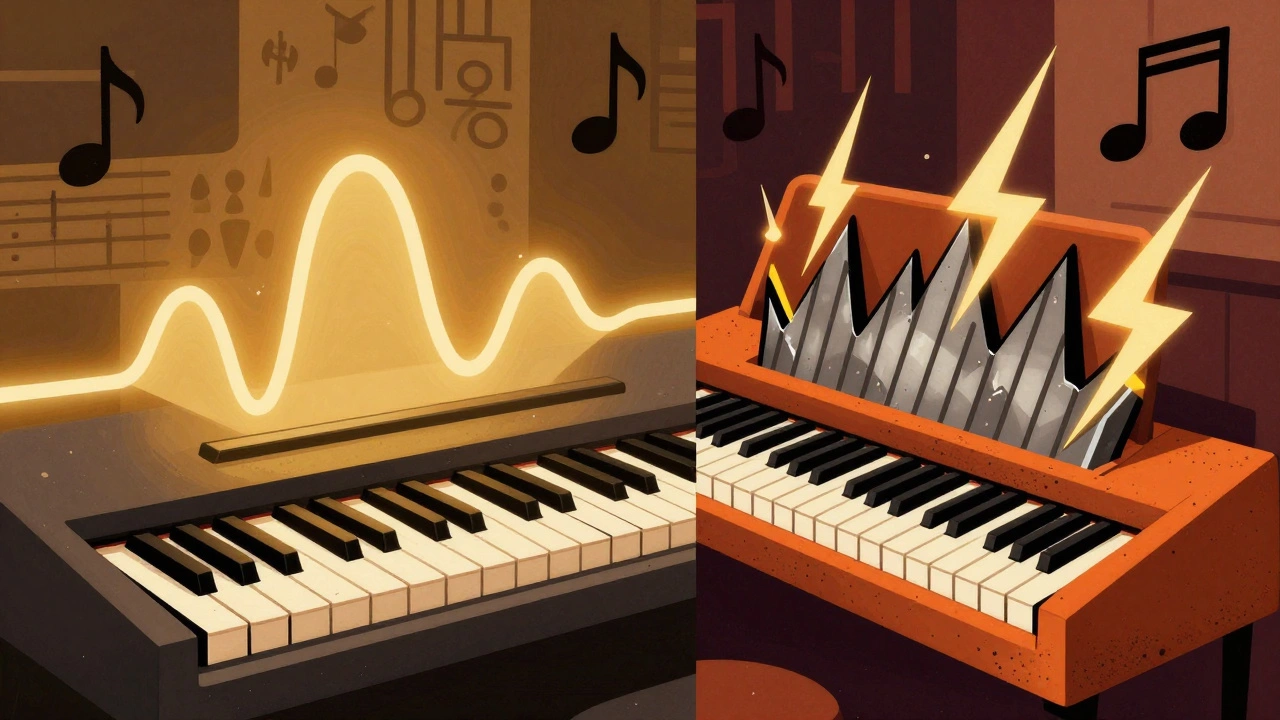

Close your eyes and listen to Herbie Hancock’s “Chameleon” or Stevie Wonder’s “Superstition.” You hear that warm, bell-like shimmer on one track and a gritty, overdriven bark on another. These aren’t just random keyboard sounds. They are the Rhodes and Wurlitzer, two electro-mechanical instruments that didn’t just accompany funk music-they helped invent its vocabulary.
Funk isn’t just about rhythm; it’s about texture. It’s about how a chord hits the air and decays. Between 1965 and 1980, these two pianos became the primary colors for musicians painting grooves. Today, even with advanced software plugins, producers still hunt for the specific physical quirks of these machines. Why? Because the way they break up, sustain, and interact with amplifiers creates a human feel that digital perfection often misses.
The Origins: From War Rooms to Dance Floors
To understand why these keyboards sound so distinct, you have to look at where they came from. They weren’t designed for discotheques. They were born from necessity and innovation in completely different contexts.
Harold Rhodes started tinkering with compact pianos during World War II. He built miniature instruments using surplus aircraft parts to help rehabilitate wounded U.S. Army Air Forces personnel between 1942 and 1945. The goal was therapeutic, not commercial. But the mechanism he developed-felt hammers striking tuned metal tines, picked up by electromagnetic pickups similar to an electric guitar-proved revolutionary. After the war, Fender acquired his company, leading to the first production models like the Piano Bass in 1959.
In contrast, the Rudolph Wurlitzer Company had a different engineering approach. Starting in the mid-1950s, they focused on amplified metal reeds. Instead of tines, the Wurlitzer used steel reeds struck by hammers and sensed by electrostatic pickups. This fundamental difference in sound generation is the key to their sonic personalities. While the Rhodes aimed for a pure, sine-wave-like tone, the Wurlitzer’s reed system naturally produced a signal that saturated into a crunchy, aggressive tone when pushed hard.
Sonic Anatomy: Tines vs. Reeds
If you look at the waveform of each instrument on an oscilloscope, the differences become obvious. The Rhodes produces a rounded wave with soft transitions. This correlates with what listeners describe as "warm," "smooth," or "bell-like." It has a percussive attack that can chime softly or growl if struck hard, but it rarely distorts in a chaotic way.
The Wurlitzer, however, generates a more triangular waveform with sharper edges. Technical analyses show this results in prominent odd harmonics. In plain English? It bites. When a player digs into the keys of a Wurlitzer, especially on syncopated 16-note patterns typical of funk, the amplifier and internal electronics break up in a musical, gritty fashion. This "crunch" is not a bug; it’s a feature. It allows the keyboard to cut through a dense mix of wah-wah guitars and loud drums without needing excessive volume.
| Feature | Rhodes Piano | Wurlitzer Electric Piano |
|---|---|---|
| Sound Source | Tuned metal tines | Tuned steel reeds |
| Pickup Type | Electromagnetic (like a guitar) | Electrostatic |
| Waveform Shape | Rounded, sine-like | Triangular, sharp edges |
| Primary Character | Warm, bell-like, smooth | Gritty, biting, overdriven |
| Ideal Funk Role | Lush chords, pads, melodic lines | Punchy riffs, rhythmic stabs |
| Key Era Models | Mark I, Suitcase (1960s-70s) | Model 200, 200A (1960s-80s) |
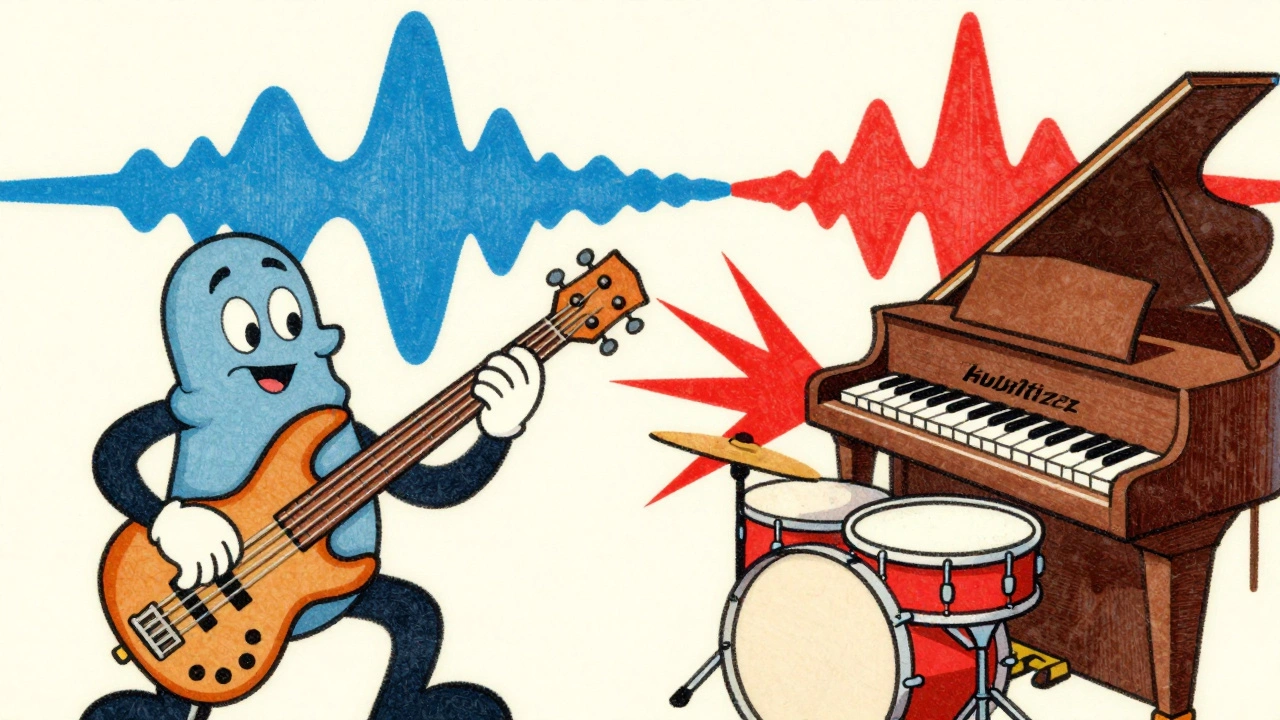
Coloring the Groove: Practical Applications in Funk
How do these technical differences translate to the dance floor? Producers and players use them for very different jobs within the same arrangement.
The Rhodes as Atmosphere and Harmony
The Rhodes excels at providing width and warmth. In jazz-funk fusion records from the 1970s, artists like Herbie Hancock and Chick Corea used the Rhodes to create lush harmonic beds. Its sustain is long and glassy, allowing chords to ring out without muddying the low end. If you want a section of a song to feel expansive, soulful, or introspective, the Rhodes is your tool. Running it through a phaser or envelope filter transforms simple vamps into evolving textures, a technique heavily used in 1970s fusion.
The Wurlitzer as Rhythm and Attitude
The Wurlitzer is a rhythmic weapon. Because of its assertive midrange and natural distortion, it locks tightly with the snare drum and bass guitar. Listen to Ray Charles’s “What’d I Say” (1959) or Marvin Gaye’s “I Heard It Through the Grapevine” (1968). The Wurlitzer doesn’t just play notes; it drives the pulse. Its built-in tremolo circuits, found in models like the 200A, add a pulsating edge that cuts through dense arrangements. When a funk groove needs to shift from a sparse verse to an intense chorus, the Wurlitzer provides that immediate aggression.

Maintenance and Modern Emulation
Playing these vintage instruments today comes with challenges. A Rhodes requires periodic tine voicing, hammer alignment, and pickup distance adjustments. These tasks can take hours and must be repeated over years of use. The Wurlitzer poses its own headaches: fragile reeds break easily and require precise replacement tuning. Furthermore, the electrostatic amplification system demands correct grounding to avoid noise, especially in high-gain settings where stage volume exceeds 100 dB SPL.
Due to these maintenance burdens and the finite number of surviving units, many modern funk producers turn to sampled or modeled sounds inside digital audio workstations. Boutique hardware revivals and extensive software emulation ecosystems now offer these tones. However, purists argue that the interaction between the mechanical action, the specific wear on the felt hammers, and the analog circuitry creates nuances that samples struggle to replicate. The "imperfections" are often what give the groove its human feel.
Why They Still Matter in 2026
Decades after original production ceased, the Rhodes and Wurlitzer remain reference points for groove-based music. Their influence extends beyond classic funk into neo-soul, hip-hop, and modern pop. Artists continue to seek out these sounds because they provide a tactile connection to the past while offering unique tonal characteristics that synthetic presets cannot fully mimic. Whether you’re tracking a live band or programming a beat, understanding the distinct roles of the bell-like Rhodes and the barking Wurlitzer allows you to color your groove with intention and depth.
Which electric piano is better for funk?
Neither is strictly "better"; they serve different roles. Use the Rhodes for warm chords, atmospheric pads, and melodic lines that need to sit back in the mix. Use the Wurlitzer for punchy, riff-based parts that need to cut through the mix with grit and attitude.
What is the main difference between Rhodes and Wurlitzer sound?
The Rhodes uses metal tines and electromagnetic pickups, creating a smooth, bell-like, sine-wave tone. The Wurlitzer uses steel reeds and electrostatic pickups, producing a triangular waveform with a gritty, overdriven character that distorts musically when played hard.
Are original Rhodes and Wurlitzer pianos still made?
Original mass production ended decades ago. The Rhodes brand has been revived with new electro-mechanical instruments, but Wurlitzer no longer manufactures electric pianos. Most available units are vintage instruments from the 1960s-1980s or high-quality software/hardware clones.
Who are some famous artists who used these pianos in funk?
Key figures include Herbie Hancock (Rhodes), Stevie Wonder (both), Ray Charles (Wurlitzer), Marvin Gaye (Wurlitzer), and Chick Corea (Rhodes). Their recordings from the late 1960s to 1970s defined the genre's keyboard sound.
Why do producers still use vintage electric pianos instead of plugins?
While plugins are convenient, vintage instruments offer unique mechanical imperfections, dynamic response, and analog saturation that are difficult to emulate perfectly. The physical interaction with worn felts and aging circuits adds a "human" feel to the groove.