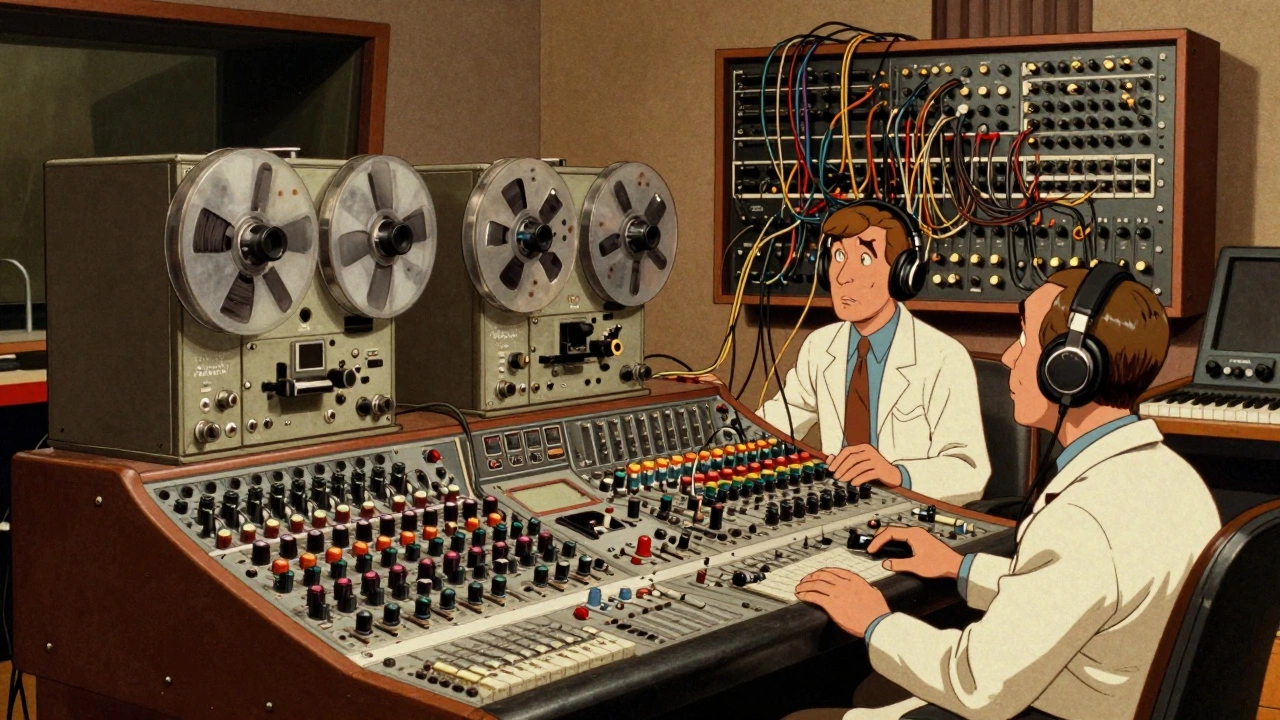

Imagine walking into a professional recording studio in 1973. You wouldn't find a laptop or a plugin suite. Instead, you'd see massive walls of tape machines, outboard compressors, and perhaps a giant, cable-strewn machine that looked more like a telephone switchboard than a musical instrument. This was the dawn of the era of recording synthesizers, a time when engineers weren't just capturing sound-they were inventing the very rules of electronic music production on the fly.
The big challenge of the 70s wasn't just how to make the synth sound good, but how to actually get that sound onto a piece of magnetic tape. Early gear was temperamental, often mono, and completely devoid of the presets we take for granted today. If you wanted a specific sound, you had to dial it in by hand and hope the oscillator didn't drift out of tune mid-take. This experimental atmosphere turned the studio into a laboratory, where the goal was to make electronic sounds feel organic, spatial, and powerful.
The Hardware Landscape: From Voltage to Digits
To understand the recording process, you first have to understand the gear. For much of the decade, the world revolved around Analog Synthesizers, which use electrical voltage to create sound. These machines, like the Moog synthesizer models that hit the market around 1972, produced rich, fat tones but were notoriously limited in their output options. Most were strictly mono, meaning you had one signal path. If you wanted a "wide" sound, you couldn't just click a stereo button.
Things shifted dramatically in 1975. That year saw the birth of the Synclavier, developed by Sydney Alonso and Cameron Jones. As the first digital synthesizer, it introduced a level of precision and stability that analog gear lacked. While the analog world was about warmth and unpredictability, the digital shift started the move toward the clinical perfection we hear in modern pop. Meanwhile, inventors like Don Tavel were pushing boundaries with instrument-controlled units that could track the pitch of a real instrument and trigger a synth sound, effectively bridging the gap between traditional musicianship and electronic synthesis.
The Battle of Mono vs. Stereo
One of the most frustrating hurdles for 70s engineers was the lack of true stereo synthesis. If a synth had stereo outputs, they were usually just for adding a chorus or flanger effect, not for creating a wide sonic image. So, how did they get those lush, sweeping soundscapes? They cheated-brilliantly.
The most common trick was "double tracking." An engineer would record a synth part once, then have the musician play the exact same part again on a second track. Because no human is a perfect robot, the tiny differences in timing and pitch between the two takes created a natural stereo spread. Other times, they'd use two different synths playing the same line, panning one left and one right. If they were feeling lazy or short on time, they'd simply run a mono signal through a stereo effects box before it ever hit the tape, forcing a stereo image where none existed.
| Method | Primary Goal | Key Attribute | Common Tool |
|---|---|---|---|
| Double Tracking | Spatial Width | Natural phasing/depth | Multi-track Tape Machine |
| Direct Input (DI) | Clarity | Clean, line-level signal | DI Box / Mixing Console |
| Amped Recording | Grit & Texture | Harmonic distortion | Ampeg Reverb Rocket |
| Room Re-amping | Realism | Natural ambience | Studio Live Room / Mics |
Capturing the Signal: DI vs. The Microphone
Engineers in the 70s were split on how to actually "catch" the sound. One camp swore by Direct Input (DI). This involved plugging the synth straight into the console. It was clean, precise, and gave the mixer total control. But for some, this sounded too "electronic" and sterile. It lacked the air and soul of a real instrument.
The other camp treated the synth like an electric guitar. They would run the output into a physical amplifier and place a microphone in front of the speaker cabinet. This added a layer of grit and harmonic saturation that you just can't get from a cable. For example, using an Ampeg Reverb Rocket amp could turn a thin synth lead into a roaring, organic presence. The real pros often did both: they'd record a clean DI signal on one track and a mic'd amp on another. This gave them the best of both worlds-the punch of the direct signal and the character of the amp-which they could blend during the final mix.
Adding Life with Ambience and Space
Because synths are generated electronically, they can sound "flat" or disconnected from a physical space. In the late 70s, engineers started using a technique called re-amping to solve this. Instead of just using a reverb unit, they would send the recorded synth track back out of the console and into the studio's live room through large loudspeakers.
They would then set up microphones around the room to capture how the synth sound bounced off the walls and ceilings. By blending this "room air" back into the original dry recording, they created a sense of place. It made the synthesizer feel like it was actually in the room with the drummer and bassist, rather than existing in some digital void. It was a physical solution to a technical problem, proving that the best way to make electronic music sound human was to introduce the unpredictability of a real physical environment.
The Legacy of 70s Experimentalism
The recording practices of the 1970s weren't based on a manual; they were based on trial and error. Every studio had its own "secret sauce." Whether it was the way they saturated the tape or the specific placement of a microphone in a concrete room, these techniques paved the way for everything we do today. The transition from the early analog days to the digital revolution of the mid-70s showed that as technology evolves, the human element-the need for warmth, space, and imperfection-remains the priority.
Why did 1970s engineers record synths twice for stereo?
Most synthesizers of that era were mono, meaning they only produced one channel of sound. To create a wide stereo image, engineers used "double tracking," where the musician played the part twice. The slight differences in timing and pitch between the two takes created a natural stereo spread that sounded fuller and more immersive than a single mono track.
What is the difference between DI and amped recording for synths?
Direct Input (DI) records the clean, electrical signal from the synth straight into the mixer, resulting in a pure and precise sound. Amped recording involves running that signal through a physical amplifier and capturing it with a microphone. This adds harmonic distortion, air, and a "grittier" texture that makes the synth sound more like a traditional acoustic instrument.
When did digital synthesizers first enter the studio?
A major turning point occurred in 1975 with the introduction of the Synclavier, created by Sydney Alonso and Cameron Jones. This was the first digital synthesizer and it began to shift studio practices away from the volatile nature of analog voltage toward the stability and precision of digital synthesis.
How did they create "room sound" for electronic instruments?
Engineers used a process where they played the synth tracks back through loudspeakers in a large live room. They then positioned microphones to capture the natural reflections and echoes of the space. Blending this recorded ambience with the original dry signal made the synth sound physically present in the recording environment.
What was the role of the Mellotron in this era?
While the Mellotron was developed in the 1960s, it served as a crucial ancestor to the 70s synth boom. It used tapes to playback recorded sounds, providing a bridge between sampling and synthesis that influenced how engineers approached layering electronic textures in the studio.


