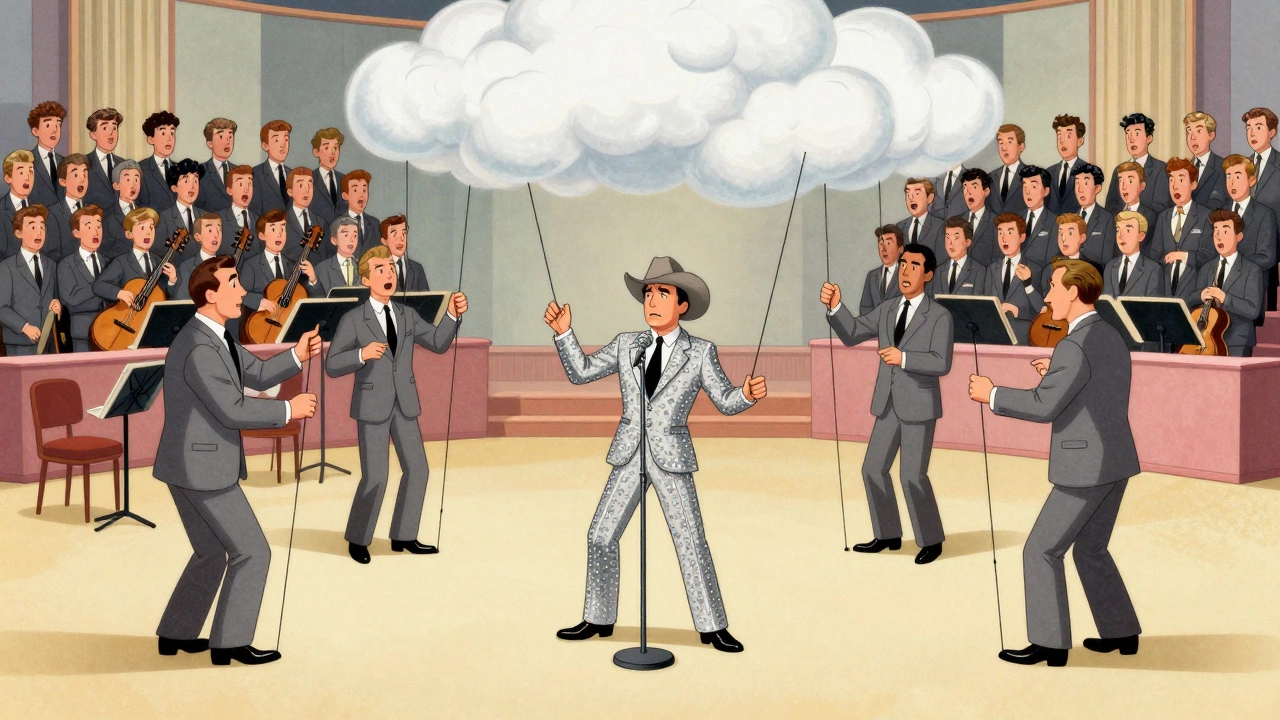

Imagine walking into a recording studio in 1970 and being told exactly how to sing, which guitar to use, and what clothes to wear for your album cover. For most country artists back then, this wasn't a nightmare-it was just Tuesday. The industry was dominated by a rigid system that valued a polished, predictable product over actual soul. But a few rebels decided they had enough of the corporate playbook, sparking a movement that changed the DNA of American music. This was the birth of Outlaw country, a middle finger to the establishment that prioritized artistic truth over chart-topping safety.
The Gilded Cage of the Nashville Sound
To understand why artists risked everything to go independent, you first have to understand the Nashville sound is a highly produced subgenre of country music that used lush string arrangements and background choirs to make the music more palatable to pop audiences. It was often called "countrypolitan," and while it sold millions of records, it acted as a creative straitjacket. Producers held all the cards. They decided the tempo, the session musicians, and even the lyrics. The artist was essentially a hired voice for a pre-packaged sonic brand.
This formulaic approach created a massive gap between the music being made and the lived experiences of the people singing it. While the labels were chasing a clean, suburban aesthetic, the artists were craving something raw. This tension reached a breaking point in the early 70s, leading a group of musicians to realize that the only way to get the sound in their heads onto a record was to bypass the gatekeepers entirely.
The Outlaws: Reclaiming the Mic
The rebellion wasn't led by newcomers, but by established figures who felt sidelined or stifled. Willie Nelson, Waylon Jennings, Johnny Cash, and Merle Haggard became the faces of this movement. They didn't just want different songs; they wanted total creative control. They wanted to pick their own bands, record in their own style, and stop pretending the world was as polished as a Nashville studio floor.
By pushing for independent ventures or renegotiating their contracts with a newfound aggression, these artists proved a vital point: authenticity sells. Fans were exhausted by the plastic feel of the mainstream and flocked to the grit of the Outlaw movement. It turned out that the "risky" move of being yourself was actually the most profitable strategy in the long run.
| Feature | The Nashville Sound | Outlaw Country Approach |
|---|---|---|
| Creative Control | Producer-led / Formulaic | Artist-led / Experimental |
| Sonic Profile | Strings, choirs, polished | Raw, honky-tonk, organic |
| Artist Role | Performer of a product | Auteur of the work |
| Primary Goal | Mass market appeal | Artistic integrity |
The High Price of Freedom
If it was such a great deal, why didn't everyone do it? Because going independent in the 70s was a terrifying gamble. The biggest threat wasn't just a bad review; it was blacklisting. The major labels controlled the distribution networks and the radio pluggers. If you burned a bridge with a powerhouse label, you could find yourself unable to get your records into stores or your songs played on the air. Your career could vanish overnight simply because you asked for too much control.
Beyond the social risk, there was the financial burden. Major labels provided the cash for studio time, marketing, and touring. Independent artists had to scrap for every dime, often managing their own logistics and building their own distribution channels from scratch. For many, the dream of freedom was crushed by the reality of an empty bank account.
The Legal Trap: Works Made for Hire
The struggle wasn't just in the studio; it was in the fine print. Most contracts in the 1970s included a devastating clause: Works Made for Hire is a legal classification where the employer (the label), not the creator, is considered the legal author and owner of the copyright. This meant that even if an artist wrote every note and sang every word, the record company owned the master recording forever.
This created a cycle of dependency. Artists couldn't simply take their music and leave; the label owned the physical and intellectual property of their best work. This loophole kept thousands of musicians tethered to companies they despised, as the cost of "buying back" their own art was often prohibitively expensive.
A Turning Point in the Law
Things finally began to shift with the Copyright Revision Act, which took effect on January 1, 1978. This wasn't just a minor tweak; it was a lifeline. Specifically, Section 203 of the Act allowed artists to terminate their grants of copyright after a certain period-eventually 35 years.
This meant that the blood, sweat, and tears recorded in the 70s and 80s wouldn't be owned by corporations indefinitely. By 2013, a massive wave of artists began reclaiming their masters. This legal victory allowed them to renegotiate terms, go fully independent in the digital age, or share their music directly with fans without a corporate middleman taking the lion's share of the profit.
The Lasting Echo of the Outlaw Era
The 1970s proved that the gatekeeper model was flawed. The success of independent-minded artists showed that audiences value honesty over perfection. This shift wasn't limited to country music; it mirrored a broader cultural move toward individualism and artistic autonomy seen across various genres during the decade.
Today, the spirit of the Outlaws lives on in the thousands of artists who choose to bypass labels entirely. When modern musicians cite "creative control" as their primary reason for staying independent-as seen in recent industry surveys-they are echoing the same frustrations Willie Nelson and Waylon Jennings felt fifty years ago. The risk is still there, but the path is now paved with the lessons of those who dared to be outlaws.
What exactly was the Nashville Sound?
The Nashville Sound was a production style from the 50s through the 70s that replaced raw honky-tonk elements with smooth strings and polished backing vocals. It was designed to cross over into the pop charts, but it often stripped away the grit and authenticity that defined traditional country music.
Who were the key figures in the Outlaw country movement?
The movement was headlined by artists like Willie Nelson, Waylon Jennings, Johnny Cash, and Merle Haggard. These musicians pushed back against studio restrictions and fought for the right to produce their own records and choose their own session players.
Why was 'Works Made for Hire' so damaging to artists?
Under this legal status, the record label was the legal 'author' of the recording. This meant the artist had no ownership over the master tapes and could not sell, license, or reclaim their music, regardless of how much it earned the company.
How did the 1976 Copyright Revision Act help musicians?
It introduced a mechanism for artists to terminate their copyright transfers after 35 years. This allowed many 1970s and 80s artists to finally own their master recordings again starting around 2013.
What were the biggest risks of starting an independent label in the 70s?
The primary risks included financial instability, lack of professional distribution, and the danger of being blacklisted by major industry players who controlled radio airplay and retail shelf space.


