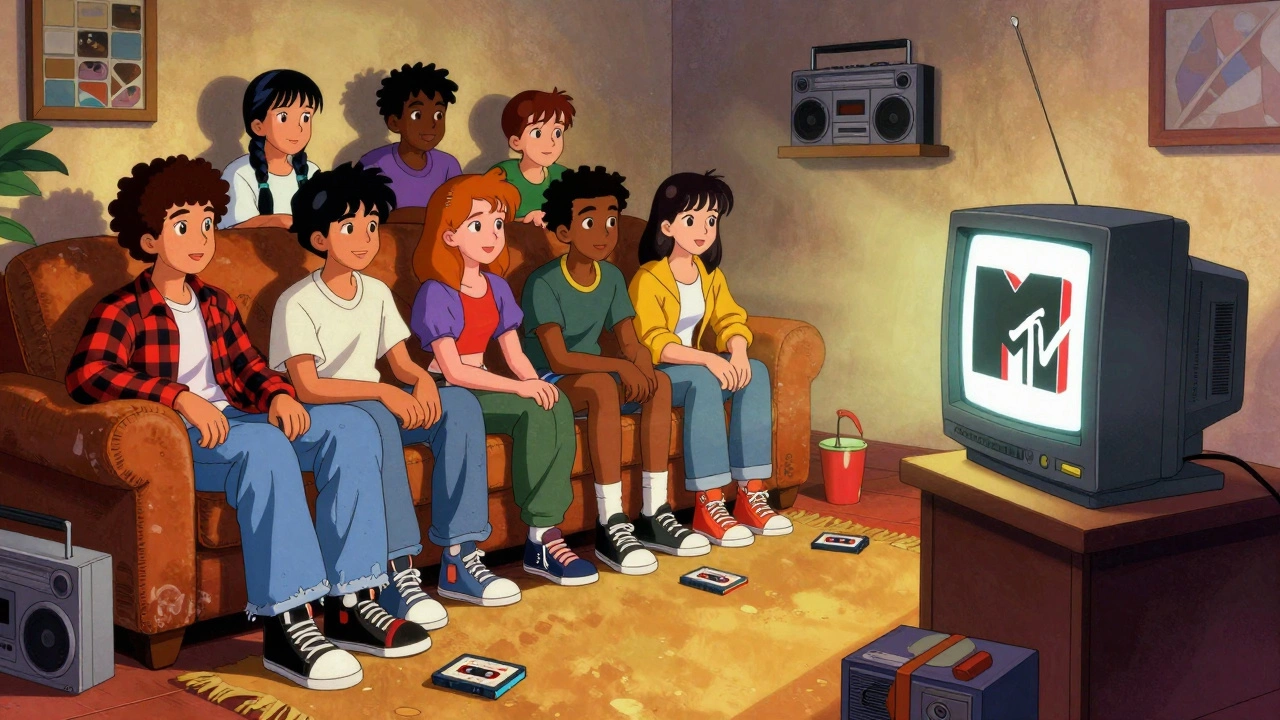

Remember when turning on the TV meant you couldn't control what song played next? In the 1990s, MTV International was the global gateway for youth culture, connecting disparate regions through a shared soundtrack of grunge, hip-hop, and Eurodance. It wasn't just a channel; it was a cultural unifier. From London to Bangkok, teenagers wore the same flannel shirts and mimicked the same dance moves because they watched the same videos. Today, that era feels distant, especially after the coordinated shutdown of niche music channels like MTV 90s in late 2025. But understanding how MTV operated internationally during its peak helps us see why those final broadcasts mattered so much.
The Blueprint: How MTV Conquered the World
Before we talk about the specific hits of the 90s, we need to look at the infrastructure. MTV didn't just expand overnight. The foundation was laid with MTV Europe, which launched on August 1, 1987. This was a bold move. At the time, the Berlin Wall had just fallen, and Europe was politically fragmented. MTV saw an opportunity to create a pan-European identity centered around music rather than politics.
This initial launch proved that a single feed could serve multiple countries. However, as the decade progressed, the strategy shifted from broad coverage to targeted regional feeds. Why? Because advertisers wanted local relevance, and audiences craved content that reflected their immediate surroundings while still feeling part of a global movement. This tension between "global hit" and "local flavor" defined the entire 1990s international strategy.
Regional Feeds: More Than Just Translation
The 1990s saw the birth of distinct regional identities within the MTV brand. These weren't just dubbed versions of the US feed. They were tailored experiences.
- MTV Latin America launched on October 1, 1993. It became crucial for promoting regional stars alongside global acts, blending English-language pop with Latin rhythms.
- MTV Brasil took a different approach, launching as a free-to-air terrestrial channel on October 20, 1990. This made it accessible to a much wider audience than cable-only feeds, deeply embedding MTV into Brazilian daily life until its closure in 2013.
- In Asia, MTV entered markets like Thailand and the Philippines, carefully navigating cultural sensitivities while introducing Western pop aesthetics to new demographics.
These regional channels allowed MTV to promote local artists who might not have crossed over to the US market but dominated their home territories. For example, a band from Brazil or South Korea could gain massive traction locally before attempting a global breakout. This decentralized approach created a richer, more diverse musical landscape than a single US-centric feed ever could have.
Global Hits: The Songs That Defined a Generation
What actually played on these screens? The 1990s playlist was incredibly diverse, reflecting the fragmentation of musical genres. MTV International served as the primary distribution engine for several key movements:
- Grunge: Bands like Nirvana and Pearl Jam broke through globally via MTV. Their raw aesthetic contrasted sharply with the polished pop of the 80s, resonating with disaffected youth worldwide.
- Eurodance and Techno: As the millennium approached, electronic music exploded across Europe. Artists like The Prodigy and CeCe Peniston dominated airwaves, creating a high-energy visual style that influenced fashion and club culture globally.
- Boy Bands and Girl Groups: The late 90s saw the rise of manufactured pop groups. The Spice Girls are perhaps the most iconic example. Their video for "Wannabe" didn't just break records; it established a template for female empowerment in pop that transcended language barriers.
- Hip-Hop's Global Expansion: While rooted in the US, artists like Tupac Shakur and The Notorious B.I.G. gained international cult followings through MTV, influencing street style and slang in cities from Paris to Tokyo.
These acts didn't just sell records; they created a shared visual language. The way a hair was styled, a jacket worn, or a dance performed was standardized by the millions of views these videos received across international feeds.
The Rise of Niche Channels: MTV 90s and Beyond
As streaming began to emerge in the 2010s and 2020s, linear TV viewership declined. To combat this, Paramount International Networks (now part of Paramount Global) segmented its audience further. They launched decade-specific channels like MTV 90s, MTV 80s, and MTV Classic.
MTV 90s was unique. It operated commercial-free in many regions, offering pure nostalgia. It served Europe, the Middle East, North Africa, and parts of Southeast Asia. For millennials, it was a time machine. You didn't need to search for a song; you just turned it on and heard your childhood soundtrack. This model worked well for a few years, capturing an audience that felt underserved by mainstream MTV's shift toward reality TV.

The Final Broadcast: A Symbolic End
The end of this era arrived swiftly in late 2024 and 2025. Facing the irreversible shift to digital streaming platforms, Paramount decided to consolidate its operations. The decision was strategic but emotionally charged for fans.
| Channel | Region | Closure Date | Final Video / Note |
|---|---|---|---|
| MTV Canada | North America | December 31, 2024 | Part of broader North American restructuring |
| MTV 90s | Netherlands | January 1, 2025 | Early exit from European market |
| MTV 90s | Australia | November 1, 2025 | Pacific region consolidation |
| MTV 90s | Pan-Europe | December 31, 2025 | "Goodbye" by The Spice Girls |
| MTV Music / Club MTV | UK, Germany, France, etc. | December 31, 2025 | Coordinated shutdown of sister networks |
The choice of final video for the Pan-European feed was deliberate. On December 31, 2025, at 07:00 CET, MTV 90s broadcast "Goodbye" by The Spice Girls. It was a poignant full-circle moment. The Spice Girls were one of the biggest beneficiaries of MTV's international reach in the 90s. Using their song titled "Goodbye" to sign off was not accidental; it was a curated farewell to a generation of viewers.
This closure marked the end of dedicated music video channels in many major markets. While MTV Global remains active as a general entertainment hub, the specialized feeds that allowed deep dives into specific eras or genres are gone. The responsibility for curating our own playlists has fully shifted to streaming algorithms.
Why It Matters Now
You might wonder why the closure of a cable channel matters in 2026. It matters because it signifies the end of passive discovery. When MTV International was at its peak, you discovered music because someone else chose it for you. There was a communal experience. Everyone watched the same premiere. Everyone argued about the same Top 20 countdown.
Today, we have infinite choice but less shared culture. The regional channels of the 90s taught us that global connectivity doesn't mean uniformity. It means finding common ground while respecting local differences. As we move forward, the legacy of MTV International isn't just in the videos it played, but in the way it connected young people across borders without them even realizing it.
When did MTV 90s officially close?
MTV 90s closed at different times depending on the region. It ceased operations in the Netherlands on January 1, 2025, in Australia on November 1, 2025, and finally in the Pan-European market on December 31, 2025.
What was the last music video played on MTV 90s?
The final music video broadcast on the Pan-European feed of MTV 90s was "Goodbye" by The Spice Girls. This aired on December 31, 2025, at 07:00 CET.
Did MTV exist in the 1990s outside of the United States?
Yes, extensively. MTV Europe launched in 1987, followed by MTV Latin America in 1993 and MTV Brasil in 1990. By the mid-90s, MTV had a significant presence across Europe, Asia, and Latin America, often with localized programming.
Why did MTV shut down its music-only channels like MTV 90s and MTV 80s?
The closures were driven by the industry-wide shift toward streaming services. Linear TV viewership declined significantly, making dedicated music video channels less economically viable. Paramount International Networks consolidated resources to focus on broader entertainment content and digital platforms.
Is MTV still available in 2026?
Yes, but it has changed. MTV Global remains active in Europe, focusing on general entertainment and reality series rather than music videos. Regional feeds like MTV UK & Ireland continued until late 2025 before shutting down local production. US-based channels like MTV Classic continue to operate.
How did MTV influence global fashion in the 1990s?
MTV acted as a visual trendsetter. Styles such as grunge flannel, baggy jeans, platform shoes, and later, the bright colors of Eurodance and Britpop were disseminated globally through music videos. Teenagers in non-English speaking countries adopted these styles, creating a unified youth aesthetic.