
Pop music has seen its share of superstars, but few have conquered the charts with the sheer velocity and consistency of Mariah Carey in the 1990s. By the end of that decade, she had amassed 14 number-one singles on the Billboard Hot 100, a feat that placed her alongside legends like The Beatles and Elvis Presley despite having been active for less than ten years. This wasn't just luck; it was a calculated blend of technical vocal mastery, strategic genre-blending, and an unwavering artistic vision that reshaped mainstream pop.
When Carey burst onto the scene in 1990, the industry didn't know what to make of her. She wasn't just another pretty face with a good voice. She was a vocalist with a five-octave range who could belt gospel-inspired runs one moment and hit whistle register notes the next. Her dominance wasn't accidental. It was built on a foundation of raw talent, smart production choices, and a willingness to take risks that label executives initially feared would backfire. Here is how she did it.
The Vocal Foundation: More Than Just Range
To understand Carey's success, you have to start with the instrument itself. In 1990, when Tommy Mottola, then-president of Columbia Records, signed her, he recognized something rare. A profile from the UK magazine Record Mirror at the time described her as "going to be a megastar," noting immediately that she was the only artist in America to top the Pop, Black (R&B), and Adult Contemporary charts simultaneously with her debut single, "Vision of Love."
This triple-format success was unusual. Most artists dominated one lane. Carey owned all three. Her vocal technique allowed her to bridge these gaps. She utilized intricate melismas-singing multiple notes on a single syllable-that were rooted in gospel traditions but polished for radio. This gave her songs a lush, emotional depth that appealed to R&B audiences while maintaining the catchy hooks required for pop radio. Later retrospectives often describe her as "the definition of vocal supremacy," but in 1990, this was a new standard. She wasn't just singing lyrics; she was arranging them into complex musical statements.
In the studio, Carey took control of her sound. She didn't rely solely on session singers for backing vocals. Instead, she recorded multiple layers of her own voice, creating what fans call a "choir of Mariahs." This self-arrangement meant every harmony matched her lead tone perfectly, creating a dense, immersive soundscape. It also gave her total creative control over how her range was showcased, ensuring that climactic belted choruses or whistle-register codas landed with maximum impact.
Vision: Rewriting the Rules of Pop Production
Talent gets you noticed, but vision keeps you relevant. Carey’s mid-decade shift demonstrates this clearly. By 1995, pop music was changing. Hip-hop was becoming dominant, and pure ballads were losing ground to rhythm-driven tracks. Carey saw this and adapted, but not by abandoning her strengths. She fused them.
The release of "Fantasy" in 1995 is the perfect case study. The original version was a sweet, melodic pop song. But Carey insisted on a remix featuring Ol’ Dirty Bastard (ODB). Label executives were skeptical. Bringing a gritty, unfiltered rapper from the Wu-Tang Clan onto a polished pop single seemed like a recipe for disaster. Carey pushed back. She wanted to merge the worlds of pop melody and hip-hop swagger. The result? "Fantasy" became the first remix to debut at number one on the Hot 100. It proved that pop and rap weren't mutually exclusive; they could amplify each other.
This decision marked a turning point. It showed that Carey wasn't just a singer executing a label's plan; she was a producer shaping the cultural conversation. She understood that to stay at the top, she had to evolve with the times without losing her identity. This bold move paved the way for countless future collaborations between pop stars and hip-hop artists, fundamentally altering the landscape of mainstream music.

Versatility: Mastering Multiple Formats
Carey’s ability to switch styles seamlessly was key to her sustained chart presence. Over the course of the 1990s, she delivered hits across nearly every subgenre of popular music. Let's look at how her approach shifted:
- Early 1990s (Gospel-Pop Ballads): Songs like "Vision of Love" and "Love Takes Time" relied heavily on emotional delivery and vocal acrobatics. These tracks dominated Adult Contemporary and R&B charts, establishing her credibility as a serious vocalist.
- Mid-1990s (Dance-Pop & Crossover): Tracks like "Dreamlover" and "Fantasy" introduced upbeat tempos and danceable beats. This era expanded her audience to include younger listeners and club-goers, proving she could handle uptempo material as well as slow jams.
- Late 1990s (R&B/Hip-Hop Fusion): With albums like Butterfly and singles like "Honey" and "Heartbreaker," Carey leaned fully into R&B grooves. "Heartbreaker," featuring Jay-Z, was a stark departure from her earlier work, showcasing a darker, more rhythmic style that kept her relevant in an increasingly urban-dominated market.
This versatility wasn't random. It was strategic. By dominating different formats, she ensured that no matter what was trending on the radio, there was a Mariah Carey song that fit. Whether it was the earnest sentimentality of "Hero" or the club-ready bounce of "Honey," she had a track ready. This multi-pronged approach meant her name remained in constant rotation, driving album sales and maintaining her status as a household name.
The Numbers Game: Quantifying Dominance
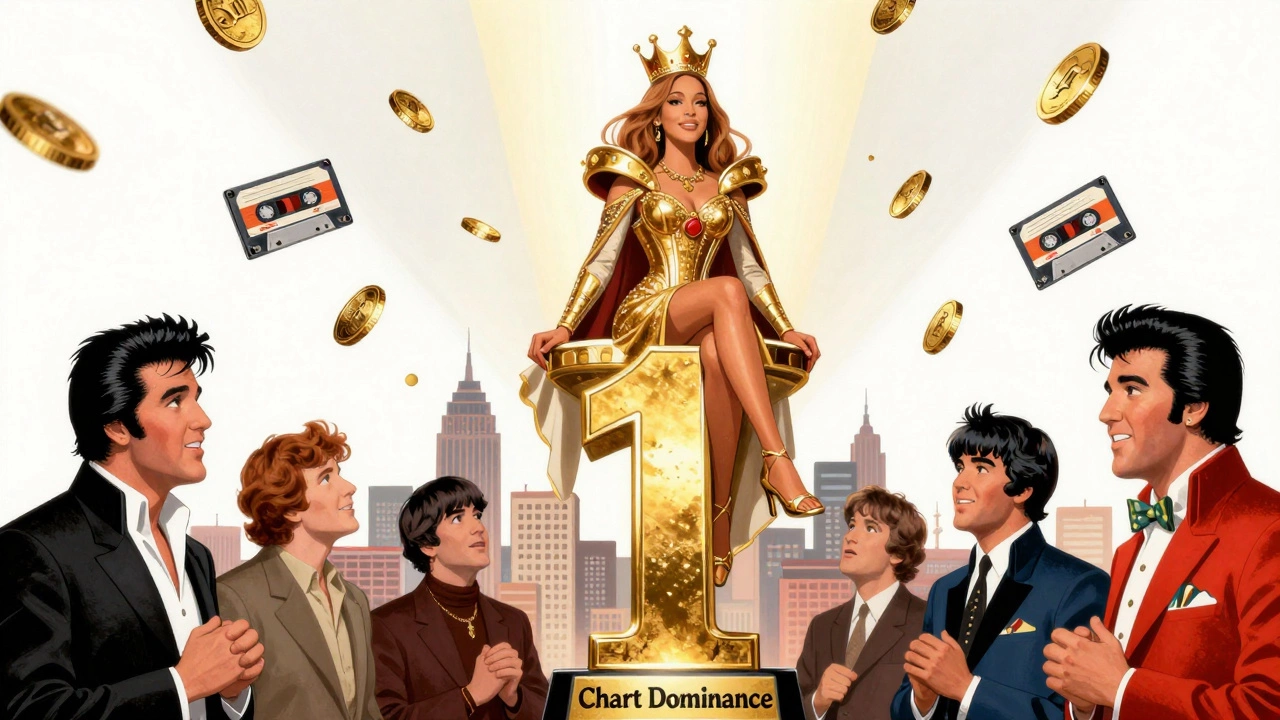
While artistry matters, the music business runs on numbers. By December 1999, performing rights organization BMI reported that Carey had secured 14 number-one singles on the Billboard Hot 100. To put that in perspective, at that time, only The Beatles (20) and Elvis Presley (18) had more. What makes this even more impressive is the timeframe. The Beatles and Elvis accumulated their totals over decades. Carey achieved hers in under ten years.
| Artist | No. 1 Singles (by 1999) | Timeframe to Reach Total | Key Strategy |
|---|---|---|---|
| Mariah Carey | 14 | ~9 years (1990-1999) | Vocal virtuosity + Genre fusion |
| The Beatles | 20 | ~10 years (1964-1970) | Songwriting innovation + Cultural zeitgeist |
| Elvis Presley | 18 | ~15+ years (1956-1970s) | Performance charisma + Cross-genre appeal |
BMI framed this achievement as evidence that she was "on top at the turn of the century." This statistical density-having a number-one hit nearly every year-is rare. It indicates not just peak popularity, but sustained relevance. While other stars might have had a massive breakout year followed by a decline, Carey maintained a steady stream of chart-toppers. This consistency forced radio stations to keep playing her music, which in turn drove streaming (or cassette/tape sales at the time) and solidified her brand.
Legacy: The Architect of Modern Pop
Carey’s influence extends beyond her own discography. She helped define the template for the modern pop diva. Before her, female vocalists often had to choose between being a credible soul singer or a pop star. Carey refused to choose. She demonstrated that technical proficiency could coexist with commercial accessibility. Today, artists like Beyoncé, Rihanna, and Ariana Grande owe a debt to the path she cleared. They blend R&B sensibilities with pop structures, use remixes to extend a song's lifecycle, and prioritize vocal prowess as a central marketing tool-all strategies Carey perfected in the 1990s.
Fan communities continue to celebrate this era as her "golden age." Retrospective videos and articles often highlight the emotional connection listeners felt with her music. Songs like "One Sweet Day," which holds the record for the most weeks at number one on the Hot 100 (16 weeks), resonated because they combined personal storytelling with universal themes of loss and hope. This emotional resonance, paired with undeniable technical skill, created a bond with fans that transcended typical celebrity worship.
In the end, Mariah Carey’s 1990s dominance wasn't just about hitting high notes. It was about understanding the mechanics of the music industry and using her unique talents to navigate them. She combined the power of her voice with the precision of her vision and the flexibility of her style to create a legacy that remains unmatched. For anyone interested in the intersection of art and commerce in music, her decade-long reign offers a masterclass in how to build and maintain superstardom.
How many number-one singles did Mariah Carey have in the 1990s?
By the end of 1999, Mariah Carey had achieved 14 number-one singles on the Billboard Hot 100. This included hits like "Vision of Love," "Fantasy," "Honey," and "Heartbreaker." At the time, this placed her third all-time behind only The Beatles and Elvis Presley.
What made Mariah Carey's vocal style unique in the 1990s?
Carey was known for her five-octave range, including the ability to sing in the whistle register. She also utilized complex melismas and layered her own backing vocals in the studio, creating a rich, gospel-influenced sound that stood out against simpler pop productions of the era.
Why was the remix of "Fantasy" significant?
The remix of "Fantasy," featuring Ol’ Dirty Bastard, was the first remix to debut at number one on the Billboard Hot 100. It validated the strategy of blending pop melodies with hip-hop elements, influencing future collaborations between pop and rap artists.
Did Mariah Carey write her own songs?
Yes, Mariah Carey co-wrote the majority of her biggest hits, including "Vision of Love," "Emotions," and "Fantasy." Her involvement in songwriting and production allowed her to tailor songs to showcase her specific vocal strengths and artistic vision.
Who signed Mariah Carey to Columbia Records?
Tommy Mottola, then-president of Columbia Records, signed Mariah Carey in the late 1980s. He played a crucial role in positioning her as a flagship pop vocalist for the 1990s, recognizing her potential early on.


