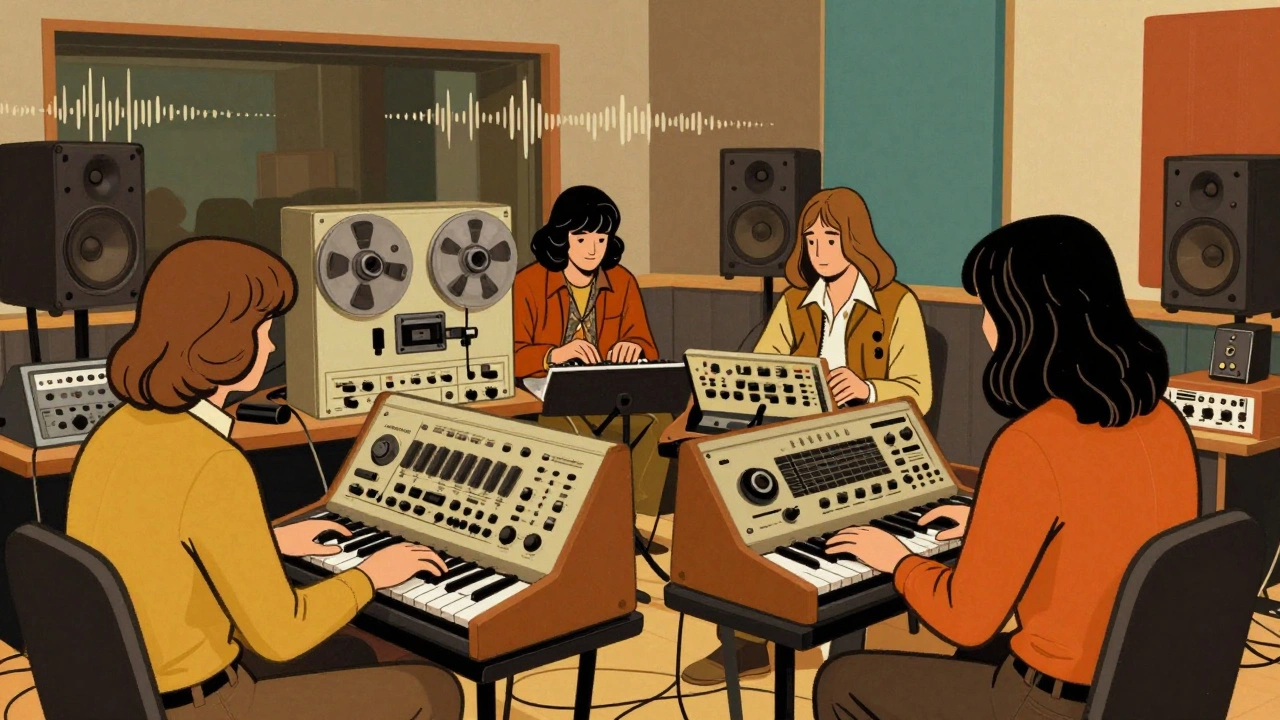

Imagine a world where rock music didn't have to sound like the Beatles or Led Zeppelin. In the early 1970s, a group of musicians in West Germany decided exactly that. They rejected the blues-based structures dominating Anglo-American charts and instead built a new sonic identity from scratch. This movement, known as Krautrock, wasn't just a genre; it was a cultural reset. These artists used early synthesizers, tape loops, and repetitive rhythms to create a sound that felt futuristic, spacious, and distinctly German. Today, we hear their fingerprints everywhere, from modern techno tracks to ambient playlists.
The term "Krautrock" itself is an outsider label, coined by British journalists who were baffled by this strange, experimental wave coming out of Düsseldorf and Berlin. Many of the artists preferred terms like Kosmische Musik (cosmic music) because it better described their atmospheric, psychedelic approach. But regardless of the name, the impact was massive. Bands like Kraftwerk, Can, Neu!, and Tangerine Dream didn't just make records; they invented the blueprint for electronic dance music.
Why Germany? The Post-War Cultural Reset
To understand Krautrock, you have to look at the context. After World War II, young Germans were desperate to distance themselves from the nationalistic traditions associated with the Nazi era. Traditional German folk music and classical compositions were tainted by that history. At the same time, copying American rock and roll felt like surrendering to another form of cultural imperialism.
Musicians needed a third way. They turned to technology. Synthesizers and drum machines were neutral tools-they had no past, no baggage. By embracing electronics, these artists could build a forward-looking identity. This wasn't just about making noise; it was a political and social statement. As historian Uwe Schütte notes, many of these bands were linked to the student counterculture and left-wing activism. Their music was communal, experimental, and deliberately anti-establishment. They weren't trying to be stars; they were trying to be explorers.
The Sound of Innovation: Motorik and Minimalism
If you listen to a track from Neu!, you’ll notice something distinct: the beat. It’s steady, relentless, and lacks the swing of traditional rock or funk. This is called the motorik beat. Inspired by the experience of driving on Germany’s Autobahn, this rhythm creates a sense of continuous motion. It’s hypnotic and mechanical, designed to lock you into a trance-like state.
This rhythmic foundation allowed for other innovations:
- Extended Improvisation: Tracks often ran longer than 10 minutes, sometimes exceeding 20. There were no verse-chorus structures to worry about. Just pure, evolving soundscapes.
- Tape Manipulation: Producers like Conny Plank became legends for how they treated the studio as an instrument. They spliced tapes, reversed sounds, and layered echoes to create textures that couldn't be played live.
- Synthesizer Integration: While some bands like Amon Düül II still used guitars, others like Kraftwerk and Cluster moved entirely to keyboards and sequencers. They explored the limits of analog technology, creating cold, precise tones that contrasted sharply with the warm fuzz of electric guitars.
This combination of minimalism and technology created a unique aesthetic. It was clean, modern, and utterly unlike anything heard before.

Key Bands and Their Global Impact
While Krautrock was a loose collective, a few groups stand out for their specific contributions to the international scene.
| Band | Primary Style | Key Innovation | International Reach |
|---|---|---|---|
| Kraftwerk | Electronic Pop | Replaced all acoustic instruments with synths and drum machines | Huge; influenced hip-hop, techno, and pop globally |
| Can | Experimental Rock | Fusion of jazz improvisation, African rhythms, and studio experimentation | Cult following; heavily sampled by later producers |
| Neu! | Minimalist Rock | Invented the motorik beat | Influenced post-punk and synth-pop |
| Tangerine Dream | Cosmic/Ambient | Long-form instrumental sequences using Moog synthesizers | Chart success in UK; pioneered film score electronics |
| Faust | Avant-Garde | Deconstructed song structure entirely; used non-musical objects | Niche but highly influential in underground scenes |
Kraftwerk deserves special attention. With their 1974 album Autobahn, they achieved something remarkable: they made electronic music radio-friendly. The title track, originally 22 minutes long, was edited down for singles and charted in both Europe and the US. Critics like Robert Christgau initially panned it, calling it repetitive and soulless. But the public listened. Kraftwerk proved that robots could have soul-or at least, that people could connect with machines.
Meanwhile, Tangerine Dream found massive commercial success in the UK. They released one top-ten album and six top-forty albums on Virgin Records during the 1970s. Their sound was less about pop hooks and more about immersive, cinematic atmospheres. This opened the door for electronic music in film scores, influencing composers for decades to come.
The Transnational Loop: From Funk to Techno
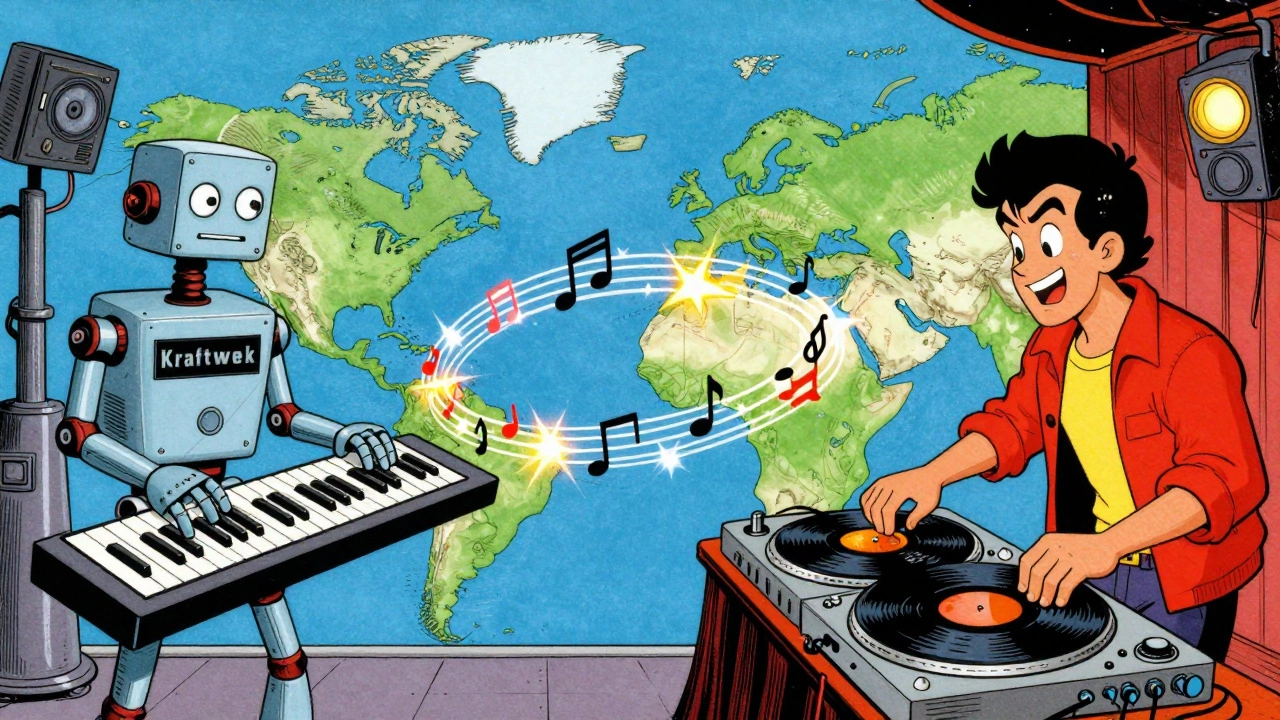
One of the most fascinating aspects of Krautrock is its relationship with Black American music. It’s easy to see German electronic music as isolated, but it was deeply connected to global currents. Bands like Can drew heavy inspiration from funk, soul, and jazz. They loved the groove of James Brown and the improvisation of Miles Davis.
Then came the return trip. When Kraftwerk perfected their robotic, synthesized beats, those sounds traveled back across the Atlantic. In Detroit, producers like Juan Atkins and Derrick May discovered Kraftwerk records and realized they could use similar techniques to create a new kind of urban music. This feedback loop-American funk inspiring German experimentation, which then inspired American techno-is crucial. It shows that Krautrock wasn't just a local phenomenon; it was part of a global conversation about rhythm, technology, and identity.
David Bowie also played a key role in bridging the gap. After meeting Brian Eno, Bowie incorporated Krautrock elements into his Berlin Trilogy (Low, Heroes, Lodger). This exposed millions of Anglo-American listeners to the motorik beat and atmospheric textures, validating the German scene on the world stage.
Legacy: Why It Still Matters Today
By 1978, the original wave of Krautrock had largely dissipated. Bands split up, members pursued solo careers, and the political fervor of the late 60s faded. But the music didn't disappear. Instead, it fragmented into new genres.
Today, if you go to a club in Berlin, New York, or London, you’re likely hearing the descendants of Krautrock. Techno, house, ambient, and synth-pop all owe a debt to these pioneers. Even contemporary pop artists use the production techniques developed by Conny Plank and Kraftwerk.
The legacy isn't just musical; it's philosophical. Krautrock taught us that music doesn't need to follow traditional rules. It can be mechanical, repetitive, and abstract, yet still deeply moving. It showed that technology can be an extension of human creativity, not a replacement for it. And perhaps most importantly, it demonstrated how art can help a society rebuild its identity after trauma.
As we look at the rise of AI-generated music and virtual performances today, the questions raised by Krautrock are more relevant than ever. How do we relate to machine-made sounds? What does it mean to be authentic in a digital age? The answers might still be hiding in those dusty vinyl records from Düsseldorf.
What is the difference between Krautrock and Kosmische Musik?
Krautrock is a term coined by British journalists to describe the entire West German experimental rock scene of the 1970s. It includes guitar-based bands like Amon Düül II as well as electronic acts. Kosmische Musik (cosmic music) is a term preferred by many of the artists themselves, particularly those focused on synthesizers and ambient textures, such as Tangerine Dream and Cluster. It emphasizes the spiritual, expansive, and psychedelic nature of their work rather than the "rock" aspect.
Did Kraftwerk invent techno?
Kraftwerk didn't invent techno directly, but they provided the essential blueprint. Their use of drum machines, sequencers, and repetitive, four-on-the-floor beats heavily influenced the founders of Detroit techno, including Juan Atkins, Derrick May, and Kevin Saunderson. Atkins famously said, "I wanted to be Kraftwerk." So while techno emerged in the US, its sonic DNA is undeniably German.
What is the motorik beat?
The motorik beat is a distinctive rhythmic pattern characterized by a steady, unswung 4/4 tempo, often played on drums or percussion. It lacks the syncopation of funk or the swing of jazz, creating a hypnotic, driving feel reminiscent of traveling on a highway. Pioneered by Neu! and Klaus Dinger, it became a hallmark of Krautrock and later influenced post-punk and electronic dance music.
Why did Krautrock emerge in Germany specifically?
Post-war Germany faced a crisis of cultural identity. Young musicians wanted to reject the nationalist traditions associated with the Nazi regime and avoid simply imitating American and British rock stars. Electronics offered a neutral, forward-looking path. Additionally, the strong engineering culture in Germany facilitated access to and innovation with synthesizer technology. The result was a unique blend of artistic rebellion and technical precision.
Which Krautrock albums should I start with?
For beginners, start with Kraftwerk's Autobahn (1974) for accessible electronic pop, or Rallye (1975) for deeper grooves. For a more experimental experience, try Can's Ege Bamyasi (1972) or Neu!'s self-titled debut (1972). If you prefer ambient and atmospheric sounds, Tangerine Dream's Phaedra (1974) is a masterpiece. These albums represent the core diversity of the movement.


