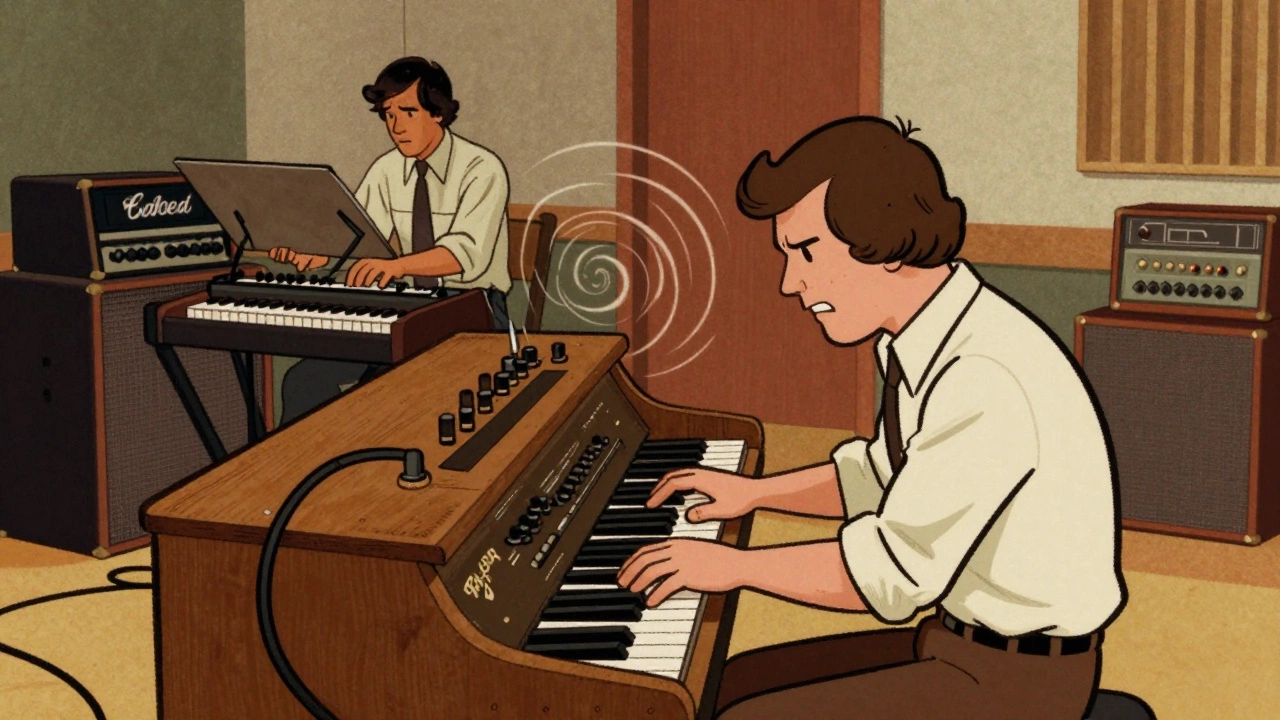

The Sound of a Decade: How Keyboards Changed Forever
Close your eyes and think about the sound of the 1980s. You probably hear that bright, metallic clinking on pop hits or the deep, resonant basslines in synth-wave tracks. That sound didn’t just happen by accident. It was the result of a massive technological revolution that turned the humble keyboard into the most powerful tool in music production. Before this decade, if you wanted a piano sound, you played a piano-or an electric version that still relied on strings and hammers. By the end of the 1980s, musicians were creating entire orchestras from silicon chips.
This era marked the definitive shift from acoustic grand pianos to fully electronic instruments. It wasn't just about making things smaller; it was about redefining what music could be. The Yamaha DX7, the Roland RD1000, and the introduction of MIDI changed how we write, record, and listen to music forever. If you’re curious about how we went from heavy wooden furniture to portable synthesizers, here is the real story behind those iconic sounds.
The Last Days of the Electric Piano
To understand why the 1980s were so revolutionary, you have to look at what came before. In the 1970s, the king of the stage was the Fender Rhodes an electric piano that uses electromagnetic pickups to capture the sound of vibrating tines. It sounded warm, organic, and jazzy. But it was also fragile, heavy, and hard to tune. Musicians loved the tone but hated the maintenance.
Then there was the Hammond organ, which dominated rock and gospel music with its swirling Leslie speaker effects. These instruments were analog giants. They worked by generating electrical signals through physical oscillators and tonewheels. While they offered new sonic possibilities, they were still tethered to physical mechanics. You couldn’t easily change the fundamental nature of the sound without swapping out hardware or using complex external effects units.
The problem? Studios needed consistency. Touring bands needed reliability. And producers wanted sounds that no acoustic instrument could physically produce. The solution lay in a new kind of technology: digital synthesis.
Yamaha’s Big Bet: FM Synthesis Arrives
In 1983, Yamaha a Japanese multinational corporation known for musical instruments, audio equipment, and electronics dropped a bombshell on the music industry with the release of the Yamaha DX7. This wasn’t just another keyboard; it was the first commercially successful instrument to use FM (Frequency Modulation) synthesis.
Unlike analog synthesizers that shaped waveforms, FM synthesis used one waveform to modulate the frequency of another. This created incredibly complex, rich harmonics. For piano sounds, this was a game-changer. Acoustic pianos have a sharp, percussive attack followed by a long decay. Analog synths struggled to mimic this "hammer" effect convincingly. FM synthesis nailed it.
The DX7 became ubiquitous overnight. If you listened to any major pop radio station between 1984 and 1989, you heard the DX7. Its clean, glassy piano tones defined the sound of artists like Whitney Houston, Michael Jackson, and Herbie Hancock. But Yamaha didn’t stop at synthesizers. That same year, they released the Yamaha YP-40 Clavinova, widely considered the first commercially marketed digital piano. It used the same FM engine as the DX7 but was designed specifically to simulate the feel and sound of a grand piano for home users.
MIDI: The Language That Connected Everything
Imagine a world where every keyboard spoke a different language. Your Yamaha synth couldn’t talk to your Roland drum machine. Your sequencer couldn’t control your sampler. That was the reality before 1983. Then came MIDI Musical Instrument Digital Interface, a technical standard that defines a protocol, digital interface, and connectors that connect modern musical instruments, computers, and other related devices.
MIDI didn’t transmit audio. It transmitted instructions. When you pressed a key, the keyboard sent a message saying, "Note On, Middle C, Velocity 100." Another device would receive that message and play its own version of Middle C. This allowed a single musician to control multiple instruments simultaneously. It turned the bedroom producer into a one-man band.
The impact was immediate. Studios began building "keyboard racks"-stacks of synthesizers controlled by a single master keyboard via MIDI cables. This efficiency lowered recording costs and increased creative possibilities. Suddenly, a producer could layer twelve different string patches to create a lush background texture, something that would have required hiring an orchestra before MIDI.
Kurzweil and the Power of Sampling
While Yamaha pushed FM synthesis, another company took a different approach. In 1984, Kurzweil Music Systems a pioneer in digital music technology and speech synthesis introduced the Kurzweil K250. This instrument was expensive-often costing over $10,000-but it offered something FM synthesis couldn’t: realism.
The K250 used sampling. Instead of mathematically generating a piano sound, it recorded actual samples of a grand piano being struck. When you pressed a key, the computer played back that recording. The result was described by many professionals as "almost impossibly accurate." For classical pianists and jazz musicians who cared deeply about the nuances of acoustic resonance, sampling felt more authentic than synthesis.
The K250 featured weighted keys, mimicking the mechanical resistance of a real piano. This was crucial. Many early electronic keyboards had light, unweighted keys that felt cheap under the fingers. The K250 proved that an electronic instrument could offer both high-fidelity sound and realistic tactile feedback. It set a new standard for professional stage pianos.
Roland Enters the Ring with the RD1000
If the DX7 defined pop music and the K250 defined luxury realism, the Roland RD1000 a digital piano released in 1986 that became an industry standard in recording studios bridged the gap. Released in 1986, the RD1000 used Roland’s proprietary SA (Sound Analysis) synthesis technology.
SA synthesis analyzed the spectral characteristics of acoustic instruments and recreated them digitally. The result was a piano sound that was bright, brilliantly defined, and incredibly responsive. More importantly, it was reliable. The RD1000 quickly became the industry standard in recording studios throughout the late 1980s. Engineers preferred it because it didn’t require tuning, wasn’t affected by humidity or temperature changes, and blended seamlessly into dense mixes.
The RD1000’s success signaled a turning point. Acoustic pianos began disappearing from professional studios. Why rent a $5,000-a-day grand piano when the RD1000 sounded great, stayed in tune, and could be automated via MIDI? This shift fundamentally changed the economics of music production.
Casio and the Democratization of Sound
Not everyone could afford a Kurzweil or a Roland. Enter Casio a Japanese electronics company known for affordable calculators, watches, and musical instruments. While Yamaha and Roland targeted professionals, Casio focused on the consumer market. Their keyboards were lightweight, battery-powered, and packed with dozens of preset sounds.
Instruments like the Casio CT series brought synthesizer sounds into millions of homes. They weren’t high-fidelity workstations, but they inspired a generation of young musicians. You could practice piano in the living room with headphones, experiment with drum machines, and learn basic music theory without investing thousands of dollars. This accessibility helped fuel the rise of home recording and DIY music culture.
| Model | Year | Technology | Primary Use | Key Feature |
|---|---|---|---|---|
| Yamaha DX7 | 1983 | FM Synthesis | Synthesizer / Pop Production | Glassy, metallic tones |
| Kurzweil K250 | 1984 | Sampling | Professional Stage Piano | Realistic acoustic emulation |
| Roland RD1000 | 1986 | SA Synthesis | Studio Recording | Bright, defined piano sound |
| Yamaha YP-40 | 1983 | FM Synthesis | Home Digital Piano | First commercial digital piano |
The Visual Identity of Electronic Music
The design of these keyboards reflected their function. Traditional electric pianos like the Fender Rhodes looked like mini-grand pianos-wooden cabinets, curved shapes, and bench seats. Early digital pianos from Yamaha kept this aesthetic to reassure buyers that they were buying a "real" piano.
Synthesizers, however, adopted a futuristic industrial look. The DX7 had a sleek, angular body with a distinctive LCD screen displaying waveform data. The Kurzweil K250 looked like a spaceship console, emphasizing its computational power. These designs signaled a break from tradition. They weren’t trying to hide their technology; they were celebrating it. This visual shift mirrored the cultural optimism of the 1980s-a belief that technology could enhance creativity rather than replace it.
Genre-Specific Adoption Patterns
Different genres embraced these technologies at different rates. Jazz musicians were initially skeptical. Many feared that synthesized sounds lacked the emotional depth of acoustic instruments. However, players like Herbie Hancock and Chick Corea adapted quickly, using the DX7 and K250 to expand their harmonic palettes. The ability to hold infinite sustain chords without pedal noise appealed to jazz composers.
Pop and rock producers jumped on board immediately. The tight, punchy drums and shimmering pads of FM synthesis fit perfectly with the polished production style of MTV-era pop. New Wave and Synth-Pop bands built entire identities around these sounds. Artists like Depeche Mode and Kraftwerk used keyboards not just as accompaniment, but as the lead voice of their music.
Classical musicians remained cautious. While some adopted digital pianos for practice due to their quiet operation, live performances still favored acoustic grands for their dynamic range and acoustic projection. However, the convenience of MIDI sequencing allowed composers to draft symphonic works on desktop computers, changing the workflow of film scoring and contemporary composition.
Why the 1980s Matter Today
The innovations of the 1980s laid the foundation for every digital instrument we use today. Modern DAWs (Digital Audio Workstations), virtual instruments, and even the way we think about music production stem directly from this decade. MIDI remains the universal standard for connecting musical devices. Sampling is now the core technique in hip-hop, EDM, and pop production. FM synthesis has seen a resurgence in recent years as producers seek out those classic retro textures.
More importantly, the 1980s taught us that technology doesn’t have to replace tradition-it can extend it. The transition from grand piano to fully electronic keyboard wasn’t about destroying the past; it was about unlocking new creative potential. Whether you’re a producer digging through vintage plugin libraries or a student learning scales on a modern digital piano, you’re benefiting from the breakthroughs made thirty-five years ago.
What was the first digital piano?
The Yamaha YP-40 Clavinova, released in 1983, is widely recognized as the first commercially marketed digital piano. It used FM synthesis to simulate piano sounds and was designed specifically for home users seeking a realistic piano experience without the maintenance of an acoustic instrument.
Why did the Yamaha DX7 become so popular?
The Yamaha DX7 became popular because it was the first mass-market instrument to use FM synthesis, which created unique, bright, and metallic tones that were impossible to achieve with analog synthesizers. Its clean piano sounds and versatile presets made it ideal for pop, rock, and jazz production in the mid-1980s.
How did MIDI change music production?
MIDI allowed electronic instruments to communicate with each other and with computers. This enabled musicians to control multiple synthesizers from a single keyboard, sequence complex arrangements, and edit performances with precision. It drastically reduced studio costs and expanded creative possibilities for solo artists.
What is the difference between FM synthesis and sampling?
FM synthesis generates sounds mathematically by modulating frequencies, creating complex harmonics and percussive attacks. Sampling records actual audio snippets of instruments and plays them back. FM is better for creating synthetic, evolving textures, while sampling offers higher realism for acoustic instruments like pianos and strings.
Did acoustic pianos disappear in the 1980s?
Acoustic pianos did not disappear, but their role in professional recording studios diminished significantly. Instruments like the Roland RD1000 offered consistent tuning, lower maintenance, and MIDI integration, making them more practical for studio work. However, acoustic pianos remained essential for classical performance and high-end live venues.
Which keyboard brands dominated the 1980s market?
Yamaha, Roland, Kurzweil, and Casio were the dominant brands. Yamaha led with FM synthesis (DX7), Roland excelled in studio-standard digital pianos (RD1000), Kurzweil pioneered high-end sampling (K250), and Casio democratized access with affordable consumer keyboards.
What was SA synthesis used in the Roland RD1000?
SA (Sound Analysis) synthesis was Roland’s proprietary technology that analyzed the spectral characteristics of acoustic instruments to recreate them digitally. It aimed to bridge the gap between the realism of sampling and the flexibility of synthesis, resulting in a bright, well-defined piano sound.
How did keyboard design reflect technological shifts in the 1980s?
Early digital pianos retained traditional wooden cabinet designs to appeal to conservative buyers. Synthesizers and advanced workstations adopted sleek, industrial aesthetics with LCD screens and angular bodies, emphasizing their computational nature and breaking away from acoustic traditions.


