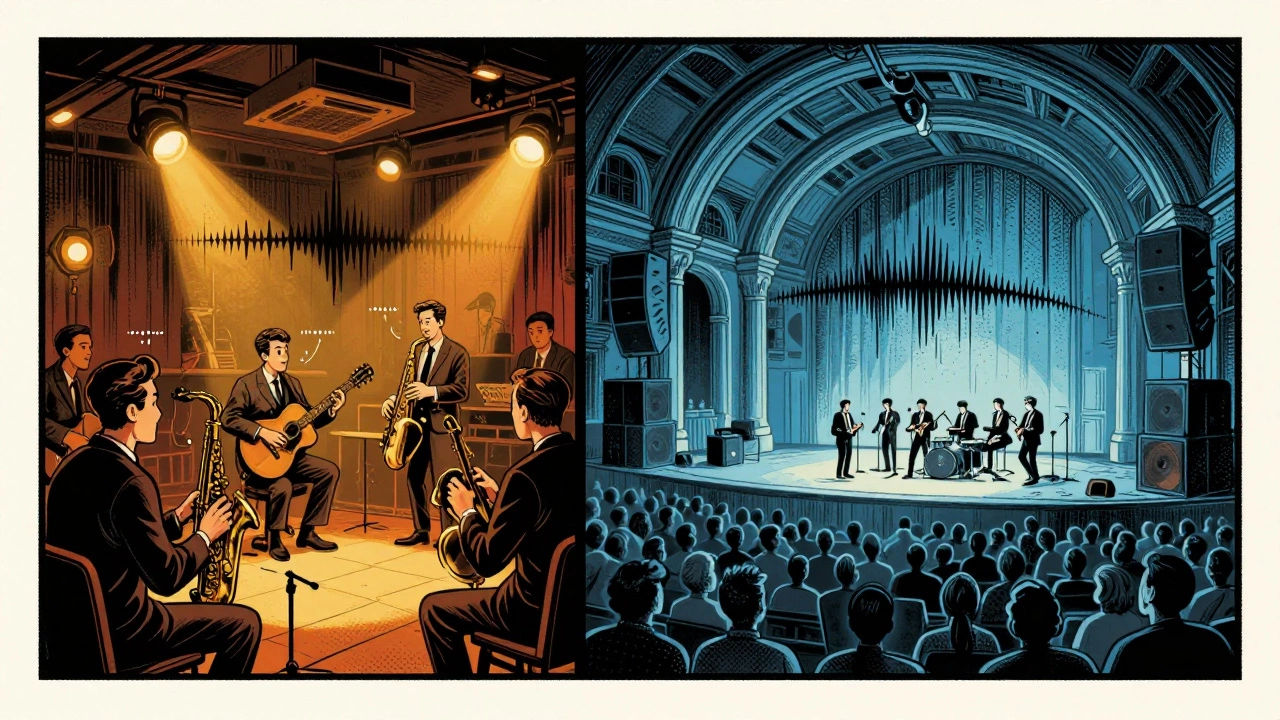

Imagine hearing every subtle ghost note on a snare drum and the breathy texture of a saxophone solo. Now imagine that same performance drowned out by a wall of noise in a cavernous stadium where you can barely distinguish the instruments. This isn't just about volume; it is about how the physical space you are standing in dictates what the music actually sounds like. For jazz fusion, a genre defined by its blend of complex harmony and rock energy, the choice between an intimate jazz club and a massive arena didn't just change the crowd size-it fundamentally rewired the music.
The Acoustic Divide: Intimacy vs. Impact
To understand why fusion sounds the way it does, we have to look at the rooms where it was played. In the late 1960s and early 1970s, musicians were navigating two very different worlds. On one side, you had traditional jazz clubs like the Village Vanguard in New York or the Cellar Door in Washington, D.C. These spaces were small, often holding fewer than 300 people, with low ceilings and short reverberation times-usually between 0.6 and 1.2 seconds.
In these tight quarters, sound travels directly from the instrument to your ear with minimal echo. This allows for "micro-timing," a term used by ethnomusicologist Ingrid Monson to describe the tiny delays and anticipations musicians make when interacting with each other. When you can hear every nuance, you play differently. You lean into the silence. You focus on dynamic shading. Early fusion groups like Chick Corea's Return to Forever and Joe Zawinul's Weather Report honed their intricate interplay in these environments.
On the other side of the spectrum were the arenas and large rock venues like Madison Square Garden or the Fillmore East. These spaces hold thousands of people and have reverberation times ranging from 2 to 4 seconds. In acoustic terms, this means sound bounces around the room for several seconds before dying out. If you play a complex, fast-paced chord progression in an arena, those notes smear together into a muddy wash of sound. The detail is lost. To survive this environment, the music had to change.
| Feature | Jazz Club (e.g., Village Vanguard) | Arena/Rock Venue (e.g., Fillmore East) |
|---|---|---|
| Capacity | 80-300 people | 2,500-20,000+ people |
| Reverberation Time (T30) | 0.6-1.2 seconds | 2.0-4.0 seconds |
| Typical SPL (Sound Pressure Level) | 85-95 dB(A) | 95-105+ dB(A) |
| Musical Focus | Detail, dynamics, interaction | Groove, power, clarity at distance |
| Instrumentation Trend | Acoustic/Electric mix, subtle textures | Fully electric, high-gain amplification |
Miles Davis and the Birth of Electric Fusion
No story illustrates this shift better than Miles Davis. In 1969, Davis began experimenting with electric instruments, leading to landmark albums like In a Silent Way and Bitches Brew. But the real catalyst for his sonic evolution wasn't just the new gear; it was the venues he started playing.
Davis's bands moved from small clubs like the Village Gate to larger rock-oriented venues like the Fillmore West and Fillmore East. In his autobiography, Davis noted that in these bigger spaces, the subtle textures of acoustic drums and pianos simply disappeared without heavy amplification. He couldn't hear himself, and neither could the audience. So, he turned up the volume and switched to electric keyboards and guitars.
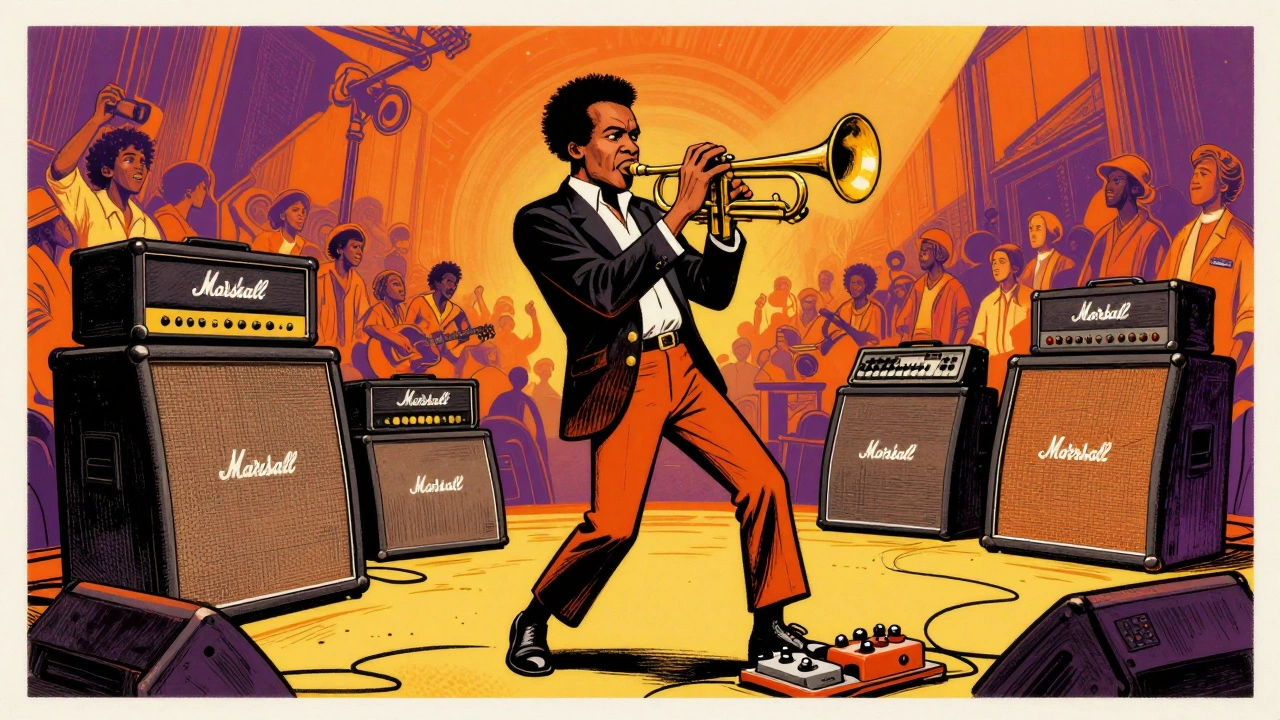
Listen to the live recordings from the Cellar Door in December 1970. The sound is dry, intimate, and detailed. You can hear Keith Jarrett's Fender Rhodes sitting comfortably in the mix alongside Jack DeJohnette's acoustic-leaning drum kit. Now compare that to the Miles Davis at Fillmore recordings from June 1970. The sound is compressed, louder, and heavier. Davis's trumpet is pushed through amplifiers and wah-wah pedals to cut through the dense mix. The music becomes more drone-based and groove-oriented because that style holds up better over long distances and high background noise.
The Technology of Loudness
The move to arenas forced musicians to adopt new technologies that would define the fusion sound for decades. In a club, you might get by with a small PA system and backline amps running at half power. In an arena, you need tens of kilowatts of power.
This demand for volume drove the adoption of specific instruments:
- Fender Rhodes electric piano: Adopted by Herbie Hancock and Chick Corea for its ability to be amplified cleanly without feedback.
- Minimoog Model D synthesizer: Released in 1970, its powerful monophonic voice could cut through any mix.
- High-wattage guitar stacks: John McLaughlin of the Mahavishnu Orchestra used 100-watt Marshall and Hiwatt amps to achieve the sustain and harmonic distortion necessary to compete with rock bands.
- Ampeg SVT bass rigs: Jaco Pastorius used massive cabinets to produce bass tones that physically shook the floor, essential for feeling the rhythm in a large hall.
In clubs, these amps were often rolled back. In arenas, they were pushed to their limits. This increased harmonic distortion became a core aesthetic feature of 1970s fusion. The aggressive, singing tone of fusion guitar and the punchy, percussive attack of fusion bass were not just artistic choices; they were survival mechanisms for loud rooms.
Economics and Arrangement Styles
Venues also dictated the economics of touring, which in turn shaped how songs were written. Jazz clubs often booked multi-night residencies. A band might play six nights a week at the Village Vanguard, allowing them to experiment with long, loosely structured improvisations. Musicians could refine complex material over time, knowing the audience was there specifically for deep listening.
Arenas operated on a different model. Promoters like Bill Graham Presents offered huge payouts but required shorter sets, often 45 to 60 minutes as opening acts. There was no time for slow builds or obscure explorations. Bands needed high-impact pieces with strong backbeats and memorable riffs. Songs like the Mahavishnu Orchestra's "Meeting of the Spirits" or Return to Forever's "Sorceress" were designed to grab attention immediately. They featured driving rhythms and clear melodic hooks that translated well to a large, distracted crowd.
This economic pressure contributed to the simplification of fusion in the late 1970s and early 1980s. As bands chased arena-ready sounds, the genre drifted toward "smooth jazz"-a style prioritizing radio-friendly melodies and polished production over the chaotic complexity of early fusion. Critics argued that the nuance of jazz was being flattened into rock-style riffing to suit the venue.
The Modern Fusion Landscape
Today, the pendulum has swung back. While the 1970s saw fusion conquer arenas, the modern era has seen the genre retreat to clubs and theaters. Bands like Snarky Puppy, The Aristocrats, and Kamasi Washington's ensembles thrive in venues seating 300 to 1,500 people. Why? Because modern fusion audiences value detail.
Listeners today want to hear the polyrhythms, the intricate bass lines, and the spontaneous interactions. They don't want a wall of sound; they want clarity. Advances in sound technology, such as line-array speakers and in-ear monitoring, have improved arena sound, but the fundamental acoustic challenges remain. Long reverb times still smear fast passages. High volumes still mask quiet dynamics.
Furthermore, noise regulations in many cities limit sound pressure levels in large venues, making the extreme volumes of the 1970s less viable. Modern productions favor high-fidelity systems that preserve detail at lower overall volumes. This aligns perfectly with the club aesthetic. Even when recorded in studios, modern fusion albums like Snarky Puppy's We Like It Here simulate the intimacy of a club setting, proving that the genre's heart beats strongest in smaller spaces.
Conclusion: The Room Is the Instrument
The history of jazz fusion is not just a story of musical innovation; it is a story of spatial adaptation. Jazz clubs nurtured the genre's intellectual and interactive roots, allowing for subtlety and complexity. Arenas demanded power, simplicity, and electric intensity, pushing fusion toward rock aesthetics. Understanding this dynamic helps us appreciate why certain fusion records sound the way they do. The next time you listen to a classic fusion album, ask yourself: was this meant for the dark corner of a club, or the bright lights of an arena? The answer changes everything.
How did venue size affect the instrumentation of jazz fusion?
In small jazz clubs, acoustic instruments and subtle electric textures could be heard clearly, allowing for a mix of acoustic and electric sounds. In large arenas, the need for higher volume and clarity at a distance led to the widespread adoption of fully electric instruments like the Fender Rhodes, Minimoog, and high-wattage guitar stacks. These instruments could be amplified loudly without losing definition, which was essential for cutting through the noise and reverb of large halls.
Why did Miles Davis switch to electric instruments?
Miles Davis switched to electric instruments largely because of the venues he began playing in the late 1960s. In large rock venues like the Fillmore East, his acoustic textures disappeared in the noise and reverb. Electric keyboards and guitars allowed him to amplify his sound sufficiently to be heard over the crowd and the natural acoustics of the large space, fundamentally changing the timbre and volume of his music.
What is the difference in reverberation time between a jazz club and an arena?
Jazz clubs typically have short reverberation times, ranging from 0.6 to 1.2 seconds, which preserves detail and allows for clear interaction between musicians. Arenas have much longer reverberation times, often between 2.0 and 4.0 seconds. This long decay causes sounds to smear together, obscuring fast rhythms and complex harmonies, which forces musicians to simplify their arrangements and increase volume to maintain clarity.
Did playing in arenas lead to the rise of smooth jazz?
Yes, partially. The economic and acoustic demands of arenas encouraged fusion bands to prioritize strong grooves, simple structures, and high-impact riffs over complex improvisation. This stylistic shift, combined with the desire for radio-friendly sounds, contributed to the development of smooth jazz in the late 1970s and 1980s. Bands adapted their music to translate well in large, noisy environments, leading to a more polished and less chaotic sound.
Where do modern fusion bands prefer to play?
Modern fusion bands like Snarky Puppy and The Aristocrats generally prefer small to medium-sized venues, such as jazz clubs and theaters seating 300 to 1,500 people. These spaces allow for the detailed listening experience that contemporary fusion audiences expect. The intimacy of these venues preserves the dynamic nuances and complex rhythmic interactions that are central to the modern fusion aesthetic, which can be lost in larger arenas.