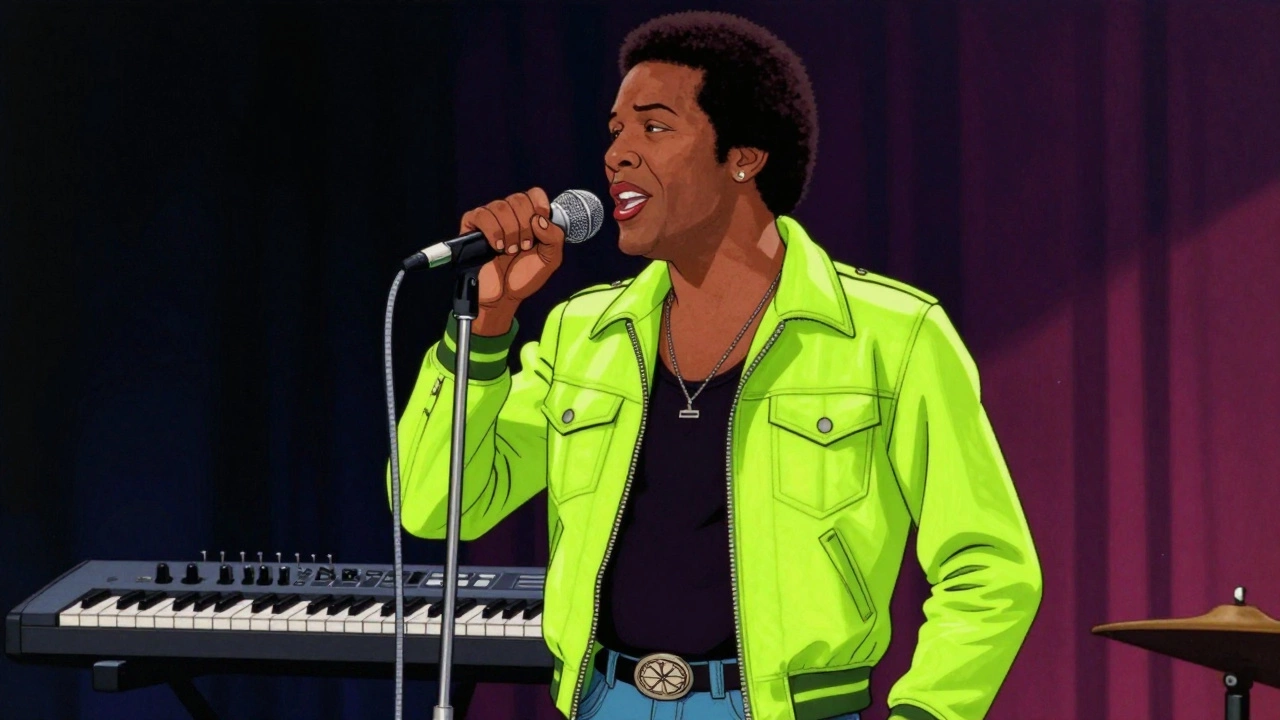

Close your eyes and think about the sound of 1980s funk. Chances are, you hear that robotic, yet deeply human voice singing “More Bounce to the Ounce.” It wasn’t a synthesizer mimicking a human. It wasn’t a vocoder processing a singer’s voice digitally. It was Roger Troutman, born November 29, 1951, in Hamilton, Ohio, using a plastic tube connected to a speaker driver to turn his mouth into an instrument. This technique, known as the talk box, is an audio effects device that routes instrumental sound through a tube into the performer's mouth for vocal shaping. While other musicians used it for novelty solos, Troutman made it the lead vocalist of his band, Zapp, which is a funk band led by Roger Troutman known for pioneering electronic funk sounds. He didn’t just use the effect; he reinvented what a funk song could sound like, bridging the gap between analog electronics and soulful expression.
The Mechanics of the Talk Box Sound
To understand why Zapp sounded so different from bands like Earth, Wind & Fire or The Commodores, you have to look at the gear. The modern talk box design dates back to experimental devices in 1939, but it gained traction in rock music with players like Peter Frampton in the 1970s. However, those rock applications were usually guitar-based and treated as a solo effect. Troutman flipped the script.
Instead of a guitar, Troutman fed his talk box with a Yamaha DX100, which is a compact 4-operator FM synthesizer released in the mid-1980s known for bright, harmonically rich tones. This specific synthesizer was crucial. Frequency Modulation (FM) synthesis produces bell-like, percussive tones with strong midrange content. When these tones travel up the plastic tube into Troutman’s mouth, they retain their clarity even when shaped into vowels and consonants. A warmer, analog synth might have muddied the articulation. The DX100 cut through the mix.
The hardware setup was equally specific. Troutman utilized a custom rig built around the Electro-Harmonix Golden Throat, which is a high-power talk box unit popular in the 1980s known for its robust driver and clear output. Unlike cheaper units that struggled with volume, the Golden Throat pushed enough air pressure to ensure every syllable was intelligible over loud stage monitors and drum machines. The signal path was simple but demanding: the Yamaha DX100 sent audio to the talk box driver on the floor, which blasted sound up a tube into Troutman’s mouth. His vocal microphone then captured the result. There was no digital processing. No pitch correction. Just physics and muscle memory.
| Feature | Rock Usage (e.g., Peter Frampton) | Funk Usage (Roger Troutman/Zapp) |
|---|---|---|
| Source Instrument | Electric Guitar | FM Synthesizer (Yamaha DX100) |
| Role in Song | Solo Effect / Novelty | Lead Vocalist / Primary Hook |
| Tone Character | Distorted, Sustained | Percussive, Bell-like, Articulate |
| Vocal Technique | Whining, Screaming | Singing, Speech, Rhythmic Phrasing |
From Novelty to Narrative: “More Bounce to the Ounce”
When Zapp released their self-titled debut album, the track “More Bounce to the Ounce” immediately stood out. In most funk songs of the era, the lead singer delivered the hook with traditional vocals. Here, the talk box *was* the singer. For the first few minutes, there are no sung lyrics. Instead, Troutman uses the talk box to deliver rhythmic phrases, melodic riffs, and ad-libs that lock tightly with the slap bass and drum machine.
This approach required a new kind of musicality. Troutman had to coordinate his fingers on the synthesizer keys with his tongue and lips in real-time. He wasn’t just playing notes; he was forming words. On tracks like “Computer Love,” this technique evolved further. The talk box carried entire romantic ballads, delivering legato lines and vibrato that felt surprisingly emotional despite the mechanical source. Listeners often describe the sound as “robotic yet soulful.” That contradiction is exactly where Troutman’s genius lay. He proved that electronic instruments could convey intimacy if played with enough human nuance.
The production choices reinforced this. Engineers kept reverb low on the talk box channel. Too much space would wash out the crisp consonants-the “T” in “bounce” or the “K” in “funk.” By keeping the sound dry and forward in the mix, the talk box acted as part of the rhythm section, hitting hard and fast alongside the kick drum and snare. This tight integration made the voice feel physical, almost tactile, rather than distant or ethereal.
The Hardware Secret: Why the DX100 Matters
If you try to recreate Zapp’s sound with a standard organ patch or a soft piano tone, it won’t work. The secret lies in the spectral content of the Yamaha DX100. FM synthesis generates complex waveforms by modulating one frequency with another. This creates partials-additional frequencies that sit above the fundamental note. These partials are essential for speech intelligibility. Human voices rely on formants (resonant frequencies) to distinguish vowels. The bright, square-wave-like spectra of the DX100 patches provided plenty of high-frequency energy for Troutman’s mouth to shape into recognizable sounds.
Modern musicians attempting to replicate this style often cite the DX100 or similar FM synths (like the Yamaha DX7) as non-negotiable. In YouTube tutorials and cover medleys, players emphasize that the synth must be “bright” and “percussive.” They also stress the importance of the talk box driver. Units like the Rocktron Banshee or the original Golden Throat are preferred because they handle high volumes without distorting. If the driver clips, the sound becomes muddy, and the articulation is lost. Troutman’s setup was optimized for clarity at high SPL (Sound Pressure Level), ensuring that whether in a studio or a crowded club, every word came through.
Influence on West Coast Hip-Hop and G-Funk
The impact of Zapp’s innovation extended far beyond the dance floors of the 1980s. When West Coast hip-hop emerged in the early 1990s, producers needed a sound that was smooth, synthetic, and rooted in funk. They found it in Troutman’s catalog. The talk box-heavy grooves of Zapp became foundational samples for the G-funk movement.
Artists like Dr. Dre and Snoop Dogg didn’t just sample the drums; they sampled the talk box hooks themselves. The robotic voice provided a cool, detached aesthetic that fit perfectly with the laid-back, car-culture vibe of G-funk. Tracks like “More Bounce to the Ounce” offered pre-packaged melodies that felt both retro and futuristic. This sampling culture cemented Troutman’s legacy. Even listeners who never heard Zapp on the radio grew up hearing his talk box lines embedded in hip-hop hits. The technique transitioned from a funk novelty to a staple of urban music production.
This cross-genre influence highlights the versatility of the talk box. In funk, it was a live performance tool requiring immense skill. In hip-hop, it became a texture-a sonic signature that evoked a specific era and mood. But in both cases, the core identity remained: the unique blend of electronic precision and human articulation that Troutman pioneered.
Legacy and Modern Replication
Roger Troutman died tragically on April 25, 1999, in Dayton, Ohio, cutting short a career that had already reshaped popular music. Yet, his techniques remain alive. Today, many funk revival bands and electronic artists use talk boxes, often citing Troutman as their primary inspiration. Gear forums are filled with discussions about the best ways to route modern synthesizers into vintage talk box units. Musicians still buy the Electro-Harmonix Golden Throat or its successors specifically to chase that 1980s Zapp timbre.
Learning the talk box remains difficult. It requires months of practice to develop the muscle memory needed to articulate clearly while playing complex rhythms. Beginners often start by learning Troutman’s iconic lines note-for-note, treating his recordings as a curriculum. The challenge isn’t just technical; it’s expressive. You have to learn how to make a machine sing with feeling. Troutman mastered this balance, turning a plastic tube and a synthesizer into one of the most distinctive voices in music history. His work reminds us that technology doesn’t replace humanity-it can amplify it, if wielded by someone with vision.
What specific equipment did Roger Troutman use for his talk box?
Roger Troutman primarily used a Yamaha DX100 FM synthesizer as the sound source, routed through a custom-built talk box based on the Electro-Harmonix Golden Throat design. This combination allowed him to produce bright, articulate tones that cut through the mix.
How does a talk box differ from a vocoder?
A talk box is an acoustic-mechanical device that routes instrumental sound through a tube into the performer's mouth, where it is shaped by the vocal tract. A vocoder is a digital processor that analyzes a carrier signal (voice) and imposes its characteristics onto a modulator signal (synth). The talk box relies on physical articulation, while the vocoder relies on algorithmic processing.
Why is the Yamaha DX100 important for talk box sounds?
The Yamaha DX100 uses FM synthesis to create bright, harmonically rich tones with strong midrange content. These frequencies are essential for speech intelligibility, allowing the performer to shape clear vowels and consonants through the talk box tube.
Did Zapp’s talk box influence hip-hop?
Yes, heavily. West Coast hip-hop producers, particularly in the G-funk genre, frequently sampled Zapp’s talk box-heavy tracks. The robotic yet soulful voice became a defining texture for 1990s rap music.
Is it difficult to learn the talk box?
It is quite challenging. It requires coordinating hand movements on an instrument with precise mouth and tongue articulations. Mastery takes significant practice to achieve clear intelligibility and expressive phrasing at performance tempo.