
Remember the smell of wet wool and diesel? Or maybe it’s the taste of dust coating your teeth after a three-hour set. For anyone who attended an outdoor music festival in the 1990s, the experience wasn’t just about the bands on stage. It was about surviving the elements with whatever temporary shelter you could find. The nineties were the decade when festivals exploded from niche gatherings into massive commercial events, but the infrastructure often lagged behind the crowd sizes. Organizers were still figuring out how to keep 200,000 people safe and sane when nature decided to throw rain, heat, or dust at them.
We tend to look back at this era through rose-tinted glasses, focusing on the grunge anthems or the electronic dance music boom. But the reality on the ground was defined by a clash between extreme weather and fragile, temporary infrastructure. From the knee-deep mud of Glastonbury to the blistering asphalt of Woodstock ’99, these events became stress tests for event planning. Understanding what went wrong-and what eventually got fixed-helps us appreciate why modern festivals feel so much more polished today.
The Mud Years: When Rain Became the Main Act
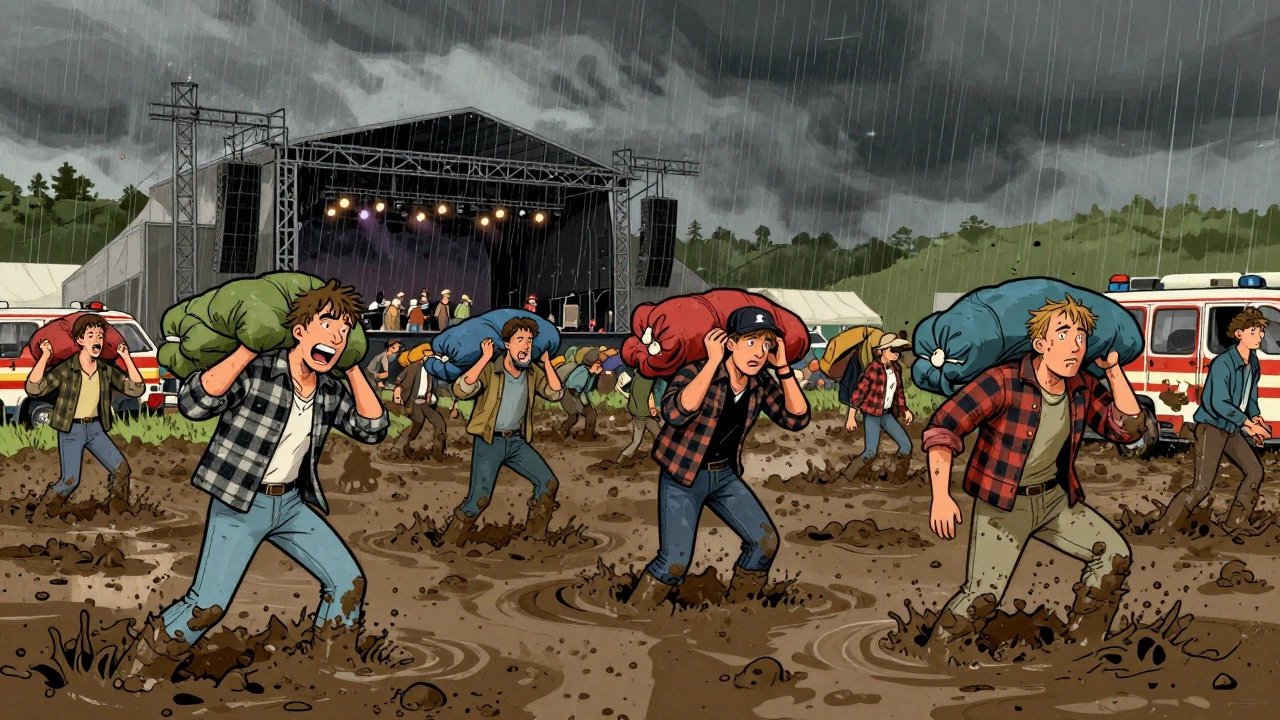
In the UK and Northern Europe, rain wasn’t just a possibility; it was a guarantee. Glastonbury Festival is a large annual music and performing arts festival held near Pilton, Somerset, England. By the mid-1990s, Glastonbury had grown from a small hippie gathering into a behemoth attracting over 100,000 attendees. But the site, Worthy Farm, was essentially clay soil. When it rained, it turned into a swamp.
The years 1997 and 1998 are legendary, not for their lineups alone, but for the sheer volume of water that fell on them. In June 1997, intense rainfall turned the fields into a sea of sludge. Tents flooded, access roads vanished, and emergency vehicles struggled to navigate the terrain. This wasn’t just uncomfortable; it was a logistical nightmare. The drainage systems designed for typical English summers were overwhelmed by sustained precipitation. Attendees waded through knee-deep mud to reach stages, and sleeping bags were soaked through within hours.
This chaos forced organizer Michael Eavis and his team to rethink everything. They couldn’t control the weather, so they had to control the ground. Post-1997, Glastonbury invested heavily in site engineering. They dug deeper drainage ditches, laid down gravel reinforcement, and introduced metal trackway panels. These heavy-duty plastic or steel grids allowed trucks and ambulances to move even when the surrounding earth was saturated. It was a costly lesson, but it transformed the festival from a risky gamble into a reliable operation.
| Festival / Event | Primary Weather Risk | Infrastructure Weakness | Key Outcome / Lesson |
|---|---|---|---|
| Glastonbury (1997) | Heavy Rain & Flooding | Poor Soil Drainage | Investment in trackways and deep drains |
| Woodstock ’94 | Prolonged Rain | Grass Pasture Degradation | Mud management became standard practice |
| Woodstock ’99 | Extreme Heatwave | Hard Surfaces, No Shade | Crisis in sanitation and hydration |
| Burning Man (Late 90s) | Dust Storms & Heat | Lack of Commercial Services | Self-reliance and radial city grid design |
Heat and Asphalt: The Woodstock ’99 Disaster
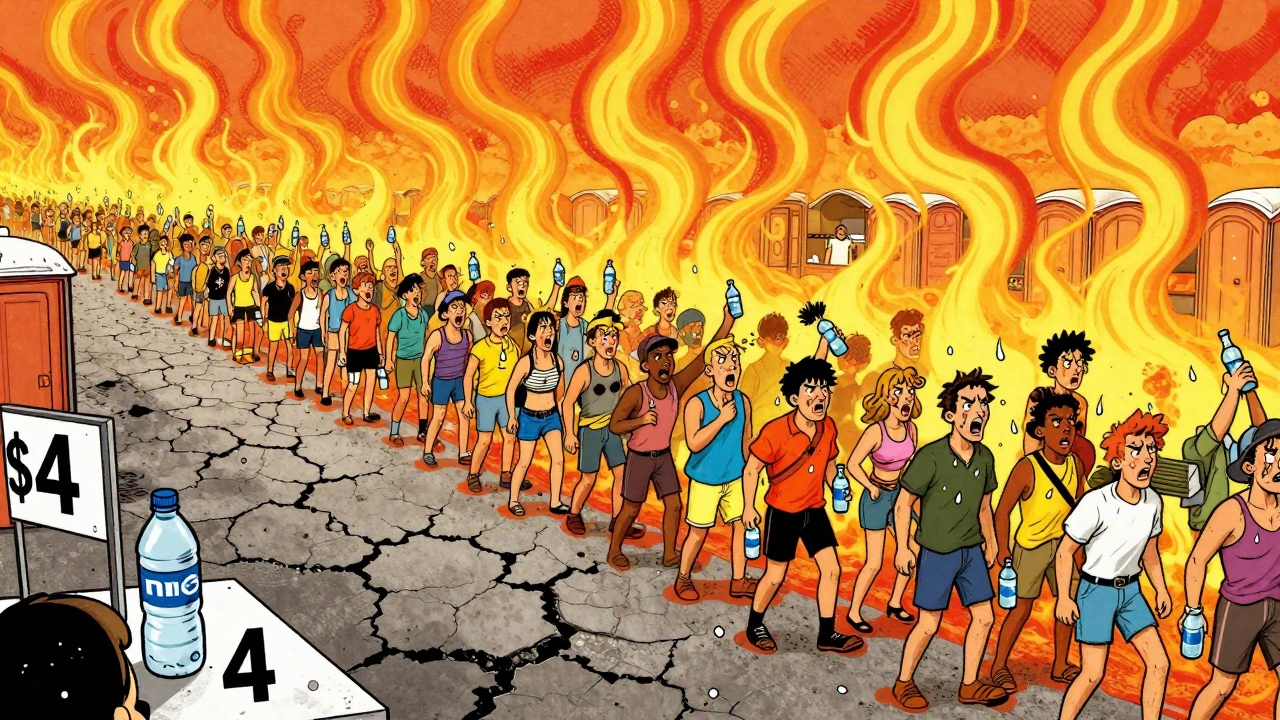
If Glastonbury taught organizers about water, Woodstock ’99 is a rock music festival held at Griffiss Air Force Base in Rome, New York, from July 22-25, 1999 taught them about fire and heat. Promoters Michael Lang, John Scher, and the estate of John Roberts chose a decommissioned air base for its vast space and existing runways. On paper, it looked perfect for managing crowds. In reality, it was a death trap under a July heatwave.
The site was covered in concrete and asphalt. Unlike grass, which retains some moisture and cools slightly, hard surfaces absorb solar radiation and radiate it back up. Temperatures soared above 32 °C (90 °F), with heat indices climbing past 40 °C (104 °F). There was almost no natural shade. The infrastructure failed spectacularly because it was designed for a cooler climate and a different type of terrain.
Water became the most critical issue. Bottled water sold for around US$4 per bottle-a steep price in 1999. Free water taps existed, but lines stretched for hours, and many ran dry. Portable toilets, already insufficient in number, became unusable as servicing trucks couldn’t access muddy or congested areas. Showers cost money and were often broken. The combination of extreme heat, dehydration, and poor sanitation created a pressure cooker environment. By the final night, the breakdown of basic services contributed to riots, arson, and assaults. It remains one of the darkest chapters in festival history, highlighting how ignoring environmental factors can lead to systemic collapse.
The Touring Model: Lollapalooza’s Resilience
Not all 1990s festivals suffered from catastrophic failures. Lollapalooza is a touring music festival founded by Perry Farrell in 1991, featuring alternative rock and electronic music took a different approach. Instead of building a temporary city from scratch every year, Lollapalooza toured existing amphitheaters and fairgrounds across North America.
This model offered built-in resilience. Venues like Shoreline Amphitheatre in California or Tinley Park in Illinois had permanent structures, fixed restrooms, and established drainage systems. While thunderstorms still caused delays-shows would pause if lightning struck within 8-16 km-the underlying infrastructure held up. The crowd size was smaller, typically 20,000 to 40,000 per day, and attendees didn’t camp overnight. This reduced the strain on sanitation and water supplies. Lollapalooza proved that leveraging existing venue infrastructure could mitigate many weather-related risks, provided organizers had clear protocols for lightning and high winds.
Desert Survival: Burning Man’s Radical Self-Reliance
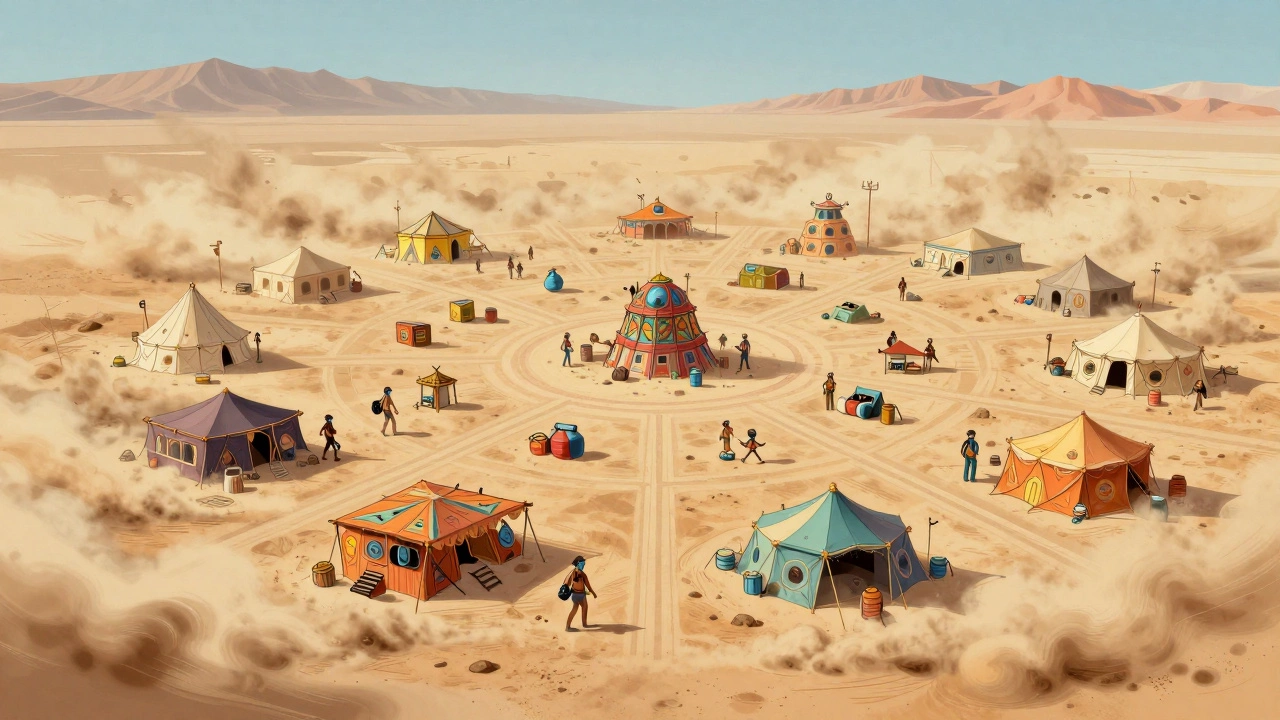
On the other end of the spectrum was Burning Man is an annual temporary community held in the Black Rock Desert of Nevada, focused on art, self-expression, and radical self-reliance. Moving to the desert in 1990, Burning Man embraced a harsh environment where daytime highs exceeded 35 °C (95 °F) and humidity dropped to single digits. Dust storms, known as “whiteouts,” could reduce visibility to zero within minutes.
There were no vendors selling water or food. Participants had to bring everything they needed for a week. This required a completely different mindset and infrastructure strategy. The event evolved into a temporary city called Black Rock City, laid out in a radial grid pattern to facilitate navigation during low-visibility conditions. Tents had to be staked deeply with rebar and guy-lined in multiple directions to withstand gusts over 50 km/h. Generators and sound equipment were housed in dust-resistant enclosures.
Burning Man’s success lay in its cultural expectation of self-reliance. Attendees planned for 4-5 liters of water per person per day. Medical teams were on-site, but the primary responsibility for survival rested with the participant. This model minimized commercial infrastructure costs but maximized individual preparedness. It showed that in extreme environments, education and community guidelines could be more effective than traditional service provision.
Building the Stage: Technical Standards of the Era
Behind the scenes, the physical construction of these festivals relied on modular steel truss systems and diesel generator farms. Stages were engineered to withstand wind speeds of up to 25 m/s (90 km/h), beyond which shows had to stop. Power distribution was complex, requiring megawatts of electricity for lighting and sound rigs that weighed tons. Water was trucked in via bladder tanks holding up to 50,000 liters, feeding standpipes across the site.
Sanitation was perhaps the weakest link. The UK’s “Event Safety Guide” (the Purple Guide) began setting standards in the mid-1990s, recommending one toilet per 75 women and one per 100 men for eight-hour events. Camping festivals required higher ratios. However, implementation varied wildly. At many US festivals, toilets were placed too far from stages, and servicing intervals were too long. When mud blocked access roads, cleaning trucks couldn’t get in, leading to overflowing units and hygiene crises. These failures drove the adoption of stricter licensing conditions and better pre-planning in subsequent years.
Lessons Learned: Shaping Modern Festivals
The 1990s were a brutal learning curve for the live music industry. Each disaster-whether mud, heat, or dust-forced changes in engineering, regulation, and culture. Glastonbury’s drainage upgrades became the gold standard for European festivals. Woodstock ’99 led to greater scrutiny of water pricing and shade provisions in hot climates. Burning Man’s grid layout influenced urban planning for temporary cities. Today’s festivals benefit from decades of trial and error, with sophisticated weather monitoring, redundant power systems, and strict safety protocols. But looking back, those sweaty, muddy, dusty weekends remind us that great music doesn’t always mean comfortable conditions. Sometimes, the struggle against the elements is part of the memory.
Why was Woodstock ’99 so dangerous compared to previous festivals?
Woodstock ’99 was held on a former air base with extensive concrete and asphalt surfaces. During a severe heatwave, these surfaces absorbed and radiated heat, creating dangerously high temperatures. Combined with inadequate shade, expensive bottled water, and insufficient free water stations, attendees faced extreme dehydration. Sanitation infrastructure also failed due to poor placement and servicing, leading to a chaotic and unsafe environment.
How did Glastonbury solve its mud problems in the late 1990s?
After the severe flooding in 1997, Glastonbury organizers invested in major site improvements. They installed deeper drainage ditches, reinforced paths with gravel, and laid down durable trackway panels. These measures ensured that emergency vehicles and supply trucks could maintain access even during heavy rain, preventing the kind of isolation seen in earlier years.
What made Burning Man’s infrastructure unique?
Burning Man operated on a principle of radical self-reliance. There were no commercial vendors for food or water. Instead, the event was structured as a temporary city with a radial street grid to aid navigation during dust storms. Participants were required to bring all their own supplies, including significant amounts of water. Structures had to be dust-proof and wind-resistant, shifting the burden of infrastructure to the attendee.
Did Lollapalooza face similar infrastructure issues?
Lollapalooza generally avoided major infrastructure failures because it toured existing amphitheaters and fairgrounds. These venues had permanent restrooms, drainage, and seating. While weather like thunderstorms could cause delays, the underlying facilities remained functional. The smaller, non-camping crowd size also reduced strain on resources compared to mega-festivals like Woodstock.
How have 1990s festival failures changed modern event planning?
The disasters of the 1990s led to stricter safety regulations and better engineering standards. Modern festivals now use advanced weather monitoring, install robust drainage and trackway systems, ensure adequate free water and shade, and place sanitation facilities strategically. Licensing authorities require detailed contingency plans for extreme weather, reducing the risk of systemic failure.


