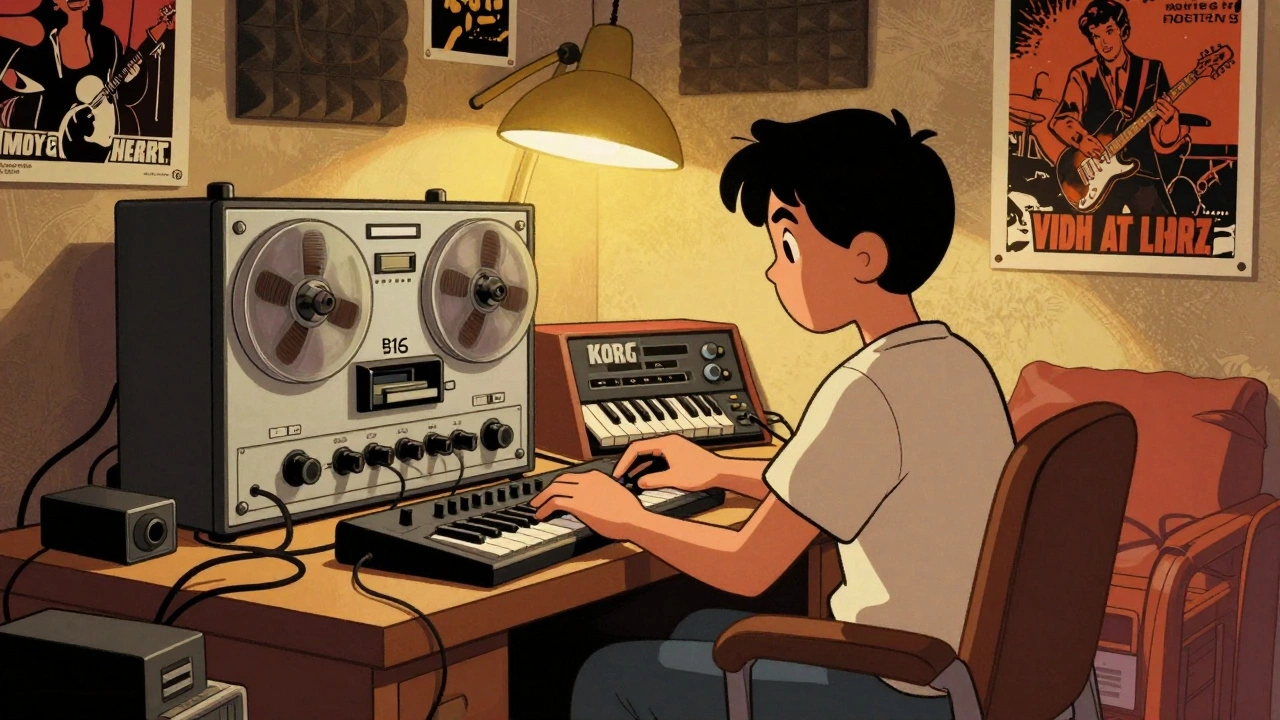

Imagine trying to record a full album in your bedroom. Now imagine doing it without an internet connection, without cloud storage, and with equipment that weighs more than a small car. This was the reality for musicians in the late 1980s. Before this era, high-quality recording was locked behind the heavy doors of expensive commercial studios. Only major labels or wealthy artists could afford the hourly rates. Then, something shifted. Technology caught up with creativity, and suddenly, you didn't need a label's blessing to make professional-sounding music. You just needed a few thousand pounds, a bit of patience, and a room you could treat acoustically.
This period, roughly between 1984 and 1989, marked a pivotal transformation in music production the process of creating recorded music using various technologies and techniques. It wasn't just about cheaper gear; it was about a fundamental change in who got to tell their story through sound. The barriers that once kept underground artists, marginalized subcultures, and bedroom producers out of the industry began to crumble. Let's look at exactly how this happened, what gear made it possible, and why those dusty tape machines still matter today.
The Hardware That Made It Possible
To understand the revolution, you have to look at the centerpiece of any serious late-80s home studio: the multi-track recorder. For many, the holy grail was the Fostex B16 a 16-track half-inch tape recorder released in 1984. Launched in 1984, this machine was a marvel of compact engineering. It offered 16 tracks of recording on half-inch tape, complete with Dolby C noise reduction. At the time, retailing for approximately £3,000 (plus another £300 for the remote control unit), it was a massive investment. But compared to the cost of renting a professional studio, it was a steal.
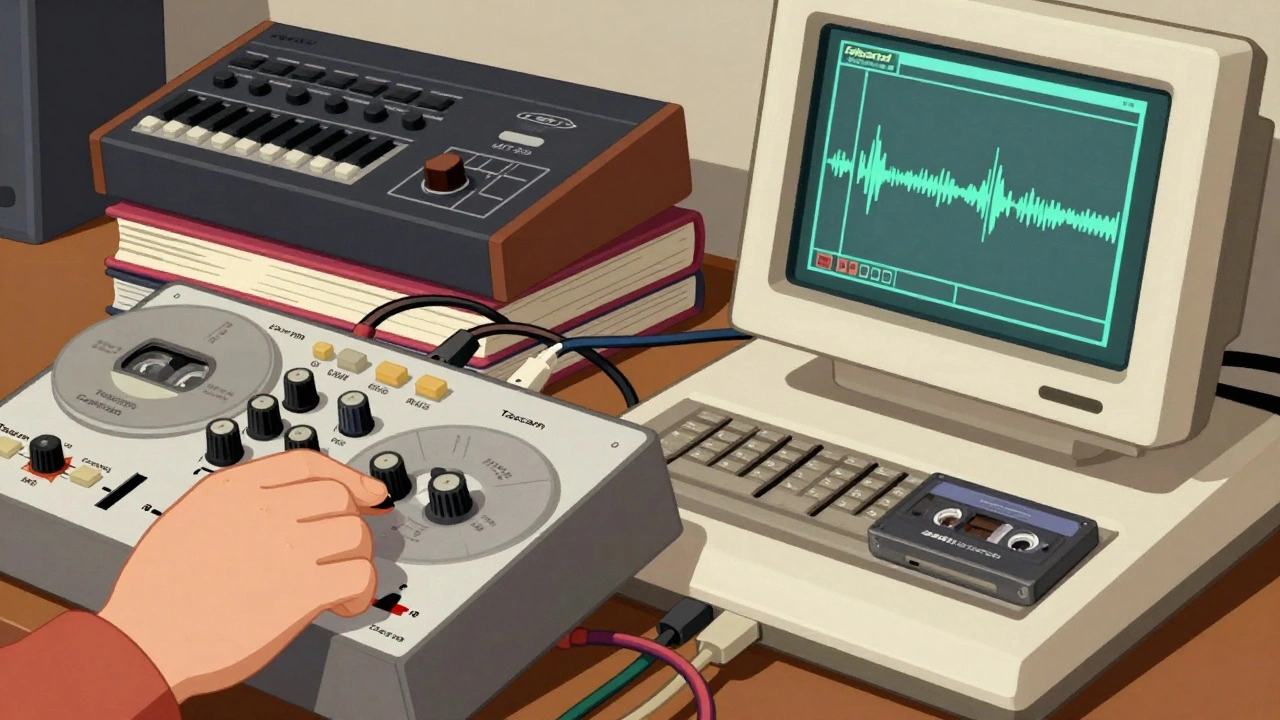
Not everyone could drop three grand on a tape deck right away. That’s where entry-level options like the Tascam Ministudio Porta One a portable four-track cassette-based recording device. came in. This four-track cassette recorder served as the gateway drug for aspiring producers. It was affordable, portable, and surprisingly capable. Many famous albums were demoed on similar four-tracks before being mixed down to stereo. If you had limited funds, this was your starting point. You’d record drums on track one, bass on two, guitar on three, and vocals on four. Once those were full, you bounced them together to free up space for more layers. It required planning, but it worked.
Sound generation also underwent a radical shift. You no longer needed a band of session players to fill out your arrangements. Affordable multitimbral synthesizers entered the market. Devices like the Yamaha TX81Z a FM synthesis module based on the DX7 architecture., the Roland MT-32, and later the Roland U-110 provided extensive sound design capabilities. These weren't just keyboards; they were entire orchestras in a box. The Korg M1, which appeared in many community-documented setups, became a staple for its piano sounds and workstations capabilities. With these tools, a single person could create complex textures that previously required dozens of musicians.
The Glue: MIDI and Computer Integration
Having great sounds and a way to record them is only half the battle. The real magic happened when all these disparate devices started talking to each other. Enter MIDI Musical Instrument Digital Interface, a technical standard for digital communication between musical instruments. (Musical Instrument Digital Interface). Before MIDI, syncing a drum machine to a sequencer or a synth to a tape deck was a nightmare of manual alignment and guesswork. MIDI standardized this communication. It allowed hardware synthesizers, drum machines, and computer-based sequencers to synchronize perfectly.
This protocol turned a collection of isolated gadgets into an integrated production system. You could program a complex drum pattern on a sequencer, trigger different synth patches from a single keyboard, and have everything hit on the exact same beat. This precision enabled the intricate compositions that defined the era's electronic genres. Without MIDI, the tight, polished sound of late-80s pop and dance music simply wouldn't have been achievable in a home environment.
Computers also began to play a role, though their part was smaller than we might expect today. Machines like the Commodore 64 an 8-bit personal home computer introduced in 1982. and Apple II were making their way into music workflows. They lacked the processing power for real-time audio editing by modern standards, but they were excellent for sequencing. Software packages began offering virtual synthesizers and drum machines within a single application. While early adoption was slow due to cost and complexity, the trajectory was clear: the computer would eventually become the central hub of the home studio.
The Real Cost of Creativity
Let’s talk money, because this is often misunderstood. When people hear "£3,000" for a tape machine, they think, "That’s cheap!" But context matters. According to comprehensive cost analyses, establishing a fully functional home studio in the late 1980s-with capabilities comparable to professional installations-cost approximately £10,893. This figure included the recorder, synthesizers, sequencers, monitoring equipment, and necessary cables.
To put that in perspective, if you were to buy that exact same setup today, adjusted for inflation, it would cost around £33,580. For an amateur or semi-professional musician in the late 80s, this was a life-altering financial commitment. It wasn't pocket change. It represented months, if not years, of savings. However, it was dramatically less than the cost of building a commercial studio or paying hourly rates for professional time. This middle ground-the "prosumer" tier-was new. It allowed serious hobbyists and independent artists to invest in their craft without needing institutional backing.
| Component | Late 1980s Cost (GBP) | Modern Equivalent Cost (GBP, 2020 values) |
|---|---|---|
| Core Recording System | ~£3,300 (Fostex B16 + Remote) | ~£1,500 (Computer + Audio Interface + DAW) |
| Synthesizers/Sound Modules | ~£4,000 - £6,000 | ~£0 - £500 (Software Plugins) |
| Sequencing/Control | ~£1,500 | ~£0 (Included in DAW) |
| Total Estimated Setup | ~£10,893 | ~£1,530 |
As the table shows, the cost disparity is staggering. A modern setup achieving equivalent or superior results can be assembled for roughly £1,530. This includes a capable computer (like a refurbished iMac or an Intel i5 laptop for under £500), an audio interface, microphones, monitors, and software. The remaining ~£1,030 covers the physical peripherals. Beyond cost, modern systems offer greater flexibility, take up far less physical space, consume less electricity, and require minimal maintenance. There are no heads to clean, no belts to replace, and no bias adjustments to worry about.
Cultural Impact: The DIY Ethos
The technological shift triggered a cultural earthquake. Before the late 80s, creating music at a professional level required access to resources most people didn't have. The democratization of production broke down these gatekeepers. Musicians no longer needed classical training or connections to get started. All they needed was passion, drive, and a computer or tape machine.
This led to a strong sense of community among like-minded individuals. The DIY ethos became a hallmark of the era. Artists from underground scenes, punk, post-punk, and emerging electronic subcultures found a voice. They could experiment freely, uninhibited by the commercial pressures of major labels. This freedom fostered innovation. Genres like synthpop, new wave, and early techno thrived because producers could iterate quickly in their own spaces. They could try weird sounds, fail, and try again without burning cash on studio time.
Consider Depeche Mode's breakthrough album *Violator* (released in 1990 but conceived during this tech boom). The album exemplified the transformative impact of home computers and synthesizers. The production was sleek, precise, and deeply personal-qualities that stem directly from the ability to refine every detail in a controlled, private environment. This influence continues to reverberate through contemporary music. Hip-hop producers sampling breaks, electronic artists layering synths, and indie bands self-recording demos all stand on the shoulders of the late-80s home studio pioneers.

Practical Setups of the Era
What did a typical home studio actually look like? It varied wildly based on budget and ambition. Community forums and historical documentation reveal common configurations. A modest but functional setup might include:
- A Korg M1 synthesizer/workstation for keys and sounds.
- A Tascam Ministudio Porta One for four-track recording.
- An Alesis MMT-8 sequencer to coordinate timing.
This combination was described by users as "totally 80's." It was functional, allowing for serious composition and recording, albeit with limitations. Bouncing tracks meant committing to decisions early; you couldn't easily go back and change the snare drum after mixing it onto track one with the bass. Mistakes were costly in terms of tape and time. Yet, this constraint bred creativity. Producers learned to arrange efficiently and make decisive choices.
For those with deeper pockets, the Fostex B16 allowed for 16 discrete tracks. This meant you could record live instruments separately, overdub vocals cleanly, and leave headroom for effects. The workflow was slower-you had to physically align tape blocks, mark leader tape, and manage reel changes-but the fidelity was unmatched. The warmth of analog tape, combined with the precision of MIDI-controlled synths, created a unique sonic signature that many producers still chase today.
Why It Matters Today
We live in an age where anyone with a laptop can produce radio-ready tracks. It’s easy to take this for granted. But the late 1980s home studio movement was the critical juncture where this future became possible. It proved that technology could serve individual creativity rather than just institutional efficiency. It established the principles of self-production, self-mixing, and self-mastering.
The legacy isn't just in the gear; it's in the mindset. The idea that you don't need permission to make art is rooted in this era. The electronic genres, production techniques, and artist communities that emerged then continue to shape music now. Whether you're using a $50 plugin or a vintage tape machine, you're participating in a lineage that started when musicians decided to bring the studio home.
Was it expensive to set up a home studio in the late 1980s?
Yes, it was a significant financial investment. A fully equipped home studio with professional-equivalent capabilities cost approximately £10,893 in the late 1980s. Adjusted for inflation, this would be over £33,000 today. However, entry-level setups using four-track cassette recorders and basic synthesizers were much cheaper, making them accessible to dedicated amateurs.
What was the most popular recorder for home studios in the 1980s?
The Fostex B16 was considered the gold standard for serious home studios, offering 16 tracks on half-inch tape. For budget-conscious musicians, the Tascam Porta One series (four-track cassette recorders) was extremely popular and served as the entry point for many producers.
How did MIDI change music production?
MIDI (Musical Instrument Digital Interface) allowed different hardware devices-synthesizers, drum machines, and sequencers-to communicate and synchronize. This eliminated the need for manual alignment and enabled complex, multi-layered compositions to be created and edited precisely, turning isolated gadgets into a cohesive production system.
Did computers play a big role in 1980s home studios?
Computers played a growing but limited role compared to today. Machines like the Commodore 64 and Apple II were used primarily for sequencing and simple sound editing. They lacked the power for real-time audio processing, so hardware synthesizers and tape recorders remained the core of the workflow.
How does the cost of an 80s home studio compare to today?
Modern home studios are drastically cheaper. A setup capable of matching or exceeding late-80s performance costs around £1,530 today. This includes a computer, audio interface, software, and monitoring equipment. The late-80s equivalent setup cost nearly £11,000, making modern production roughly one-tenth the price in real terms.