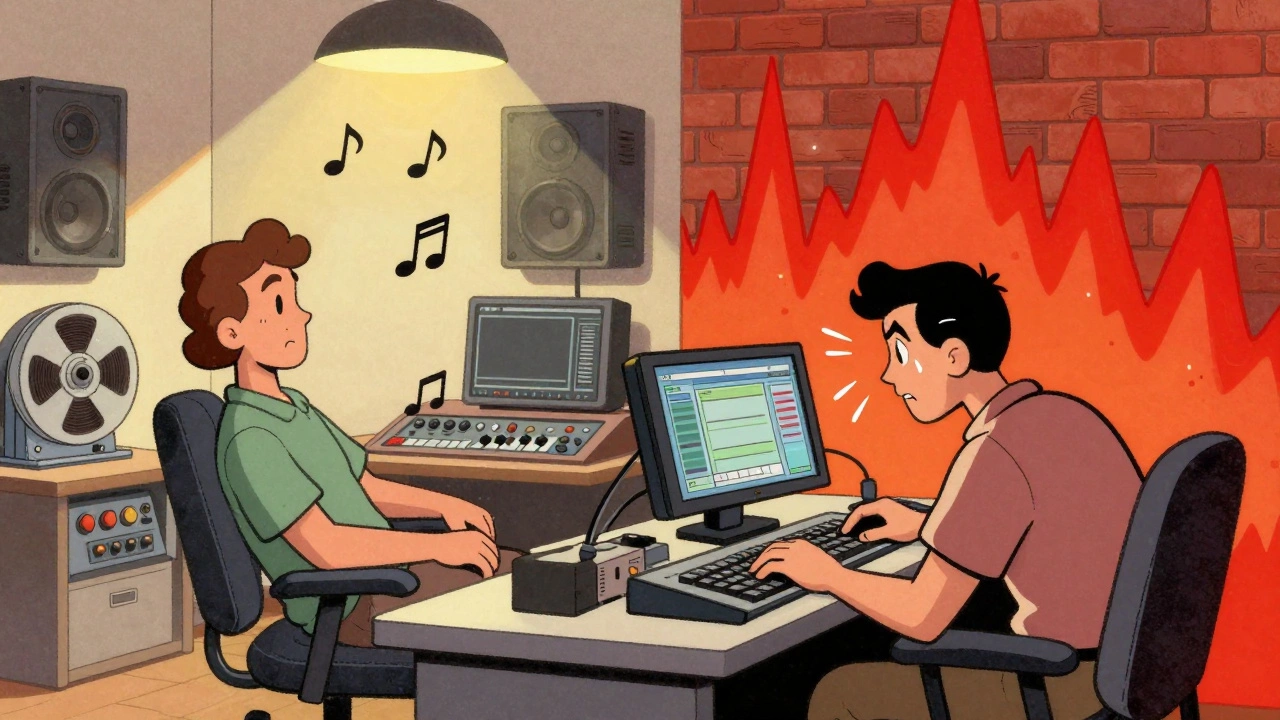

Pop on a CD from 1985 and then one from 1999. You’ll hear the difference immediately. The earlier record breathes; drums hit with punch, vocals sit naturally in the mix, and quiet moments feel intimate. The later record hits you like a brick wall. It’s louder, yes, but it also feels flat, congested, and exhausting after just a few minutes. This isn’t a coincidence or a change in musical taste. It is the result of an industry-wide phenomenon known as the loudness war, which fundamentally rewired how we master music.
The loudness war wasn't a battle fought with armies, but with compressors and limiters. It was a competitive race among record labels, producers, and mastering engineers to make their releases sound louder than everyone else's. The logic was simple: if your song sounded louder on the radio or in a car stereo, people would pay more attention to it. Over the course of the 1990s, this pursuit of volume stripped away the natural dynamics of recordings, creating a new aesthetic that prioritized constant intensity over emotional contrast.
What exactly was the loudness war?
The loudness war refers to the trend in commercial music production, particularly from the late 1980s through the 2000s, where mastering engineers used heavy dynamic range compression and limiting to increase the average loudness of tracks. The goal was to make songs stand out against competitors on radio and physical media, often at the expense of audio quality and dynamic range.
Why did the loudness war start in the 1990s?
The rise of the compact disc (CD) format played a huge role. Unlike vinyl records, which have physical limitations that prevent them from being too loud without distorting, CDs could handle much higher peak levels. Engineers realized they could use digital limiters to crush transients and raise the average volume without hitting the hard ceiling of digital clipping, leading to a rapid escalation in loudness standards.
How does dynamic range affect how music sounds?
Dynamic range is the difference between the quietest and loudest parts of a recording. High dynamic range allows for emotional expression through contrast-soft verses building into powerful choruses. When dynamic range is compressed, as in the loudness war, the music stays at a consistently high volume, which can cause listener fatigue and reduce the perceived impact of climactic moments.
Is the loudness war over today?
In many ways, yes. The introduction of loudness normalization by streaming platforms like Spotify and Apple Music has reduced the incentive to make tracks excessively loud. These services turn down overly loud masters to match a standard level, meaning hyper-compressed tracks no longer gain a competitive advantage and often sound worse due to added distortion. However, some genres still favor higher loudness for specific contexts like festivals.
What are LUFS and why do they matter?
LUFS stands for Loudness Units relative to Full Scale. It is a standardized measurement of perceived loudness that accounts for human hearing sensitivity. Before LUFS, engineers relied on RMS or peak levels, which didn't accurately reflect how loud a track sounded to listeners. LUFS allowed for consistent loudness targets across different platforms and helped end the subjective guessing game of the loudness war.


