

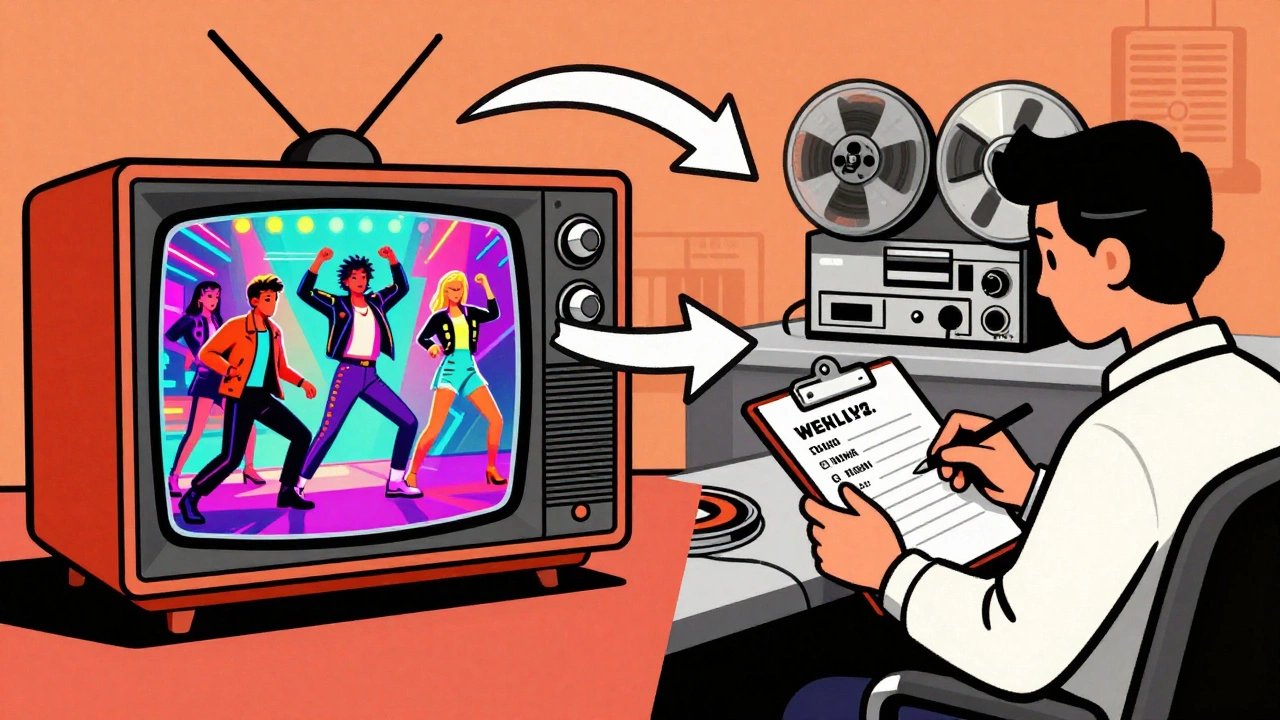
Before streaming numbers flashed in real-time on your phone, hitting number one meant something entirely different. It meant a song had survived a grueling, manual gauntlet of fax machines, phone calls, and handwritten reports from hundreds of radio stations and record stores. If you look back at 1980s chart performance metrics, which defined how commercial success was measured in the music industry before digital tracking, you’ll find a system that was less about precise data and more about influence, visibility, and sheer momentum.
The landscape changed drastically during this decade. We went from an era where vinyl sales dominated to one where compact discs began to rise, and crucially, where television-specifically MTV, the cable channel launched in 1981 that revolutionized music video promotion-became a make-or-break factor for artists. Understanding how these charts worked isn’t just nostalgia; it explains why certain songs became anthems while others, despite being great, faded into obscurity.
The Anatomy of the Billboard Hot 100
To understand the stakes, you have to look at the Billboard Hot 100, the primary weekly ranking of singles in the United States based on sales and airplay. Established in 1958, it was the undisputed king of music metrics throughout the 1980s. But unlike today’s algorithm-driven rankings, the Hot 100 was a hybrid beast. It didn’t just count what people bought; it counted what they heard.
The formula was roughly split into three buckets:
- Radio Airplay (approx. 50%): This was the heavy lifter. Billboard tracked reports from about 200 to 300 radio stations across the country. Program directors or their assistants would manually log which songs were played most frequently. If a station played "Billie Jean" ten times in a week, that contributed significantly to its score.
- Retail Sales (approx. 40%): This relied on physical units sold. Stores like Tower Records or local mom-and-pop shops would report their inventory movements. However, this wasn’t comprehensive. Industry estimates suggest only 50-60% of actual retail volume was reported, meaning the chart was often a snapshot of major chains rather than the entire market.
- Jukebox Plays & Other Factors (approx. 10%): Believe it or not, jukeboxes still mattered in the early 80s. Later in the decade, as technology evolved, other minor factors began to creep in, though they weren't formally integrated until later.
- Heavy Rotation: Videos playing 12-15 times per day. This was the gold standard, ensuring constant visibility.
- Medium Rotation: 6-12 plays daily. Enough to keep a song relevant without dominating the screen.
- Light Rotation: 4-6 plays daily. Often reserved for new releases testing the waters.
This weighting meant that a song could be a massive radio hit even if sales were modest, provided it had enough "legs" on the airwaves. Conversely, a song with huge initial sales but poor radio support might peak high and then drop off quickly, lacking the sustained exposure needed to climb higher.
The MTV Effect: A New Variable
If there was one thing that shook up the 1980s measurement model, it was the launch of MTV on August 1, 1981. Before MTV, visual appeal wasn't part of the equation. Afterward, it became arguably the most important unofficial metric in the game.
For the first few years, MTV airplay wasn't directly factored into the Billboard Hot 100 calculations. Billboard didn't officially incorporate video play data into the main chart until 1988. Yet, the correlation was undeniable. Artists like Michael Jackson and Madonna leveraged the channel to create cultural moments that drove both radio requests and store traffic.
MTV used internal rotation categories that acted as a proxy for success:
A song receiving heavy rotation would see a disproportionate spike in its chart position. It created a feedback loop: viewers saw the video, requested the song on radio, and then bought the single. This made "chart success" less about pure audio popularity and more about multimedia dominance.
Album Dominance: The Billboard 200
While singles got the glory, albums were the money makers. The Billboard 200, the album chart that ranked the top 200 albums in the US based on sales and airplay operated on similar principles but placed heavier emphasis on retail sales because album purchases were less dependent on radio play than singles were.
The key metric here was longevity. Peak position mattered, but weeks at number one told the real story of commercial viability. Take Prince's Purple Rain, which spent 24 consecutive weeks at number one between 1984 and 1985. That kind of run indicated sustained consumer interest, not just a one-week burst driven by a single hit track.
Then there was Michael Jackson's Thriller. It achieved number one on the Billboard 200 for 37 non-consecutive weeks between 1982 and 1984. This album redefined what chart success looked like, proving that an album could remain culturally dominant for over two years through strategic single releases and relentless media presence.
| Metric | 1980s Methodology | Modern Equivalent |
|---|---|---|
| Data Collection | Manual reports via phone/fax from sample retailers and stations | Real-time electronic tracking (SoundScan/Nielsen) |
| Sales Tracking | Estimated ~50-60% of total retail volume | Near 100% capture including digital downloads and streams |
| Airplay Weight | ~50% of Hot 100 calculation | Integrated with streaming counts (often weighted differently) |
| Visual Impact | Unofficial driver (MTV rotation) until 1988 | Officially integrated (YouTube views, TikTok usage) |
| Update Frequency | Weekly, with 5-7 day lag | Daily updates available for many platforms |
The Blind Spots: What Wasn't Counted
The 1980s system had significant blind spots. Because it relied on major retailers and mainstream radio stations, independent music and alternative scenes were largely invisible. If a punk band sold out shows and moved tapes through grassroots networks, none of that showed up on the Billboard charts. The metrics favored major label artists who had the marketing budgets to push records into large chain stores and secure prime radio slots.
Additionally, the transition from vinyl to compact discs created confusion. By 1980, vinyl accounted for roughly 90% of sales. By 1990, CDs had risen to about 50%. Retailers often reported these formats together, making it hard to gauge exactly which format was driving the surge. This lack of granularity meant that shifts in consumer behavior were smoothed over by the aggregated data.

Year-End Charts: The Ultimate Scorecard
At the end of every year, Billboard released its year-end Hot 100 chart. This wasn't just a list of the biggest hits; it was a cumulative calculation of points earned over 52 weeks. A song that peaked at number one for one week but dropped off quickly might rank lower than a song that peaked at number five but stayed in the top 40 for six months.
This metric rewarded consistency. Michael Jackson dominated the year-end charts in 1983 and 1984, reflecting his unprecedented ability to maintain multiple hits simultaneously. For artists, landing in the year-end top 10 was a career-defining achievement, signaling broad, sustained appeal rather than fleeting viral fame.
Why It Matters Today
Understanding these old metrics helps us appreciate the shift in power dynamics within the music industry. In the 1980s, gatekeepers-radio programmers and store owners-had immense control over what succeeded. Today, algorithms and social media share that power with listeners. The manual, imperfect nature of 1980s charting meant that success was often a mix of genuine popularity and aggressive industry push. Recognizing this distinction allows us to view historical data with a critical eye, understanding that a number one spot then required a different set of strategies than it does now.
Did MTV affect Billboard charts in the 1980s?
Yes, significantly. Although MTV airplay was not officially included in the Billboard Hot 100 calculation until 1988, heavy rotation on the channel drove radio requests and record sales. Artists like Madonna and Michael Jackson used MTV to amplify their reach, creating a strong correlation between video popularity and chart success long before it was formally measured.
How accurate were 1980s sales figures?
They were estimates, not exact counts. Billboard relied on manual reports from a sample of retailers, covering approximately 50-60% of total retail volume. This meant independent stores and smaller regional chains were often underrepresented, potentially skewing results toward major label artists distributed through large chains.
What was the formula for the Billboard Hot 100 in the 1980s?
The Hot 100 was calculated using a weighted average of approximately 50% radio airplay, 40% retail sales, and 10% jukebox plays and other factors. This balance ensured that both listener exposure and consumer purchase behavior influenced a song's ranking.
Why did some songs stay on the charts longer than others?
Longevity depended on "legs," or sustained commercial viability. Songs with strong radio support and consistent sales would climb gradually and remain on the chart for many weeks. Hits that relied solely on initial hype might debut high but fall off quickly once radio play decreased or inventory sold out.
When did electronic sales tracking replace manual reporting?
Electronic tracking via SoundScan was introduced in 1991, replacing the manual reporting systems used throughout the 1980s. This shift allowed for more accurate, comprehensive data collection, capturing nearly 100% of retail sales and eliminating the sampling errors inherent in the previous method.