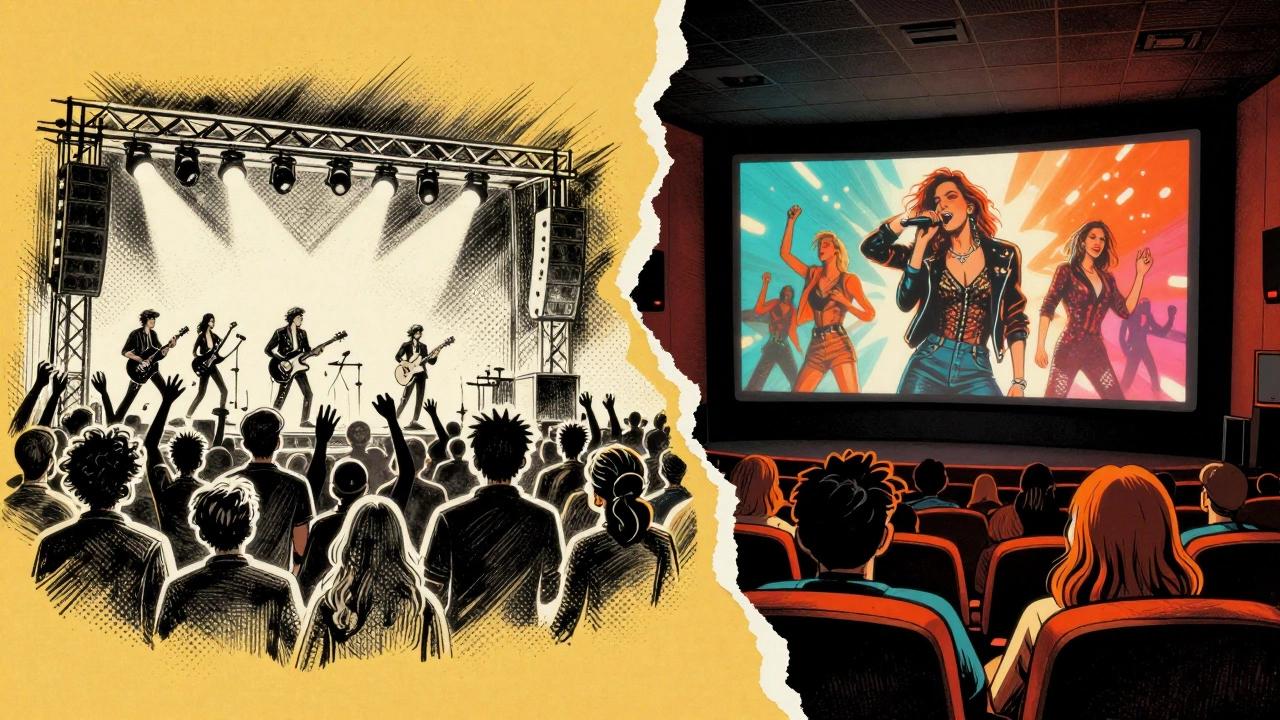

Have you ever watched a movie about a band and suddenly felt like you knew exactly what it was like to be in the front row at Wembley Stadium in 1985? You weren’t there. You might not have even been born. Yet, thanks to films like Bohemian Rhapsody, which is a 2018 biographical musical drama film about the British rock band Queen, that moment feels real. This isn't just nostalgia; it's a manufactured memory.
We are living in an era where Hollywood has turned the 1970s rock scene into its most reliable goldmine. From Elton John’s sequined suits to Jim Morrison’s leather pants, these films don't just tell stories-they shape how we remember a decade that defined modern popular culture. But here is the catch: these movies rarely give us the truth. They give us a myth. And for millions of viewers, especially those who never experienced the 1970s firsthand, that myth becomes their history.
The Myth-Making Machine of the Rock Biopic
Rock biopics are not documentaries. They are emotional engines designed to sell tickets and streaming catalogs. When studios greenlight a project about a 1970s legend, they aren't looking for historical precision. They are looking for a narrative arc that fits neatly into two hours. Scholar Belén Vidal notes that modern biopics follow a predictable four-act structure: early struggle, breakthrough and excess, crisis or collapse, and finally, partial redemption.
This formula turns complex human beings into archetypes. Take Rocketman, which is a 2019 biographical musical fantasy film about the life of singer-songwriter Elton John. Released in 2019 with a budget of around US$40 million, it grossed nearly US$195 million worldwide. The film doesn't pretend to be realistic. It uses fantastical sequences to visualize Elton’s internal state-like turning his song "Rocket Man" into an actual space journey. This approach bypasses facts to hit emotions. It tells the audience how to feel about Elton’s childhood trauma and his 1970s superstardom without getting bogged down in the messy details of his daily life.
In contrast, Bohemian Rhapsody tries harder to look like a traditional drama but still bends reality for dramatic effect. The film compresses timelines significantly. For instance, it suggests Freddie Mercury knew he had HIV before the legendary Live Aid performance in July 1985. In reality, evidence points to his diagnosis occurring later, in the late 1980s. By moving this tragedy forward, the filmmakers turn Live Aid into a heroic final stand rather than just another concert in a long career. This change creates a cleaner, more satisfying story of redemption, but it erases the complexity of Mercury’s later years.
Authorized vs. Unauthorized: Who Controls the Story?
One of the biggest factors shaping your memory of a 1970s artist is whether the band gave permission for the film. This distinction between authorized and unauthorized biopics changes everything-from the music you hear to the flaws you see.
| Feature | Authorized (e.g., Bohemian Rhapsody) | Unauthorized/Fictionalized (e.g., Velvet Goldmine) |
|---|---|---|
| Music Rights | Full access to original master recordings and hits | Must use pastiche songs or cover versions due to lack of rights |
| Narrative Control | Estates/bands approve script; controversial events often softened | Directors have creative freedom to critique or reimagine the era |
| Public Perception | Reinforces the official, polished legacy of the artist | Often presents a critical, darker, or more abstract view |
| Example Film | Bohemian Rhapsody (2018), Rocketman (2019) | Velvet Goldmine (1998), Stardust (2020) |
When Brian May and Roger Taylor co-produced Bohemian Rhapsody, they ensured the film highlighted Queen’s musical genius and camaraderie. However, critics argued this resulted in a sanitized version of Freddie Mercury’s life, downplaying his queer relationships and the band’s internal tensions. The goal was to celebrate the brand, not dissect the man.
On the other hand, Velvet Goldmine, which is a 1998 fictionalized glam-rock drama inspired by David Bowie and Iggy Pop, couldn’t secure Bowie’s music rights. Director Todd Haynes created a fictional character, Brian Slade, and used new songs to mimic the glam-rock sound of the early 1970s. Because it wasn’t bound by the need to please an estate, the film could explore the misogyny, confusion, and fleeting nature of fame in the glam scene with a critical eye. It offers a different kind of memory-one that questions the mythology rather than worshipping it.
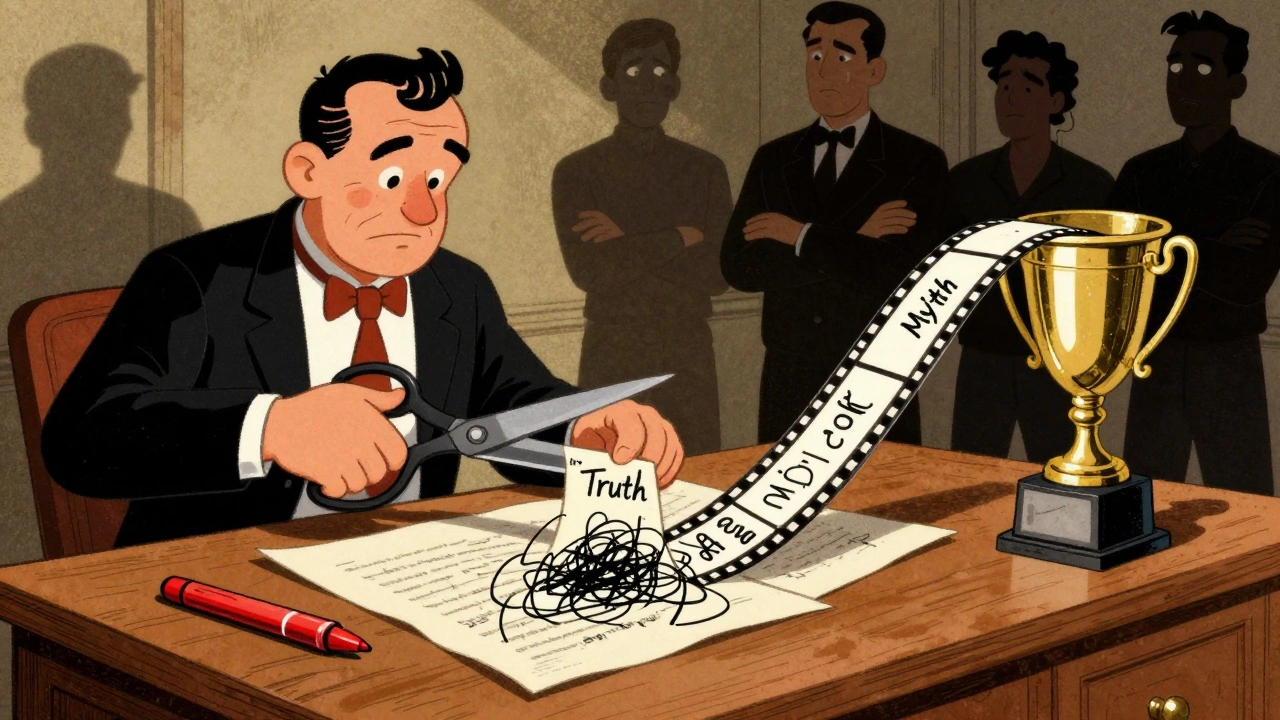
The Distortion of Reality: Case Studies in Memory
To understand how deeply these films reshape history, we need to look at specific examples where the screen diverged sharply from the record.
The Doors, which is a 1991 biographical drama film directed by Oliver Stone about the American rock band The Doors is perhaps the most controversial entry in this genre. Released in 1991, it portrays Jim Morrison as a shamanic, constantly intoxicated figure whose life spirals out of control between 1965 and 1971. Surviving band members Robby Krieger and John Densmore publicly criticized the film, arguing it exaggerated Morrison’s erratic behavior and ignored his discipline as a poet and songwriter. For many viewers, however, Val Kilmer’s performance became the definitive image of Morrison. If you ask someone today what Jim Morrison was like, they will likely describe the chaotic, leather-clad wild child from the movie, not the nuanced artist described by his peers.
Then there is The Runaways, which is a 2010 biographical film based on Cherie Currie's memoir about the all-girl rock band formed in the mid-1970s. This film shifts the focus from male genius to female exploitation. Directed by Floria Sigismondi, it highlights the predatory nature of manager Kim Fowley and the gender politics of the 1970s rock industry. While films like Bohemian Rhapsody reinforce the idea of rock stars as untouchable icons, The Runaways reminds us that many young women were used as disposable commodities in that same era. It challenges the dominant, male-centric memory of 1970s rock by centering the experiences of teenagers like Cherie Currie and Joan Jett.
Prosthetic Memory: Why We Believe What We See
Why do we accept these distortions? Cultural theorist Alison Landsberg introduced the concept of "prosthetic memory" to explain this phenomenon. She argues that mass media allows people who did not live through a historical event to acquire memories of it that feel just as real and emotionally powerful as lived experiences.
For Generation Z and younger millennials, the 1970s rock era is not something they remember; it is something they have consumed. When they watch Rocketman or Bohemian Rhapsody, they are not just watching a movie. They are inheriting a feeling. The digital cinematography, the remastered audio, and the contemporary moral frameworks applied to these stories create a bridge across time. A viewer born in 2000 can feel the sweat of a 1975 stadium concert because the film constructs that sensory experience so vividly.
This has a massive impact on music discovery. Spotify and label reports from the late 2010s showed double-digit percentage spikes in streaming for Queen and Elton John tracks following the release of their respective biopics. These films act as entry points. They introduce the music to new audiences, but they also frame how those audiences interpret the lyrics and the legacy. The song "We Are the Champions" isn't just a track on an album anymore; it is the climax of a hero’s journey.

The Economic Engine Behind the Nostalgia
Let’s talk money, because it drives every decision in Hollywood. The success of 1970s-focused rock biopics has created a feedback loop between film, memory, and finance.
- Box Office Power: Bohemian Rhapsody earned approximately US$910 million worldwide against a budget of US$50-55 million. That is an incredible return on investment.
- Catalog Revival: Music catalogs from the 1960s and 1970s are now some of the most valuable assets in the entertainment industry. Films drive renewed interest, increasing the value of publishing rights and licensing deals.
- Franchise Potential: The success of these films has led to a rush of new projects. We’ve seen biopics for Elvis Presley (Elvis, 2022), Bob Marley (Bob Marley: One Love, 2024), and Aretha Franklin (Respect, 2021). Even though not all are strictly "rock," they all tap into the same cultural memory of the 1960s-1970s peak era.
Studios know that audiences crave familiarity. The 1970s represent a "golden age" in the public imagination-a time of rebellion, artistic freedom, and iconic fashion. By packaging this era into digestible, two-hour narratives, studios can monetize nostalgia repeatedly. However, this economic pressure often leads to safe choices. Studios prefer authorized biopics because they guarantee music rights and avoid legal battles with estates. This results in a homogenized version of history where controversy is minimized and triumph is maximized.
What Comes Next for Rock History?
As we move further away from the 1970s, the gap between fact and fiction will only widen. Future generations will rely entirely on these cinematic interpretations to understand the era. The question is whether filmmakers will continue to sanitize these stories or if they will embrace more complex, critical narratives.
There is growing demand for diversity in these portrayals. Critics and fans alike are calling for stories that address the role of Black artists in shaping rock, the underrepresentation of women beyond niche cases like The Runaways, and the darker realities of substance abuse and industry exploitation. Films like Velvet Goldmine show that alternative approaches are possible, but they often struggle to find wide distribution compared to the blockbusters.
For now, the rock biopic remains the primary way we process the legacy of 1970s legends. Whether it’s the tear-jerking finale of Bohemian Rhapsody or the psychedelic chaos of The Doors, these films do more than entertain. They curate our collective memory. They decide which moments become iconic and which fade into obscurity. So, the next time you watch a rock biopic, ask yourself: Am I seeing history, or am I seeing a brand?
Are rock biopics historically accurate?
Rarely. Most rock biopics prioritize narrative flow and emotional impact over factual precision. They often compress timelines, omit controversial events, and simplify complex relationships to fit a standard dramatic structure. Films like Bohemian Rhapsody have been criticized for rearranging key dates, such as Freddie Mercury’s HIV diagnosis, to enhance the dramatic climax.
What is the difference between an authorized and unauthorized biopic?
An authorized biopic is produced with the approval of the artist’s estate or surviving band members, granting access to original music recordings and influencing the screenplay to protect the artist’s legacy. Unauthorized biopics, like Velvet Goldmine, must use pastiche music and often take a more critical or fictionalized approach to the subject’s life and era.
Why do so many rock biopics focus on the 1970s?
The 1970s are viewed as a foundational myth period for modern popular music, characterized by iconic artists, distinct fashion, and cultural rebellion. This era offers rich material for storytelling about rise, excess, and legacy. Additionally, the music catalogs from this decade are highly lucrative, and biopics drive significant streaming and sales revenue for these classic tracks.
How do rock biopics affect public memory?
Through a concept called "prosthetic memory," rock biopics allow viewers who did not live through the 1970s to form vivid, emotional impressions of the era. These films shape how future generations perceive the artists and the culture, often replacing nuanced historical facts with simplified, cinematic myths that emphasize heroism and tragedy.
Which rock biopics are considered the most successful?
Bohemian Rhapsody (2018) is the highest-grossing, earning nearly US$910 million worldwide. Rocketman (2019) also performed well, grossing around US$195 million. Both films were critically acclaimed for their performances and musical numbers, though they received mixed reviews regarding historical accuracy.


