

Think about the last time you heard a song that felt like it was everywhere. In the 1980s, if a track wasn't on your local Top 40 station, it practically didn't exist for most people. But getting there wasn't just about writing a catchy tune. It was a high-stakes game of strategy, segregation, and sheer willpower. The Billboard Hot 100 wasn't an objective scoreboard; it was a reflection of who held the keys to the airwaves.
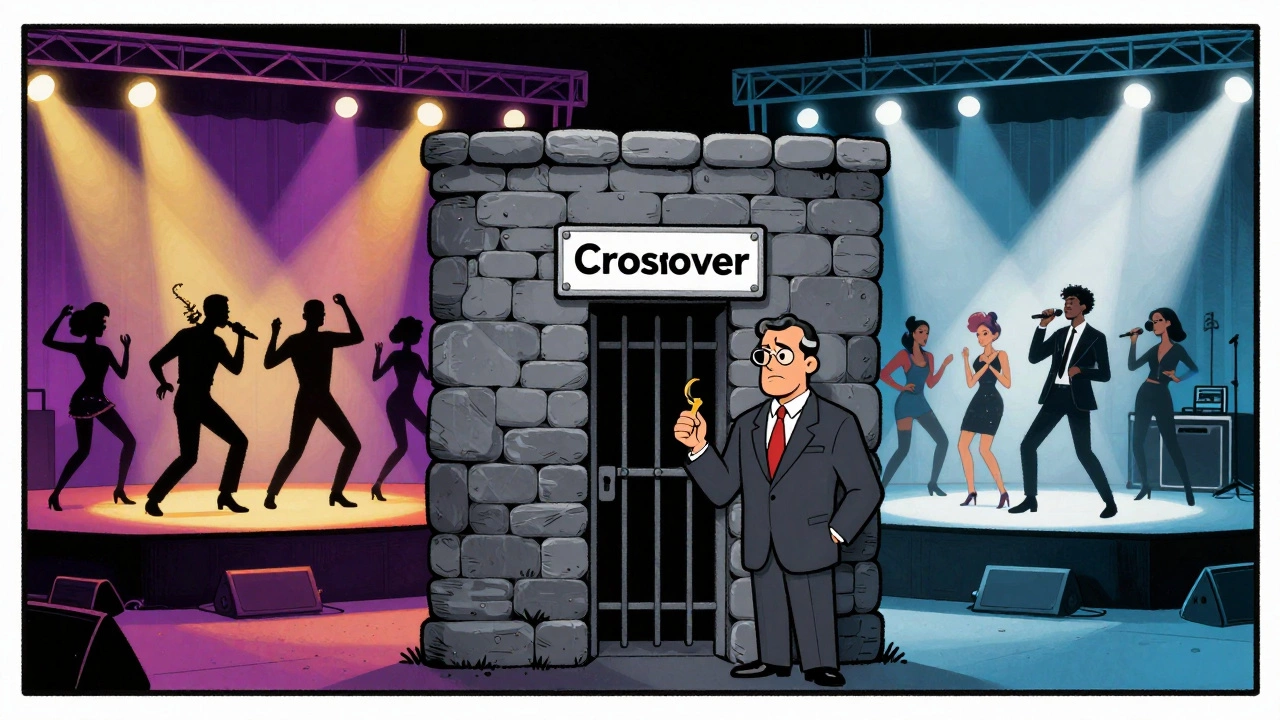
The music landscape of the 1980s was defined by rigid radio formats. Stations didn't play everything. They played specific types of music for specific demographics. This segmentation created a system where Contemporary Hit Radio (CHR), Adult Contemporary (AC), Album-Oriented Rock (AOR), and Urban Contemporary operated in silos. Crossing between these silos-known as "crossover"-was the holy grail for record labels. If a song stayed in one lane, it might hit number one on its genre chart, but it would likely stall on the national pop charts. Understanding this dynamic explains why some massive records peaked at number three while others with less radio support somehow cracked the top ten.
The Gatekeepers: CHR and AC Domination
To understand 1980s chart politics, you have to look at the two dominant formats: CHR and AC. These weren't just playlists; they were economic engines designed to capture advertising dollars from specific age groups.
Contemporary Hit Radio (CHR), often called Top 40, targeted listeners aged 12 to 34. By the early 1980s, CHR had evolved from the looser Top 40 style of the previous decades into a tightly controlled machine. Program directors relied heavily on call-out research-calling random listeners to rate song hooks-to decide what got airplay. If a song didn't test well with teenagers, it didn't get spun. This meant CHR playlists were incredibly narrow, often rotating only 30 to 40 current hits. Songs had to be punchy, immediate, and undeniably popular to survive this gauntlet.
On the other side was Adult Contemporary (AC). This format targeted adults roughly aged 25 to 54. AC stations avoided the edgy, aggressive sounds of rock or the rhythmic intensity of dance music. Instead, they focused on melodic, mid-tempo pop, soft rock, and ballads. Artists like Phil Collins, Lionel Richie, and Whitney Houston thrived here. The split between CHR and AC created a two-tier system. A power ballad might be ignored by CHR programmers looking for high-energy tracks but become a staple on AC. This separation meant that for a song to truly dominate the Billboard Hot 100, it needed to cross over. It needed spins on both CHR and AC to accumulate enough points to climb the ranks.
The Urban Divide and the Crossover Struggle
The most contentious aspect of 1980s chart politics involved race and genre segregation. Black popular music, including funk, R&B, and early hip-hop, primarily aired on Urban Contemporary stations. These stations served African American audiences in major cities like New York, Chicago, and Los Angeles. While these records could easily hit number one on the Billboard Hot Black Singles chart, breaking into the mainstream Hot 100 was a different story.
Mainstream CHR and AC stations were often hesitant to play R&B or rap records. Programmers feared alienating white advertisers or listeners who they assumed wouldn't connect with the sound. This created a structural barrier. Labels had to execute sophisticated "crossover" campaigns. They would first push a single to urban radio and dance clubs. Once the song gained traction, they would lobby CHR and AC program directors to add it to their playlists. Sometimes, this required remixing the track to make it sound more "pop-friendly."
Artists like Michael Jackson and Prince mastered this art. Their success wasn't just musical; it was political. They forced open doors that had been closed for decades. When Michael Jackson's "Thriller" singles crossed over, they didn't just sell records; they changed the demographic makeup of Top 40 radio. However, for every Michael Jackson, there were dozens of talented artists whose records remained confined to the R&B charts because they couldn't secure the necessary CHR spins. This dynamic meant that the Hot 100 often underrepresented the true popularity of black music during this era.
Rock's Retreat and the Rise of Consultants
While pop and R&B battled for crossover status, rock music was undergoing its own transformation. Album-Oriented Rock (AOR) had been the dominant force for rock fans in the 1970s, playing deep cuts and full album tracks. But by the early 1980s, AOR was losing ground. Stations began flipping to more tightly formatted "Classic Rock" or "Active Rock" outlets. Even within AOR, the playlists narrowed. Research-driven programming reduced the number of exploratory tracks, turning many AOR stations into "rock-leaning CHR" outlets.
This shift hurt progressive and hard rock bands that relied on album exposure. Without deep cuts getting airplay, their singles had a harder time climbing the Hot 100 unless they appealed to pop audiences. Bands like Journey and Bon Jovi succeeded because they wrote radio-friendly singles that could play on both AOR and CHR. Meanwhile, more experimental rock acts found themselves marginalized in the chart calculations. The influence of format consultants grew during this period. These experts advised stations on how to maximize ratings, often recommending uniform playlists across multiple markets. This led to a homogenization of sound, where regional variations in taste disappeared, and the same 40 songs played nationwide.
The Mechanics of the Hot 100
How exactly did a song get onto the chart? The Billboard Hot 100 used a hybrid methodology combining reported singles sales and radio airplay. Unlike today, where data is collected electronically via Nielsen SoundScan, the 1980s relied on human reporting. Retailers submitted sales figures, and radio stations reported their playlists. This manual process left room for manipulation and bias.
Labels knew which stations carried the most weight in Billboard's formula. They focused their promotional budgets on courting those specific program directors. If a label could get a song added to a cluster of powerful CHR stations in key markets like New York, Los Angeles, and Chicago, the song would likely rise quickly on the charts. This created a feedback loop. High chart positions encouraged other stations to add the song, which further boosted its position. Conversely, a song that struggled to get initial airplay, even if it was selling well in stores, might never break through the barrier to enter the top 40.
This system also favored major labels with large promotion teams. Independent labels often lacked the resources to navigate the complex web of relationships required to secure national airplay. As a result, the charts became increasingly dominated by a small number of corporate entities. The "politics" of the charts weren't just about payola scandals, though concerns about improper payments persisted. They were about structural advantages. Large labels could afford to buy ads, hire independent promoters, and leverage relationships with format consultants to ensure their artists got heard.

Country Music and the Niche Barrier
Country music operated in its own sphere during the 1980s. Billboard maintained separate country singles charts, and country radio was largely distinct from CHR. For a country song to impact the Hot 100, it needed crossover appeal. Nashville labels deliberately produced "crossover country" tracks aimed at pop audiences. Artists like Kenny Rogers and Dolly Parton achieved significant pop success, but for most country acts, the Hot 100 remained out of reach.
This segregation meant that hundreds of country hits each year never appeared on the national pop charts. It illustrated how format segmentation functioned as a gatekeeping mechanism. Unless a song broke through to CHR or AC, it remained invisible to the broader pop audience, regardless of its commercial success within the country genre. This dynamic would only change significantly in the 1990s when electronic monitoring revealed the true scale of country and rock consumption, forcing Billboard to adjust its methodologies.
Why It Matters Today
The 1980s model of radio formats and chart politics laid the groundwork for the modern music industry. The shift to electronic data collection in the early 1990s reduced the direct influence of programmer-reported spins, revealing how much certain genres had been underrepresented. However, the legacy of format segmentation persists. Streaming algorithms today act similarly to 1980s program directors, curating playlists based on user data and predicted appeal.
Understanding this history helps us see that charts are never purely objective. They reflect the priorities of the platforms that measure them. In the 1980s, those priorities were driven by radio formats, advertiser demands, and the strategic maneuvering of record labels. The songs we remember as "hits" from that decade were not just popular; they were winners in a highly structured political game.
| Format | Target Demographic | Key Characteristics | Chart Influence |
|---|---|---|---|
| CHR (Top 40) | 12-34 years old | Narrow playlist, high rotation, research-driven | Highest weight for Hot 100 |
| Adult Contemporary (AC) | 25-54 years old | Melodic, soft rock, ballads, polished production | Crucial for crossover success |
| Urban Contemporary | African American audiences | R&B, funk, early hip-hop, tight formatting | Limited direct Hot 100 impact without crossover |
| Album-Oriented Rock (AOR) | Young male listeners | Deep cuts, full albums, rock focus | Declining influence on Hot 100 by late 80s |
What was the main difference between CHR and AC radio in the 1980s?
CHR (Contemporary Hit Radio) targeted younger listeners (12-34) with high-energy, current pop and dance tracks, using tight playlists and heavy rotation. AC (Adult Contemporary) targeted older adults (25-54) with softer, melodic pop and ballads, avoiding edgy or aggressive sounds. This split forced artists to choose between youth appeal or adult accessibility, impacting their chart potential.
How did radio formats affect the Billboard Hot 100?
The Hot 100 combined sales and airplay data. Since airplay came from self-reported playlists of specific stations, songs that dominated high-weight formats like CHR and AC climbed faster. Songs stuck in niche formats like Urban Contemporary or Country often stalled on the Hot 100 unless they achieved "crossover" airplay on multiple formats.
What role did race play in 1980s chart politics?
Race played a significant role due to genre segregation. Black artists often started on Urban Contemporary stations. To succeed on the Hot 100, they needed to "cross over" to mainstream CHR and AC, which were slower to adopt R&B and rap. This created barriers for many artists, though superstars like Michael Jackson and Prince successfully broke through these divides.
Why did Album-Oriented Rock (AOR) lose influence in the 1980s?
AOR lost influence as radio ownership consolidated and stations adopted tighter, research-driven formats. Many AOR stations flipped to Classic Rock or became "rock-leaning CHR," focusing on proven hits rather than deep album cuts. This reduced the pathway for rock bands to gain airplay on the Hot 100 unless they wrote pop-friendly singles.
How did the Billboard Hot 100 calculate rankings in the 1980s?
It used a hybrid formula of reported singles sales and radio airplay. Sales came from retailer reports, and airplay came from station playlists. This manual, human-reported system allowed for strategic promotion and bias, favoring songs with strong support from major CHR and AC stations over those popular in niche formats.