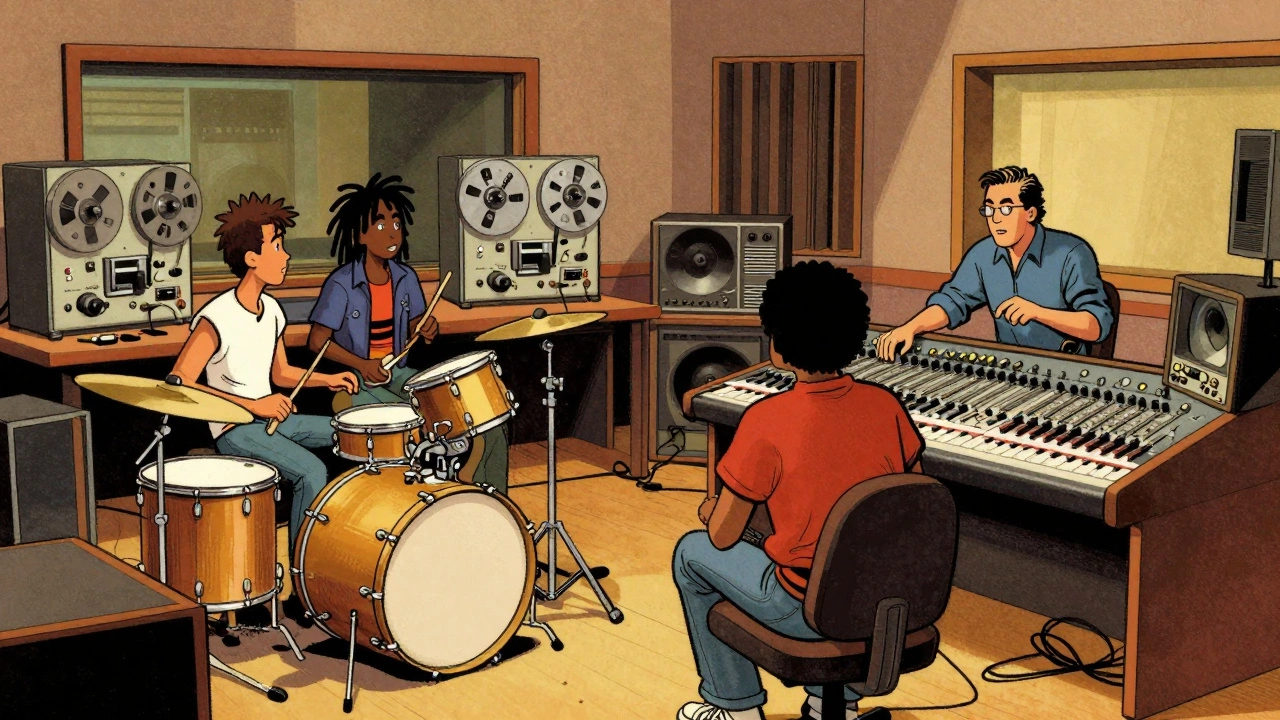

When you listen to a track from the mid-1990s that feels loose, warm, and slightly off-beat, you are hearing the deliberate work of a producer. Before Neo-soul is a music genre that emerged in the 1990s by fusing classic soul with hip-hop rhythms and jazz textures became a household term, it was simply a sound being crafted in studios across New York and Detroit. The credit for this aesthetic shift belongs less to the singers on the microphone and more to the people behind the mixing console. These producers rejected the polished, quantized perfection of mainstream R&B in favor of human imperfection, live instrumentation, and complex grooves.
The Birth of a Label and a Sound
The term "neo-soul" did not emerge from academic journals or fan forums. It was a marketing strategy created by Kedar Massenburg is an executive who coined the term neo-soul to market artists like D'Angelo and Maxwell. As the manager for D'Angelo is a singer-songwriter and producer whose 1995 album Brown Sugar launched the neo-soul movement, Massenburg needed a way to distinguish his client’s music from the slick, synthesizer-heavy R&B dominating radio stations in 1994. He labeled D’Angelo’s debut album, Brown Sugar, as "neo-soul" to signal its blend of 1970s soul sensibilities with contemporary hip-hop basslines.
This branding move highlighted a crucial reality: the identity of the genre was rooted in production choices. While traditional soul relied on big bands and orchestral arrangements, and modern R&B leaned on drum machines and digital polish, neo-soul producers sought a middle ground. They wanted the warmth of analog recording equipment but the rhythmic complexity of hip-hop. This hybrid approach required producers to act as curators of texture, selecting specific drum sounds, bass tones, and keyboard presets that evoked nostalgia while feeling fresh. The success of Brown Sugar, which went platinum, proved that this producer-driven aesthetic had commercial viability, paving the way for a broader movement.
The Soulquarians Collective
If there is a central hub for understanding 1990s neo-soul aesthetics, it is the Soulquarians is a collective of musicians and producers including D'Angelo, Questlove, and J Dilla who defined the neo-soul sound. This group was not a band in the traditional sense; it was a rotating circle of collaborators who gathered primarily at Electric Lady Studios is a famous recording studio in New York City where many neo-soul classics were recorded in New York City between 1997 and 2000. The core members included D’Angelo, drummer Questlove is the drummer and bandleader of The Roots known for his behind-the-beat rhythmic style (Ahmir Thompson), and producer J Dilla is a pioneering beatmaker known for his unquantized, human-like drum programming (James Yancey). Pianist James Poyser, along with artists like Erykah Badu, Common, and Mos Def, also contributed to their sessions.
The Soulquarians treated the studio as a laboratory. Instead of laying down tracks individually and stitching them together digitally, they often played live off one another. This approach captured the energy of a jam session, complete with slight timing variations and improvisational flourishes. Critics described their output as "organic soul" and "boho-rap," terms that reflect the relaxed, natural vibe these producers prioritized. By refusing strict genre boundaries, they created a sonic palette that felt both timeless and innovative. The collective disbanded shortly after a Vibe magazine feature portrayed Questlove as the leader, a narrative that clashed with their ethos of free-spirited collaboration. However, their impact on production techniques remained undeniable.
| Feature | Mainstream R&B | Neo-Soul |
|---|---|---|
| Rhythm | Quantized (perfectly timed) | Loose, "behind the beat" feel |
| Instrumentation | Synthesizers, drum machines | Live drums, bass, Fender Rhodes |
| Mixing | Polished, compressed, bright | Warm, spacious, dynamic range |
| Philosophy | Radio-ready perfection | Human imperfection and groove |
Redefining Rhythm: Questlove and J Dilla
The rhythmic foundation of neo-soul owes much to two distinct approaches to time and space. Questlove, as the drummer for The Roots, brought a "behind-the-beat" technique to his productions. Rather than hitting the snare exactly on the grid, he would delay it slightly, creating a laid-back, swinging feel that made listeners want to move. This subtle manipulation of timing gave tracks a human quality that rigid computer programming could not replicate. His work on D’Angelo’s Voodoo exemplifies this approach, where the drums provide a pulsating, physical low-end that anchors the song.
In contrast, J Dilla revolutionized rhythm through digital means. Known for his eccentric, off-kilter beats, Dilla used sampling and drum machines to create patterns that felt unquantized yet cohesive. He chopped up vinyl records and rearranged the snippets in ways that defied standard musical notation. This "Dilla swing" introduced a new sense of syncopation to neo-soul, influencing how producers approached swing and groove in the late 1990s and early 2000s. While Questlove emphasized organic performance, Dilla demonstrated that digital tools could also capture human emotion when used creatively. Together, their contributions redefined what a beat could do in soul music.
The Producer-Artist Model
One of the most significant shifts in 1990s neo-soul was the rise of the producer-artist model. Unlike previous eras where performers hired separate producers, key figures like D’Angelo took control of the entire creative process. On Brown Sugar and later Voodoo, D’Angelo served as co-producer, overseeing everything from songwriting to final mix. This holistic approach ensured that the production aesthetics aligned perfectly with the artistic vision. It allowed for greater experimentation and authenticity, as the artist had direct input into every sonic detail.
This model empowered other artists to take similar roles. Erykah Badu collaborated closely with her producers to craft albums like Baduizm and Mama’s Gun, emphasizing warm Fender Rhodes keyboards and spacious mixes that complemented her conversational vocal style. Raphael Saadiq, working with Tony! Toni! Toné!, produced Sons of Soul (1993), an early precursor to neo-soul that deliberately echoed 1970s soul using live instrumentation. These producer-artists understood that the sound itself was part of the message, conveying authenticity and cultural heritage through their technical choices.
Legacy and Evolution
The influence of 1990s neo-soul producers extends far beyond the decade in which they worked. Their emphasis on organic textures and complex rhythms laid the groundwork for subsequent genres like alternative R&B and progressive soul. Artists such as Frank Ocean, The Weeknd, and SZA cite these pioneers as major influences, adopting similar production techniques to create intimate, emotionally resonant music. The legacy of J Dilla’s beat-making and Questlove’s rhythmic sensibilities continues to shape how modern producers approach groove and timing.
Moreover, the collaborative spirit of the Soulquarians remains a powerful ideal in today’s music industry. In an era dominated by isolated digital workflows, the idea of gathering talented musicians in a room to experiment and create together holds enduring appeal. The 1990s neo-soul movement reminds us that technology should serve creativity, not constrain it. By blending old-school craftsmanship with new-school innovation, these producers created a timeless sound that continues to inspire generations of musicians.
Who coined the term "neo-soul"?
The term "neo-soul" was coined by Kedar Massenburg, an executive and manager, around 1994-1996. He used it to market the music of D’Angelo, Maxwell, and Erykah Badu, distinguishing their blend of classic soul and hip-hop from mainstream R&B.
What makes neo-soul production different from mainstream R&B?
Neo-soul production emphasizes live instrumentation, loose rhythmic feels, and warm analog textures. Unlike mainstream R&B, which often uses quantized drums and polished synthesizers, neo-soul embraces human imperfections and complex grooves to create a more organic sound.
Who were the key members of the Soulquarians?
The core members of the Soulquarians included D’Angelo, Questlove (Ahmir Thompson), and J Dilla (James Yancey). Other notable contributors were James Poyser, Erykah Badu, Common, Mos Def, and Bilal.
How did J Dilla influence neo-soul?
J Dilla influenced neo-soul through his unique approach to beat-making. He used sampling and drum machines to create off-kilter, unquantized rhythms that added a human touch to digital production. His "swing" became a defining characteristic of the genre's rhythmic complexity.
Why is Electric Lady Studios important to neo-soul?
Electric Lady Studios in New York City was the primary recording location for the Soulquarians collective in the late 1990s. Many landmark neo-soul albums, including D’Angelo’s Voodoo and Erykah Badu’s Mama’s Gun, were recorded there, making it a symbolic hub for the genre.