
Imagine trying to record a symphony where every instrument is controlled by a different remote, none of which talk to each other. That was the reality for electronic musicians in the early 1980s. If you owned a Roland synthesizer and an Oberheim drum machine, you couldn’t sync them up without custom wiring or expensive proprietary cables. Then came MIDI, or Musical Instrument Digital Interface. It wasn't just a cable; it was a universal language that allowed computers and instruments to share data. This shift didn't just make recording easier-it completely rewired how we compose music, turning the studio from a place of capturing performances into a laboratory for editing digital notes.
The Birth of a Universal Language
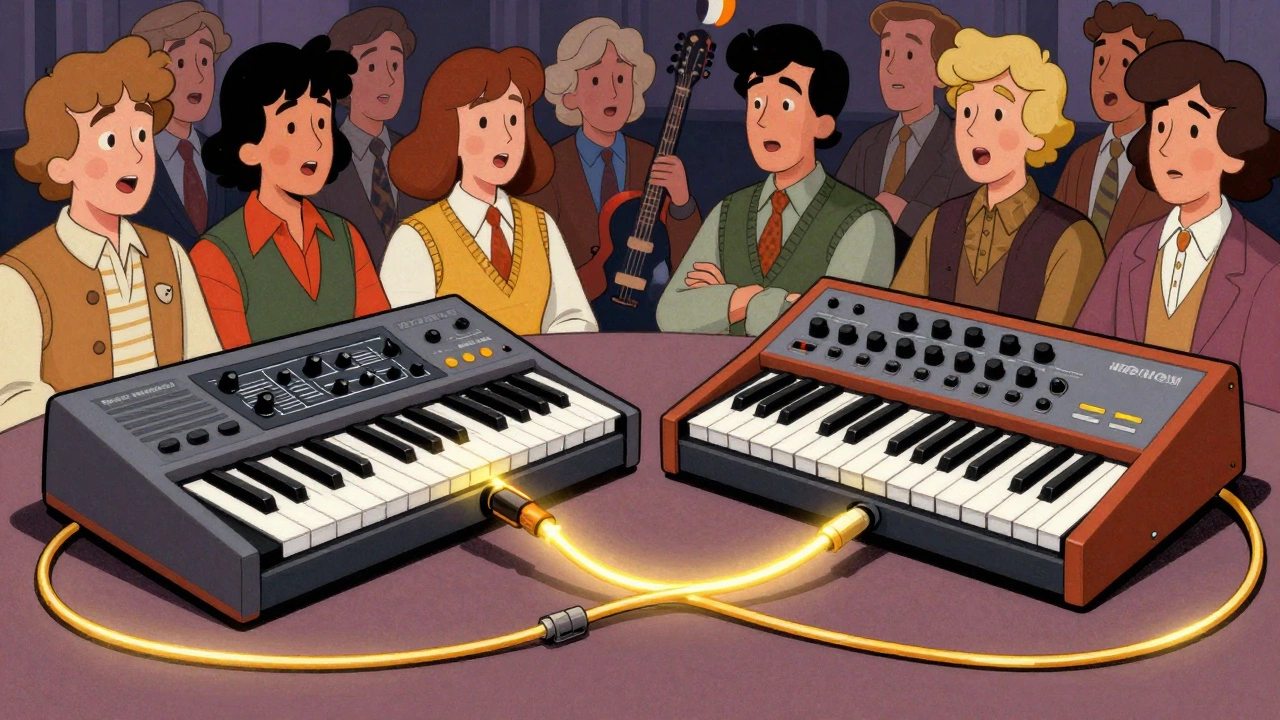
The idea for MIDI started with a simple goal: interoperability. In October 1981, Dave Smith of Sequential Circuits and Chet Wood presented a paper on a "Universal Synthesizer Interface" at the Audio Engineering Society. They weren't alone. Ikutaro Kakehashi of Roland, Tom Oberheim, and reps from Yamaha, Korg, and Kawai joined forces between June and October 1981 to standardize this communication. The result was the MIDI 1.0 specification, agreed upon in August 1983.
The first public demo happened at the Winter NAMM show in January 1983 in Anaheim, California. A Sequential Prophet-600 connected to a Roland Jupiter-6 played together seamlessly. It looked like magic to the audience, but under the hood, it was a serial digital protocol running at 31.25 kbit/s over a 5-pin DIN connector. This connection carried status bytes and data bytes for note-on, note-off, pitch, velocity, and control changes across 16 logical channels. For the first time, a single cable could address up to 16 independent parts, allowing composers to build complex arrangements without physical limitations.
Dedicated Hardware Sequencers: The Workhorses
In the mid-80s, before personal computers became powerful enough to handle heavy sequencing tasks, dedicated hardware boxes ruled the studio. These machines were built specifically for timing precision and reliability.
| Device | Release Year | Key Features | Timing Resolution (PPQ) |
|---|---|---|---|
| Roland MSQ-700 | 1983 | First commercial MIDI sequencer, step-time and real-time recording | N/A |
| Yamaha QX1 | 1984 | 8 tracks, floppy disk storage, tape sync, job-based editing | 384 |
| Roland MC-500 Micro Composer | 1986 | 4 tracks + rhythm track, LCD display, rock-solid reliability | 96 |
| Akai MPC60 | 1988 | Sampling drum machine + sequencer, swing algorithms, pattern chaining | 96 |
The Yamaha QX1 launched in October 1984 was a beast. It cost around ¥480,000 (several thousand dollars) and offered 80,000 note capacity. It used a computer-style keyboard and organized operations into modes like REC, PLAY, and EDIT. However, it had quirks. It couldn't pass incoming MIDI data directly to all outputs, and if the floppy drive failed, the whole unit was useless. Despite this, its high PPQ (Pulses Per Quarter Note) resolution of 384 allowed for incredibly fine rhythmic editing.
On the other hand, the Roland MC-500 became a touring staple. Priced at £999 in the UK, it was praised for being "cheap, fast and rock solid." It used numeric entry and function keys rather than visual waveforms, forcing users to think in terms of patterns and tracks. Its 96 PPQ resolution provided tight timing that many musicians preferred over the sometimes rigid feel of early software.
Then there was the Akai MPC60, co-designed with Roger Linn. Released in 1988, it combined sampling with sequencing. With 768 KB of RAM and a dedicated sequencer section, it became the heart of hip-hop and R&B production. The MPC60’s swing algorithm gave beats a human feel that strictly grid-quantized computer sequences lacked, proving that technical specs aren't everything-feel matters.
The Rise of Computer-Based Sequencing
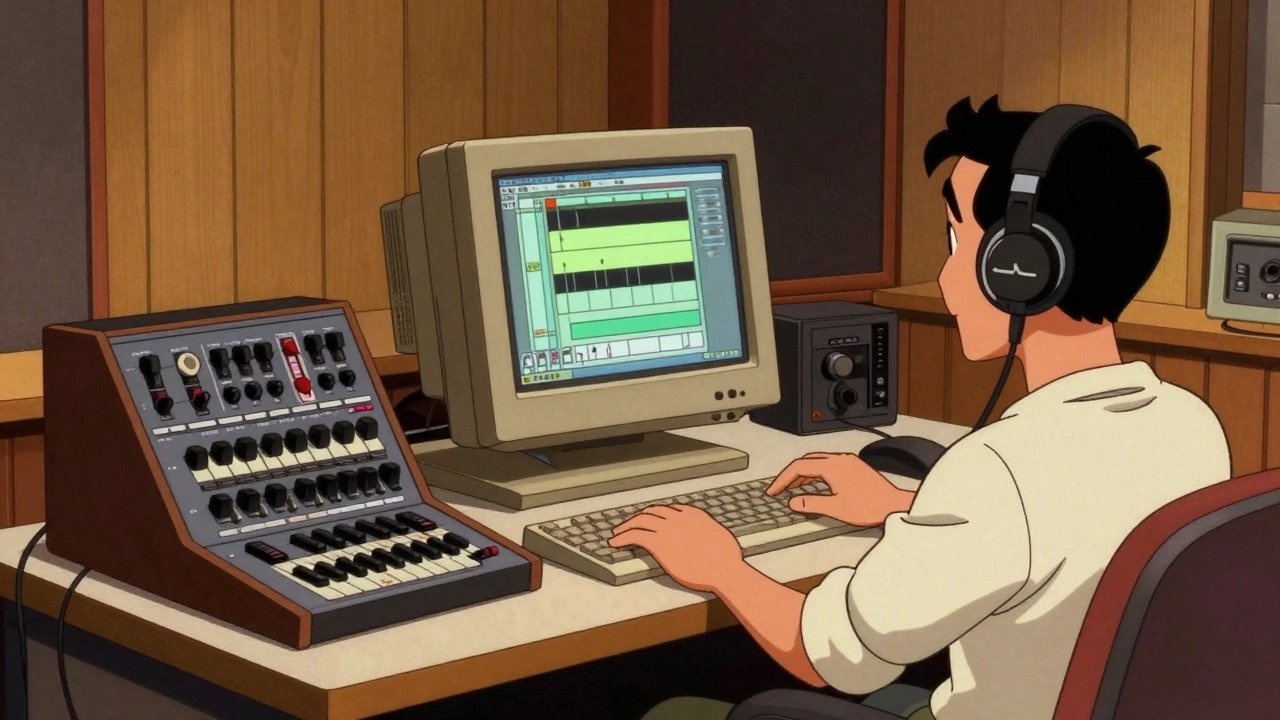
While hardware sequencers dominated the early 80s, general-purpose computers quickly caught up. The key was the interface. The Roland MPU-401, introduced around 1984, was one of the first widely available MIDI interfaces for home computers like the IBM PC, Commodore 64, and Apple II. It allowed these machines to act as sequencers, bridging the gap between consumer electronics and professional audio gear.
But the real game-changer was the Atari ST. Released in 1985, it included built-in MIDI IN and OUT ports as standard. This small detail made it the darling of musicians. Paired with software like Steinberg Cubase 1.0 (released in 1989), the Atari ST became an affordable powerhouse. Cubase introduced the now-standard song overview screen with horizontal tracks and an arrange window. Before this, editing meant navigating menus; after Cubase, you could see your music visually.
Another major player was C-Lab (later Emagic), which released Creator 1.0 for Atari ST in 1987. It was a 64-track MIDI sequencer with a vertical, non-linear layout. In 1988, they added Notator, a score editor that allowed for interactive real-time notation. This appealed to classically trained composers who needed traditional staff views. Even on modest hardware like a 1 MB Atari ST, these programs demonstrated that fully featured notation-capable sequencers were possible outside of expensive studios.
On the IBM PC side, Voyetra Sequencer Plus became a staple. Users recall loading it from floppy disks and waiting minutes for it to boot on 386 or 486 PCs. While frustrating by today's standards, it offered robust features like SMPTE sync and multi-port support, making it viable for professional film scoring sessions.
High-End DAWs vs. MIDI Workflows
It's important to distinguish between MIDI sequencing and early Digital Audio Workstations (DAWs). Systems like the Fairlight CMI Series III and New England Digital Synclavier were true DAWs, combining sampling, synthesis, and multitrack digital recording. But they cost hundreds of thousands of dollars. By contrast, a MIDI setup required only a sequencer, some synths, and maybe an analog tape recorder. This democratization meant that individual musicians, not just major studios, could produce complex, layered compositions.
MIDI itself doesn't store audio; it stores instructions. A MIDI file tells a synth "play middle C at velocity 100." This separation of control data from sound generation was revolutionary. Composers could reassign sounds, modify timing, and layer instruments without generational loss or tape wear. As one historian noted, MIDI offered effectively "lossless recording" of performance data. However, this also meant that exchanging a MIDI sequence between studios with different synths could produce drastically different sonic results, highlighting the dependency on the quality of connected instruments.
Legacy and Impact on Modern Production
The innovations of the 1980s laid the groundwork for everything we do today. Software originally rooted in 80s MIDI sequencers evolved into mainstream DAWs. Emagic’s Notator Logic became Apple’s Logic Pro, while Steinberg’s Cubase added audio recording and VST plugin support. The graphical arrange windows, track-based editing, and quantization tools we take for granted were born in this era.
MIDI 1.0 remains in use, maintained by the MIDI Manufacturers Association. Extensions like General MIDI 1 (1991) built on the original 1983 spec. Today, when you plug a USB controller into your laptop, you're using a descendant of that 5-pin DIN connection. The 1980s transformed composition from a primarily performance-capturing activity to a data-driven, editable process. It turned the musician into a programmer, and the studio into a canvas of infinite possibilities.
What was the first MIDI sequencer?
The Roland MSQ-700, released in 1983, is widely cited as the first commercial MIDI sequencer. It offered step-time and real-time recording of MIDI note data with basic pattern chaining.
Why was the Atari ST so popular among musicians?
The Atari ST, released in 1985, included built-in MIDI IN and OUT ports as standard hardware. This eliminated the need for expensive external interfaces and made it an affordable platform for running software sequencers like Cubase and Creator.
What is PPQ in MIDI sequencing?
PPQ stands for Pulses Per Quarter Note. It defines the timing resolution of a sequencer. Higher PPQ values, like the 384 found in the Yamaha QX1, allow for finer rhythmic editing and more natural swing compared to lower resolutions like 96 PPQ.
Did MIDI replace analog tape recording in the 1980s?
Not entirely. MIDI complemented analog tape. Most composers used MIDI to control synthesizers and drum machines, which then output audio to analog multitrack recorders. True digital audio recording (DAWs) was too expensive for most until the late 80s and early 90s.
Who created the MIDI standard?
MIDI was developed jointly by Dave Smith of Sequential Circuits, Ikutaro Kakehashi of Roland, Tom Oberheim, and representatives from Yamaha, Korg, and Kawai. The specification was finalized in August 1983.


