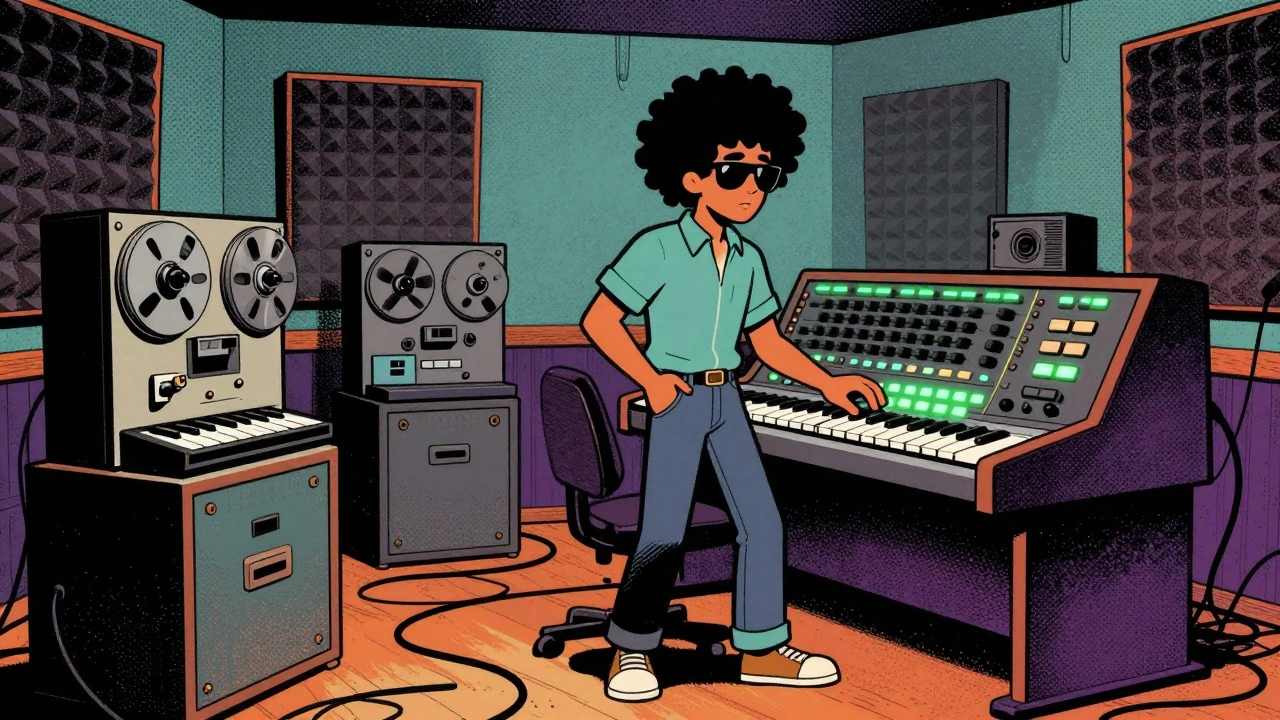

Walk into any record store or scroll through a streaming playlist labeled "Classic R&B," and you will hear the same heartbeat. It is tight, synthetic, and impossible to ignore. That specific groove didn't happen by accident. It was engineered by three distinct forces in the 1980s: Kashif, who traded live bands for synthesizers; Jimmy Jam & Terry Lewis, who turned drum machines into rhythmic weapons; and Quincy Jones, who applied big-band orchestration to pop records. These producers did not just make hits; they rewired the DNA of rhythm and blues, moving it away from the lush, horn-heavy disco of the previous decade toward a sleeker, more electronic future.
The Synth-Pioneer: Kashif’s Minimalist Funk
If you want to understand how R&B shed its disco skin, look at Kashif. Born Michael Jones in Harlem, he entered the foster care system as an infant and found his footing in music early. By the late 1970s, he had adopted the name Kashif (meaning "discoverer") and began experimenting with technology that most producers ignored. While others were still relying on large ensembles of session musicians, Kashif was plugging into the New England Digital Synclavier, one of the first digital sampling systems.
His approach was radical for the time. He stripped away the clutter. Instead of filling every frequency with strings and horns, Kashif focused on percussive synth bass lines and crisp, programmed drum patterns. This "minimalist techno-funk" style defined his own solo albums like Kashif (1983) and Send Me Your Love (1984). But his real impact came from behind the board. He produced Evelyn "Champagne" King’s "I’m in Love," a track that marked a sharp departure from her earlier work. The song relied on a hypnotic, synthesized groove rather than live instrumentation, setting a new template for post-disco R&B.
Kashif’s obsession with sound design was legendary. In interviews, he described renting dozens of snare drums in New York City just to find the perfect timbre for a single beat. He wasn’t trying to hide the technology; he was showcasing it. This method influenced everyone from Whitney Houston, whose early singles he produced, to Kenny G. His legacy isn’t just in chart positions-though he scored around a dozen Top 10 R&B hits-but in proving that a computer could have soul.
The Minneapolis Machine: Jimmy Jam & Terry Lewis
While Kashif was refining the minimalist aesthetic in New York, James Samuel Harris III (Jimmy Jam) and Terry Steven Lewis were building something different in Minneapolis. They met in high school and initially played in rival funk bands before joining forces under Prince’s mentorship in the band The Time. After being fired by Prince for missing a concert due to a snowstorm, they pivoted entirely to production, forming Flyte Tyme Productions.
Jam & Lewis brought a unique hybrid sound to the table. They combined the raw energy of Minneapolis funk with the precision of studio technology. Their workflow was methodical: start with a drum machine pattern (often using the LinnDrum), layer a synthesized bass line, and then build the melody around the artist’s voice. Unlike many producers who imposed their own signature sound onto artists, Jam & Lewis believed the artist’s story was the key ingredient. They designed the sonic environment to serve that narrative.
Their breakthrough came with Janet Jackson’s Control in 1986. Recorded at their Flyte Tyme Studios, the album fused R&B, rap vocals, and aggressive, syncopated rhythms. Tracks like "What Have You Done for Me Lately" and "Nasty" became anthems because they felt both futuristic and deeply human. The duo went on to produce over 40 US Top 10 hits, including massive successes for the S.O.S. Band, Alexander O’Neal, and Cherrelle. Their ability to blend hip-hop sensibilities with mainstream pop accessibility made them the most commercially dominant production team of the decade.
The Architect: Quincy Jones’s Genre-Bending Vision
Quincy Jones approached the 1980s not as a technician, but as a conductor. With a career spanning jazz arranging, film scoring, and pop production, Jones brought a level of musical sophistication that few of his peers could match. After recovering from a near-fatal cerebral aneurysm in 1974, he focused intensely on record production, launching Qwest Records in 1980 to maintain creative control.
Jones’s genius lay in his ability to break down walls between genres. On Michael Jackson’s Thriller (1982) and Bad (1987), he didn’t just use synthesizers; he orchestrated them alongside live instruments, funk guitars, and rock elements. He treated the recording studio as an instrument itself, leveraging emerging technology to create dense, layered textures that remained clear on radio broadcasts. His collaboration with songwriter Rod Temperton resulted in some of the most iconic songs in history, blending smooth R&B grooves with cinematic scope.
Beyond Michael Jackson, Jones produced his own album The Dude (1981), which featured hits like "Ai No Corrida" and "Just Once." These tracks demonstrated his ability to absorb contemporary dance trends while reshaping them through complex harmonic structures. He also produced Frank Sinatra’s L.A. Is My Lady and organized the charity single "We Are the World." For Jones, R&B was never isolated; it was part of a larger cultural conversation involving jazz, pop, and social activism.

Comparing the Titans: Style, Scale, and Impact
| Producer(s) | Core Technology | Musical Approach | Key Signature Works | Chart Impact (Est.) |
|---|---|---|---|---|
| Kashif | Synclavier, MIDI, Drum Machines | Minimalist, synth-led, hypnotic grooves | Evelyn King's "I'm in Love", Whitney Houston's early singles | ~12 Top 10 R&B Hits |
| Jimmy Jam & Terry Lewis | LinnDrum, Synthesizers, 4-Track Recorders | Rhythm-centric, artist-focused, Minneapolis funk | Janet Jackson's Control, S.O.S. Band's "Just Be Good to Me" | 41+ US Top 10 Hits |
| Quincy Jones | Live Orchestration + Studio Tech | Genre-blending, sophisticated arrangement, cinematic | Michael Jackson's Thriller, The Dude | Tens of Millions in Album Sales |
These three producers represent different facets of the same revolution. Kashif provided the technological blueprint, showing that synths could carry emotional weight. Jam & Lewis industrialized the groove, creating a repeatable formula for hit-making that prioritized rhythm and vocal clarity. Quincy Jones elevated the entire genre, applying classical and jazz arranging techniques to make R&B palatable to global audiences. Together, they shifted the industry from a model reliant on live bands to one driven by producer-auteurs who controlled every aspect of the sonic landscape.
Lessons for Modern Producers
What can today’s creators learn from these 1980s giants? First, technology should serve the song, not distract from it. Kashif’s intuitive use of the Synclavier reminds us that innovation comes from exploration, not just reading manuals. Second, understand your artist. Jam & Lewis’s success stemmed from their ability to amplify an artist’s identity rather than mask it. Finally, study harmony. Quincy Jones’s background in big-band arranging allowed him to create complex textures that modern producers often overlook in favor of simple loops. Mastering the interplay between rhythm, melody, and space remains the core challenge of R&B production, regardless of the era.
Who was the most influential R&B producer in the 1980s?
Influence depends on the metric. Quincy Jones had the highest commercial sales and global reach, particularly with Michael Jackson. Jimmy Jam & Terry Lewis had the most consistent chart dominance with over 40 Top 10 hits. Kashif was arguably the most stylistically influential, pioneering the synth-heavy sound that defined the decade's shift away from disco.
What equipment did Kashif use to create his sound?
Kashif was an early adopter of the New England Digital Synclavier, a powerful digital sampling and sequencing system. He also heavily utilized MIDI technology and various drum machines to create his minimalist, synth-driven funk tracks. He was known for auditioning multiple physical snare drums to capture specific acoustic textures within his electronic productions.
How did Jimmy Jam & Terry Lewis get started?
They met in high school in Minneapolis and played in rival bands before joining Prince's protégé group, The Time. After being fired by Prince for missing a tour date, they formed Flyte Tyme Productions and focused on producing other artists, starting with the S.O.S. Band before achieving massive success with Janet Jackson.
Did Quincy Jones produce only Michael Jackson?
No. While his work with Michael Jackson (Off the Wall, Thriller, Bad) is his most famous, he also produced his own album The Dude, worked with Frank Sinatra on L.A. Is My Lady, George Benson, and organized the charity single "We Are the World." He launched his own label, Qwest Records, in 1980.
What is the "Minneapolis Sound" associated with Jam & Lewis?
The Minneapolis Sound is characterized by the heavy use of drum machines (like the LinnDrum), synthesized bass lines, and gated reverb effects. It blends funk, rock, and pop elements. Jam & Lewis refined this sound by adding precise keyboard arrangements and focusing on strong vocal melodies, distinguishing themselves from the grittier style of Prince.