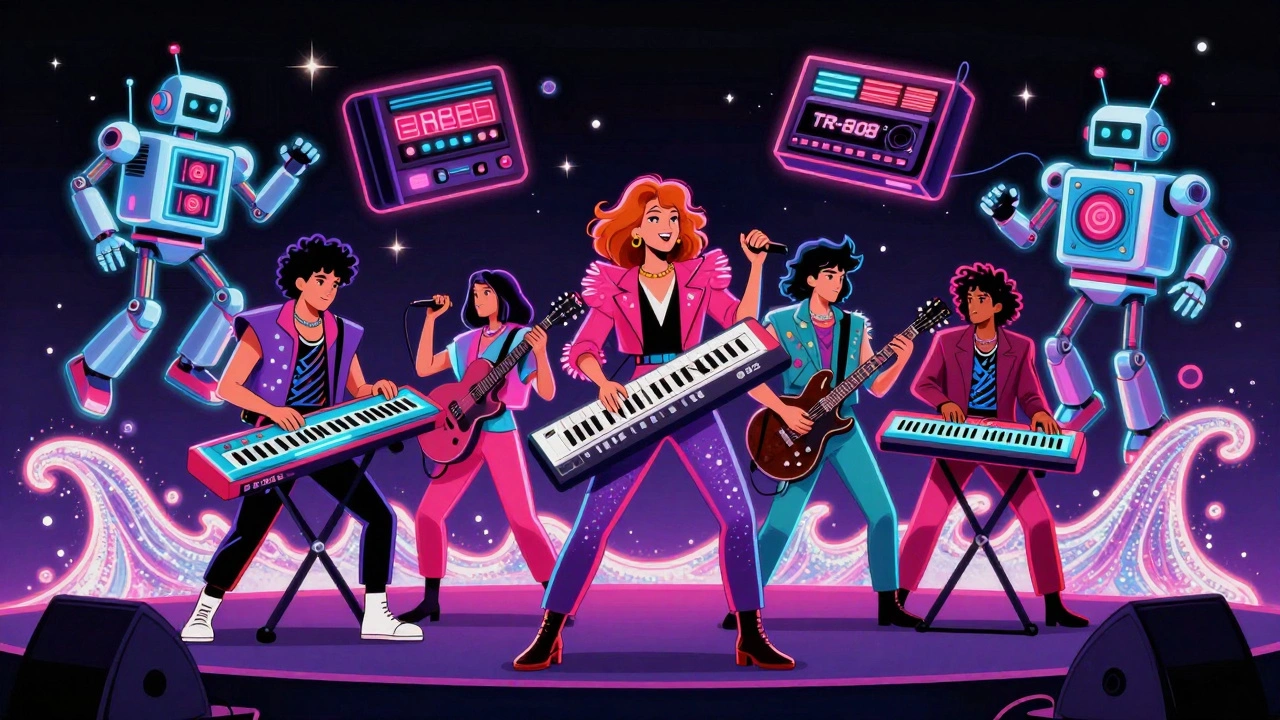

Think about the music you heard growing up. Now imagine it stripped of its polish - no glossy synths, no perfect drum machines, no choreographed dance moves. That’s what the 1990s did to the 1980s. It didn’t erase it. It reversed it. And that reversal didn’t happen by accident. It was built on the very tools and tricks the 1980s invented.
The 1980s didn’t just make music. It built a new language for it. Synthesizers like the Yamaha DX7 and drum machines like the Roland TR-808 weren’t just instruments - they were revolutionaries. They let bands like Depeche Mode, The Human League, and Duran Duran craft sounds that felt like they came from another planet. These weren’t just pop songs. They were sonic worlds: shiny, synthetic, and bigger than life. That was the goal - to sound like the future. And it worked. Millions bought into it.
But underneath all that glitter, something else was brewing. Hip-hop, born on street corners in the Bronx, exploded in the 1980s. Run-D.M.C. didn’t just rap. They smashed a guitar riff into a beat and called it "Rock Box." That wasn’t a gimmick. It was a blueprint. Suddenly, music didn’t need to stay in its lane. A rap verse could ride over a rock solo. A funk bassline could anchor a dance track. Sampling wasn’t stealing - it was storytelling. And by the end of the decade, that idea had taken root everywhere.
At the same time, alternative rock was quietly building its own rebellion. While Mötley Crüe and Bon Jovi wore spandex and screamed about love in stadiums, bands like R.E.M., The Smiths, and Pixies were playing basements with worn-out guitars and lyrics that sounded like journal entries. They didn’t want to be heroes. They just wanted to be real. Their sound was raw, quiet, and full of doubt. It was the opposite of everything the 1980s celebrated. But here’s the twist: they used the same tools. The drum machines, the synths, the recording techniques - they didn’t throw them out. They twisted them. Turned the polished into the gritty. The loud into the whispered.
Then came the 1990s. And everything changed. Nirvana’s "Smells Like Teen Spirit" didn’t just top the charts. It shattered a whole culture. MTV stopped playing videos of people lip-syncing in front of neon backdrops. Suddenly, it was Kurt Cobain, slumped in a flannel, mumbling through a song that sounded like it was recorded in a garage. The 1980s had been about standing out. The 1990s was about disappearing into the noise.
But here’s what most people miss: the 1990s didn’t reject the 1980s. It inherited it. The same drum machines that made "Take On Me" became the heartbeat of Portishead’s "Glory Box." The same samplers that chopped up James Brown records for Public Enemy were now stitching together soul loops for Massive Attack. The tools were identical. The mood? Totally different.
Pop music didn’t disappear - it evolved. Britney Spears didn’t invent dance-pop. She perfected it using the same synth patterns from Depeche Mode and the same basslines from Prince. The Backstreet Boys? Their harmonies came from 1970s R&B, but their production? Pure 1980s studio wizardry. Add in a little hip-hop rhythm, and boom - you had global domination. Mariah Carey’s whistle notes? They were technically insane. But the way she layered them over programmed beats? That was pure 1980s innovation, now used to express vulnerability instead of power.
R&B in the 1990s didn’t just get smoother - it got smarter. Boyz II Men didn’t just sing about love. They sang about heartbreak in four-part harmony over a beat that sampled a 1980s synth ballad. TLC’s "No Scrubs"? That groove came from funk, but the production? A direct line from the Roland TR-909. Even Aaliyah, with her whispery vocals and slow, sliding rhythms, was using the same electronic textures that defined 1980s new wave - just slowed down, buried under reverb, and made to feel intimate.
And then there were the soundtracks. "Singles," "Grosse Pointe Blank," "Trainspotting" - these weren’t just movie collections. They were cultural manifestos. One track might be a punk song from 1977, the next a trip-hop loop from 1994, then a garage rock riff from a band you’d never heard of. These compilations didn’t just play music. They told stories. And they assumed you’d get it. You’d grown up hearing Prince mixed with Public Enemy, then Talking Heads with Depeche Mode. You didn’t need explanations. You just knew.
The 1980s taught music how to mix. The 1990s taught it why to mix. The 1980s used technology to build fantasy worlds. The 1990s used the same technology to dig into the mess of real life. One was about escape. The other was about truth.
That’s why modern music sounds the way it does. Today’s pop songs? They’re built on 1980s synths, 1990s hip-hop beats, and 2000s auto-tune. But the DNA? That came from the collision of two decades that refused to stay in their boxes. The 1980s gave us the tools. The 1990s gave us the reason to use them differently.
There’s no such thing as pure genre anymore. That’s not new. That’s the legacy of the 1980s. And the 1990s didn’t break it - they deepened it.
How the 1980s Built the Musical Toolkit of the 1990s
The 1980s didn’t just produce hits - it produced technology that changed how music was made. The Roland TR-808 and TR-909 drum machines became the backbone of everything from hip-hop to house. Their deep bass kicks and snappy snares weren’t natural. They were artificial. And that was the point. These machines let producers create rhythms that human drummers couldn’t play - tight, repetitive, hypnotic. By the time the 1990s rolled in, every producer knew how to use them.
Then there were synthesizers. The Yamaha DX7 didn’t just make sounds. It made textures. It could mimic a piano, a brass section, or a spaceship. Bands like Depeche Mode and New Order used it to build entire songs without guitars. That freedom changed everything. In the 1990s, producers didn’t need a full band. They just needed a laptop, a sampler, and a few presets from the 1980s. The tools were already there. They just needed a new purpose.
Sampling didn’t start in the 1990s. It started in the 1980s. Grandmaster Flash cut up James Brown records. Run-D.M.C. layered a rock guitar over a beat. LL Cool J turned a disco track into a rap anthem. These weren’t accidents. They were experiments. And by the time the 1990s came, sampling wasn’t a novelty - it was standard practice. Hip-hop producers like Dr. Dre and The Dust Brothers took those early ideas and turned them into full-blown compositions. One sample could be the foundation of a whole song. That’s how "The Chronic" and "Illmatic" were made. And it all started in the 1980s.
Alternative Rock: The Anti-1980s Movement That Still Used 1980s Tools
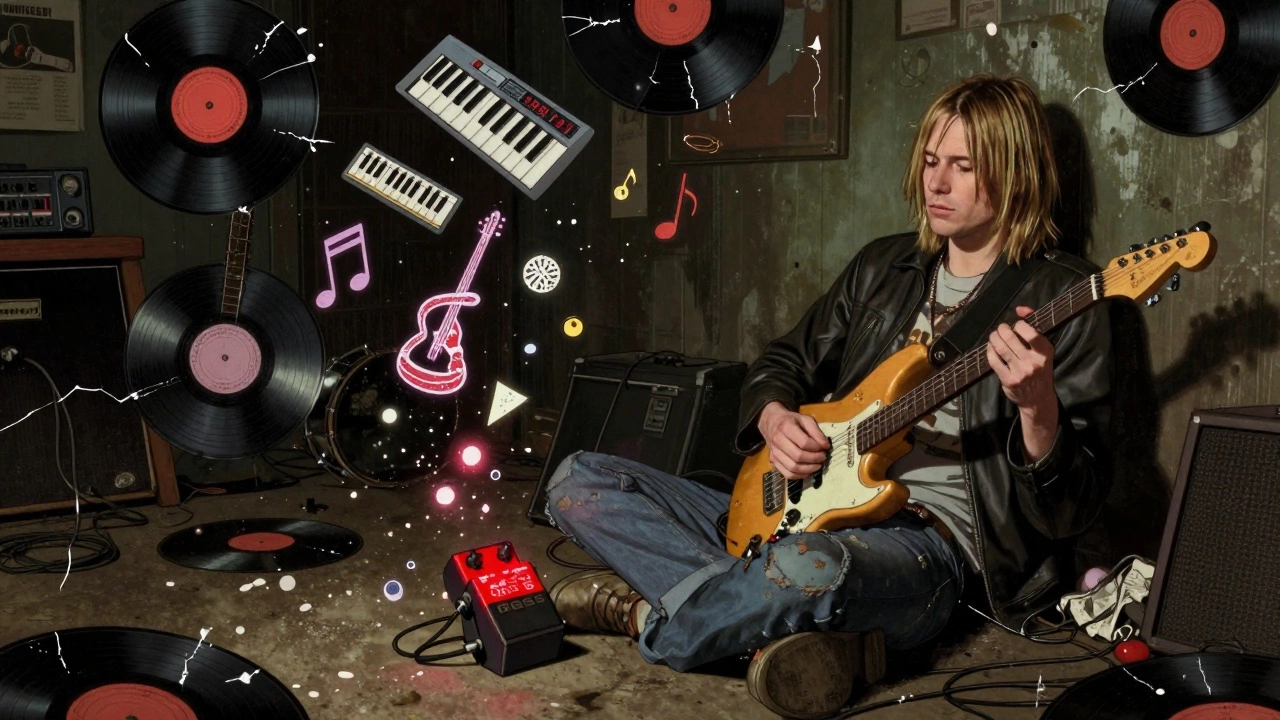
Grunge didn’t come out of nowhere. It came from boredom. Kids in Seattle were tired of hair metal. They were tired of overproduced pop. They wanted something that felt like it was made by real people, not studio robots. But here’s the irony: they still used the same gear. Kurt Cobain played a Fender Mustang - a guitar that had been around since the 1960s. But he ran it through a Boss DS-1 distortion pedal, a device that had been invented in the 1970s. His drums? A basic kit, but tuned low and recorded with a single mic - a technique borrowed from 1980s lo-fi punk recordings.
Pixies didn’t invent quiet-loud-quiet. They refined it. Their 1989 album "Doolittle" was built on feedback, sudden silence, and shouted choruses. That structure became the template for Nirvana’s "Nevermind." And that album? It sold 10 million copies. Why? Because it felt real. But it was built on the same production tricks that made "Take On Me" a hit. The difference? One was designed to make you dance. The other was designed to make you cry.
Even R.E.M., often seen as the "original" alternative band, used drum machines on albums like "Out of Time." They didn’t reject technology. They used it to make music feel more human. That’s the paradox of the 1990s: it rejected the image of the 1980s but kept its tools. And that’s why it worked.
Pop’s 1990s Explosion: When Synth-Pop Met Hip-Hop
Britney Spears didn’t invent dance-pop. She inherited it. Her producer, Max Martin, didn’t come from a rock background. He came from Swedish synth-pop. He grew up on Abba, Depeche Mode, and Roxette. He took their melodies, their chord progressions, their synth hooks - and he added hip-hop beats. That’s how "...Baby One More Time" became a global smash. It had the structure of an 1980s pop song, but the rhythm of a 1990s rap track.
The Backstreet Boys? Their harmonies came from 1960s doo-wop. But their production? Pure 1980s. Every beat, every synth stab, every echo on the vocals - it was straight out of a Duran Duran demo. And when TLC’s "Waterfalls" dropped, it had a beat that sampled a 1980s R&B groove, layered over a hip-hop drum pattern, with a vocal arrangement that sounded like a gospel choir. That wasn’t random. That was strategy.
Even Mariah Carey’s "Fantasy" - a song that samples Tom Tom Club’s "Genius of Love" - was built on a 1980s foundation. That sample wasn’t just a nod. It was a bridge. It connected the past to the present. And it worked because the audience already knew both sides.
Why the 1990s Didn’t Kill the 1980s - It Just Changed Its Purpose
The 1980s was about excess. Big hair. Big drums. Big emotions. The 1990s was about restraint. Flannel. Silence. Subtext. But both decades believed in the same thing: music doesn’t have to fit in a box.
Paul Simon’s "Graceland" in 1986 brought South African rhythms to American radio. That wasn’t a one-off. It was a signal. The world had more music than we thought. The 1990s took that idea and ran with it. Radiohead mixed rock with electronica. Björk fused pop with avant-garde noise. OutKast blended funk, soul, and hip-hop into something completely new.
The 1980s gave us the permission to mix. The 1990s gave us the courage to make it mean something. That’s the real legacy.
| 1980s Tool | Used For in the 1980s | Repurposed For in the 1990s |
|---|---|---|
| TR-808/909 Drum Machines | Polished dance beats (Depeche Mode, Duran Duran) | Moody, lo-fi grooves (Portishead, Massive Attack) |
| Yamaha DX7 Synthesizer | Shiny, romantic melodies (Phil Collins, A-ha) | Atmospheric textures (Radiohead, Björk) |
| Sampling Technology | Looping funk breaks (Run-D.M.C., Beastie Boys) | Complex, layered compositions (Dr. Dre, DJ Shadow) |
| Auto-Tune (early versions) | Subtle pitch correction (Prince, Michael Jackson) | Emotional effect (TLC, Aaliyah) |
| Music Videos (MTV) | Visual spectacle (Madonna, Michael Jackson) | Underground aesthetic (Nirvana, Smashing Pumpkins) |
Why This Matters Today
When you hear a pop song today with a retro synth line and a trap beat, you’re hearing the 1980s and 1990s together. That’s not nostalgia. That’s evolution. The idea that genres can bleed into each other isn’t new. It’s been the rule since the 1980s.
Today’s artists don’t ask, "What genre is this?" They ask, "What feeling do I want to create?" And that’s the real gift of the 1980s and 1990s. They didn’t just make music. They made a new way to think about it. You don’t need to be pure. You just need to be honest.
How did 1980s synth-pop directly influence 1990s pop stars like Britney Spears?
Britney Spears’ producer, Max Martin, grew up on 1980s synth-pop bands like Depeche Mode and A-ha. He took their catchy melodies, layered harmonies, and synth-driven hooks - the same techniques used in "Take On Me" and "People Are People" - and combined them with hip-hop rhythms and modern studio production. The result? Songs like "...Baby One More Time" had the structure of an 80s pop anthem but the energy of a 90s dance track. It wasn’t a new sound. It was a remix of the 80s with 90s attitude.
Did grunge bands completely reject 1980s technology?
No. Grunge bands rejected the *image* of the 1980s - the spandex, the hairspray, the over-the-top solos - but not the tools. Kurt Cobain used the same Boss DS-1 distortion pedal that 80s punk bands used. Nirvana’s producer, Butch Vig, recorded drums with the same techniques used on 1980s metal albums - just with less reverb and more rawness. They didn’t throw out the gear. They used it to sound broken, not polished.
Why did sampling become so important in the 1990s?
Sampling became the backbone of 1990s music because it let producers build songs from fragments of the past. In the 1980s, sampling was experimental - used by hip-hop pioneers like Grandmaster Flash. In the 1990s, it became systematic. Producers like Dr. Dre and DJ Shadow didn’t just loop a beat. They chopped, reversed, and layered dozens of samples to create entirely new sounds. That’s how albums like "The Chronic" and "Endtroducing..." were made. Sampling wasn’t a trick. It was a language.
How did R&B evolve from the 1980s to the 1990s?
1980s R&B was smooth, polished, and often tied to dance floors - think Prince, Lionel Richie. In the 1990s, artists like Aaliyah, TLC, and Mary J. Blige kept the soulful harmonies but added hip-hop beats, heavier basslines, and more personal lyrics. The production became darker, slower, and more intimate. The 1980s gave R&B its tools - drum machines, synths, studio effects. The 1990s gave it its voice.
Why did 1980s artists struggle to adapt to the 1990s sound?
Many 1980s artists tried to stay relevant by making their music "darker" or "grittier," but it felt forced. Sting’s 1993 album "Ten Summoner’s Tales" still had polished production and melodic hooks - it just lacked the emotional edge that 1990s audiences wanted. The problem wasn’t skill. It was context. The 1990s wasn’t just about sound. It was about mood. And that mood - cynical, introspective, real - couldn’t be copied. It had to be lived.
What Comes Next?
Today’s music is a collage of every decade since 1980. You hear 80s synths in Billie Eilish. You hear 90s hip-hop beats in Olivia Rodrigo. You hear 70s funk in Dua Lipa. That’s not coincidence. It’s inheritance.
The lesson of the 1980s and 1990s is simple: genres aren’t walls. They’re doors. And every time someone blends two styles, they open another one. You don’t need to choose between rock and electronic. You don’t need to pick between pop and punk. You just need to feel it. And that’s exactly what the 1980s taught us - and what the 1990s made us believe.


