
There is a specific feeling you get when you press play on a classic heavy rock live album from the 1970s. It’s not just the music; it’s the sheer volume of energy trapped in the grooves. You hear the crowd roaring, the feedback squealing, and the guitars tearing through the mix with a raw power that studio recordings often struggle to replicate. This era didn’t just document concerts; it invented the blueprint for how amplified rock should sound on stage.
The 1970s was the decade that codified the heavy rock stage sound. Bands stopped trying to recreate their polished studio hits live and started embracing the chaos, the improvisation, and the technical limitations of early multitrack recording. The result? A collection of records that stand as definitive milestones in metal evolution and hard rock history. From Deep Purple’s thunderous Japanese tour to Thin Lizzy’s controversial studio fixes, these albums taught us what "live" really means.
The Gold Standard: Deep Purple’s Made in Japan is a landmark 1972 live double album recorded during the band's first Japanese tour, featuring the Mark II lineup and engineered by Martin Birch on eight-track tape.
If you are looking for the absolute center of gravity for 1970s heavy rock live sound, it is Deep Purple's Made in Japan. Recorded over three nights in August 1972 at Osaka’s Festival Hall and Tokyo, this double LP captured the Mark II lineup-Ritchie Blackmore, Ian Gillan, Roger Glover, Jon Lord, and Ian Paice-at their most volatile and powerful. Unlike many contemporaries who relied heavily on studio polish, Deep Purple hired engineer Martin Birch to capture the show on eight-track tape. This technology allowed for discrete tracks for drums, guitar, organ, and vocals, preserving the raw feel while providing enough separation for a massive stereo image.
The sonic character here is unmistakable: wide dynamic range, thunderous drum ambience, and searing guitar leads that sit high in the mix. The band acted as their own producers, meaning they controlled the balance. They wanted the improvisations to breathe. Tracks like "Highway Star" and "Smoke on the Water" were stretched into long jam sessions, showcasing the interplay between Blackmore’s guitar and Lord’s Hammond organ. In a 2025 review of the Steven Wilson remix, critics noted that the original tapes remain robust enough for modern audiophile reinterpretations, proving that the technical quality of those 1972 recordings was exceptional. For fans, this album isn't just a concert record; it is the benchmark against which all other heavy rock live performances are measured.
The Overdub Debate: Thin Lizzy’s Live and Dangerous is a 1978 live album produced by Tony Visconti that blends genuine concert footage with extensive studio overdubs to create a perfected twin-guitar hard rock sound.
Then there is the elephant in the room: Thin Lizzy's Live and Dangerous. Released in June 1978, this album is widely considered one of the greatest live records ever made, but it comes with a caveat. Producer Tony Visconti famously claimed that about 75% of the album was overdubbed in the studio. Guitarist Scott Gorham countered this, insisting that roughly 75% of the tapes were genuinely live performances, with only 25% consisting of fixes. The truth likely lies somewhere in between, but the debate itself highlights a key tension in 1970s rock production: the desire for raw authenticity versus the need for technical perfection.
Despite the controversy, the result is undeniable. The chemistry between Phil Lynott, Scott Gorham, Brian Robertson, and Brian Downey is electric. Visconti’s ability to blend live backing tracks with post-production corrections created a sonic ideal that later bands tried to emulate. The twin-guitar harmonies are tighter than any live performance has a right to be, yet the crowd noise and spontaneous ad-libs keep the energy palpable. Whether you view it as "cheating" or "craftsmanship," Live and Dangerous demonstrates how overdubs can enhance a live record without killing its soul. It remains a masterclass in capturing the excitement of a stadium show while ensuring every note rings true.
Pure Hard Rock Energy: UFO’s Strangers in the Night is a 1979 double-album live recording from UFO's 1978 U.S. tour, celebrated for its high-gain guitar tones and curated multi-show compilation.
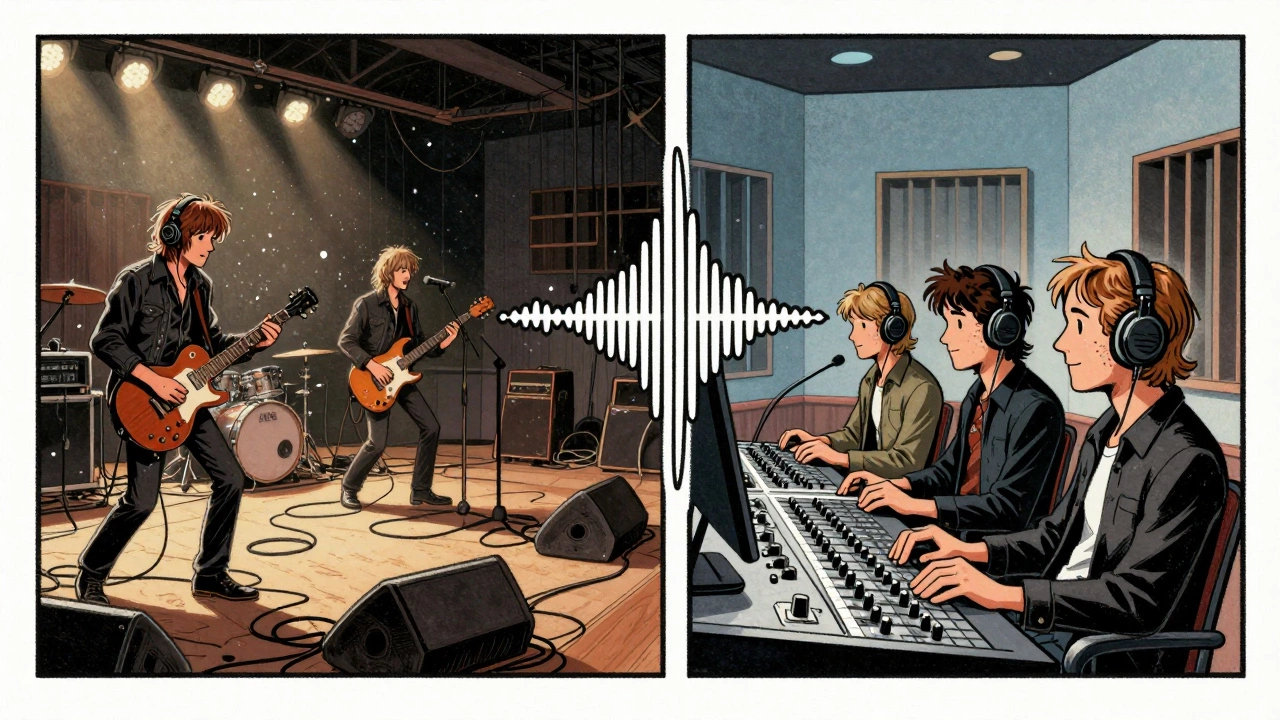
By the late 1970s, the strategy for capturing live sound had evolved. UFO's Strangers in the Night, released in 1979, represents the culmination of this approach. Recorded during their 1978 U.S. tour, this double album compiles performances from multiple shows. This allowed producers to choose the best-sounding takes for each song and assemble an idealized set list. The result is a record that feels less like a documentary and more like a perfect concert experience.
Fans and critics alike have praised this album for its high-gain guitar tones and solid-state amplification. The Mighty Decibel ranked it as the number one hard rock live album of the 1970s, citing its "perfection" in song selection and energy. Songs jump to life with a clarity that surpasses many studio versions from the same era. By curating the best moments from several nights, UFO achieved a consistently high performance level that single-concert recordings often miss. This method became a template for future live releases, showing that "live" doesn't always mean "unedited." It can mean "the best possible version of what happened on stage."
Other Defining Moments in 1970s Live Rock
While Deep Purple, Thin Lizzy, and UFO dominate the heavy rock conversation, other acts played crucial roles in defining the decade's stage sound. Here is how they fit into the landscape:
| Album | Artist | Release Year | Key Production Trait | Impact on Stage Sound |
|---|---|---|---|---|
| Live at Leeds | The Who | 1970 | Minimal overdubs, raw energy | Set the standard for punk-influenced rock intensity |
| Alive! | Kiss | 1975 | High vocal presence, theatrical sound | Proved live albums could break new artists commercially |
| Frampton Comes Alive! | Peter Frampton | 1976 | Extensive use of Talk Box | Showcased effects-driven guitar solos in a live context |
| At Budokan | Cheap Trick | 1979 | Clean production, pop-rock precision | Bridged the gap between heavy rock and arena pop |
The Who's Live at Leeds (1970) is often cited as the purest expression of rock energy. Recorded in a single night, it captures the band’s explosive power with minimal studio interference. On the other end of the spectrum, Kiss's Alive! (1975) used high vocal presence and theatrical sound design to create a larger-than-life persona. Meanwhile, Peter Frampton's Frampton Comes Alive! (1976) demonstrated how effects like the Talk Box could define a live guitar sound. These albums, along with Cheap Trick’s At Budokan, show the diversity of approaches within the broader rock genre, but it is the heavy rock titles that pushed the boundaries of volume and distortion.
Technical Foundations of the 1970s Heavy Rock Sound
What exactly makes these albums sound so distinct? It comes down to three key technical factors:
- Multitrack Recording: The shift from two-track to eight-track (and eventually 16-track) tape allowed engineers to isolate instruments. This meant guitars and organs could be mixed louder without drowning out the vocals, creating the "wall of sound" associated with heavy rock.
- Ambient Microphone Placement: Engineers like Martin Birch placed microphones further back in the hall to capture the natural reverb and crowd noise. This gave the drums a huge, thunderous quality that felt immersive rather than dry.
- Overdrive and Distortion: Solid-state amplifiers and early fuzz pedals allowed guitarists to achieve high-gain tones that cut through the mix. This was essential for defining the aggressive edge of heavy rock.
These techniques transformed live albums from mere souvenirs into standalone artistic statements. They proved that the stage was not just a place to perform studio songs, but a laboratory for sonic experimentation.
Why These Albums Still Matter Today
In an age of digital perfection and auto-tune, the 1970s heavy rock live albums remind us of the value of human error and raw emotion. When you listen to Made in Japan, you hear Ritchie Blackmore taking risks. When you listen to Live and Dangerous, you feel the tension between perfection and reality. These records are not just nostalgic artifacts; they are lessons in how to capture energy on tape.
For modern musicians, these albums offer a blueprint for balancing technical skill with visceral impact. For listeners, they provide a window into a time when rock music was loud, dangerous, and unapologetically alive. As labels continue to release deluxe editions and remixes, such as the 2025 Steven Wilson remix of Made in Japan, the legacy of these recordings grows stronger. They remain the gold standard for anyone interested in the evolution of heavy rock.
What makes Deep Purple's Made in Japan so highly regarded?
Made in Japan is praised for its raw energy, extended improvisations, and high-quality eight-track recording. It captures the Mark II lineup at their peak, with iconic performances of "Highway Star" and "Smoke on the Water" that are considered definitive by many fans.
Is Thin Lizzy's Live and Dangerous actually live?
It is a mix. While the core performances are live, producer Tony Visconti added significant overdubs to tighten guitar harmonies and fix vocal imperfections. Estimates vary, but most agree that about 75% of the audio is genuine live performance, with 25% being studio enhancements.
Why is UFO's Strangers in the Night considered a top hard rock live album?
Strangers in the Night is celebrated for its high-gain guitar tones, energetic performances, and careful curation of the best takes from multiple shows. It represents a polished yet thrilling snapshot of late-1970s hard rock.
How did recording technology change live albums in the 1970s?
The introduction of eight-track and 16-track tape allowed for greater isolation of instruments, enabling louder mixes and clearer separation between guitars, drums, and vocals. This helped create the massive, immersive sound characteristic of heavy rock live records.
Which live album defined the stage sound for heavy rock?
While several albums contributed, Deep Purple's Made in Japan is often cited as the central milestone due to its influence on subsequent heavy rock and metal recordings, setting a standard for volume, improvisation, and sonic power.