

There is a specific magic to hearing a singer-songwriter perform. It’s not just the melody or the lyrics; it’s the way the voice and the guitar breathe together. When you record vocals and guitar separately, you often lose that organic connection. The timing feels slightly off, or the emotional push-and-pull between the instrument and the singer disappears. Capturing an intimate guitar-vocal performance is a recording approach where both elements are tracked simultaneously to preserve their natural musical interplay and dynamic relationship requires solving a tricky problem: how do you keep the two dominant sound sources from bleeding into each other while maintaining clarity?
The goal isn't just technical perfection. It’s about capturing the truth of the performance. If you spend too much time fixing phase issues or EQing out mud in post-production, you might fix the frequency balance but kill the vibe. The best recordings happen when the engineer gets the setup right before the red light goes on. Here is how professional engineers capture that elusive intimacy without sacrificing audio quality.
The "Frame" Technique for Three-Dimensional Depth
One of the most effective methods for simultaneous tracking is known as "The Frame." This technique uses three microphones to create a wide, immersive stereo image while keeping the vocal dead center. It’s particularly useful for performers who prefer a relaxed posture, perhaps leaning over their guitar rather than sitting up straight facing a mic stand.
| Role | Microphone Model | Positioning | Polar Pattern |
|---|---|---|---|
| Vocal | MXL Genesis | Nearly horizontal, facing upward toward mouth | Cardioid |
| Guitar (Left) | MXL R-77-L | Upper bout, 1 foot away, rotated 90 degrees right | Figure-8 (Ribbon) |
| Guitar (Right) | Shure KSM27 | 45 degrees off-axis, looking across sound hole | Cardioid |
In this setup, the MXL Genesis is a tube condenser microphone with a fixed cardioid pattern designed for close-miking applications requiring natural harmonic warmth captures the vocal. Because it’s positioned horizontally, the singer can adopt a comfortable, almost fetal position while playing. The guitar is captured by two mics. The MXL R-77-L is a ribbon microphone featuring Lundhal iron-wound transformers that provide deep, warm tonal characteristics and figure-8 polar pattern rejection sits at the upper bout, capturing room ambience due to its figure-8 pattern. The Shure KSM27 is a large-diaphragm condenser microphone known for bright character and forward upper midrange frequencies suitable for detailed instrument capture captures the left-hand action near the neck. Panning the ribbon hard left, the condenser hard right, and the vocal center creates a massive, three-dimensional stage.
Dual Figure-8 Microphones for Maximum Isolation
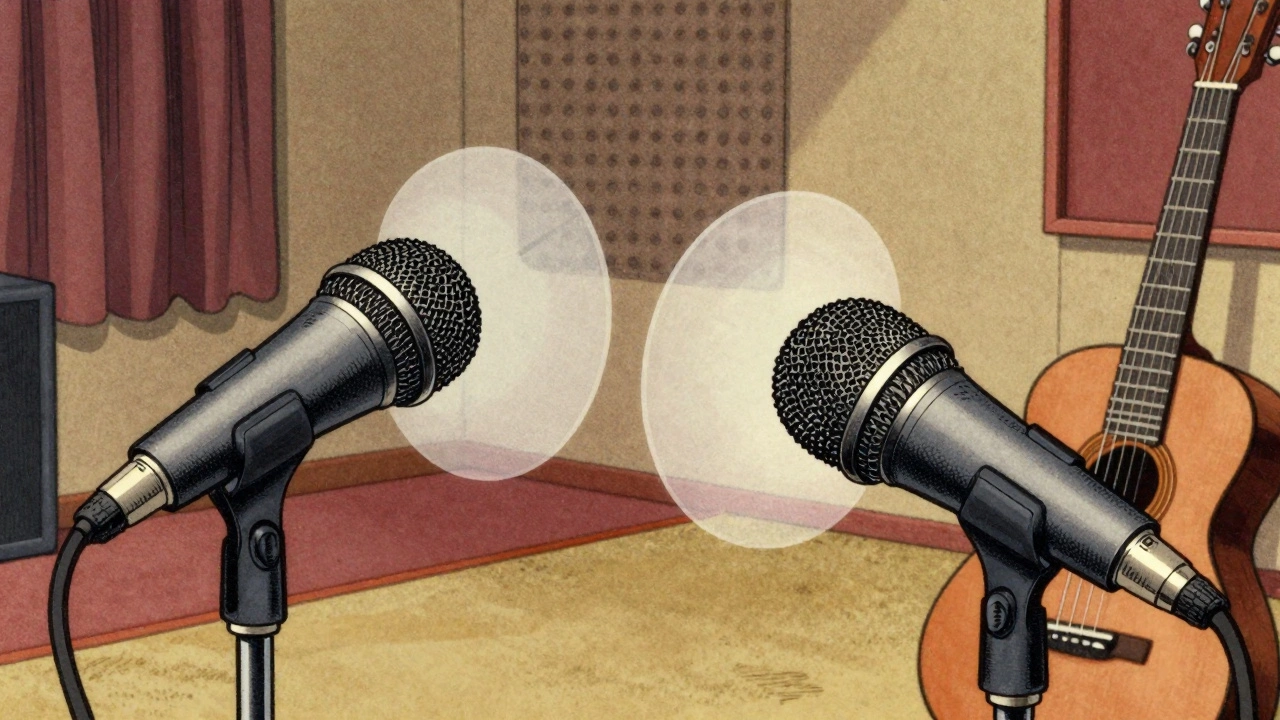
If your room is untreated or particularly reflective, "The Frame" might pick up too much noise. In those cases, the dual figure-8 technique offers superior isolation. This method exploits the unique directional properties of bi-directional microphones, which reject sound coming from the sides.
You place one figure-8 mic with its front lobe aimed at the 12th fret of the guitar. The vocalist looks down at the top of this capsule. The second figure-8 mic faces the vocalist’s mouth, with its side pointing down toward the guitar. Since figure-8 mics reject sound from the sides, the guitar bleed into the vocal mic is significantly reduced. However, you must keep these mics close-between 5 and 8 inches from their respective sources. If they are too far away, the direct-to-ambient ratio drops, and you’ll hear more of the room’s reflections in the rear lobes. This technique works best in rooms with soft furnishings like carpets and heavy drapes, which dampen the reflections that the rear lobes would otherwise capture.
Signal Processing and Gain Staging
Capturing the sound is only half the battle. How you process the signal during recording determines whether the final mix sounds professional or muddy. Ribbon microphones, like the MXL R-77-L, output very low signal levels because they rely on electromagnetic induction. You need high-quality, low-noise preamps to boost them without adding hiss.
A common chain involves routing the ribbon mic into a unit like the Avalon 737sp is a professional preamp/compressor/EQ module capable of handling high-gain requirements for passive ribbon microphones with transparent coloration. Important: never use phantom power on a ribbon mic unless it is specifically designed for it, as it can damage the delicate diaphragm. Apply gentle compression at a 3:1 ratio with a moderately fast attack. Set the threshold so you only get about 3 decibels of gain reduction on the loudest strums. This tames the dynamic range of the acoustic guitar, which can swing wildly between quiet fingerpicking and aggressive strumming.
For EQ, try a Pultec-style trick. Cut 3 decibels at 80 Hz with a low-shelf filter, then boost 5 decibels at 80 Hz with a narrow Q. This tightens the bass response, removing the flabbiness that often plagues home recordings. Add a slight boost at 1.5 kHz for presence and a substantial lift at 20 kHz for air. The vocal mic, if it’s a tube model like the Genesis, often needs no processing at all during tracking. Its inherent compression and harmonic excitement usually translate beautifully to the digital domain.
Managing Phase Coherence
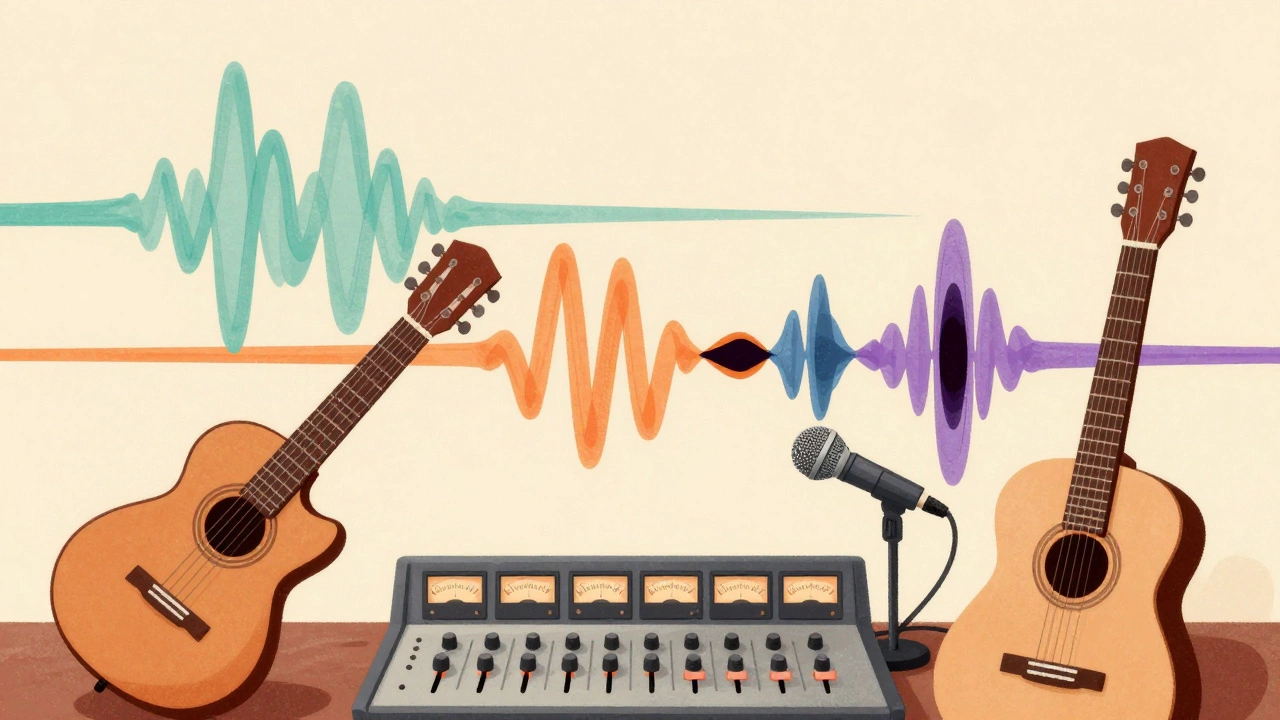
When you use multiple microphones on the same source, phase cancellation becomes your biggest enemy. Sound waves travel at different speeds to each mic. If the waveforms arrive out of sync, they cancel each other out at certain frequencies, making the sound thin or hollow. This is especially problematic with the dual guitar mics in "The Frame" technique.
To check for phase issues, solo the two guitar channels and pan them both to the center. Listen carefully. Does the sound get thinner or lose low-end punch? If so, flip the polarity button on one of the channels. Most digital audio workstations have a phase correlation meter. Keep an eye on it while recording. A reading closer to +1 indicates good coherence, while readings near -1 suggest severe cancellation. You can also adjust the physical distance of the mics. Moving one mic slightly closer or further away changes the arrival time of the sound waves, potentially resolving the phase issue without flipping polarity.
Room Acoustics and Environment
No amount of microphone technique can fix a terrible room. Hard surfaces like drywall, tile, and hardwood floors create early reflections that smear the transient details of the guitar and vocal. These reflections arrive at the microphone milliseconds after the direct sound, causing comb-filtering effects that make the recording sound unnatural.
If you don’t have a professionally treated studio, look for the "deadest" room in your house. A bedroom with carpet, a bed, and heavy curtains is often better than a living room with bare walls. Place absorption materials at the first reflection points. You can find these by standing where the performer will be and having someone slide a mirror along the walls. Wherever you can see the microphone in the mirror, that’s a reflection point. Hang thick blankets or acoustic foam there. For the figure-8 technique, pay special attention to what is behind the microphones, as the rear lobes are fully open to the environment.
Simultaneous vs. Sequential Recording
Many producers ask if they should record the guitar first and then overdub the vocals. Sequential recording gives you total control. You can fix every squeak, adjust the EQ independently, and ensure perfect isolation. But it often kills the performance. The singer loses the visual and auditory cue of seeing and hearing themselves play the instrument. The subtle rhythmic pushes and pulls that define a great singer-songwriter track vanish.
Simultaneous recording preserves the energy. It forces you to solve problems upfront through mic placement and performance rather than relying on post-production fixes. While it requires more discipline and better room acoustics, the result is almost always more emotionally compelling. For intimate acoustic material, the authenticity of the moment is worth the technical challenges.
What is the best microphone for recording vocals and guitar simultaneously?
There is no single "best" microphone, but small-diaphragm condensers like the Neumann KM84 or Rode NT5 are popular for guitar due to their accuracy and tight cardioid patterns. For vocals, large-diaphragm condensers like the Shure SM7B or tube mics like the MXL Genesis offer warmth and proximity effect. The choice depends on your room and budget.
How do I prevent phase cancellation when using two mics on an acoustic guitar?
Use the 3:1 rule: place the second microphone at least three times the distance from the first microphone as the first mic is from the source. Check phase alignment in your DAW by flipping polarity and listening for changes in low-end fullness. Adjust mic distances slightly until the combined sound is thickest and most coherent.
Can I record guitar and vocals in an untreated room?
It is challenging but possible. Use directional microphones (cardioid or figure-8) to reject room noise. Get close to the sources (within 6-12 inches). Use heavy blankets or furniture to dampen reflections. Avoid parallel walls if possible. The dual figure-8 technique may struggle in very reflective spaces compared to cardioid setups.
Why does my acoustic guitar sound muddy when recorded with vocals?
Mud usually comes from excessive low-frequency buildup. Both the vocal (due to proximity effect) and the guitar have strong low ends. Use a high-pass filter on the guitar tracks around 80-100 Hz. Cut some low-mids (200-400 Hz) on both tracks to reduce boxiness. Ensure your room doesn't have modal resonances in these frequencies.
Should I use compression on the acoustic guitar during recording?
Yes, gentle compression helps manage the wide dynamic range of acoustic guitar. Aim for 2-4 dB of gain reduction on peaks. Use a moderate ratio (2:1 to 3:1) and a fast enough attack to catch transients but slow enough to let the initial pick strike through. This makes the performance easier to mix later.