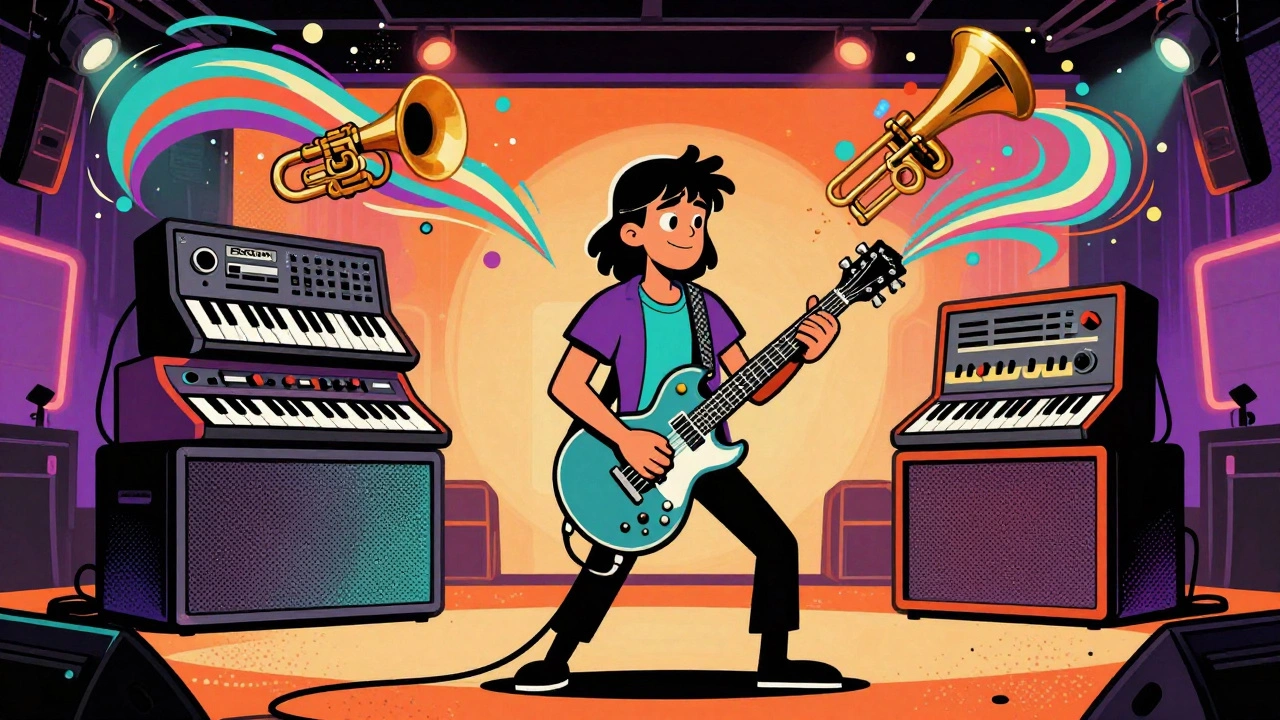

Imagine picking up your electric guitar, strumming a chord, and hearing a massive brass section or a sweeping string pad instead of distorted power chords. For most musicians, this is now a standard feature of digital modeling software. But in the 1980s, achieving this sound required bulky floor units, strange-looking controllers with stabilizer bars, and thousands of dollars. This era was the high-water mark for hardware guitar synthesizers, which were devices that allowed guitarists to control analog or digital synthesizers using a guitar-like interface, often via hexaphonic pickups or pitch-to-MIDI conversion. These instruments weren't just niche curiosities; they fundamentally altered the sonic landscape of jazz fusion, progressive rock, and experimental pop.
The technology didn't appear out of nowhere. Late-1970s precursors like the ARP Avatar attempted to bridge the gap between guitar and synth but suffered from poor tracking and high costs. However, the introduction of the MIDI 1.0 specification in January 1983 changed everything. Suddenly, guitarists could use their instrument as a controller for any external synthesizer module. This shift sparked a decade of intense experimentation by Japanese giants like Roland and Yamaha, alongside boutique British innovators, resulting in some of the weirdest and most influential gear ever made.
The Roland Revolution: From Analog Magic to Digital Precision
Roland Corporation dominated the early conversation with its GR-series. The Roland GR-300, introduced around 1980, was a dedicated analog synthesizer paired with special G-series guitars featuring individual pickups for each string (hexaphonic pickups). Unlike later systems that tried to convert audio signals into data, the GR-300 used direct string-derived waveform synthesis. This meant near-instantaneous tracking-often cited as under 5 milliseconds on higher strings-which felt incredibly natural to players.
This speed made it a favorite among top-tier musicians. Pat Metheny used it extensively on albums like Offramp (1982) and Travels (1983), creating lush, orchestral textures that would have been impossible with traditional amps. Andy Summers of The Police also adopted it for live tours in the early 1980s, adding atmospheric layers to the band's post-punk sound. The GR-300’s "trumpet" patch became iconic, offering a warm, expressive tone that responded beautifully to vibrato and bends. While sales numbers were never officially released, estimates suggest thousands of units were sold, making it the most successful dedicated guitar synth of the era.
By 1984, Roland pivoted to digital technology with the Roland GR-700. This system featured digitally controlled oscillators (DCOs) similar to those found in the popular JX-3P keyboard, allowing for 64 user presets and MIDI output. It was paired with the futuristic G-707 guitar, recognizable by its carbon-fiber stabilizer bar connecting the headstock to the body. While the GR-700 offered greater versatility and connectivity, it introduced latency issues-particularly on lower notes, where delays of 20-30 milliseconds were common. This made it excellent for pads and leads but less ideal for fast, rhythmic playing compared to its analog predecessor.
The SynthAxe: Britain’s Most Expensive Oddity
If you want to understand the extreme end of 1980s experimentation, look no further than the SynthAxe. Developed in the UK by Bill Aitken, Mike Dixon, and Tony Sedivy, this instrument launched in 1985 with a price tag between £10,000 and £13,000 (roughly $15,000-$25,000 USD at the time). Fewer than 100 units were ever built before the company collapsed around 1988.
The SynthAxe did not use traditional vibrating strings for sound generation. Instead, it featured two sets of short strings-one on the main neck and another on a separate strumming area-alongside optical sensors that detected fret position and pluck velocity. All inputs were converted into MIDI, allowing control over complex parameters like pitch bend and vibrato per string. Its most famous advocate was guitarist Allan Holdsworth, who described it as "the most expressive instrument I’ve ever played." He used it on albums like Atavachron (1986) and Sand (1987), dedicating entire sections of his live shows to its unique textures.
Despite rave reviews from session players like Lee Ritenour and Gary Moore, the SynthAxe’s adoption was limited by its prohibitive cost, weight (over 10 kg), and steep learning curve. Interestingly, its legacy survived through Roy "Future Man" Wooten of Béla Fleck and the Flecktones, who heavily modified one unit in the early 1990s to create the "SynthAxe Drumitar," effectively turning it into a MIDI percussion controller.
Other Notable Experiments: Stepp, Yamaha, and Casio
Beyond Roland and SynthAxe, several other manufacturers pushed the boundaries of what a guitar could be. The Stepp DGX, produced in very limited numbers (under 50 units) between 1982 and 1985, used fingerboard sensors and digital scanning to output control voltages or MIDI. Its angular, futuristic design and touch-sensitive areas made it one of the rarest and strangest controllers of the decade. Surviving units today are highly sought after by collectors.
Yamaha entered the market mid-decade with the Yamaha G10 system. Announced around 1984, it featured non-resonant metal strings and fret sensors, producing no acoustic sound whatsoever. While it offered relatively low latency, the rigid, un-bendable strings made it feel alien to traditional guitarists. Similarly, Casio pursued a more consumer-oriented path with its DG-series digital guitar synthesizers. The Casio DG-20, released around 1987, was a plastic-bodied controller with nylon strings and built-in PCM synthesis. Priced around $300-$400, it was accessible to hobbyists and students, offering reliable MIDI triggering despite ergonomic complaints about its thick neck and stiff strings.
| Model | Manufacturer | Technology | Approx. Price (1980s) | Key Feature |
|---|---|---|---|---|
| Roland GR-300 | Roland | Analog / Hexaphonic | $2,000 - $3,000 | Near-zero latency tracking |
| Roland GR-700 | Roland | Digital / DCO | $2,500 - $3,500 | MIDI output & presets |
| SynthAxe | SynthAxe Ltd. | Sensor-based / MIDI | $15,000 - $25,000 | Per-string expression control |
| Yamaha G10 | Yamaha | Sensor-based / Non-vibrating | $2,000+ | No acoustic sound, pure electronic |
| Casio DG-20 | Casio | PCM / Sensor Strings | $300 - $400 | Affordable entry-level option |
Why Did They Fade?
Despite their innovation, 1980s guitar synths never achieved mainstream success. Several factors contributed to their decline. First, the technology was inherently flawed for many users. Pitch-to-MIDI systems suffered from latency and mistracking, especially when playing chords or using distortion. Setup was tedious, requiring precise adjustment of pickup heights within millimeter tolerances. Second, the cost was prohibitive for most musicians. Even the "affordable" Casio models were expensive compared to standard electric guitars, while pro systems like the SynthAxe cost as much as a car.
Third, the rise of powerful keyboard workstations like the Korg M1 (released in 1988) provided an easier alternative. Musicians could achieve rich synth sounds without struggling with guitar-specific tracking issues. By the late 1980s, major manufacturers began discontinuing these lines. Roland shifted focus toward rack-mount interfaces like the GI-10, while Casio withdrew from the market entirely. Boutique makers like SynthAxe and Stepp ceased operations due to financial pressures.
Legacy and Modern Revival
Though commercially unsuccessful, 1980s guitar synths left a lasting impact. Their experiments paved the way for modern technologies like Roland’s GK-series pickups and VG-99 processors, Fishman’s TriplePlay wireless MIDI system, and software solutions like Jam Origin’s MIDI Guitar. Today, these vintage units are prized by collectors and historians. Rare models like the SynthAxe and Stepp DGX command high prices on the secondary market, reflecting their status as icons of 1980s futurism.
For contemporary musicians interested in exploring this sound, understanding the limitations of 1980s technology is key. While modern software offers superior tracking and flexibility, the unique character of analog systems like the GR-300 remains unmatched. If you’re looking to dive into this world, start with affordable options like the Casio DG-series or explore modern MIDI guitar plugins before investing in rare vintage hardware.
What makes the Roland GR-300 so special?
The Roland GR-300 is renowned for its near-instantaneous tracking speed, thanks to its direct string-derived waveform synthesis. Unlike later pitch-to-MIDI systems, it didn’t rely on analyzing audio signals, resulting in minimal latency. This made it feel natural to play, especially for techniques like vibrato and bends, earning praise from artists like Pat Metheny.
How much did the SynthAxe cost in the 1980s?
The SynthAxe launched in 1985 with a price tag between £10,000 and £13,000, equivalent to roughly $15,000-$25,000 USD depending on configuration. This extreme cost, combined with its complexity and weight, limited its adoption to a small circle of elite session players and enthusiasts.
Why did guitar synths become unpopular?
Guitar synths faded due to several factors: high costs, technical limitations like latency and mistracking, and the difficulty of setup. Additionally, the rise of affordable and versatile keyboard workstations like the Korg M1 offered musicians easier ways to access synth sounds without the frustrations associated with guitar-specific controllers.
Are there any modern equivalents to 1980s guitar synths?
Yes, modern technology has evolved significantly. Systems like Roland’s VG-99 and Fishman’s TriplePlay offer improved tracking and wireless capabilities. Software solutions such as Jam Origin’s MIDI Guitar provide even greater flexibility, allowing guitarists to trigger virtual instruments with minimal latency and high accuracy.
Who famously used the SynthAxe?
British guitarist Allan Holdsworth was the most prominent advocate of the SynthAxe. He used it extensively on albums like Atavachron and Sand, praising its expressive capabilities. Other notable players who experimented with it included Lee Ritenour and Gary Moore, though few adopted it long-term due to its challenges.