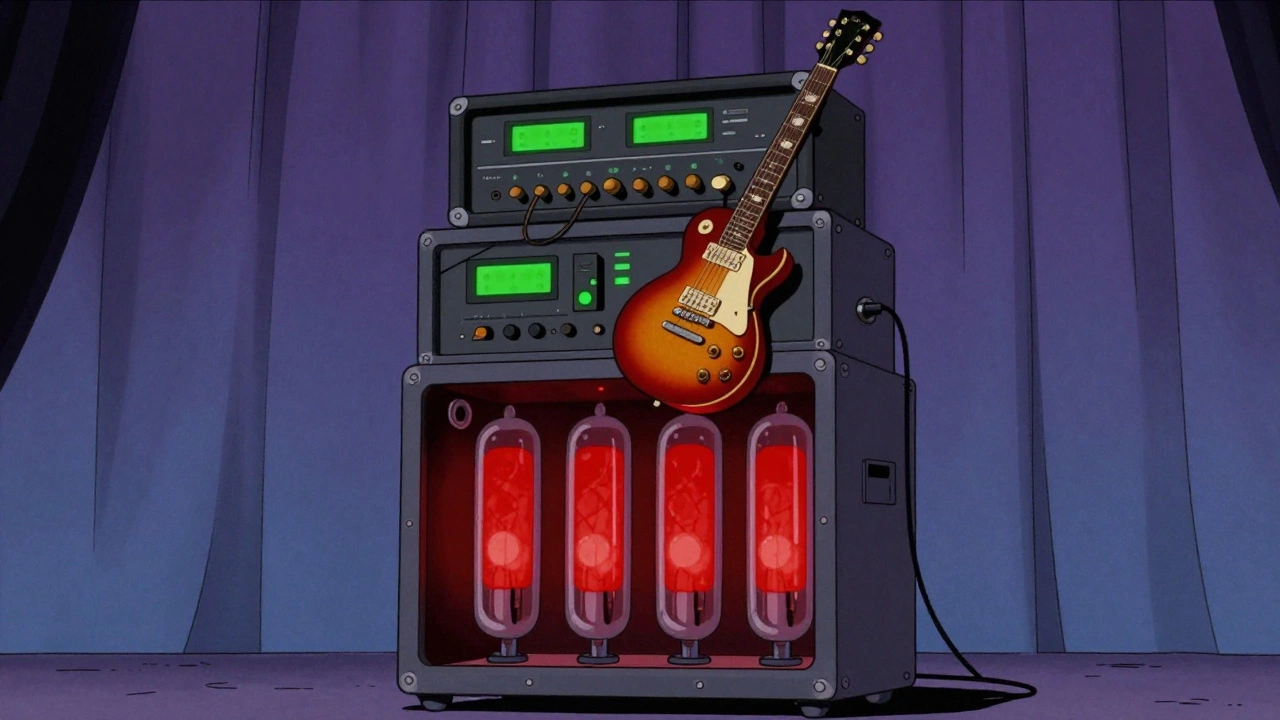

Picture a road case taller than you are. It weighs sixty kilograms. Inside, tubes glow red while digital displays blink green. This isn't a sci-fi prop; it is the standard touring setup for metal guitarists between 1990 and 1999. If you want to understand the sound of 1990s metal, which defined the heavy, rhythmic aesthetic of groove, industrial, and extreme metal genres through specific gear choices, you have to look at the hardware that built it. The era was defined by three things: massive rack systems that modular collections of audio equipment including preamps, effects, and power amplifiers mounted in standardized frames, obsessive pursuit of tight high gain distortion that heavily saturated amplifier tones characterized by compression and sustain, and the radical shift toward drop tunings that lowered string pitches such as Drop D or C Standard to achieve heavier chord voicings.
The Anatomy of a 1990s Rack Rig
You cannot separate the sound from the signal chain. In the early 1990s, the pedalboard was dead on stage. Instead, guitarists plugged into a complex tower of electronics. A typical rig started with a high-output humbucker guitar-think Gibson Les Pauls or Ibanez RGs with pickups measuring around 13-18 kΩ DC resistance. That signal hit a wireless receiver or a buffered line driver before entering the heart of the system: the rack preamp that a compact tube-based amplifier section designed to generate distortion before the power amp stage.
Units like the ADA MP-1 (introduced circa 1987) or the Mesa/Boogie TriAxis were central here. These 1U or 2U units offered multiple programmable channels via MIDI. You could store dozens of presets for clean, crunch, and lead tones. The signal then moved to multi-effects processors from brands like Alesis, Rocktron, or Digitech. Finally, it hit a stereo tube power amp-often a Mesa/Boogie Strategy or VHT unit running 2x50W to 2x100W-and pushed air through one or two 4x12 cabinets.
Why go through all this trouble? Modularity. If your preamp broke mid-tour, you swapped the 1U module, not the entire head. You could re-patch the rear panel and update MIDI presets without buying new amps. But there was a cost: complexity. Troubleshooting a 12-unit rack with tangled cabling was a nightmare compared to plugging into a single amp head.
Dialing in the High Gain Tone
High gain in the 1990s wasn't just about turning the volume knob up. It was about control. The goal was a saturated but tight distortion that didn't turn into mud when you palm-muted fast riffs. Modern tutorials recreating these tones reveal specific numerical settings that mirror how engineers shaped the sound back then.
Consider a typical setup using a Dual Rectifier-style amplifier, which became the gold standard for heavy rhythm tones. To get that industrial or groove metal punch, players often set the gain to maximum (20 in many plugins), but kept the bass low-at 1. The middle frequencies were scooped slightly, often set to -4, while treble was boosted to 4. Presence sat around 2. This EQ curve removed the flubby sub-bass that kills articulation and emphasized the cutting top end.
Mic placement mattered just as much. Engineers typically used a Shure SM57 dynamic mic on the left channel and an AKG C414 condenser on the right, both placed close to the speaker cone but slightly off-center. They hard-panned these tracks left and right to create a wide stereo field. Then came the secret weapon: multiband compression on the group bus. This controlled the low-frequency rumble from palm-muted parts, ensuring every chug hit with surgical precision.
The Shift to Lower Tunings
Gear changes didn't happen in a vacuum. Guitarists were also changing how they tuned their instruments. Standard E tuning puts the low E string at approximately 82.41 Hz. By the mid-1990s, bands were dropping down to Drop D (D-A-D-G-B-E), lowering that sixth string to about 73.42 Hz. Others went to C Standard (C-F-A#-D#-G-C), hitting roughly 65.41 Hz, or even adopted 7-string guitars tuned to B Standard (B-E-A-D-G-B-E), where the lowest note sits near 61.74 Hz.
This downward shift forced rig designers to adapt. Low frequencies eat up headroom and can make an amp sound loose and undefined. Players needed speakers with higher power handling-often 60-100 W per speaker-and cabinets that could reproduce these frequencies with clarity. Amps with strong damping factors and carefully voiced negative feedback circuits became essential. They maintained definition under heavy palm-muting, keeping the low end tight rather than boomy.
| Tuning | String Configuration | Lowest Note Frequency | Typical Use Case |
|---|---|---|---|
| Standard E | E-A-D-G-B-E | 82.41 Hz | Traditional Thrash/Hard Rock |
| Drop D | D-A-D-G-B-E | 73.42 Hz | Groove Metal / Nu-Metal Roots |
| C Standard | C-F-A#-D#-G-C | 65.41 Hz | Death Metal / Extreme Metal |
| B Standard (7-String) | B-E-A-D-G-B-E | 61.74 Hz | Progressive Metal / Djent Precursors |
From Racks to Heads: The Late 90s Transition
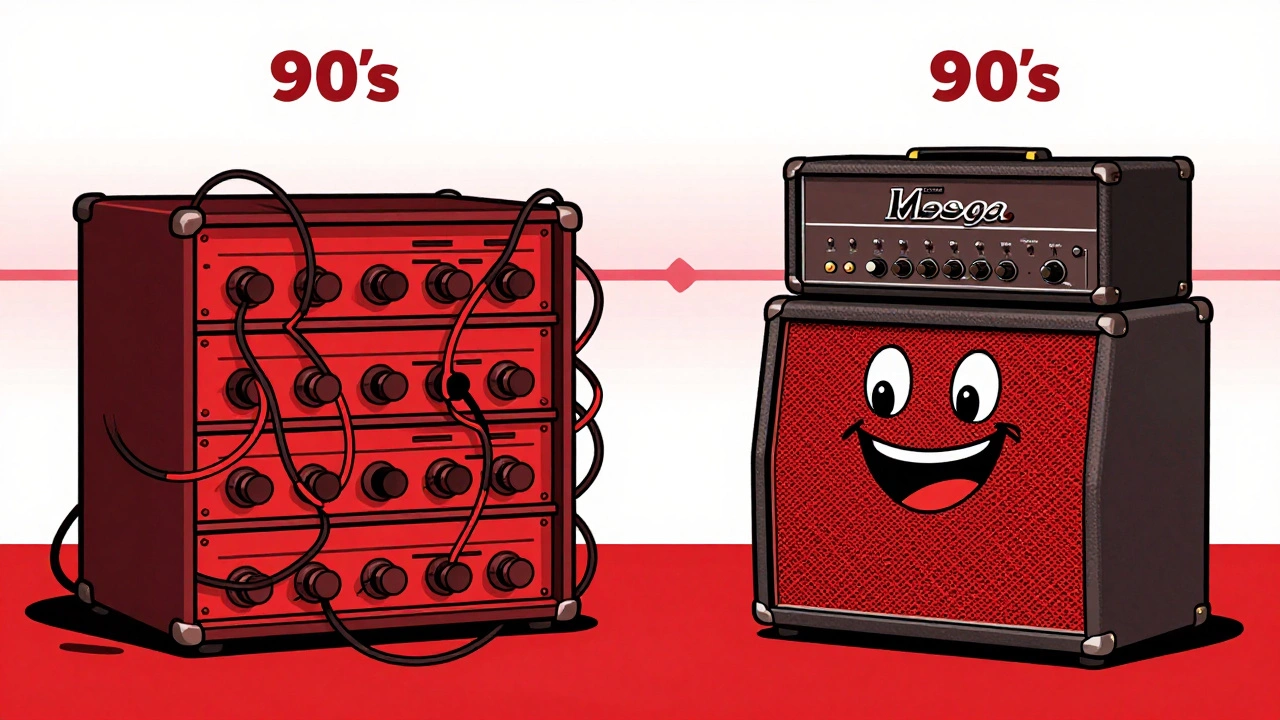
By the late 1990s, the tide began to turn. The very complexity that made racks appealing also made them burdensome. Touring techs hated the maintenance. Tubes aged, components failed, and programming errors could kill a show. Enter the Peavey 5150 and the Mesa/Boogie Dual Rectifier. These standalone heads offered more than enough gain and channel switching for metal needs without external preamps.
The Dual Rectifier, in particular, changed the game. Its rectified power supply provided a snappy, compressed response that worked perfectly with lower tunings. Players realized they didn't need a 12-unit rack to get a huge sound. They just needed a great head and a few pedals. This shift simplified touring setups and democratized the tone. You no longer needed a team of engineers to build your rig; you could buy one box and plug in.
Yet, the influence of the rack era lingered. The modular thinking persisted in how players approached signal chains. Even today, debates rage on forums about whether modern modelers capture the unique grain of classic 80s and 90s rack preamps like the ADA MP-1 or Soldano SLO. Many argue that those older digital units and analog preamps had tonal signatures worth emulating, distinct from the smoother sounds of modern processors.
Recreating the Sound Today
If you want to nail that 1990s metal tone now, you don't need to haul a sixty-kilogram rack. But you do need to understand the principles. Focus on gain structure. Don't just max out the drive; cut the bass to tighten the low end. Use EQ to boost the highs for cut. And if you're recording, experiment with dual mic techniques and multiband compression to control the dynamics.
Whether you use a vintage Mesa/Boogie TriAxis, a modern plugin modeling a Rectifier, or a Peavey 5150 head, the core ideals remain the same: high saturation, clear articulation, and strong low-end control. The hardware has evolved, but the sonic blueprint laid down in the 1990s still defines heavy music.
What was the most common preamp in 1990s metal rigs?
The ADA MP-1 and Mesa/Boogie TriAxis were among the most influential rack preamps of the era. They offered tube-driven, MIDI-programmable channels that provided tight crunch and overdrive tones essential for metal rhythm playing.
Why did metal guitarists switch from racks to amp heads in the late 90s?
Rack systems were complex, heavy, and difficult to troubleshoot on tour. The introduction of high-gain heads like the Mesa/Boogie Dual Rectifier and Peavey 5150 provided sufficient gain and versatility in a simpler, more reliable format.
How did drop tunings affect amplifier design?
Lower tunings required amps with tighter low-frequency response and better damping factors to prevent mud. This led to the popularity of amps with strong negative feedback circuits and speakers with higher power handling capabilities.
What EQ settings define the 1990s high-gain metal tone?
A common approach involved setting bass low (around 1), mids slightly scooped (around -4), and treble boosted (around 4). Post-amp EQ often added further high-frequency emphasis, while multiband compression controlled low-end rumble.
Are 1990s rack rigs still used today?
Full hardware racks are rare on mainstream tours today due to the rise of digital modelers and compact heads. However, their tonal concepts and modularity influence modern rig design, and vintage units remain sought after by collectors and purists.