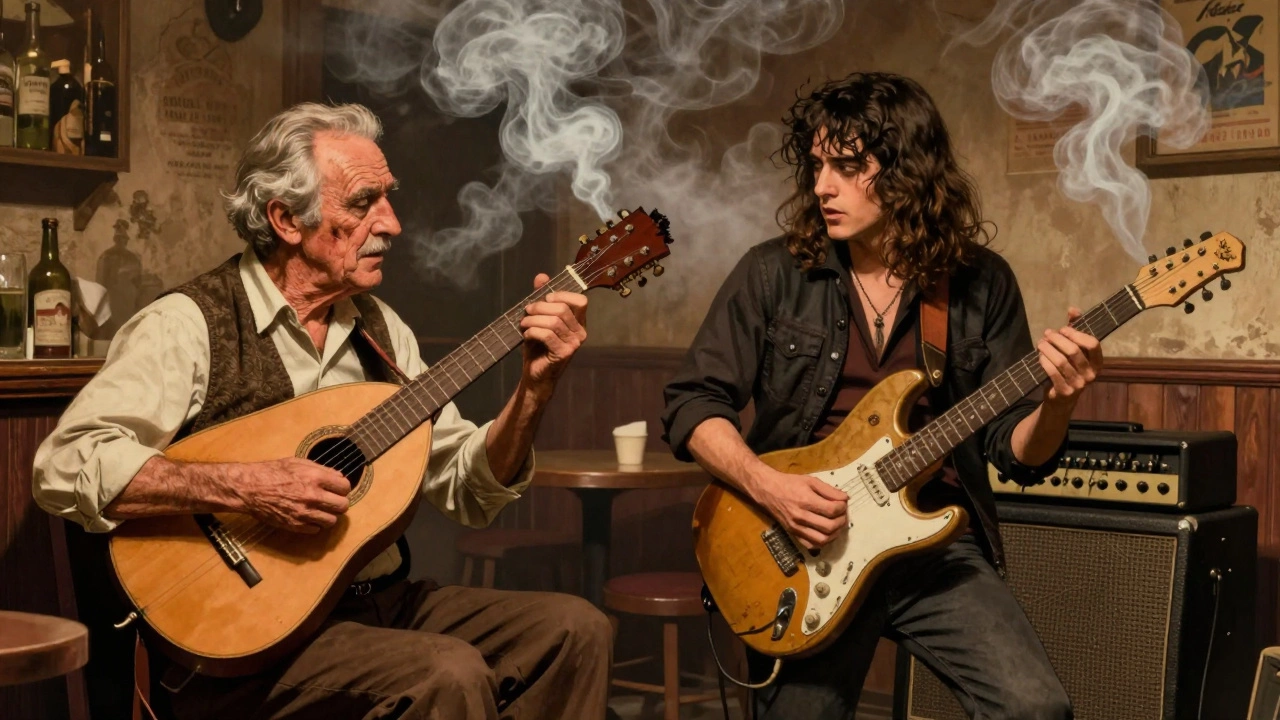

Imagine a smoky tavern in Athens in 1975. On one side of the room, you've got a bouzouki player gripping a traditional melody, and on the other, a young musician with a distorted electric guitar. For a long time, these two worlds-the ancestral folk sounds and the rebellious energy of Western rock-were seen as opposites. But during the 1970s, they collided in a way that redefined what popular music sounded like in Greece. This wasn't just about adding a drum kit to a folk song; it was a cultural reclamation project that blended the raw grit of the streets with the loud, amplifier-driven sound of a global movement.
What Exactly is Laïko?
To understand the 70s explosion, we first have to get a handle on Greek Laïko is a popular Greek music genre, literally meaning "song of the people," that evolved from the urban folk traditions of the early 20th century . It didn't just appear out of thin air. It grew directly out of Rebetiko, the "blues" of Greece, which was the music of the marginalized and the exiled. By the 1930s, Rebetiko started moving from the underground into the commercial spotlight, paving the way for Laïko to become the mainstream sound of the city.
By the 1960s and 70s, Laïko had entered its "classic" phase. It was the dominant cultural force in Greece, characterized by a heavy influence of Eastern melodies. You could hear it in the orientalized scales and rhythmic patterns that echoed the music of Turkey. In some cases, this went so far that a style called indoyíftika (Indian-gypsy songs) emerged, which basically sounded like Bollywood soundtracks but with Greek lyrics. This openness to outside influence is exactly why the genre was so primed to merge with rock and roll when the 70s hit.
The 1970s: When Folk Met the Electric Guitar
The 1970s were a turning point. After years of political turmoil, there was a massive hunger for identity. Young musicians started looking back at their roots, but they didn't want to just copy their grandfathers. They wanted something that felt current. This is where the fusion happened. They began incorporating Rock elements-heavy bass lines, electric guitars, and a more aggressive drumming style-into the traditional Laïko framework.
This wasn't just a musical choice; it was a statement. By blending the bouzouki (the quintessential Greek lute) with rock instrumentation, artists created a sound that was both nationalistic and global. They took the sentimental ballads of classic Laïko and gave them a raw, edgy energy. It turned the music of the tavern into the music of the stadium.
| Feature | Classic Laïko (Pre-70s) | 70s Folk-Rock Fusion |
|---|---|---|
| Primary Instrument | Bouzouki, Baglamas | Electric Guitar, Bouzouki, Drums |
| Musical Influence | Balkan, Turkish, Byzantine | Anglo-American Rock, Psychedelia |
| Typical Setting | Small Tavernas, Nightclubs | Concert Halls, Large Festivals |
| Lyrical Focus | Heartbreak, Poverty, Exile | Social Change, Identity, Modern Love |
The Bridge to High Art: The Entekhno Movement
While some were rocking out, others were trying to make popular music "respectable." This led to the rise of Éntekhno, which is essentially a fusion of folk idioms and classical orchestration. Think of it as the sophisticated cousin of Laïko. Composers like Mikis Theodorakis and Manos Hatzidakis played a huge role here. They didn't see Rebetiko or Laïko as "low-brow" music; they saw it as the true soul of Greece and set modern poetry to these folk rhythms.
This movement created a bridge. It allowed the grit of the street to enter the concert hall. In the post-1970s era, artists like Haris Alexiou and George Dalaras became superstars by navigating all three worlds: the raw folk of Laïko, the polished art of Éntekhno, and the modern energy of global pop and rock. If you listen to their work from that era, you can hear the seamless transition from a traditional Zeibekiko rhythm to a lush, orchestral arrangement.
Rhythms that Define the Soul
You can't talk about this era without talking about the dance. The music of the 70s was designed to be moved to. The fusion didn't kill the traditional dances; it just gave them a new heartbeat. Whether it was a rock-infused track or a classic ballad, the skeletal structure of the music remained rooted in Greek dance rhythms.
Some of the key rhythms that persisted through the rock fusion include:
- Zeibekiko: A heavy, soulful 9/8 rhythm, often used for songs of solitude and pain.
- Hasapiko: A more structured, communal dance rhythm that provided a steady beat for folk-rock blends.
- Syrta: A fluid, winding rhythm that allowed for the improvisational feel common in both jazz-rock and traditional folk.
- Kalamatianos: A bright, energetic dance rhythm that often appeared in the more "upbeat" pop-laïko tracks of the era.
When a 1970s band played a Zeibekiko with an electric bass instead of a double bass, they weren't changing the song-they were translating it for a new generation.
The Rebetiko Revival and Cultural Memory
Interestingly, while the 70s were pushing music forward into rock, there was also a massive look backward. The early 1970s saw a surge in the Rebetiko revival. Old 78 rpm records were being re-released as LPs. This wasn't just nostalgia; it was a way for people to reconnect with an authentic Greek identity that had been polished away by commercial pop.
This revival created a strange but beautiful paradox. At the same time that musicians were experimenting with synthesizers and distortion, they were obsessively studying the raw, unvarnished recordings of artists like Markos Vamvakaris. This deep dive into the archives ensured that the "rock" side of the music didn't erase the "folk" side. Instead, it gave the fusion more credibility. The musicians knew exactly where the sounds came from, which is why the 70s fusion feels so authentic rather than like a gimmick.
From Classic to Modern Laïko-Pop
The experiments of the 70s laid the groundwork for what we now call modern laïko or laïko-pop. Today, the mainstream music in Greece is a direct descendant of that 70s collision. Modern hits often use a mix of digital production, rock guitars, and the occasional bouzouki flourish, all while maintaining those sentimental, heart-on-the-sleeve lyrics that have defined the genre for a century.
If you look at the evolution, it's a straight line: the marginalized sounds of Rebetiko became the popular songs of the people in Laïko, which then absorbed the artistic ambitions of Éntekhno and the sonic power of Rock. What started as music for the displaced became the soundtrack of a nation.
What is the main difference between Rebetiko and Laïko?
Rebetiko is the older, more underground precursor to Laïko. It was the music of the urban poor and marginalized groups, often with themes of crime, drugs, and exile. Laïko, which emerged as Rebetiko became commercialized in the 1930s, is a more polished, mainstream version of the music designed for a wider audience, blending folk roots with pop sensibilities.
Who are some of the most influential figures in the Entekhno movement?
Manos Hatzidakis and Mikis Theodorakis were the primary architects of Entekhno. They fused traditional Greek folk and urban idioms with classical music and high-quality poetry, effectively bridging the gap between popular street music and the academic art world.
How did rock music influence 1970s Greek music?
Rock introduced electric instrumentation, such as the electric guitar and drums, and a more aggressive energy to traditional Greek music. This resulted in a fusion where traditional folk rhythms and bouzouki melodies were paired with the sonic weight of Western rock, reflecting the social and political changes of the decade.
What are some typical rhythms used in Laïko music?
Common rhythms include the 9/8 Zeibekiko (often slow and soulful), the communal Hasapiko, the fluid Syrta, and the energetic Kalamatianos. These dance rhythms are the backbone of the music's identity, even in modern pop versions.
What is "laïko-pop"?
Laïko-pop is the contemporary version of the genre. It blends traditional Greek folk elements and sentimental ballads with modern pop, rock, and electronic dance music (EDM) production. It is currently the dominant mainstream music style in Greece.