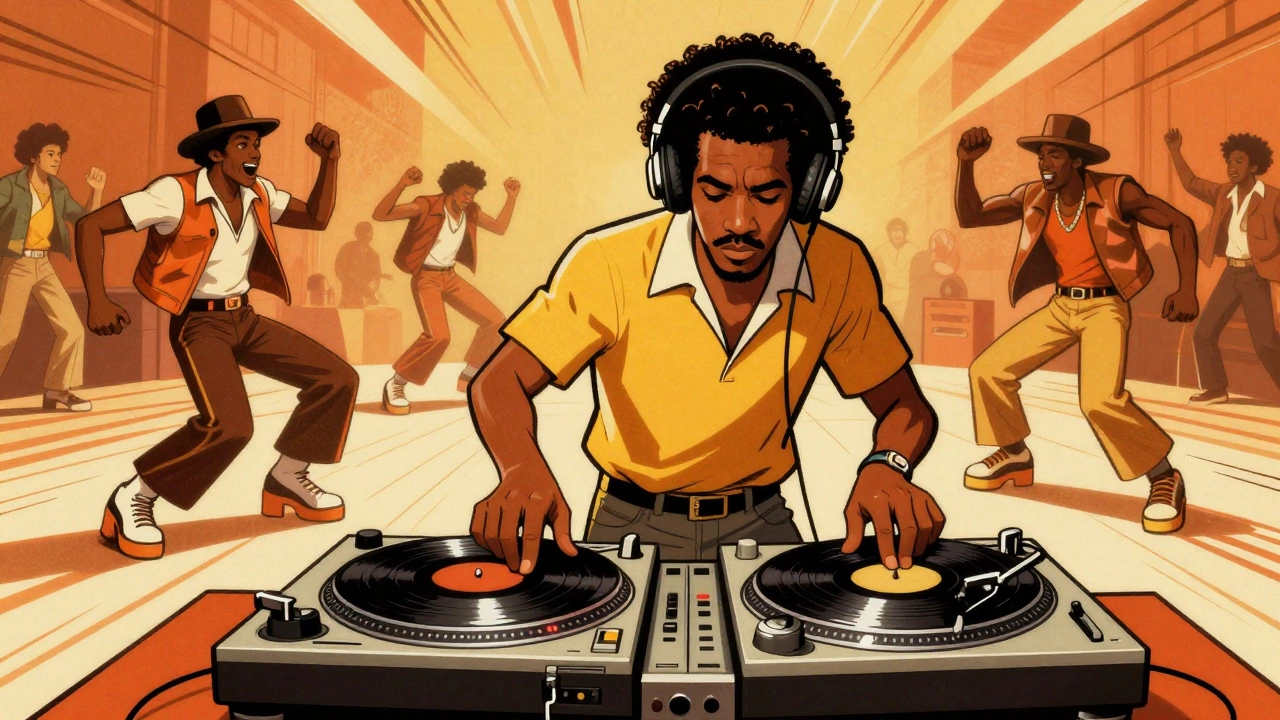

Imagine you are at a party in the Bronx in 1975. The breakbeat-the part of the song where the band drops out and just the drums play-is only eight seconds long. Then it ends. The dancers stop. The energy dies. Now imagine a DJ who can stretch that eight-second burst into five minutes of non-stop rhythm. That is exactly what Grandmaster Flash is a pioneering hip-hop DJ and innovator who developed Quick Mix Theory to loop drum breaks indefinitely using two turntables and precise backspinning techniques. Born Joseph Saddler in Barbados, he moved to New York and revolutionized how music was performed live. He didn't just spin records; he edited them in real-time. This technique, often called beat juggling is a DJ technique involving the rapid switching between two identical copies of a record to create an extended loop of a specific musical phrase, laid the groundwork for modern sampling, turntablism, and the entire structure of hip-hop production.
The Problem with Vinyl Breaks
To understand why Grandmaster Flash’s innovation was so big, you have to look at the limitations of vinyl records in the 1970s. Most funk and disco tracks had short instrumental sections. A typical drum break might last four bars-roughly 8 to 16 seconds at 100 beats per minute (BPM). If a DJ played the whole song, the dancers would get bored waiting for the next break. Before Flash, DJs like DJ Kool Herc is the Jamaican-born pioneer credited with starting hip-hop culture by isolating and extending drum breaks using the 'merry-go-round' technique used a method called the "merry-go-round." He would switch between two or three different records that had similar breaks. It worked, but it wasn't seamless. You could hear the change. The rhythm would stutter.
Flash wanted something tighter. He wanted a continuous, unbroken loop of the best part of the track. To do this, he needed more than just good ears; he needed engineering skills. Growing up in the Bronx, Flash studied electronics at Samuel Gompers High School. He looked at his gear not as consumer appliances, but as tools that could be hacked. He realized that if he had two copies of the same record, he could rewind one while the other played. But standard turntables weren't built for that kind of manipulation. The friction was too high. If you tried to spin a record backward quickly, the whole platter would stop, causing a bad sound effect known as wow and flutter.
Inventing the Slipmat and Cue Monitoring
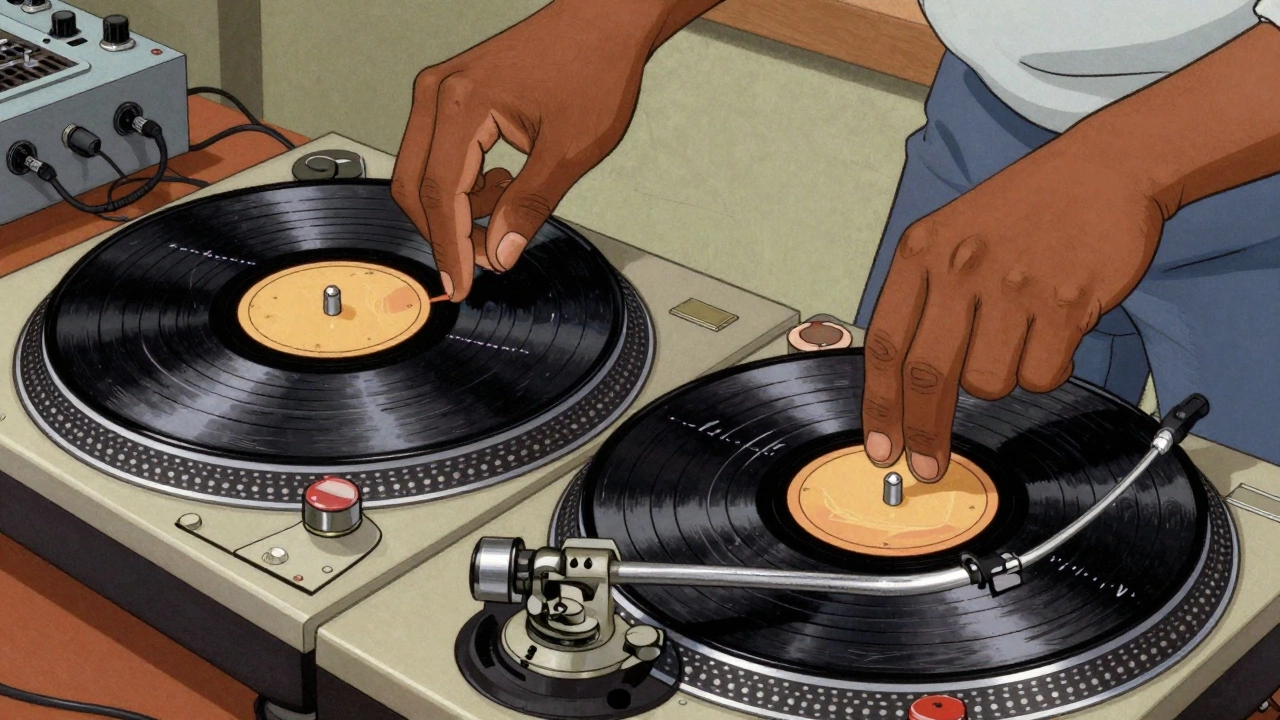
Flash solved the friction problem by inventing the slipmat is a low-friction mat placed under a vinyl record on a turntable, allowing the DJ to manipulate the record independently of the spinning platter. He cut up old felt mats, glued layers together, and added wax paper. This created a surface where the record could slide freely over the spinning motor. With a slipmat, Flash could hold the record still, push it forward, or spin it backward without stopping the motor underneath. This allowed him to execute a "backspin"-rewinding the record to the start of the break-in less than a second.
But seeing isn't enough; you need to hear. Early DJ mixers didn't let you listen to both turntables in your headphones at once. You had to guess when the next beat would hit. Flash wired his own mixer, splicing cables and using household glue to create a cue system. This let him hear Turntable B in his headphones while the audience heard Turntable A. He could line up the beats perfectly before bringing them into the main mix. This precision meant he could switch decks within milliseconds, making the loop sound infinite to the listener.
Quick Mix Theory: The Math Behind the Magic
This brings us to Quick Mix Theory is the mathematical framework developed by Grandmaster Flash to calculate exact record rotations needed to loop breaks seamlessly based on tempo and phrasing. Flash didn't just guess; he calculated. He discovered a simple ratio that made looping reliable. For a standard 33⅓ RPM record playing a 4-bar phrase, he found that rewinding the record exactly six counter-clockwise revolutions (CCR) would bring the needle back to the start of the break right on time.
Here is the logic:
- A 4-bar phrase at roughly 110-120 BPM lasts about 10-12 seconds.
- On a 33⅓ RPM record, the groove moves at a specific speed.
- By spinning the record backward six full times, the needle travels back precisely the distance of those 4 bars.
Flash marked the start and end of the break with a grease pencil. When the break reached bar 4 on Deck A, he would grab Deck B, spin it back six revolutions, and snap the crossfader. Because the math was consistent, he didn't have to rely on visual cues alone. He could feel the timing. This turned DJing from a passive activity into a compositional one. He was no longer just playing songs; he was creating new structures out of existing material.
| Technique | Pioneer | Method | Goal |
|---|---|---|---|
| Merry-Go-Round | DJ Kool Herc | Switching between different records with similar breaks | Keep dancers moving by chaining breaks |
| Scratching | Grand Wizzard Theodore | Rubbing record back and forth under needle | Create rhythmic percussive sounds |
| Beat Juggling / QMT | Grandmaster Flash | Backspinning identical records to loop a single break | Create infinite, seamless rhythmic beds for MCs |
Serving the MC and the Dancer
Why did Flash bother with all this complexity? His goal was practical. He wanted to serve two groups: the breakdancers and the MCs (rappers). Breakdancers needed long stretches of intense rhythm to perform their power moves. An 8-second break wasn't enough for a routine. By looping the break for 2 to 5 minutes, Flash gave them a stable platform.
For MCs, the benefit was even bigger. Rappers like Melle Mel of Grandmaster Flash and the Furious Five is the influential hip-hop group featuring Grandmaster Flash and MC Melle Mel, known for socially conscious lyrics and complex rhyme schemes enabled by extended breakbeats needed space to develop their stories. With a consistent, looping beat, they could write 16-bar or 32-bar verses without worrying about the music changing unexpectedly. Flash’s rule was simple: "Never go into the wack part." He stripped away the verses and choruses of pop songs, leaving only the most energetic drum breaks. This curation defined the early sound of hip-hop.
From Vinyl Loops to Digital Samples
The impact of Quick Mix Theory extends far beyond the dance floor. When samplers became available in the late 1980s, producers like Marley Marl didn't invent looping; they digitized Flash’s technique. The E-mu SP-1200 sampler, released in 1987, had limited memory, forcing producers to chop samples into small pieces-often 4-bar loops. This was essentially digital beat juggling.
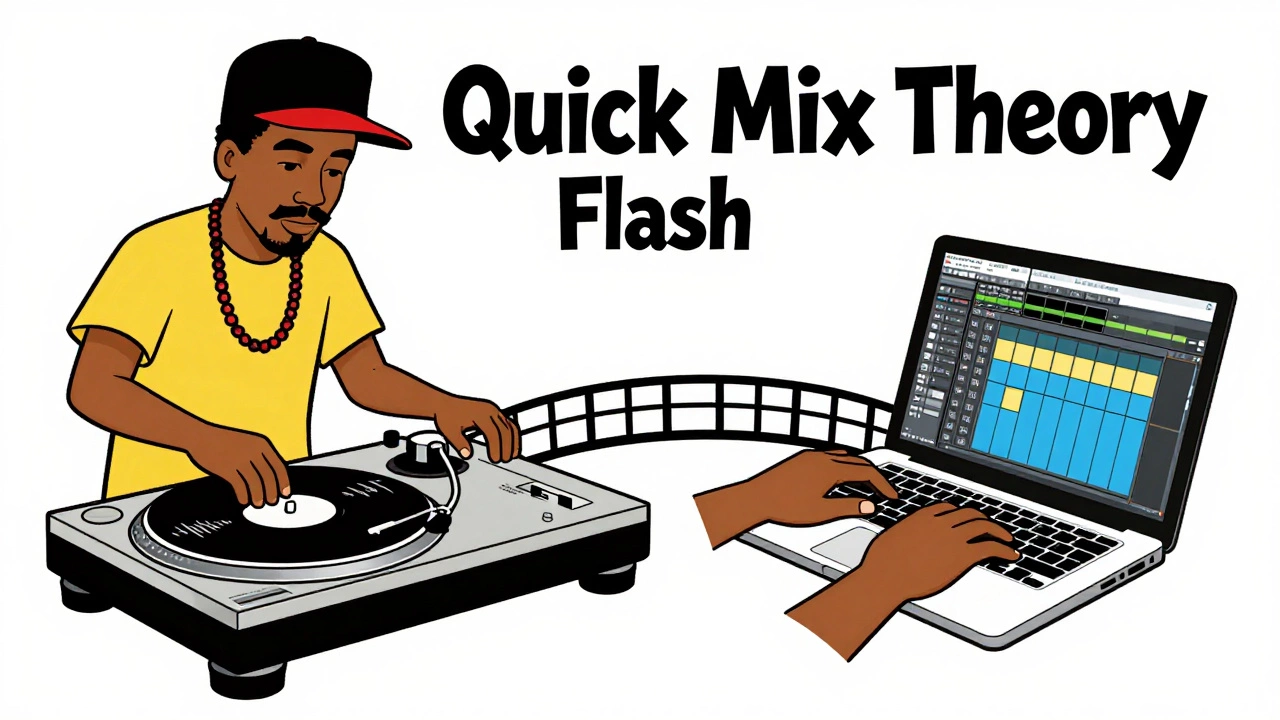
Today, software like Serato DJ Pro or Ableton Live automates this process. You can set a hot cue and trigger a loop with a button press. But the underlying concept remains the same: isolate a rhythmic unit, repeat it, and build upon it. Modern DJs still use the term "beat juggling," though it now often refers to more complex routines involving multiple cue points and scratching patterns developed by later artists like DJ Qbert. However, the foundation-that a DJ can control time and repetition through mechanical manipulation-belongs to Flash.
Learning the Technique Today
If you want to try beat juggling yourself, you don't need vintage gear, but you do need discipline. Here is a basic checklist for practicing Flash-style looping:
- Get two copies of the same track. This is non-negotiable for true beat juggling.
- Identify a clear 4-bar break. Look for funk or soul records with distinct drum hits on every beat.
- Mark the start point. Use a grease pencil on vinyl or set a hot cue in software.
- Practice the backspin. On vinyl, practice spinning the record back six revolutions smoothly. In software, practice triggering the loop roll function on the downbeat.
- Focus on the crossfade. The switch between decks must happen exactly on the beat. Any delay creates a stutter.
It takes hundreds of hours to master. Flash himself spent years refining his timing. The key is internalizing the 4-bar phrase so you can anticipate the transition before it happens.
Legacy of Innovation
Grandmaster Flash’s contribution to music history cannot be overstated. He transformed the DJ from a background figure into a central performer. By applying mathematical precision to analog technology, he created a new form of musical composition. His work paved the way for the Rock and Roll Hall of Fame induction in 2007 and continues to influence producers and DJs worldwide. Whether you are listening to a trap beat in 2026 or watching a turntablist battle, you are hearing the echoes of Quick Mix Theory.
What is the difference between beat juggling and scratching?
Scratching involves manually rubbing a record back and forth to create percussive sounds, focusing on the noise of the needle in the groove. Beat juggling, pioneered by Grandmaster Flash, focuses on looping a specific section of music seamlessly by backspinning one record while another plays, aiming for transparency rather than audible effects.
Who invented the slipmat?
Grandmaster Flash is credited with modifying and popularizing the slipmat in the mid-1970s. He layered materials like felt and wax paper to reduce friction, allowing DJs to manipulate the record independently of the turntable's motor, which was essential for precise backspinning.
How does Quick Mix Theory work mathematically?
Quick Mix Theory relies on a fixed ratio between musical phrases and record rotations. For a 33⅓ RPM record, Flash determined that a 4-bar phrase corresponds to approximately 6 counter-clockwise revolutions. By rewinding the record exactly 6 times, the DJ returns to the start of the break in sync with the music.
Did DJ Kool Herc use beat juggling?
No, DJ Kool Herc used a technique called the "merry-go-round," where he switched between different records with similar breaks. Grandmaster Flash improved on this by using two copies of the same record to create a seamless, infinite loop of a single break, which is the core of beat juggling.
Can you do beat juggling with digital DJ software?
Yes, modern DJ software like Serato or Rekordbox allows you to simulate beat juggling using hot cues and loop roll functions. While the physical act of backspinning vinyl is replaced by buttons or jog wheels, the conceptual structure of looping a 4-bar phrase remains the same.