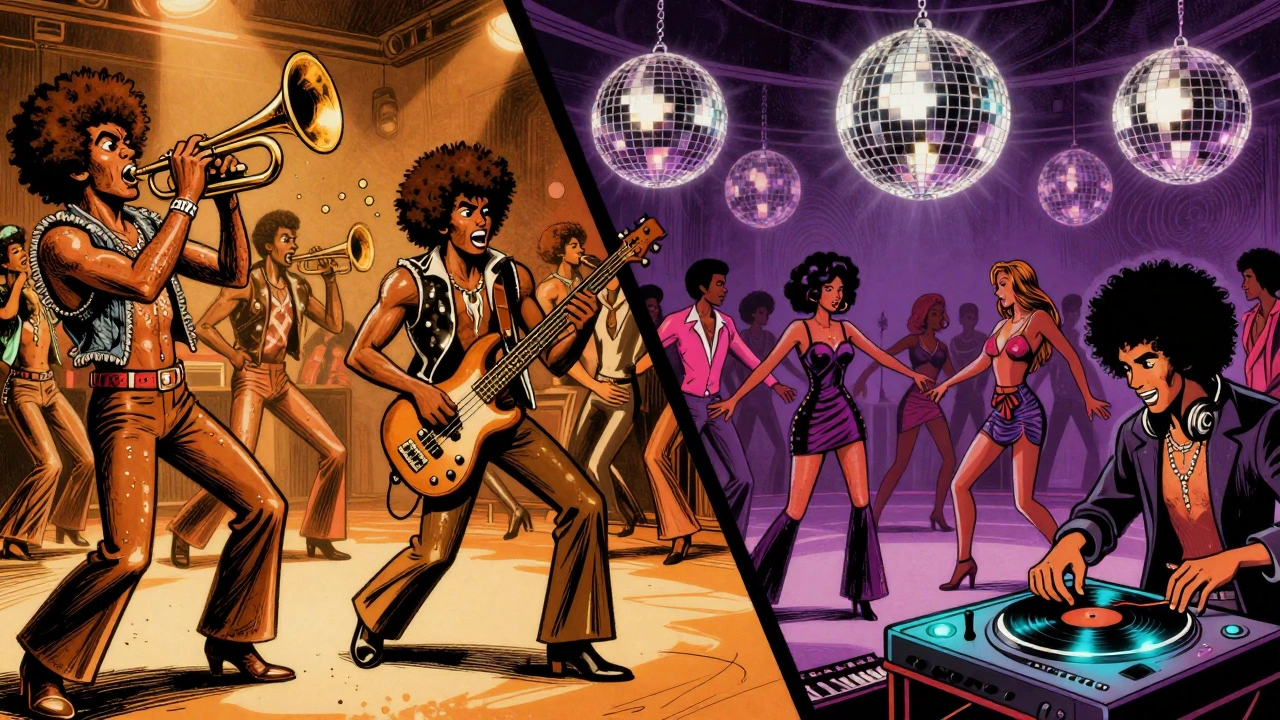

By the mid-1970s, if you stepped into a nightclub anywhere in America, you were likely to hear one of two things: the thick, punchy groove of funk a rhythm-driven Black musical style rooted in soul and blues, defined by syncopated bass lines and the "one" beat pioneered by James Brown, or the relentless, pulsing beat of disco a dancefloor-focused genre built on four-on-the-floor rhythms, synthesizers, and glossy production that became a cultural refuge for marginalized communities. They sound similar-both make you move-but they’re not the same. In fact, they were built on completely different rules, made for different rooms, and spoke to different parts of the American experience.
Where the Beat Begins: The One vs. Four to the Floor
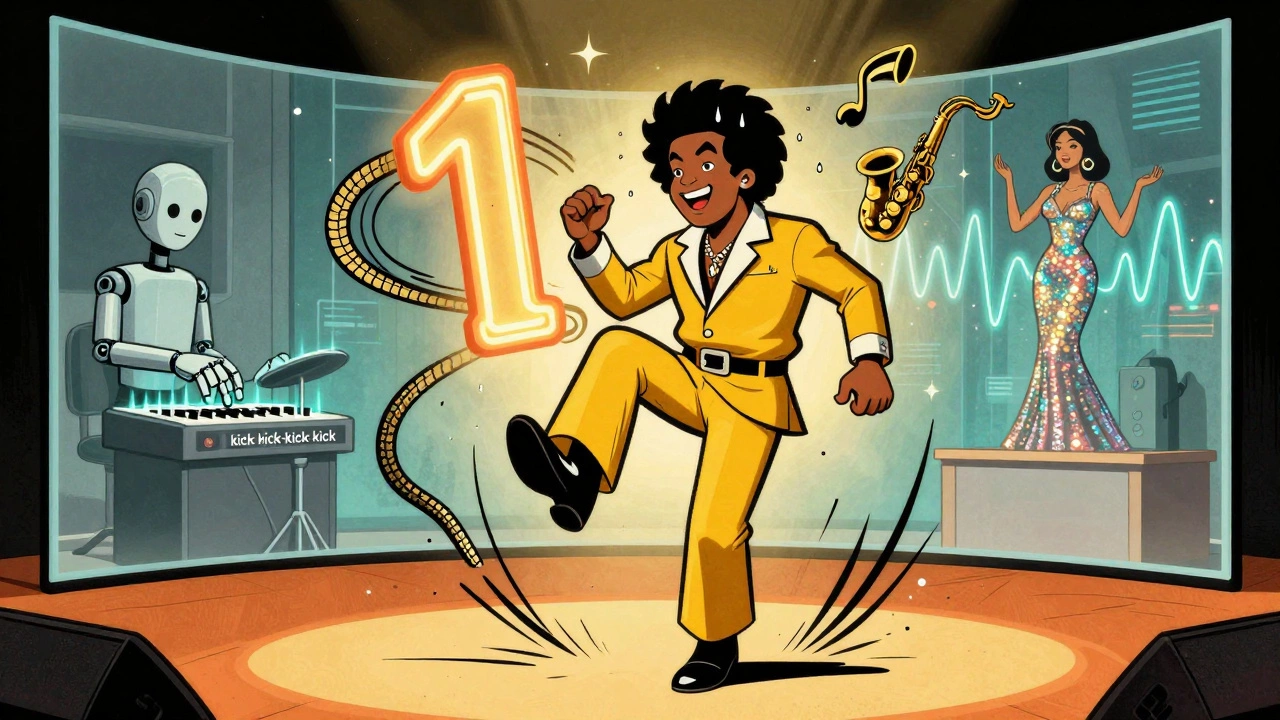
At the heart of every funk song is the one. James Brown didn’t just play drums-he redefined how rhythm works. In funk, the first beat of every measure hits like a hammer. Everything else-the bass, the guitar, the horns-dances around it. It’s not just a beat; it’s a declaration. You feel it in your chest. You feel it in your hips. That’s why when you hear "Super Bad" or "Give It Up or Turnit a Loose," you don’t just tap your foot-you lock into it. Funk is polyrhythmic. It’s layered. A bassline might groove on the offbeats while the snare cracks on 2 and 4, and a cowbell taps somewhere in between. It’s complex. It’s messy. It’s alive.
Disco? It’s the opposite. Disco lives on four to the floor. Every single beat-1, 2, 3, 4-is hit by the kick drum. No variation. No surprises. Just steady, mechanical, hypnotic pulse. Think "Stayin’ Alive" by the Bee Gees. That beat doesn’t change. It doesn’t need to. It’s not meant to be analyzed-it’s meant to be danced to for hours. DJs could mix one track into another because every song had the same heartbeat. No improvisation. No syncopated chaos. Just pure, consistent motion.
Sound and Texture: Raw Grit vs. Polished Shine
Funk doesn’t care about sounding clean. It wants to sound real. Horns blare. Guitars squeal with feedback. Basslines are thick, slapping, and slightly distorted. James Brown’s band might have had ten people on stage, all playing different rhythms at once. George Clinton’s Parliament-Funkadelic crew brought a full orchestra of weirdness-tambourines, theremins, talking boxes. Funk is about texture. It’s about sweat. It’s about musicians listening to each other and reacting in real time.
Disco? It was made in studios. Not bars. Not clubs. Studios. And it was engineered to be perfect. Synthesizers replaced horns. Drum machines (like the Roland TR-808, which started showing up in the late '70s) replaced live drummers. Strings were layered in like icing on a cake. Donna Summer’s "I Feel Love" in 1977 was a game-changer-not because of the vocals, but because every sound was electronic. No guitars. No live bass. Just pulses, bleeps, and a relentless beat. It sounded like the future. And it was.
Who Made It? Who Danced to It?
Funk was born in Black neighborhoods-from Macon to Detroit to Oakland. It was music made by Black artists, for Black audiences. It carried the weight of civil rights, Black pride, and self-determination. Sly Stone’s "Stand!" wasn’t just a dance song-it was a manifesto. Funk didn’t need to be popular. It needed to be true.
Disco, on the other hand, was born in underground clubs-mostly gay, mostly Black, mostly Latino. Places like Studio 54 in New York, The Loft, and Paradise Garage weren’t just venues. They were sanctuaries. For people rejected by mainstream society, disco was the only place where you could dance freely, be yourself, and feel safe. DJs like David Mancuso and Larry Levan didn’t just play records-they curated emotional journeys. The music had to keep moving. No one wanted to stop. No one wanted to think. Just dance. And because disco became popular with white audiences in the late '70s, it was quickly commercialized. Suddenly, it wasn’t just about liberation-it was about chart positions and radio play.
Structure: Improv vs. Formula
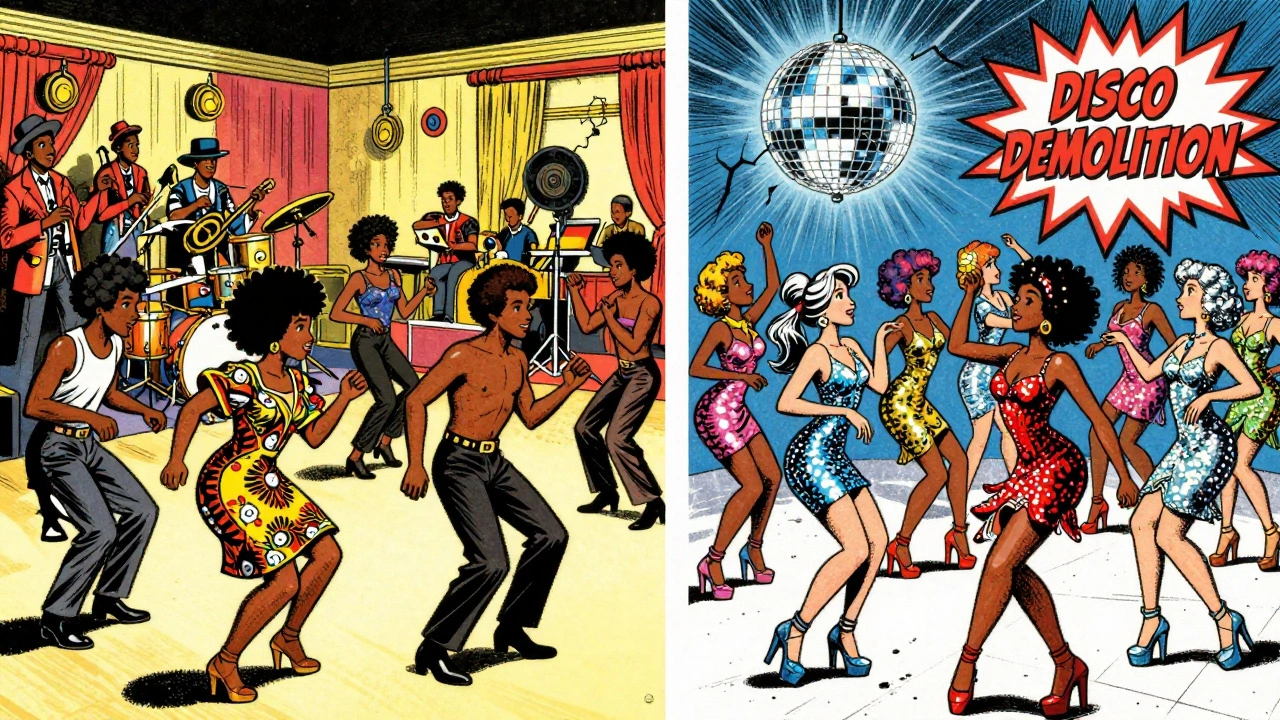
Funk songs don’t follow rules. They stretch. They jam. A song might start with a bassline, then a horn enters, then the guitar starts riffing, then the drummer drops out for a few bars just to bring it back harder. You never know where it’s going. That’s the point. Funk is built for live performance. It’s about energy, not structure.
Disco? Every song had the same blueprint: intro, verse, chorus, breakdown, build-up, chorus, outro. It was designed for DJs to loop, mix, and extend. The vocals were often repeated-"I feel love," "It’s raining men," "Don’t leave me this way"-because repetition made it stick. You didn’t need to understand the lyrics. You just needed to feel the beat. Disco was pop music with a dancefloor agenda.
Legacy: One Faded. One Evolved.
Funk didn’t die. It changed. The rawness of funk became the backbone of hip-hop. Every sampled breakbeat-from "Funky Drummer" to "Give It Up"-is a direct line from James Brown’s drum kit. P-Funk’s wild experimentation paved the way for Prince, OutKast, and even modern acts like Thundercat. The basslines? Still driving today’s R&B.
Disco? It was crushed. In 1979, the infamous "Disco Demolition Night" in Chicago tried to erase it from pop culture. But disco didn’t disappear. It split. The electronic side became house music in Chicago, then techno in Detroit. Derrick May’s "String of Life" in 1987 didn’t sound like disco-but it carried its heartbeat. The glossy production? That became pop. The four-on-the-floor beat? That’s still in every EDM festival, every club, every TikTok dance trend.
So yes-funk and disco are related. They both came from soul. They both made people dance. But funk was about feeling. Disco was about moving. One was a revolution. The other was a refuge. And both? Both changed music forever.
Is funk just disco with more horns?
No. Funk and disco share instruments, but not rhythm or intent. Funk uses syncopation, polyrhythms, and the "one" beat to create complex, improvisational grooves. Disco uses a steady four-on-the-floor beat to keep dancers moving. Funk is about musical depth; disco is about dance continuity.
Why did disco become more popular than funk in the late '70s?
Disco was easier to sell to mainstream audiences. Its clean production, repetitive hooks, and danceable beat made it perfect for radio and MTV. Funk, with its raw, complex rhythms and Black cultural roots, was harder to package for white, suburban listeners. As disco became a commercial product, funk was pushed to the margins-even though it was the foundation.
Did disco copy funk, or did it evolve from it?
Disco evolved from funk, but not by copying it. Early disco DJs played funk records because they had strong grooves. But as disco grew, producers stripped away funk’s complexity-removed the horns, simplified the drums, added synths and strings-to make it more dancefloor-friendly. It wasn’t theft. It was transformation.
What’s the difference between the basslines in funk and disco?
Funk basslines are syncopated, melodic, and often played with a slap technique-they’re meant to stand out and interact with other instruments. Disco basslines are steady, repetitive, and locked into the four-on-the-floor beat. They’re there to support the rhythm, not to lead it. Think of funk bass as a conversation; disco bass as a metronome.
Can you dance to funk the same way you dance to disco?
You can, but it’s not the same. Disco encourages continuous, flowing movement-swaying, spinning, gliding-because the beat never stops. Funk invites more isolated, sharp movements-stomps, freezes, body rolls-because the rhythm shifts. Funk makes you react. Disco makes you surrender.


