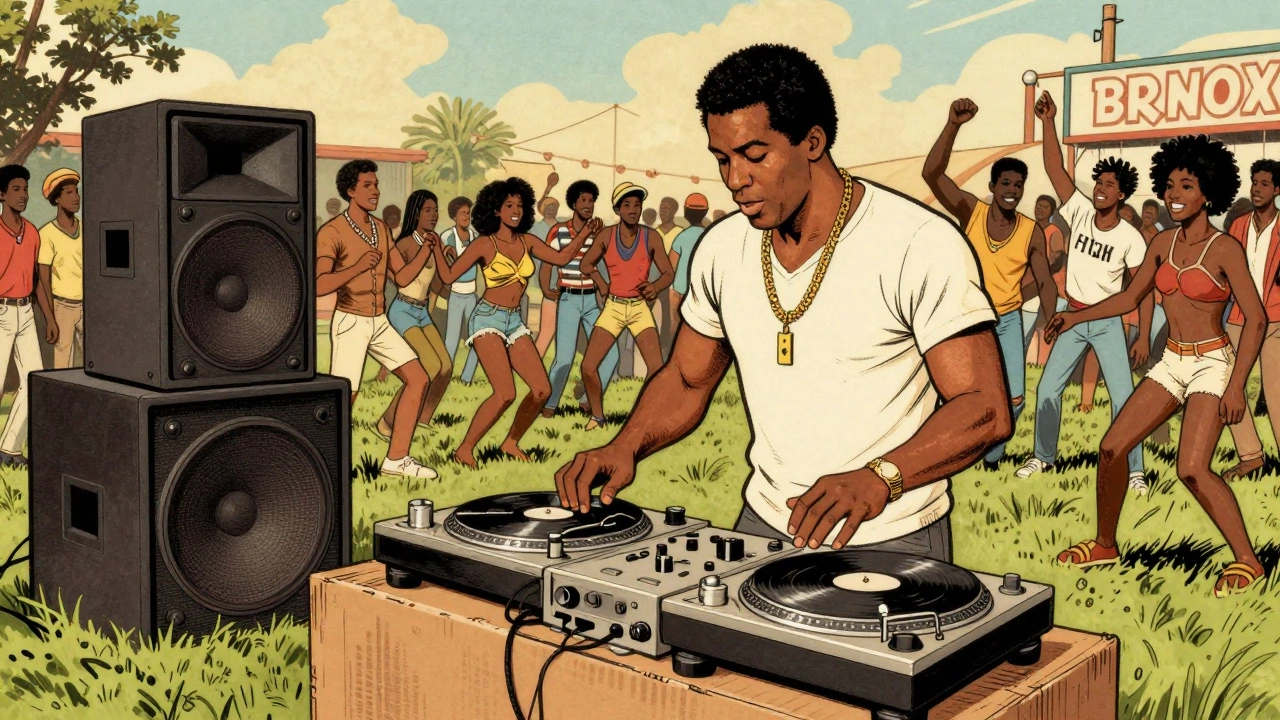

Picture a Bronx park in the summer of 1973. There are no expensive sound systems or professional lighting rigs. Just cardboard laid out on the grass for dancers, two turntables, and a microphone connected to a generator-powered speaker stack. This was not a concert; it was a community gathering that would accidentally invent a new genre of music. The story of how hip-hop emerged from the ashes of disco is not just about songs-it is about technology, technique, and the sheer ingenuity of DJs who turned playback devices into instruments.
The Bridge: Why the 12-Inch Single Matters
To understand how rap began, you have to look at the vinyl records themselves. In the mid-1970s, the music industry introduced the 12-inch single. Originally designed for disco DJs, this format allowed for wider grooves on the record. Wider grooves meant louder volume and deeper bass without distortion. More importantly, it provided enough physical space to press longer versions of songs-often eight minutes or more.
Disco producers used these extended mixes to keep club dancers moving through long sets. But Bronx DJs saw something else in those wide grooves. They saw room to experiment. The 12-inch format became the technical bridge between the polished, orchestral sound of disco and the raw, rhythmic focus of early hip-hop. It gave DJs the physical medium needed to isolate drum breaks and loop them without the needle skipping or the sound distorting.
Kool Herc and the Merry-Go-Round
The pivotal moment arrived in 1973 when DJ Kool Herc, born Clive Campbell, moved from Jamaica to the Bronx. He brought with him the concept of the "sound system" culture popular in his homeland-large mobile speaker setups used for street parties. At a party hosted by his sister Cindy at 1520 Sedgwick Avenue, Herc noticed something crucial: dancers didn't care about the verses or the melody. They went wild during the "break" sections-the short instrumental passages where only the drums and percussion played.
Herc realized he could extend these moments. He bought two copies of the same funk or soul record. When the break started on the first turntable, he would cue up the second copy. As the break ended on the first record, he switched to the second one, restarting the break instantly. By bouncing back and forth between the two turntables, he created what he called the Merry-Go-Round. This technique effectively looped the most danceable part of a song indefinitely, turning a 10-second drum solo into a five-minute backdrop for breakdancing.
This was a radical departure from disco DJing. Disco DJs focused on beat-matching smooth transitions between different songs to maintain a continuous flow. Herc was deconstructing songs entirely, stripping away the vocals and harmony to leave only the rhythm. He transformed the DJ from a selector of music into a creator of new musical structures in real time.
Grandmaster Flash and Precision Cutting
As the late 1970s progressed, other DJs refined Herc’s methods. Grandmaster Flash, whose real name was Joseph Saddler, approached DJing with a scientific mindset. He noticed that simply switching records wasn't always perfectly timed. To fix this, he developed Quick Mix Theory.
Flash would carefully mark his vinyl records with grease pencils, noting exactly where a break began and ended. He calculated the number of rotations needed to spin the record backward to return to the exact start point of the break. This allowed him to cut in and out of beats with millisecond precision. Unlike Herc’s broader loops, Flash could create tight, repetitive patterns of just a few bars, repeating them seamlessly for minutes at a time.
| Technique | Pioneer | Primary Function | Impact on Music Structure | ||||
|---|---|---|---|---|---|---|---|
| Merry-Go-Round | DJ Kool Herc | Extending drum breaks | Created infinite loops from existing records | ||||
| Quick Mix Theory | Grandmaster Flash | Precise cutting and blending | Allowed for complex, layered rhythmic arrangements | Scratching | Grand Wizzard Theodore | Percussive sound manipulation | Turned the turntable into a melodic/percussive instrument |
The Accidental Invention of Scratching
If looping provided the rhythm, scratching provided the texture. This technique is credited to Grand Wizzard Theodore. The story goes that while practicing in his bedroom, his mother knocked on the door complaining about the noise. Theodore grabbed the record to stop it quickly but kept the needle on the vinyl. As he moved his hand back and forth, he heard a rhythmic, chattering sound. Instead of discarding it as a mistake, he perfected the motion.
Scratching allowed DJs to add percussive accents and melodic phrases directly with their hands. It transformed the turntable from a playback device into a performance instrument akin to a guitar or piano. By the mid-1980s, advanced techniques like the Transform Scratch had emerged, showcased by artists like DJ Jazzy Jeff. These manipulations added a new layer of complexity to hip-hop tracks, making the DJ's presence audible even on recorded albums.
From Hype Men to MCs: The Birth of Rap
With the DJ holding down an extended breakbeat, there was a void in the mix. Initially, friends and family members would shout encouragement to the crowd-"Check it out," "Get on the floor." These individuals were known as Masters of Ceremonies, or MCs. Over time, these simple shouts evolved into rhyming chants.
Because the DJ could now keep a break going for several minutes, MCs had the space to develop longer, more intricate verses. They began telling stories, boasting about their skills, and engaging in call-and-response with the audience. This rhythmic speech over a prerecorded instrumental track is the definition of rap. Carnegie Hall defines rap as original poetry recited in rhythm and rhyme over prerecorded instrumental tracks. The DJ’s manipulation of disco and funk records provided the canvas; the MC’s voice provided the paint.
This dynamic stood in stark contrast to the mainstream disco scene. Disco was heavily orchestrated, featuring strings, horns, and polished production aimed at adult clubgoers. Hip-hop was minimalist, street-level, and built on raw rhythm and vocal prowess. It was accessible, requiring only a turntable, a mixer, and a crate of records.
From Block Parties to Records
The transition from live performance to commercial release relied once again on the 12-inch single. Record labels recognized that the energy of the block party could be captured on vinyl. Early rap records like Sugarhill Gang’s "Rapper’s Delight" used the 12-inch format to include long instrumental sections, allowing DJs to scratch and blend the tracks in clubs.
This format preserved the live feel of the Bronx parties. Listeners at home could hear the DJ cues, the scratches, and the extended breaks that defined the culture. The 12-inch single ensured that hip-hop remained a DJ-driven art form even as it entered the mainstream market. It bridged the gap between the ephemeral nature of a live set and the permanence of a recorded album.
The Legacy of Turntablism
The techniques developed by Herc, Flash, and Theodore did not just create hip-hop; they influenced all of modern electronic music. The concept of looping, sampling, and rearranging existing recordings became the foundation for house, techno, and later digital production. Today’s producers use software to do what these pioneers did with vinyl, but the core philosophy remains the same: taking existing sounds and recontextualizing them to create something new.
The DIY ethos of early hip-hop-using affordable equipment to build complex musical experiences-continues to inspire artists worldwide. The transformation from disco to hip-hop was not a rejection of dance music, but an evolution of it. It proved that innovation often comes from constraint, and that a simple breakbeat can change the world.
Who invented the breakbeat looping technique?
DJ Kool Herc (Clive Campbell) is credited with inventing the breakbeat looping technique in 1973. He used two copies of the same record to extend the instrumental "break" sections, creating the "Merry-Go-Round" method.
What is the difference between disco DJing and hip-hop DJing?
Disco DJing focused on seamless transitions between full songs using extended mixes to maintain a continuous flow. Hip-hop DJing involved isolating specific drum breaks and looping them repeatedly, treating the turntable as an instrument to create new rhythmic structures rather than just playing existing songs.
How did scratching originate?
Scratching was accidentally discovered by Grand Wizzard Theodore. While trying to silence a record quickly when his mother interrupted him, he moved the vinyl back and forth under the needle, creating a rhythmic sound that he then perfected into a technique.
Why was the 12-inch single important for hip-hop?
The 12-inch single provided wider grooves for louder sound and more physical space on the vinyl. This allowed DJs to press long drum breaks and extended remixes, which were essential for looping techniques and providing enough time for MCs to perform raps.
What role did MCs play in the evolution of rap?
MCs started as hype men introducing DJs and encouraging dancers. As DJs extended breakbeats, MCs began delivering longer, rhythmic rhymes over the music. This evolution turned simple announcements into complex poetic performances, defining the vocal component of rap music.