
Have you ever heard a guitar solo that sounded like it was coming from another planet? For millions of rock fans in the late 1970s and throughout the 1980s, that otherworldly noise came from one man: Eddie Van Halen. He didn't just play guitar; he rewired how we thought about what an electric guitar could do. While his debut album dropped in 1978, it was the decade that followed-the 1980s-where his influence exploded into a global revolution. We aren't just talking about fast fingers here. We are talking about a complete overhaul of tone, technique, and hardware that defined hard rock for a generation.
The Myth of Invention: Where Two-Handed Tapping Really Came From
There is a persistent myth that Eddie invented two-handed tapping. If you ask him, or look at the historical record, the truth is more interesting. Eddie didn't invent it; he popularized it. He took a niche jazz and classical technique and turned it into the language of stadium rock.
Eddie has told this story many times, including in a 2015 interview at the Smithsonian Institution. He said he saw Jimmy Page of Led Zeppelin performing hammer-ons and pull-offs during a concert at the Los Angeles Forum around 1971-1972. Page held his fretting hand high off the neck to execute these legato moves. Eddie went home, looked at his own hands, and realized he could use his picking-hand index finger as an extension of his fretting hand. He essentially moved the nut up the neck with his right hand.
This wasn't entirely new ground. Jazz guitarist Emmett Chapman had patented a comprehensive tapping method in the 1970s and even built the Chapman Stick instrument. Prog-rock legend Steve Hackett used recorded tapping on Genesis’s Nursery Cryme (released November 12, 1971), years before Van Halen's debut. But nobody played it like Eddie. On "Eruption," released in February 1978, he combined rapid arpeggios with wide-interval melodies so fluidly that listeners thought they were hearing a synthesizer. That ambiguity was part of the magic. By the early 1980s, albums like Women and Children First (1980) and 1984 showed that tapping wasn't just a trick; it was a musical vocabulary for creating contrapuntal lines and multi-octave structures.
Decoding the “Brown Sound”: More Than Just Distortion
If tapping was the vehicle, the "brown sound" was the fuel. This term describes Eddie’s signature tone: saturated, harmonically rich, mid-heavy, and incredibly dynamic. It wasn't the scooped-mid metal sound that would dominate later in the decade. It was chewy, articulate, and alive. How did he get it? It wasn't a pedalboard full of effects. It was raw power tube saturation managed with science.
The core of the rig was simple but specific:
- The Amp: A late-1960s Marshall Super Lead 100-watt head (often called a Plexi).
- The Voltage Trick: Eddie ran the amp through a Variac (variable autotransformer). He lowered the mains voltage to around 90 volts. This allowed him to turn the volume knob up to 10 without blowing out the power tubes, pushing them into natural compression and sag.
- The Cabinets: 4x12 cabinets loaded with Celestion speakers. In the studio, engineers blended mic positions to capture both the "sizzle" of the tweeters and the body of the bass response.
- The Guitar Wiring: This is crucial. Eddie bypassed the standard tone controls on his guitars. He wired a single 500 kΩ volume pot directly to the pickup. Why? To minimize signal loss and keep the highs bright when running long cables into the amp.
He also dipped his pickups in paraffin wax. This process, known as wax-potting, stabilized the windings and reduced microphonic squeal-a common problem when cranking high-output humbuckers into a sensitive preamp stage. The result was a clean attack that cut through the mix, even under heavy distortion.
| Component | Eddie’s Setup (Early 80s) | Standard Rock Setup (Typical) |
|---|---|---|
| Amp Head | Marshall Super Lead 100W (Plexi) | Modern High-Gain Head (e.g., Peavey 5150) |
| Voltage Control | Variac set to ~90V | Standard 110V/230V outlet |
| Guitar Wiring | Single 500k Volume Pot (No Tone Controls) | Volume + Tone Pots + Pickup Selector |
| Pickup Treatment | Wax-Potted Humbucker | Standard Unpotted Pickups |
| Tremolo System | Floyd Rose Double-Locking | Fender Stratocaster Tremolo |
The Frankenstrat: Hardware That Changed Guitar Design
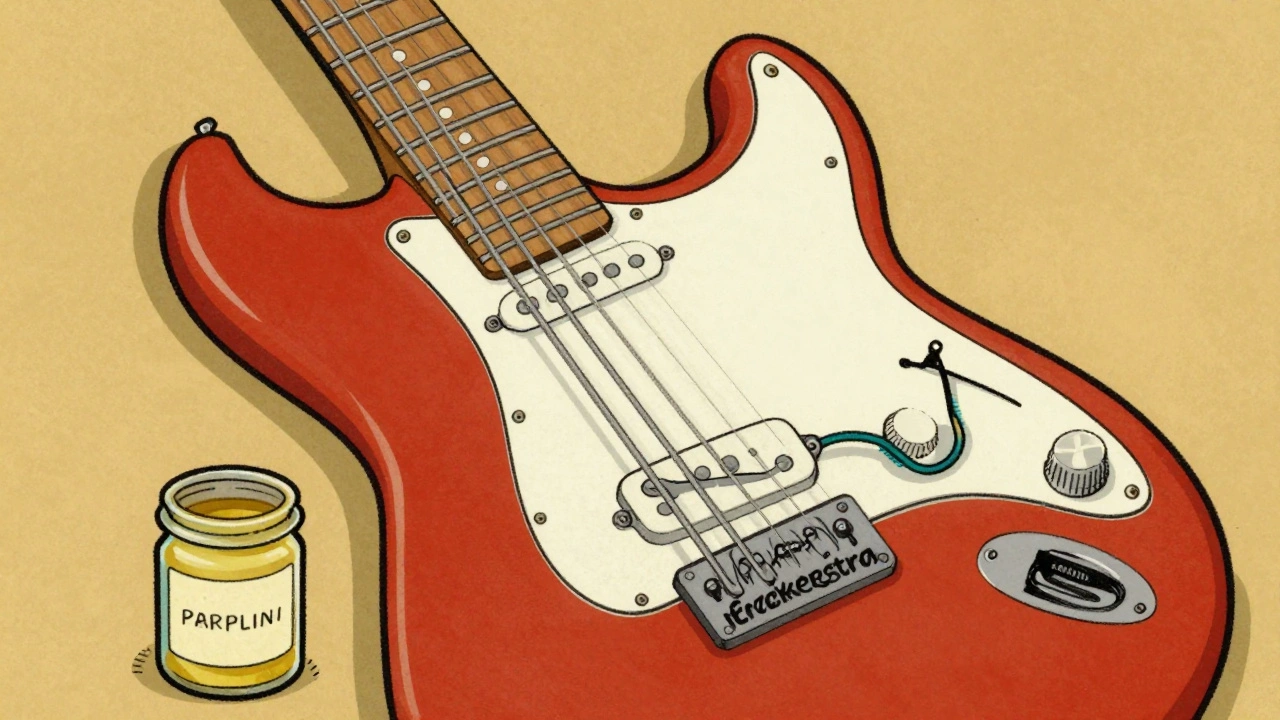
You can’t talk about Eddie’s tone without talking about the guitar itself. His main weapon in the 1980s was the "Frankenstrat." It started as a Frankenstein monster of parts: a Strat-style body, a maple neck, and a bridge humbucker. But the electronics inside were radically simplified.
Eddie admitted he "didn't know how to wire the tone controls back" after removing the pickguard on his first build, so he left them out. This accidental simplicity became a feature. By using only a volume control, he ensured maximum output and brightness. The pickups themselves were often modified Gibson PAFs (Patent Applied For), which provided a warmer, smoother sound than the brighter Fender single-coils typical of Stratocasters.
Another critical piece of hardware was the Floyd Rose double-locking tremolo system. Eddie adopted this in the late 1970s and used it heavily throughout the 80s. Before locking trems, diving the whammy bar caused guitars to go out of tune instantly. The Floyd Rose locked the strings at the nut and the bridge, allowing Eddie to perform extreme dives, flutters, and vibrato without losing pitch stability. This reliability was essential for his lead style, where he treated the tremolo arm as an expressive tool rather than a novelty.
1984: When Synthesizers Met Shred
Released on January 9, 1984, the album 1984 marked a pivotal shift. It was commercially massive, driven by "Jump," whose Oberheim synth riff became the band’s first U.S. Billboard Hot 100 No. 1 single. Some purists criticized the move toward keyboards, but looking at the data, Eddie was expanding his sonic palette, not abandoning his roots.
Three of the nine tracks on 1984 are dominated by synths. However, the guitar work remained fiery. Tracks like "Top Jimmy" showcased Eddie’s willingness to experiment with specialized gear, such as the Kramer Ripley guitar with pan-able pickups, creating distinctive stereo movement. The album proved that synthesizers and high-gain guitar could coexist in mainstream rock. In fact, 1984 helped drive an exponential increase in synthesizer sales, coinciding with the release of more affordable polyphonic units in the early 80s. Eddie didn't replace the guitar; he layered it, proving that technology could enhance, rather than dilute, rock energy.

How to Learn Eddie’s Style: Practical Steps for Players
Want to play like Eddie? It’s not just about speed. It’s about phrasing and dynamics. Here is a realistic path to mastering his approach:
- Master the Basics First: Don’t jump straight into "Eruption." Start with simple triadic arpeggios using two-handed tapping. Focus on even volume between your picking hand and fretting hand. Eddie emphasized that his right-hand fingers acted as extra fretting fingers for scalar lines.
- Practice Legato Independently: Work on hammer-ons and pull-offs with your left hand alone. This builds the strength and coordination needed for smooth transitions when you add the right hand.
- Dial in Your Tone: You don’t need a vintage Marshall. Use a modern high-gain amp or modeler, but focus on the EQ. Boost the mids slightly. Cut the excessive bass to avoid mud. Add a touch of presence for the "chew" Eddie loved. If you have a Variac or a plugin that simulates voltage drop, try lowering the gain structure to mimic tube sag.
- Use a Locking Tremolo: If you want to dive-bomb like Eddie, a standard tremolo will frustrate you. Invest in a Floyd Rose or similar locking system. Set it up correctly with proper string tension and nut lubrication.
- Listen to the Music, Not Just the Solos: Eddie used tapping to create melodies, not just noise. Study how he integrates tapped passages into the song’s structure. Notice the space he leaves between phrases. Silence is as important as the notes.
Remember, Eddie’s technique was steep. He spent years refining it. Be patient. Focus on clarity over speed. A slow, clean tapped run sounds infinitely better than a fast, muddy one.
The Legacy: Why It Still Matters in 2026
Eddie Van Halen passed away on October 6, 2020, but his impact hasn't faded. If anything, interest in his techniques has grown. New generations of players use digital modeling gear to approximate his Marshall/Varic rig at bedroom-friendly volumes. Social media platforms are filled with tutorials breaking down his 1978-1984 tone, showing that the quest for the "brown sound" is ongoing.
His influence extends beyond rock. Jazz fusion players, progressive metal shredders, and pop guitarists all borrow from his vocabulary. The combination of creative two-handed fretboard use, voltage-controlled tube saturation, and simplified signal paths remains a benchmark for gear design. Boutique amp builders still seek to emulate that specific harmonic complexity. Whether you’re playing a vintage Strat or a modern super-strat, understanding Eddie’s principles helps you unlock a deeper, more expressive connection to your instrument. He taught us that the guitar isn't just a tool; it's an extension of your voice.
Did Eddie Van Halen invent two-handed tapping?
No, Eddie did not invent two-handed tapping. Techniques existed earlier in jazz (Emmett Chapman) and prog-rock (Steve Hackett). However, Eddie popularized the technique in mainstream hard rock, making it a standard part of the guitarist's vocabulary through his performance on "Eruption" and subsequent albums.
What is the "brown sound" and how do I get it?
The "brown sound" is Eddie's signature saturated, mid-rich distortion. To achieve it, use a Marshall-style amp pushed to saturation, ideally with a Variac to lower voltage for tube sag. Use a guitar with a single volume control and a high-output humbucker. Avoid excessive bass frequencies and keep the mids present for articulation.
Why did Eddie remove the tone controls from his guitars?
Eddie removed tone controls to minimize signal loss and maintain brightness. Tone pots act as low-pass filters, cutting high frequencies. By wiring only a volume pot, he ensured the full harmonic content of the pickup reached the amplifier, which was crucial for his clear, cutting tone.
What guitar did Eddie use in the 1980s?
His primary instrument was the "Frankenstrat," a custom-built guitar with a Strat-style body, maple neck, and a bridge humbucker. He also used Kramer guitars, particularly the Ripley model, for specific studio recordings on the album 1984.
How did the album 1984 change Eddie's sound?
The album 1984 introduced prominent synthesizers into Van Halen's music, most notably on the hit "Jump." While some fans missed the pure guitar focus of earlier albums, it showcased Eddie's versatility and helped integrate keyboards into mainstream rock, driving significant synth sales in the mid-80s.