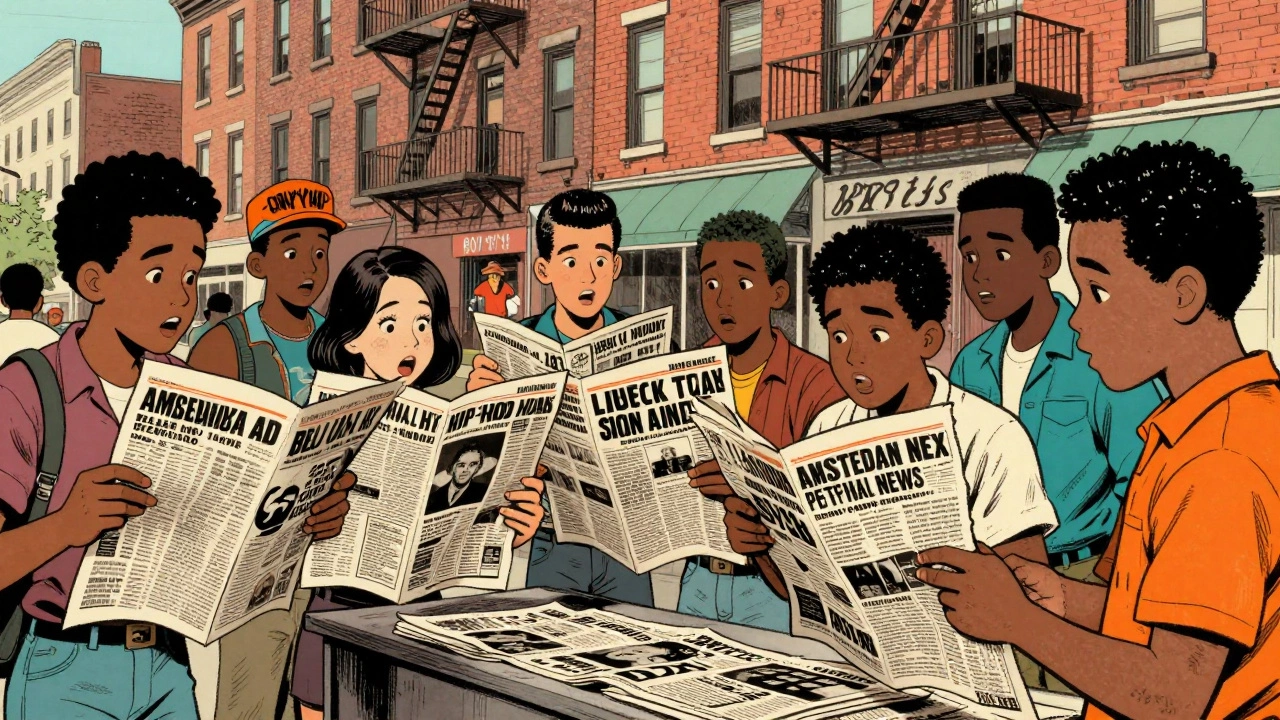

Before streaming algorithms told you what to listen to, before MTV’s Yo! MTV Raps put faces on the music, there was paper. In the late 1970s and throughout the 1980s, the story of hip-hop wasn’t just heard in the Bronx; it was read in the pages of Black newspapers, alternative weeklies, and hand-stapled fanzines. These publications did more than report news-they argued for the culture’s existence. They turned local park jams into a documented movement, framing rap either as a dangerous fad or as the most vital artistic expression of Black youth.
This early print coverage is the backbone of hip-hop history. Without these journalists and zinesters, many of the foundational moments, artist profiles, and scene dynamics might have vanished with the original cassette tapes. Understanding this era requires looking at three distinct pillars of media: the community-focused Black press, the critical voice of alternative weeklies like the Village Voice, which provided serious music criticism when mainstream outlets ignored the genre, and the DIY energy of underground zines that operated outside commercial constraints.
The Black Press: Community Roots and Early Legitimacy
If you want to understand where hip-hop came from, you have to look at the papers that served the communities where it started. Black newspapers played a crucial role in validating hip-hop long before national magazines took notice. Papers like the New York Amsterdam News, founded in 1909, offered detailed profiles of young artists and covered local events that white-owned dailies largely skipped.
The Amsterdam News claims credit for one of the earliest printed uses of the term “hip-hop” in an early-1980s article, though flyers from 1979 suggest the phrase was already circulating in grassroots print. Regardless of who used it first, these papers treated hip-hop as a significant cultural shift rather than a novelty. While national media often dismissed rap as noise, Black newspapers devoted a high proportion of their arts coverage-sometimes over 50%-to Black cultural forms. This meant readers got nuanced stories about MCs, DJs, and crews, providing a level of detail and respect that was rare elsewhere.
These articles weren’t just entertainment pieces. They were records of social change. By documenting parties in the Bronx, a borough with about 1.2 million residents in 1980, these journalists anchored the music to a specific place and people. They showed that hip-hop was not an abstract trend but a lived reality for thousands of young people navigating economic hardship and urban decay. This community-first approach laid the groundwork for how later scholars would view the genre-not as a sudden explosion, but as a gradual evolution rooted in local identity.
Alternative Weeklies and the Rise of Critical Rap Coverage
While Black newspapers provided community context, alternative weeklies brought critical weight. The Village Voice stands out as a pioneer in treating rap with the same seriousness as jazz or rock. Founded in 1955, the Voice distributed hundreds of thousands of free copies weekly across New York City by the late 1970s. It didn’t just run short blurbs; it published long-form criticism that challenged dismissive narratives.
Writers like Robert Christgau, Greg Tate, and Harry Allen used column space ranging from 800 to 2,000 words to argue that hip-hop was innovative art. Allen, known as “The Media Assassin,” was particularly influential. He didn’t just review albums; he dissected how mainstream media stereotyped rap as violent and apolitical. His work bridged the gap between journalism and activism, bringing critical theory into the conversation about Black music.
The Voice also quantified support for hip-hop through its annual “Pazz & Jop” critics’ poll. By including rap singles and albums in these lists, the publication forced the broader music industry to acknowledge artists like Run-DMC and Grandmaster Flash & The Furious Five. This wasn’t just about popularity; it was about legitimacy. When respected critics ranked rap albums alongside classic rock records, it signaled to readers and industry insiders that this was real music worth studying. A 2024 retrospective noted that this coverage helped transform music journalism itself, shifting the center of critical attention toward genres emerging from Black and Latino communities.
Zines: The Underground Documentation
If newspapers and weeklies were the public face of early hip-hop journalism, zines were its nervous system. Drawing on a tradition that started with science-fiction fandom in the 1930s and exploded during the punk era of the 1970s, hip-hop zines offered a raw, unfiltered look at the culture. These were small-circulation publications, often photocopied on standard letter-size paper and stapled together. Circulations could be as low as 50 to 500 copies per issue, but their impact was massive.
For fans living in neighborhoods where average incomes were thousands of dollars below city medians, zines were accessible. They didn’t require expensive subscriptions or glossy magazine racks. Instead, they circulated hand-to-hand at parties, record stores, and schools. Inside, you’d find interviews with local MCs, reports on DJ battles, and reviews of cassette tapes-often written in 200 to 1,500-word bursts. The aesthetics matched the content: black-and-white photocopies, cut-and-paste graphics, and typewritten text. This DIY style mirrored the resourcefulness of the culture itself.
Zines filled a void left by mainstream media. They documented regional scenes that never made national headlines. If a crew in Queens or Brooklyn was putting on a legendary party but selling only a few thousand records, a zine might be the only permanent record of that event. Today, archivists treasure these fragile documents because they capture the granular details of early hip-hop life: specific dates, locations, line-ups, and slang. Online communities still trade scans of these issues, proving their enduring value to historians and fans alike.
From Newsletter to Bible: The Birth of The Source
The transition from amateur zine to professional magazine marked a turning point in hip-hop journalism. In the summer of 1988, David Mays and Jonathan “Jon” Shecter, both Harvard undergraduates, launched The Source as a simple newsletter mailed from Boston to about 500 industry contacts and college radio stations. It was humble in size-just four pages-but ambitious in scope. By 1990, two years after its launch, it had grown into a monthly magazine with circulation in the tens of thousands, eventually reaching hundreds of thousands of readers.
The Source branded itself “The Bible of Hip-Hop Music, Culture & Politics” and pioneered formats that defined the genre’s media landscape. Most notably, it introduced the “mic” rating system for album reviews, creating a standardized way to judge quality that fans still reference today. But it went beyond reviews. Under editors like James Bernard, the magazine published multi-page investigative features on police brutality, record-label politics, and social justice issues, often exceeding 3,000 words. This brought long-form cultural journalism standards to a subject previously confined to short columns.
The editorial team was predominantly Black, mostly in their 20s and 30s, and they treated hip-hop as a serious intellectual arena. Former readers describe growing up with the magazine, using it as a textbook on Black music and culture. Issues were read cover-to-cover, sometimes multiple times a month. The Source didn’t just report on hip-hop; it shaped the conversation, offering a platform for artists and thinkers to articulate the philosophy behind the beats. Its success proved that there was a massive, hungry audience for deep, respectful coverage of the culture.
International Perspectives: UK Magazines and Global Reach
Hip-hop wasn’t just an American phenomenon, and its journalism reflected that global spread. In the United Kingdom, magazines like Hip Hop Connection, founded in 1988, adapted the fanzine ethos to a professional monthly model while maintaining ties to underground scenes. Running until 2009, HHC became the world’s longest-running dedicated hip-hop magazine. At a time when British hip-hop was overshadowed by reggae, soul, and rave culture, HHC gave visibility to local MCs and DJs whose record sales might number only in the low thousands.
There was a clear pipeline from zine to magazine in the UK. Writers from fan-run publications like Fat Lace, which emerged in the 1990s with runs of 100 to 500 copies, later moved into roles at Hip Hop Connection and other outlets. This illustrated how zines served as training grounds for professional journalists. Readers today still reminisce about buying August 1990 issues, highlighting cover stories and reviews that shaped their listening habits. These international publications ensured that hip-hop’s narrative wasn’t solely defined by New York, allowing local scenes in London, Paris, and Tokyo to document their own contributions.
| Publication Type | Key Examples | Circulation Estimate | Primary Focus | Production Style |
|---|---|---|---|---|
| Black Newspapers | New York Amsterdam News | Local/Regional (Thousands) | Community events, artist profiles, social context | Professional print, weekly distribution |
| Alternative Weeklies | Village Voice | High (Hundreds of thousands in NYC) | Critical analysis, legitimization, cultural critique | Long-form essays, critic polls |
| Fanzines/Zines | Various (e.g., Fat Lace in UK) | Low (50-500 copies) | Underground scenes, DIY documentation, raw interviews | Photocopied, stapled, cut-and-paste graphics |
| Specialty Magazines | The Source, Hip Hop Connection | Growing (Tens to hundreds of thousands) | Album reviews (“mics”), investigative features, culture | Full-color (later), professional layout |
Preserving the Record: Archival Challenges and Legacy
Today, accessing this early journalism is harder than it sounds. Many zines were produced on cheap paper and in small runs, meaning complete collections are rare. University research guides recommend using databases like Ethnic NewsWatch for Black newspapers and special collections for zine archives. However, researchers often encounter incomplete runs, missing issues, and fragile physical conditions due to decades of wear and tear.
Digitization projects and community-driven scanning efforts are crucial for preserving this history. Libraries now hold boxes of flyers, press kits, and zines from local scenes outside major hubs like New York and Los Angeles. For example, a collection at a major research library includes materials from an Atlanta-based hip-hop engineer, showing that local scenes everywhere were documenting themselves. These archives allow scholars to analyze how hip-hop was framed over time-tracking the shift from “fad” to “threat” to “transformative art form.”
The legacy of these early journalists is evident in modern hip-hop media. Blogs and online magazines that emerged in the mid-2000s explicitly referenced 1980s and 1990s print predecessors as inspirations. They combined the rigorous contextual approach of writers like David Toop and Harry Allen with the community accountability of zines. As hip-hop became a multibillion-dollar global industry, the need for independent, critical voices remained strong. The future of hip-hop journalism lies in honoring that past-using new digital tools while maintaining the detailed, named, and date-specific documentation that made early newspapers and zines indispensable.
What was the first newspaper to use the term “hip-hop”?
The New York Amsterdam News claims to have used the term “hip-hop” in an early-1980s article, marking one of the first times it appeared in a newspaper. However, some historians note that flyers from 1979 already used the phrase, suggesting the term evolved in grassroots print before hitting major papers.
How did The Source magazine start?
The Source began in the summer of 1988 as a four-page newsletter created by Harvard students David Mays and Jonathan Shecter. It was initially mailed to about 500 industry contacts and college radio stations before evolving into a full-color monthly magazine that became known as “The Bible of Hip-Hop.”
Why were zines important to early hip-hop culture?
Zines were crucial because they documented underground scenes that mainstream media ignored. Produced on minimal budgets with circulations as low as 50 copies, they provided raw, unfiltered access to local parties, DJ battles, and artist interviews, serving as primary sources for historians today.
Who was Harry Allen and what was his role in hip-hop journalism?
Harry Allen, known as “The Media Assassin,” was a pioneering journalist who wrote for the Village Voice, Vibe, and The Source. He brought critical theory and media critique to hip-hop coverage, challenging stereotypes and working closely with artists like Public Enemy to shape the narrative around the culture.
Where can I find archived early hip-hop zines and newspapers?
Researchers can access early hip-hop print media through university special collections, databases like Ethnic NewsWatch for Black newspapers, and community-driven digitization projects. Some libraries hold specific collections of zines and flyers, though finding complete runs can be challenging due to the fragile nature of early photocopies.


