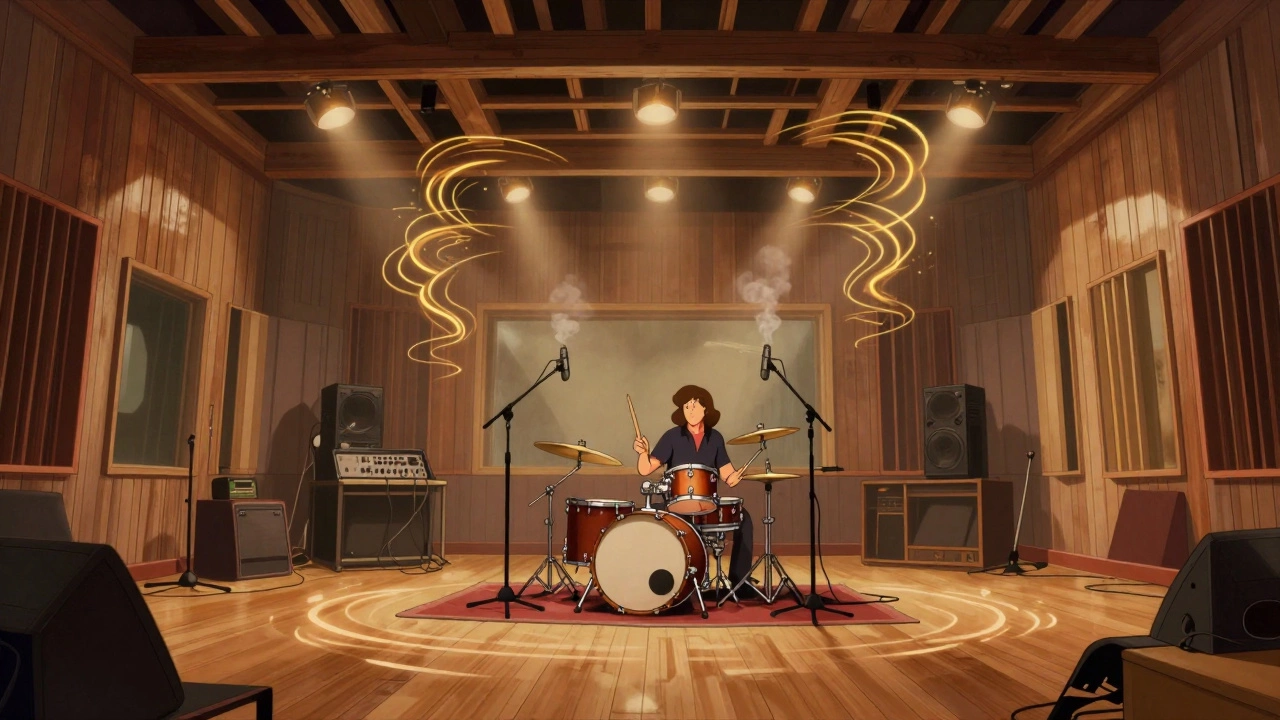

Imagine walking into a recording studio in 1975. You aren't looking at screens or clicking mice. You are standing in a massive, wood-paneled room that smells like old carpet and ozone. A drummer sets up his kit in the center of this cavernous space. When he hits the snare, the sound doesn't just stop; it bounces off the ceiling, dances around the corners, and settles into a warm, thick cloud of noise. This is the magic of the drum room, also known as the live room. It was the heart of the classic rock and soul sound.
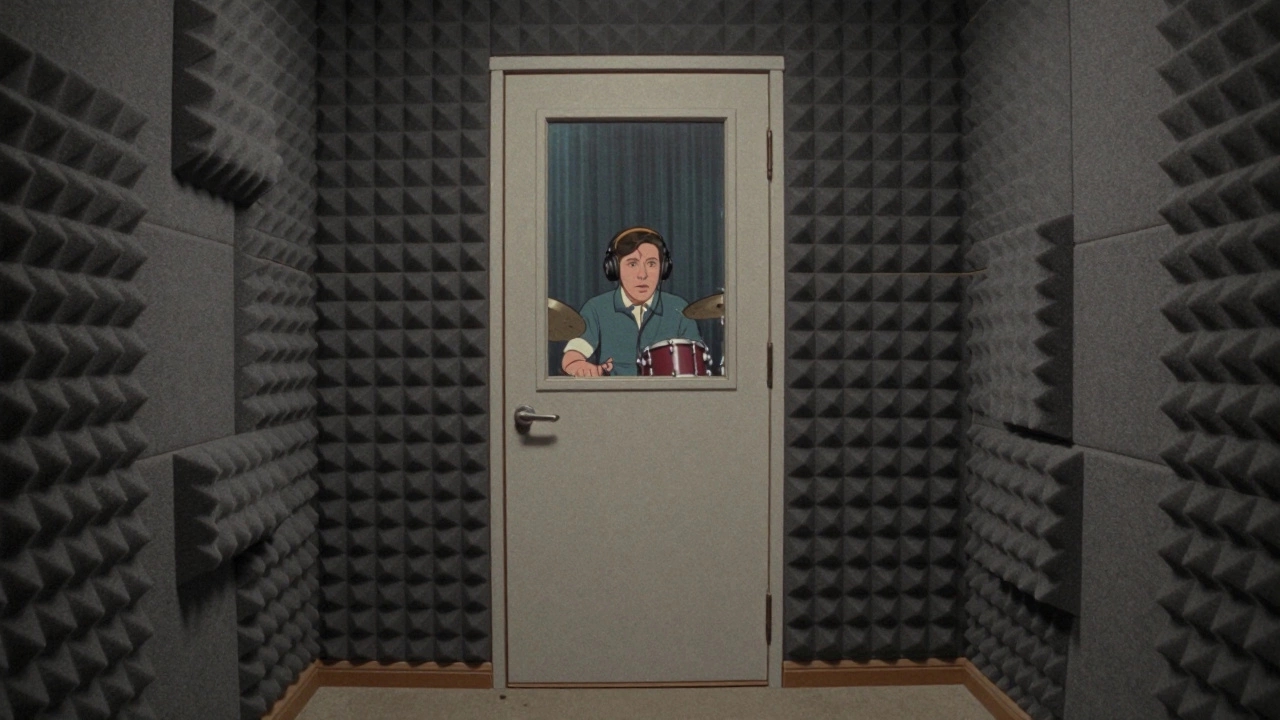
Now, picture the alternative. A small, windowless box lined with heavy foam and rock wool. The door seals shut with a thud. Inside, when you clap your hands, the sound dies instantly. This is the isolation booth, or iso booth. In the 1970s, engineers faced a constant battle: do they chase the natural grandeur of the drum room, or do they lock things down in the iso booth for total control? The answer defined the sonic landscape of an entire decade.
The Architecture of Sound: Live Rooms vs. Isolation Booths
To understand why 1970s records sound the way they do, we have to look at how these spaces were built. They weren't just random rooms; they were engineered environments with specific jobs.
A live room was designed to be alive. These spaces were often huge-think floor areas between 100 and 300 square meters with high ceilings. The goal wasn't to kill the sound but to manage it. Walls might be covered in wood paneling or plaster to create early reflections that added depth. The Music Producers Guild describes these as primary acoustic environments where musicians perform together. The air itself became part of the instrument.
In contrast, an isolation booth had one job: containment. Wikipedia notes that these smaller rooms exist specifically to accommodate loud instruments like drums or guitar amps without their sound bleeding into other microphones. If you wanted a dry, tight sound, or if you needed to record vocals while a band played loudly nearby, the iso booth was your only option. It was a soundproof cage, intentionally dead acoustically.
| Feature | Drum Room (Live Room) | Iso Booth |
|---|---|---|
| Primary Purpose | Capture natural ambience and ensemble performance | Prevent sound bleed and isolate sources |
| Acoustic Character | Lively, reverberant, spacious | Dry, dead, tightly controlled |
| Typical Size | Large (100-300+ m²) | Small (<10-15 m²) |
| Reverberation Time (RT60) | 0.4-1.0 seconds (midband) | Under 0.3 seconds |
| Best For | Rock, Funk, Soul bands playing together | Vocals, guitar amps, overdubs, tight funk drums |
Why 1970s Engineers Loved the Drum Room
If you listen to albums from Led Zeppelin, Stevie Wonder, or Earth, Wind & Fire, you hear more than just instruments. You hear the room. That’s because iconic studios like Abbey Road in London, Record Plant in New York, and Criteria Studios in Miami were famous for their signature live rooms. Producers didn’t just book a studio; they booked a specific room because its size, shape, and materials created a recognizable drum sound.
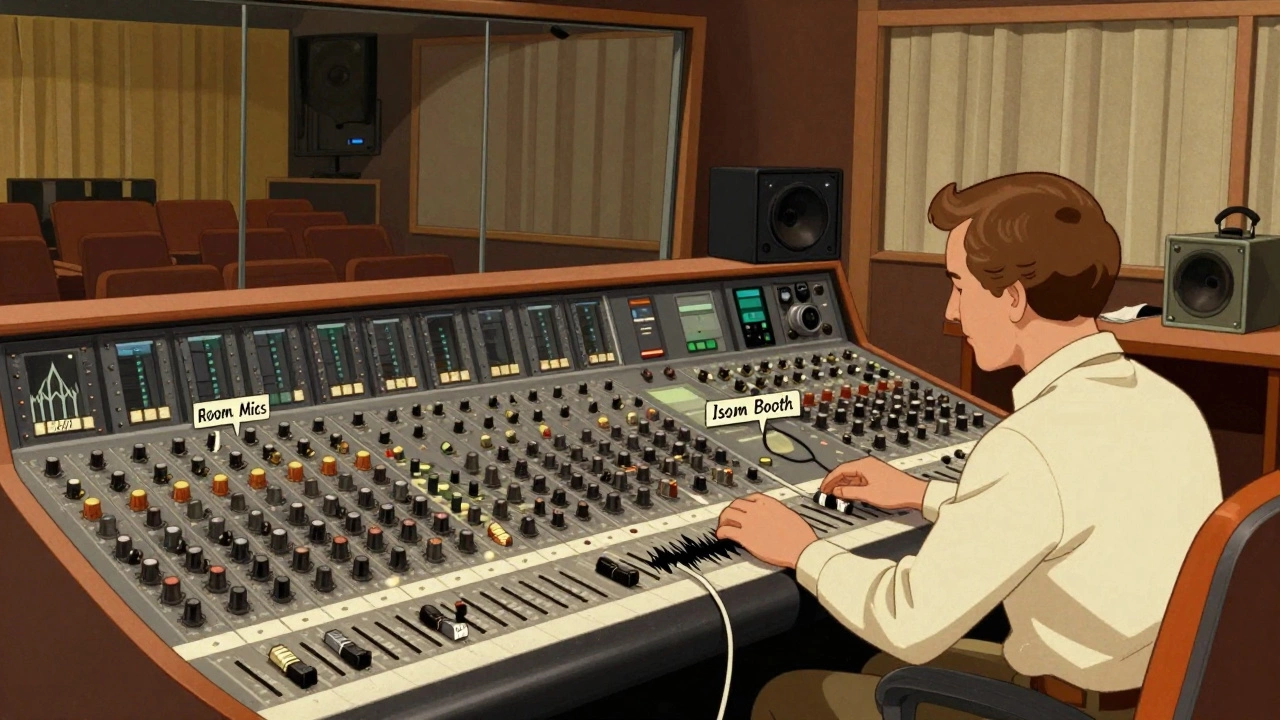
In these large spaces, a full drum kit could excite the room modes-the natural resonances of the architecture. Engineers would place close microphones on the kick, snare, and toms to capture the direct hit. But they also placed overhead mics and additional room microphones several meters away. These distant mics picked up the reverb tail, the slap-back echoes, and the energy of the space. At mixdown, they blended these signals to create a sense of depth and power that felt physical.
This approach worked perfectly for genres like rock, funk, and disco, where the rhythm section needed to feel big and expansive. The drum room allowed the band to play together in real-time, feeding off each other’s energy. The slight bleed between microphones wasn't seen as a mistake; it was part of the glue that held the track together.
The Role of the Iso Booth: Control Over Chaos
So why build iso booths at all? Because sometimes, you don't want the room to sing. Sometimes, you need surgical precision.
Isolation booths were essential for multi-track recording. Imagine trying to record a delicate vocal take while a guitarist cranks an amplifier next door. Without isolation, the guitar would spill into the vocal mic, ruining the take. Iso booths solved this by creating a barrier. As noted by studio design experts, these booths are heavily absorbent internally and massively isolated externally.
When drums were recorded in an iso booth, the result was starkly different. The sound was tight, dry, and immediate. There was no natural reverb. This style became popular in certain subgenres of funk and early disco, where producers wanted every drum hit to punch through the mix without any muddy resonance. However, because the booth killed the natural ambience, engineers had to add artificial effects later. They used plate reverbs, echo chambers, or tape delays to sweeten the dry drum tracks, simulating the space they had physically removed.
Acoustic Science: Mass, Absorption, and Decay
The difference between these two spaces comes down to basic physics: mass, absorption, and decay time.
A well-built drum room requires significant mass to keep sound in, but its interior surfaces are chosen to reflect and diffuse sound. Studio designers often tune the walls so their natural resonant frequency is at least one octave lower than the lowest frequency they need to isolate. For example, if the critical low end is 50 Hz, the wall resonance should be pushed down to around 25 Hz. This ensures the room feels solid and doesn't rattle, while still allowing mid and high frequencies to bounce around and create ambience.
An iso booth, however, is built to kill those reflections. Modern examples, like modular booths tested today, show us what 1970s permanent booths likely achieved. These booths often use internal walls made of fabric-covered 10 cm thick rock wool (mineral wool) panels. Behind that, there might be two layers of drywall with mass-loaded vinyl (MLV) in between. This combination creates a highly absorbent interior and a heavy, decoupled shell.
The result is a drastic reduction in volume and reverberation. Tests on similar modular booths show that sound levels can drop by 20 to 34 dB between the inside and outside of the booth. More importantly for our discussion, the RT60 (the time it takes for sound to decay by 60 decibels) drops to well under 0.3 seconds. In a drum room, that number might be 0.8 seconds or higher. That fraction of a second makes the difference between a sound that feels "in your face" and one that feels like it's happening in a cathedral.
How Engineers Chose Between the Two
Choosing between a drum room and an iso booth wasn't just about preference; it was a strategic decision based on the song, the genre, and the technical constraints of the session.
- Genre Aesthetics: Rock and soul often favored the lively, organic feel of the drum room. Tight funk, pop ballads, or complex overdub sessions often preferred the dry control of the iso booth.
- Ensemble Tracking: If the whole band was playing together, the drum room was usually the choice. Engineers would use gobos (movable acoustic screens) to control bleed if necessary, but they kept the space open. If the drums were being overdubbed after the rest of the track was laid down, the iso booth offered cleaner separation.
- Artist Comfort: Some drummers loved the feeling of a big room; it helped them play bigger and harder. Others preferred the focused, quiet environment of a booth, which helped them concentrate on timing and precision.
It’s worth noting that many 1970s studios used both. A typical layout included a control room, one large live room, and several smaller iso booths. A producer might start a session in the live room to capture the raw energy of the band, then move the drummer to an iso booth for final overdubs to tighten up the groove. Or, they might keep the drums in the live room but put the guitar amp in an iso booth to prevent it from drowning out the vocals.
Legacy: How We Capture Ambience Today
The debate between drum rooms and iso booths didn't end in the 1970s; it evolved. Today, home studios and project studios rarely have massive live rooms. Space is expensive, and neighbors complain about noise. So, what happened to that classic 1970s ambience?
We brought the technology to the music. Modern digital audio workstations (DAWs) offer convolution reverbs, algorithmic plates, and spring simulations that can mimic the sound of Abbey Road or Record Plant with startling accuracy. Engineers can record drums in a small, dry iso booth-or even a bedroom closet-and then load a plugin that adds the exact reverb tail of a famous 1970s studio.
However, veteran engineers still argue that nothing beats the real thing. As discussions on forums like Gearspace reveal, those who have worked in both single-room setups and traditional multi-room facilities often say they wouldn't go back. There is a qualitative difference in how a large live room interacts with a drum kit-a complexity of phase relationships and spatial cues that is hard to replicate digitally. The drum room isn't just adding reverb; it's changing the way the drummer plays and the way the microphones interact.
So, while iso booths gave us control and efficiency, the drum room gave us soul. Understanding this distinction helps us appreciate why the records from the 1970s still sound so vibrant today. They weren't just recorded; they were captured in spaces that breathed.
What is the main difference between a drum room and an iso booth?
The main difference lies in their acoustic goals. A drum room (or live room) is a large, treated space designed to capture natural reverberation and ambience, giving recordings a sense of depth and space. An iso booth is a small, heavily insulated room designed to isolate sound, preventing bleed into other microphones and producing a dry, tight sound with minimal natural reverb.
Why did 1970s studios prefer drum rooms for rock and soul?
In the 1970s, genres like rock, soul, and funk valued a big, organic sound. Large drum rooms allowed drum kits to excite the room's natural acoustics, creating rich early reflections and reverb tails. Engineers used room microphones to capture this ambience, blending it with close mics to create a powerful, three-dimensional sound that felt energetic and alive.
Can you get a 1970s-style drum sound using an iso booth today?
Yes, but it requires post-processing. Since iso booths produce a very dry sound, modern engineers use digital reverb plugins (such as convolution or algorithmic reverbs) to simulate the ambience of a large live room. While effective, some purists argue that the natural interaction between the drummer, the kit, and the physical space of a live room cannot be fully replicated digitally.
What is RT60, and why does it matter for drum recording?
RT60 is the time it takes for sound to decay by 60 decibels in a space. It measures reverberation. In a drum room, RT60 might be 0.4 to 1.0 seconds, providing warmth and space. In an iso booth, RT60 is typically under 0.3 seconds, resulting in a dry, precise sound. Choosing the right RT60 is crucial for matching the desired aesthetic of the music.
How did isolation booths help with multi-track recording in the 1970s?
Multi-track recording allowed engineers to record instruments separately or simultaneously with better control. Iso booths prevented loud instruments like guitar amps or drums from bleeding into microphones intended for quieter sources like vocals or acoustic guitars. This isolation gave producers more flexibility during mixing, as they could adjust the volume of each element independently without unwanted interference.