
There was a specific ritual to listening to an album in the 1980s that has vanished from our digital lives. You pulled the record out of its sleeve, placed it on the turntable, and listened for twenty minutes until the needle lifted into the run-out groove. Then came the physical act: lifting the tonearm, flipping the disc over, and dropping the needle back down. That moment wasn't just a pause; it was a chapter break. The distinction between Side A and Side B, which defined the pacing, emotional arc, and commercial strategy of classic rock and pop records was not accidental. It was a calculated engineering and artistic decision that shaped how we experienced icons like Michael Jackson, Bruce Springsteen, and Prince.
Today, streaming algorithms shuffle tracks or let us skip instantly, destroying the narrative flow producers spent weeks perfecting. But understanding how 1980s artists structured their work reveals why albums like Thriller or Born in the U.S.A. still feel cohesive. They weren't just collections of singles; they were two-act plays constrained by physics and driven by psychology.
The Physics of Vinyl and the Psychology of Listening
To understand the strategy, you have to respect the medium. In the 1980s, the dominant formats were vinyl LPs and cassettes. Both had hard limits. A standard vinyl record could hold about 40 to 45 minutes of high-fidelity audio before the grooves became too narrow, causing distortion or skipping. This forced a split. Engineers typically aimed for roughly equal halves-about 18 to 22 minutes per side.
This physical constraint created a psychological framework. Listeners expected a complete experience on Side A, followed by a reset when they flipped the record. Producers treated Side A as the "hook" and Side B as the "payoff." If Side A dragged, listeners might put the record away. If Side B started weak, the momentum built by the first half would collapse.
Cassette tapes added another layer. With C60 or C90 tapes, the magnetic ribbon had a fixed length. Programmers labeled sections "Program 1" and "Program 2," ensuring that the transition point didn't cut a song in half awkwardly but instead landed at a natural musical breather. This reinforced the idea that an album was a journey with distinct stages, not a playlist.
Side A: The Introduction and the Peak
Side A had a job to do: establish identity and maintain energy. Most 1980s albums opened with a high-energy, uptempo track. This wasn't random. The outer edge of a vinyl record offers better sound quality and less distortion than the inner grooves. Therefore, loud, bass-heavy songs-the ones with the most dynamic range-were placed at the start of Side A.
The opening track set the tone. Industry professionals viewed this position as the album's focal point. After the opener, producers often varied the pace to keep interest without exhausting the listener. Mid-tempo tracks or duets frequently appeared in positions two or three. This variation prevented ear fatigue.
Crucially, Side A usually ended on a climax. The final track of Side A needed to be strong enough to motivate the listener to flip the record. It often featured dramatic sound effects, a powerful chorus, or a sudden stop that left the audience wanting more. This was the "cliffhanger" of analog music.
| Position | Function | Musical Characteristics |
|---|---|---|
| Track 1 (Start of Side A) | Introduction / Hook | High energy, loud, bass-heavy, establishes genre |
| Tracks 2-3 | Pacing Variation | Mid-tempo, smoother vocals, potential radio single |
| Track 4-5 (End of Side A) | Climax / Cliffhanger | Dramatic, intense, complex arrangement, motivates flip |
| Track 6 (Start of Side B) | Re-introduction | Strong return, often a hit single, resets attention |
| Tracks 7-9 | Deepening / Exploration | Experimental, quieter, thematic development |
| Final Track (End of Side B) | Resolution | Ballad, reflective, soft ending, encourages replay |
Case Study: Michael Jackson’s Thriller
Thriller, released in November 1982 by Epic Records, is perhaps the masterclass in this strategy. The vinyl release splits nine core tracks into two distinct arcs. Side One opens with "Wanna Be Startin’ Somethin’," a funk-driven powerhouse that immediately grabs attention with its rhythmic intensity. This fits the rule of placing high-energy material on the outer groove.
The side then slows slightly with "Baby Be Mine" and the Paul McCartney duet "The Girl Is Mine," providing a breath before launching into the epic closer, "Thriller." That title track, with its horror-movie narration and heavy percussion, serves as the ultimate cliffhanger. It doesn't fade out gently; it builds tension until the needle lifts. When you flip the record, you are eager to see where the story goes.
Side Two begins with "Beat It" and "Billie Jean," two massive rock-and-pop hits. Placing these here ensures that if anyone stopped listening after Side A, they missed the biggest commercial successes. However, the side doesn't stay loud forever. It transitions into the smoother "Human Nature" and "P.Y.T. (Pretty Young Thing)," easing the listener toward the end. The album closes with "The Lady in My Life," a romantic ballad. This gentle resolution provides emotional closure, making the listener want to rewind the tape or drop the needle again immediately.
Case Study: Bruce Springsteen’s Born in the U.S.A.
Born in the U.S.A., released on Columbia Records in June 1984, shows a different approach to the same constraints. Springsteen used the format to balance stadium anthems with somber storytelling. Side A opens with the title track, a politically charged anthem that frames the entire record. It is loud, brassy, and immediate.
Unlike Thriller, which saves some hits for Side B, Springsteen places major singles like "Dancing in the Dark" and "Glory Days" near the end of Side B (tracks 11 and 10). This suggests a confidence in the listener's commitment. He uses Side A to build a narrative of working-class struggle with tracks like "Cover Me" and "Working on the Highway."
The transition to Side B introduces "No Surrender," acting as the re-introduction hook. The side then moves through personal stories before landing on "My Hometown" as the closer. This final track is reflective and melancholic, serving as a summation of the album's themes. By saving the softer, more introspective material for the inner grooves of Side B, Springsteen adhered to technical best practices while delivering a poignant emotional finish.
Technical Constraints: Grooves, Bass, and Distortion
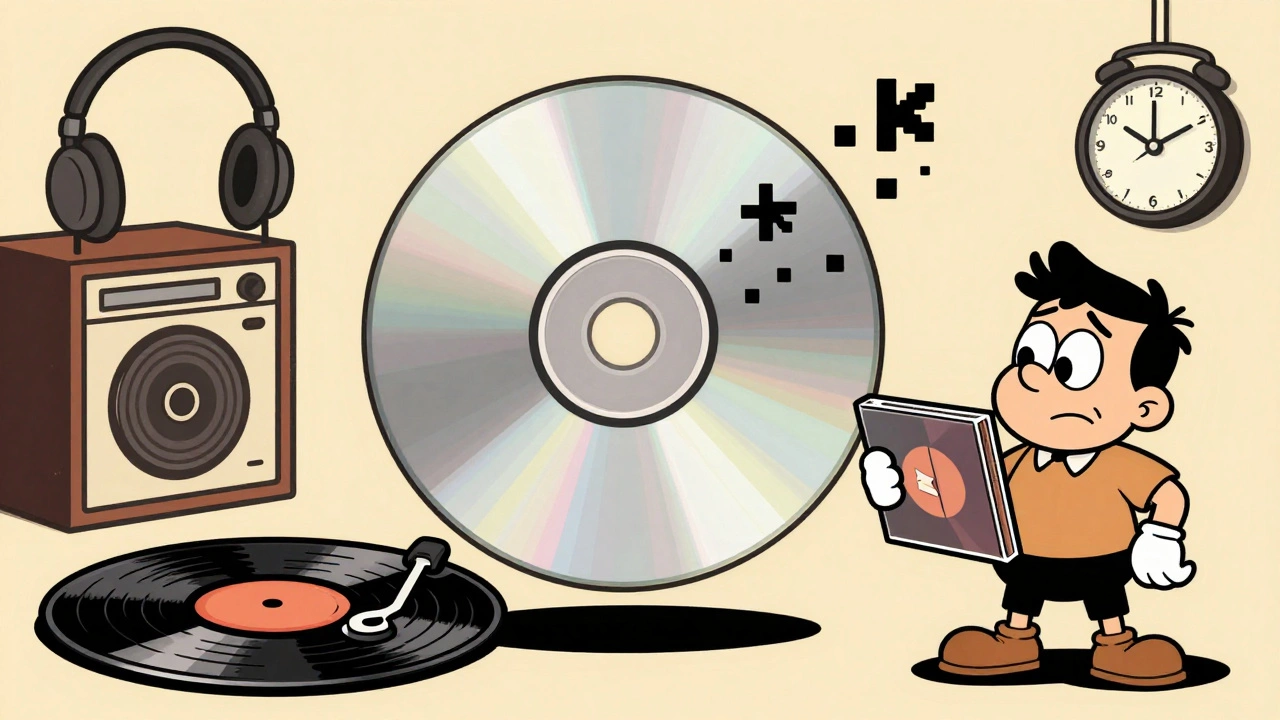
Producers in the 1980s worked closely with cutting engineers who understood the physics of vinyl. Loudness and low frequencies take up more space on a record. If you put a bass-heavy song near the center of the disc (the end of Side B), the grooves must be etched very close together. This increases the risk of surface noise, distortion, and tracking errors.
Therefore, the sequencing strategy often dictated that the loudest, most compressed tracks go on the outside (start of Side A and start of Side B), while quieter, acoustic, or vocal-focused tracks went toward the inside (end of Side A and end of Side B). This isn't just theory; it's engineering. If a producer wanted a heavy metal track to sound crisp, it couldn't be the last song on the album.
Key changes also mattered. Musicians avoided placing two songs in the same key next to each other to prevent monotony. Transitions were carefully managed so that the chord progression of one song flowed naturally into the next, or contrasted sharply to create drama. These decisions were finalized before the album was mastered, meaning the sequence was part of the creative art, not an afterthought.
The Shift to CD and the End of the Flip
By the late 1980s, compact discs began to change everything. CDs could hold up to 74 minutes of audio and had no sides. There was no physical flip. Record stores installed listening stations where customers could sample tracks. Marketing teams realized that if a customer heard only the first minute of an album, that first track had to be a hit.
This led to "front-loading." Labels started placing the lead single as Track 1 on every CD release, regardless of the original vinyl sequence. The nuanced A/B structure began to erode. Albums got longer, filling the extra space with filler tracks rather than tight, balanced arcs. The immersive, two-part journey of the 1980s vinyl era gave way to a consumer-friendly model designed for quick sampling and instant gratification.
However, the legacy remains. Many modern artists who release vinyl editions still respect the old rules, splitting tracks to ensure good sound quality and a satisfying listening experience. And even in streaming, the best playlists mimic the 1980s album structure: a strong opener, varied pacing, and a memorable closer.
Why did 1980s albums have Side A and Side B?
Vinyl records physically limited playing time to about 40-45 minutes total to maintain audio quality. To fit more songs, albums were split into two sides. This physical constraint created a psychological structure where Side A introduced the artist and Side B deepened the theme, encouraging listeners to engage with the full album.
How did physical limitations affect track order?
Loud, bass-heavy tracks cause more distortion if placed near the center of a vinyl record due to narrower grooves. Therefore, producers placed energetic songs at the start of Side A and Side B (outer edges) and quieter, acoustic tracks toward the end of Side B (inner grooves).
What was the purpose of the last track on Side A?
The last track on Side A acted as a cliffhanger. It was often a dramatic or high-energy song designed to motivate the listener to physically flip the record and continue listening to Side B, maintaining engagement throughout the album.
Did cassette tapes follow the same sequencing rules?
Yes, cassettes had fixed lengths (e.g., C60, C90) and were divided into Program 1 and Program 2. Producers balanced the time and mood across both sides to ensure a coherent listening experience, similar to vinyl, though they sometimes adjusted track orders to avoid cutting songs in half during the midpoint.
How did CDs change album sequencing?
CDs eliminated the physical flip and allowed longer playtimes. Record store listening stations meant customers often only heard the first track. This led to "front-loading," where labels placed the biggest hit as Track 1 to grab attention, reducing the importance of the traditional Side A/Side B narrative arc.