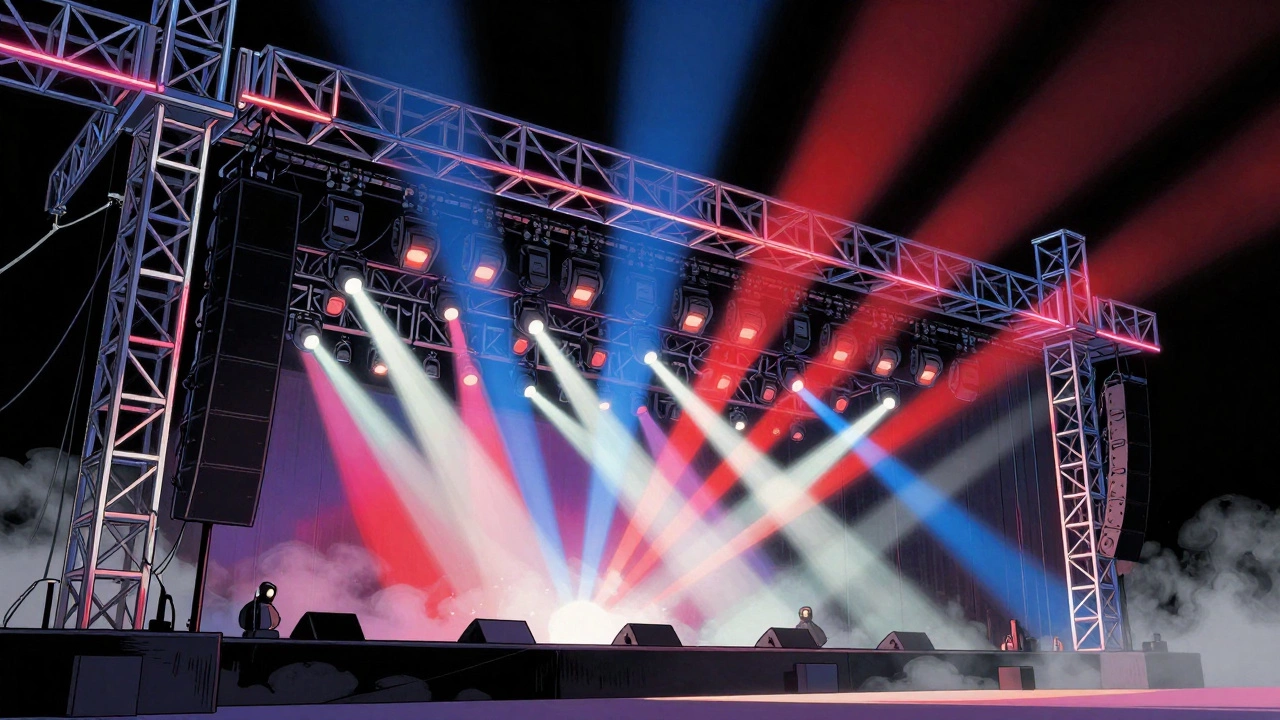

Close your eyes and picture a rock concert in 1985. You probably see a wall of blinding white light, thick fog rolling across the stage, and maybe a sharp red beam slicing through the air. That wasn’t just decoration; it was a revolution. The 1980s marked the moment when live music stopped being just about sound and started becoming a massive visual experience. Before this decade, lighting was functional-bright enough to see the band. By 1989, it was theatrical, dangerous, and huge.
This era sat right between the simple analog setups of the 1970s and the digital precision of the 1990s. It was defined by three things: the sheer weight of aluminum truss, which became visible art itself; the raw power of gas lasers that required water cooling and safety officers; and the endless banks of PAR 64 lamps that created walls of color. If you want to understand how modern concerts look, you have to look at how these tools were first pushed to their limits.
The Heavy Metal Foundation: PAR Cans and Analog Control
Before we talk about high-tech lasers, we need to talk about heat. The backbone of any 1980s tour was the PAR 64 can. These were heavy, metal fixtures holding a single 1,000-watt incandescent lamp. They didn’t move. They didn’t change color electronically. To get blue light, you physically screwed a sheet of colored gel over the lens. To get more light, you hung another one next to it.
A typical arena rig for a major act might use anywhere from 100 to 400 of these cans. Imagine the electricity bill alone. These fixtures were hung in tight rows on overhead structures, creating what designers called "walls of light." When they all hit full brightness together, the effect was overwhelming. It was brutal, bright, and incredibly effective for highlighting performers against a dark background.
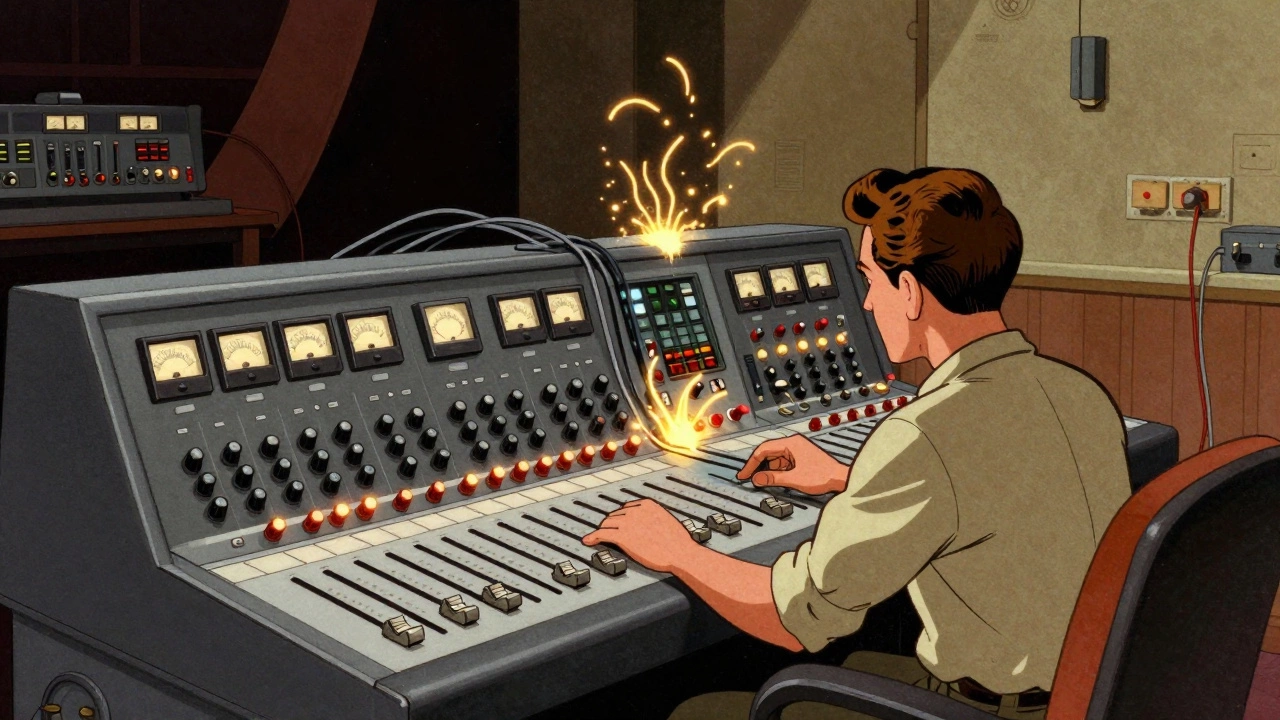
Controlling them was no small feat. There were no iPads or wireless controllers. Designers used large analog consoles with physical faders. Each fader controlled a dimmer rack channel, which adjusted voltage to the lamps. A show cue stack might have 50 or 100 steps, but changing the order mid-show was nearly impossible without stopping the music. This limitation forced designers to plan every second of the performance meticulously. If you wanted a blackout, you pulled the master fader down. Simple, mechanical, and reliable.
- Fixture: PAR 64 (1,000W)
- Control: Analog dimmer boards (0-10V)
- Color: Physical gel filters (Rosco/Lee)
- Quantity: 100-400+ per major tour
Truss as Sculpture: Making Structure Visible
In the 1970s, you tried to hide the rigging. In the 1980s, you made it part of the show. Aluminum box truss became the standard framework for hanging lights, but designers realized the structure itself could be iconic. Bands like The Who famously toured with custom truss shapes that spelled out their name or formed geometric arches over the stage.
These weren't just decorative. They were engineering marvels. A typical span might be 30 to 80 feet long, supported by chain hoists rated for tons of weight. The truss had to hold hundreds of pounds of steel fixtures, cables, and sometimes even video screens. Because the truss was so prominent, it was often outlined with smaller film-style lamps or neon tubes, turning the skeleton of the stage into a glowing graphic.
This approach changed how audiences perceived space. The ceiling of the venue disappeared behind a grid of metal and light. It created a sense of enclosure and scale that felt futuristic. Today, we try to make truss invisible again, using black cloth and strategic placement. But in the 80s, the industrial aesthetic was cool. It said, "Look how big this production is."
| Feature | 1980s Era | Modern Era |
|---|---|---|
| Visibility | High (Exposed aluminum) | Low (Blackout cloth/concealed) |
| Material | Heavy Steel/Early Aluminum | Lightweight Extruded Aluminum |
| Function | Structural + Scenic Element | Purely Structural Support |
| Load Capacity | Static (Chain Hoists) | Dynamic (Motorized Winches) |
The Laser Revolution: Gas, Haze, and Danger
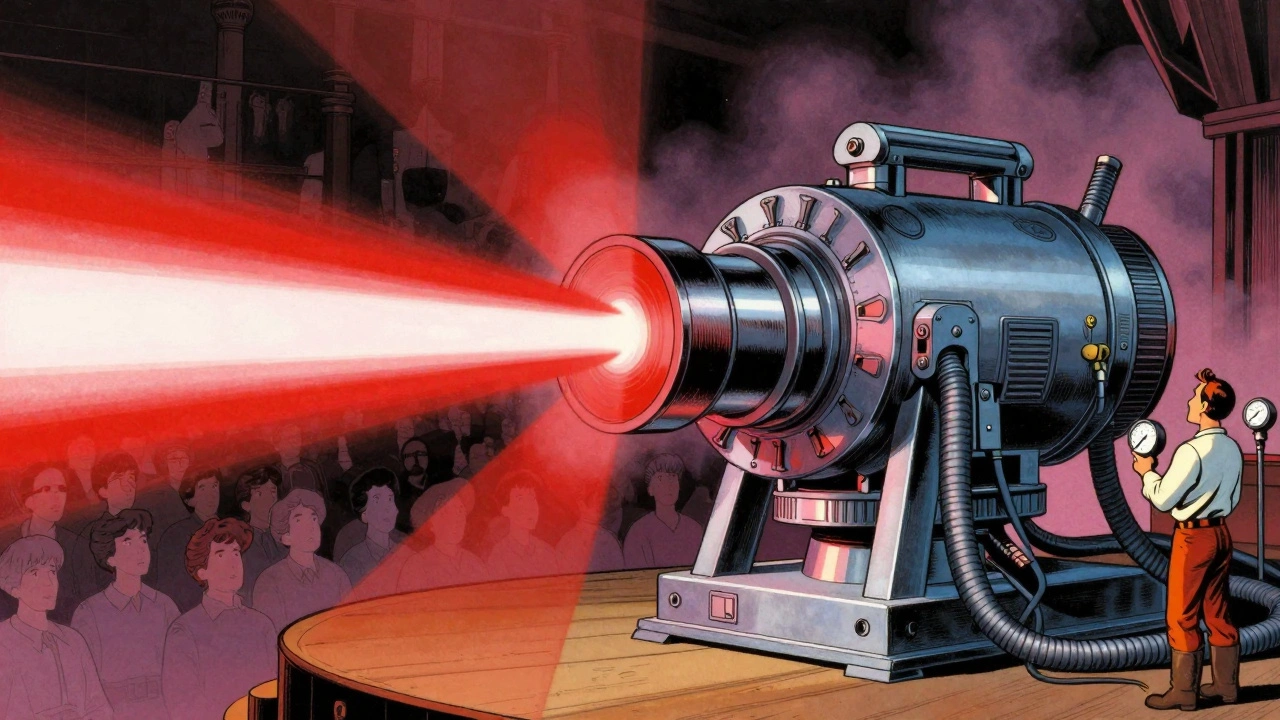
If PAR cans provided the body, lasers provided the soul of the 1980s spectacle. For the first time, light could appear as a solid object in the air. But this technology was alien to most lighting crews. It wasn’t something you bought at a rental house; it was something you hired a specialist company for.
The lasers of this era were gas-based. You had Helium-Neon (HeNe) lasers for red beams and Argon-ion lasers for green or blue-green. These machines were monstrous. They required high-voltage power supplies, complex water-cooling systems, and constant maintenance. A single projector could weigh as much as a person and needed its own technician to align the mirrors.
The magic happened when these beams hit haze. Without smoke or fog, a laser beam is invisible from the side. With atmospheric effects, the coherent light scattered off particles, creating volumetric shapes like fans, tunnels, and cones. Designers would place scanning heads at the ends of trusses, sweeping beams through the audience volume. The result was mesmerizing. Audiences had never seen light behave like that before.
However, there was a catch: safety. Lasers are powerful enough to burn retinas. By the mid-80s, regulations tightened significantly. In the U.S., the FDA’s Center for Devices and Radiological Health (CDRH) began enforcing strict rules. Audience scanning was largely banned. Shows required dedicated Laser Safety Officers (LSOs) to monitor exposure levels. This meant lasers were often reserved for specific climactic moments-like a guitar solo-where the risk could be managed, rather than running continuously throughout the set.
Control Consoles: The Bridge Between Eras
How did you control all this chaos? The control desk was the nerve center. In the early 80s, most consoles were still analog. As the decade progressed, microprocessors entered the scene. Brands like High End Systems and Strand introduced digital memories, allowing designers to store complex cues.
But don’t confuse this with today’s software. These early digital boards had tiny monochrome screens and limited memory. DMX512, the protocol that standardized communication between consoles and fixtures, was finalized in 1986. Before that, every manufacturer had their own wiring scheme. If you mixed brands, you needed adapters. Moving lights were rare until the late 80s, and when they appeared, they were expensive, fragile, and controlled via proprietary systems.
Laser control was entirely separate. Laser projectors had their own analog controllers with knobs for scan speed and modulation. There was no integration with the main lighting console. The laser operator worked independently, watching the show and triggering effects manually or via pre-programmed sequences. This separation meant timing had to be perfect, relying on earplugs and count-ins rather than digital sync.
Safety and Limitations: The Cost of Spectacle
We romanticize the 80s look, but working on those tours was grueling. The limitations of the technology dictated the design. Power consumption was insane. Hundreds of 1,000-watt lamps drew massive currents, requiring generators that weighed tons. Heat was a constant enemy. Backstage areas were ovens, and crew members suffered burns from touching hot PAR cans.
Weight was another issue. Flying a rig took hours. Focus times were long because every lamp had to be aimed individually. Gel changes were manual labor. If you wanted to change the color palette for a different city, you spent the whole night swapping plastic sheets. This lack of flexibility meant shows looked similar everywhere. You couldn’t easily adapt the lighting to the architecture of each venue.
Lasers added another layer of complexity. Transporting water-cooled ion lasers was a logistical nightmare. Leaks could ruin equipment. Misalignment could kill the beam. And the regulatory scrutiny meant paperwork was as important as the art. Despite these hurdles, the impact was undeniable. The combination of heavy truss, blinding PARs, and piercing lasers created a visual language that defined rock music for a generation.
Legacy: Why the 80s Still Matter
Today, we have LED washes, moving heads, and compact diode lasers that fit in a backpack. We can change colors instantly and program intricate animations. But the core principles of 1980s lighting design remain intact. We still use truss to define space. We still use haze to make beams visible. We still build climaxes around intense bursts of light.
Designers today study the 80s not for the technology, but for the attitude. It was an era of excess and experimentation. It proved that lighting could tell a story just as well as the music. When you see a modern stadium show with a giant truss arch and a laser finale, you’re seeing the direct descendant of those 1980s rigs. The tools have changed, but the desire for spectacle hasn’t.
What kind of lasers were used in 1980s concerts?
The primary lasers used were gas-based systems, specifically Helium-Neon (HeNe) for red beams and Argon-ion for green or blue-green beams. These required high voltage and water cooling, making them large and difficult to transport compared to modern diode lasers.
Why were trusses visible in 1980s stage designs?
In the 1980s, truss was treated as a scenic element rather than just support. Bands like The Who shaped truss into logos or arches, outlining them with lights. This industrial aesthetic was considered stylish and emphasized the scale of the production, unlike modern trends that aim to hide rigging.
How did lighting control work before DMX512?
Before DMX512 became standard in 1986, lighting control relied on analog dimmer boards using 0-10V signals. Each manufacturer had proprietary wiring protocols, making it difficult to mix fixtures from different brands. Memory was limited, and cues were often static stacks rather than flexible programs.
Were lasers safe for audiences in the 1980s?
Safety was a major concern. Regulations by agencies like the FDA's CDRH restricted audience scanning due to eye injury risks. Dedicated Laser Safety Officers were required for high-power shows, and beams were often directed above head height or used only during specific musical climaxes to minimize exposure.
What was the role of PAR 64 fixtures in 80s lighting?
PAR 64s were the workhorse of 1980s lighting. Hundreds of these 1,000-watt fixtures were hung on trusses to create intense walls of light. Colors were achieved by attaching physical gel filters to the lenses. They provided the bulk illumination and dramatic backlighting that defined the era's visual style.


