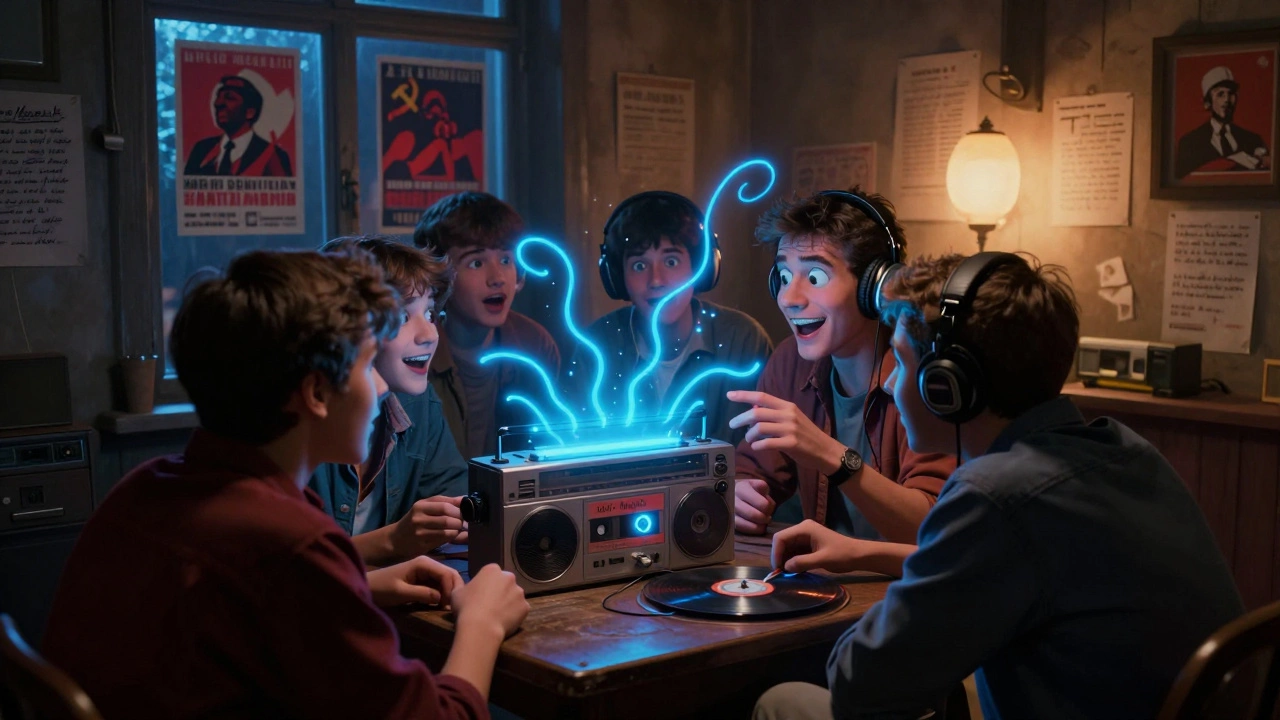

On a cold night in 1982, a group of teenagers in Belgrade slipped a smuggled cassette into a battered tape deck. The opening chords of Idoli’s "Maljčiki" crackled through the room-raw, rebellious, and utterly forbidden. Outside, the state’s propaganda blared from loudspeakers. Inside, the music was a revolution. This wasn’t just rock. It was survival.
Behind the Iron Curtain, rock music didn’t just exist-it thrived in basements, dorm rooms, and secret radio broadcasts. While governments in Yugoslavia, Poland, Czechoslovakia, Hungary, Bulgaria, Romania, and the Soviet Union tried to control culture, young people built an underground network that turned guitars into weapons and lyrics into manifestos. Rock wasn’t entertainment here. It was resistance.
Yugoslavia: The Odd One Out
Unlike the rest of the Eastern Bloc, Yugoslavia wasn’t part of the Warsaw Pact. Under Tito, it broke from Stalin in 1948 and carved out a strange middle ground: socialist, but open to the West. That freedom didn’t mean full access-it meant just enough.
Western records still had to be smuggled in. Radio Free Europe’s signal was jammed. But Yugoslav bands like Riblja Čorba, Azra, and Šarlo Akrobata wrote songs in Serbian, Croatian, and Slovenian that cut deeper than any protest sign. Their lyrics mocked bureaucracy, questioned authority, and sang about alienation in a society that claimed to be free.
By the late 1970s, Belgrade had its own punk scene. The 1980 album Pljuni i zapjevaj moja Jugoslavijo by Riblja Čorba was banned by state radio. Yet, it sold over 150,000 copies-more than any Western band in the region that year. The government didn’t know how to stop it. They couldn’t arrest a song.
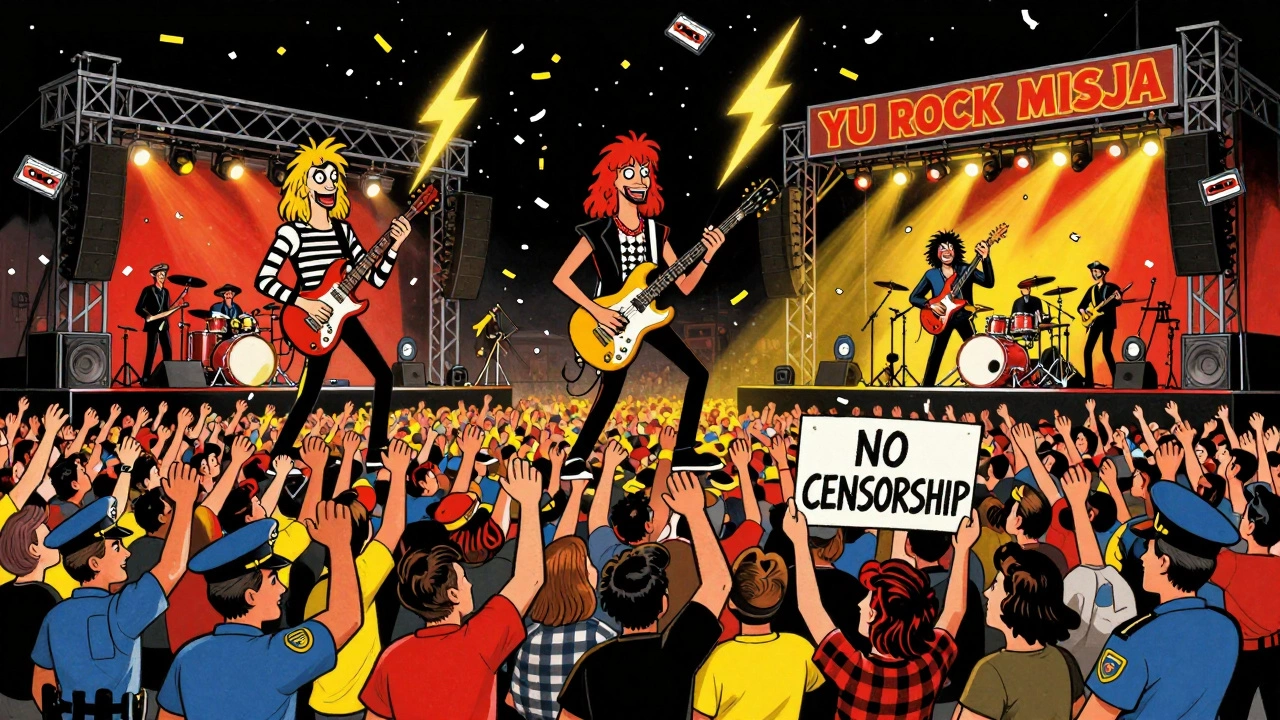
Concerts were monitored. The police showed up. But crowds of 10,000+ packed arenas anyway. In 1985, the "YU Rock Misija" festival in Belgrade drew 80,000 people. It was the largest rock event ever held in Eastern Europe. No one asked for permission.
Poland: Solidarity and Slogans
In Poland, rock music became tied to the Solidarity movement. Bands like Pankrti and Kryzys didn’t just play music-they made zines, taped bootlegs, and distributed records through underground networks. The state banned albums, but people copied them by hand.
One of the most famous cases was 2 Plus 1, whose 1981 album Wszystko jedno was pulled from shelves after the government declared martial law. The band’s lead singer, Janusz Panasewicz, was briefly detained. The album? It sold 200,000 copies anyway-mostly on homemade cassettes.
Polish punk bands like Brygada Kryzys and Kult used their lyrics to call out police brutality and censorship. One song, "Nie ma takiego kraju" (There Is No Such Country), became an anthem. It didn’t mention Solidarity by name. But everyone knew what it meant.
Czechoslovakia: The Power of Silence
Czechoslovakia had no rock scene like Yugoslavia’s. It had something quieter, more dangerous: The Plastic People of the Universe.
Formed in 1968, the band was inspired by Frank Zappa and Captain Beefheart. Their music was abstract, chaotic, and deeply political. In 1976, they were arrested for "organized disturbance of the peace." The trial became an international scandal. Václav Havel, the future president of Czechoslovakia, wrote a famous essay about it: "The Power of the Powerless."
Their arrest didn’t silence them-it made them legends. Their 1982 album Egon Bondy’s Happy Hearts Club Banned was recorded in secret and passed hand-to-hand. By 1989, it was a symbol of everything the regime tried to crush.
Hungary: The First Crack
Hungary was the first Eastern Bloc country to let Western music in. By the 1970s, state radio played Beatles and Rolling Stones. But local bands still had to fight.
Illés and Omega were huge. Omega’s 1975 album Omega 7 sold over 500,000 copies in Hungary alone. They toured East Germany, Poland, and even the Soviet Union. Their song "A Nap Rendje" became an unofficial anthem.
By the 1980s, Hungary’s rock scene was more open than anywhere else. The government even funded a state record label, Opus, which released albums by Hungarian rock bands. It wasn’t freedom-but it was a crack in the wall.
Behind the Scenes: How the Music Spread
How did rock music cross borders when radios were jammed and borders were guarded?
- Smuggled Cassettes: People brought tapes from Vienna, Prague, or Istanbul. They copied them on reel-to-reel machines in basements. One tape could be duplicated 20 times.
- Radio Free Europe: Despite jamming, RFE’s signal still reached parts of Yugoslavia, Poland, and Hungary. Listeners recorded broadcasts and shared them.
- Student Networks: Universities became hubs. Students in Ljubljana, Warsaw, and Bucharest traded tapes like currency.
- Foreign Tourists: Western visitors brought records. A single copy of Pink Floyd’s The Wall could be copied 50 times before the vinyl wore out.
There was no internet. No streaming. Just human connection. A handshake. A hidden tape. A whispered name: "Idoli. Next week. My apartment. 11 p.m. Bring a blanket."
The Cost of Rock
It wasn’t risk-free.
In Romania, the Securitate monitored rock fans. In 1983, a 17-year-old in Cluj was jailed for three months for owning a copy of AC/DC’s Highway to Hell. In Bulgaria, punk kids were beaten at concerts. In Moscow, fans of Kino-led by Viktor Tsoi-were detained for "anti-Soviet agitation."
But they kept playing.
Yugoslav bands were sometimes forced to sing in English to avoid censorship. Czech musicians had to change lyrics to avoid arrest. Hungarian bands were pressured to play covers of Western hits instead of originals.
Still, they wrote songs about love, loneliness, and freedom. And those songs carried more truth than any state newspaper.
Why It Mattered
This wasn’t just about music. It was about identity.
Under communist rule, people were told they were part of a collective. Rock told them: "You’re an individual. You have a voice."
When the Berlin Wall fell in 1989, it wasn’t just politics that collapsed. It was silence. The first thing people did in Prague, Budapest, and Belgrade? Turned on the radio. And played rock.
By 1990, Yugoslav bands were playing in London. Czech bands were touring New York. Polish punkers were signing with German labels. The Iron Curtain hadn’t just been broken-it had been replaced by a stage.
The Legacy
Today, you won’t find many of these bands on Spotify. But their influence is everywhere.
Idoli’s frontman, Nebojša Krstić, now runs a radio station in Belgrade that plays only 1980s Yugoslav rock. In Warsaw, a museum exhibit called "Cassette Revolution" shows the tape decks and homemade labels used to spread music. In Sofia, a statue of a punk with a guitar was erected in 2021.
The music didn’t topple governments. But it gave people the courage to believe they could. And that’s more powerful than any law.


