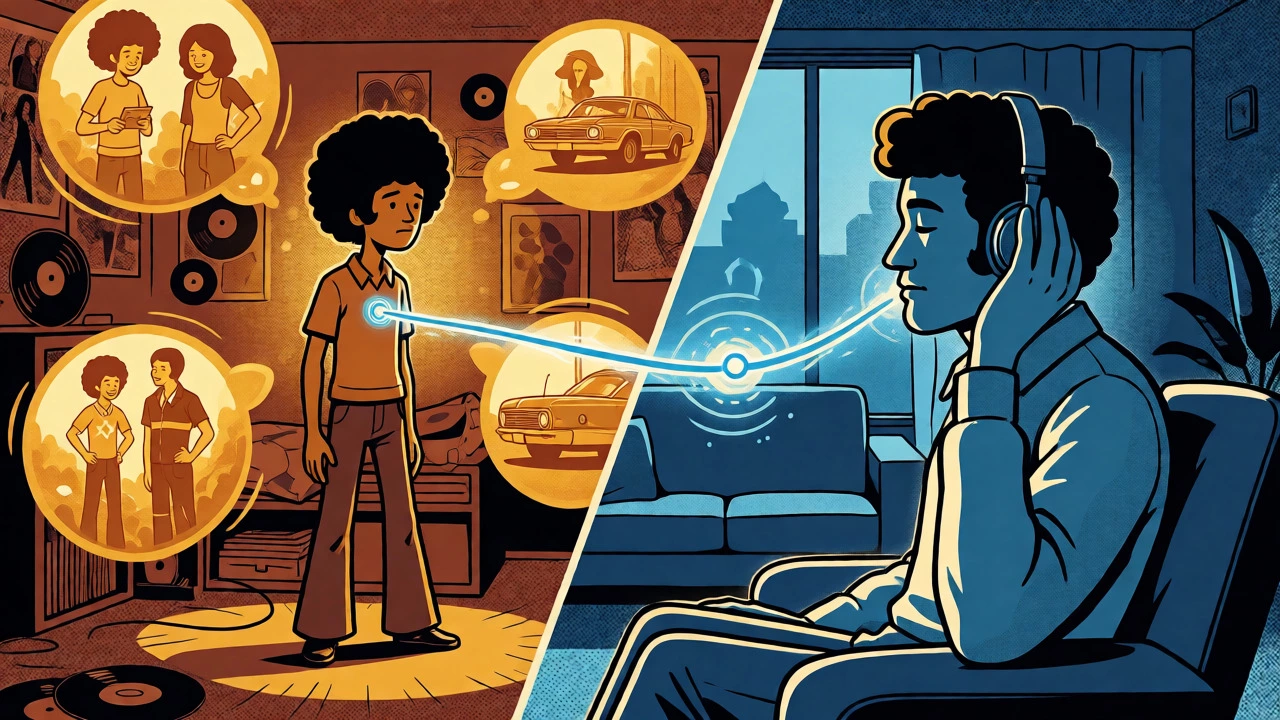

You’re watching a scene. The protagonist is driving through a neon-lit city at night, or maybe they’re just staring out a window while rain hits the glass. Suddenly, a familiar guitar riff kicks in. It’s not new. It’s not current pop. It’s a track from the 1970s, and your brain instantly rewires itself to feel something deep, personal, and oddly specific. You don’t need dialogue to understand the mood. The song does it for you.
This isn’t an accident. It’s a calculated move by music supervisors who know exactly what they’re doing. In 2026, the use of 1970s music in film and television remains dominant, but the reasons have shifted from simple period accuracy to complex psychological and economic strategies. Why do these songs still work? Is it just because our parents liked them? Or is there something deeper happening in our brains when we hear David Bowie or Fleetwood Mac?
The Reminiscence Bump: Why Your Brain Loves Old Music
There is a well-documented psychological phenomenon called the reminiscence bump. This is the tendency for adults to recall a disproportionate number of memories from their adolescence and early adulthood, roughly ages 10 to 30. During this time, your identity forms, your friendships solidify, and your cultural tastes lock in. Music heard during these years becomes hardwired into your emotional landscape.
Research supports this heavily. A 2025 study published in Memory & Cognition tested participants on how different media triggered autobiographical memories. The researchers found that musical cues produced a significantly stronger reminiscence bump than movie clips alone. When you hear a song from your formative years, it doesn’t just remind you of a date; it triggers a cascade of sensory details-the smell of your first car, the texture of a school carpet, the feeling of freedom.
But here’s the twist: this effect isn’t limited to people who actually lived in the 1970s. A 2023 global study involving over 4,800 participants from 102 countries confirmed that this bump is pervasive across cultures. More importantly, a "cascading" effect exists. Children often inherit the musical preferences of their parents. If your parents were teenagers in the 1970s, you likely grew up hearing those tracks on vinyl or cassette. By the time you hit your own teens, those songs were already part of your family’s sonic backdrop. This creates a multi-generational familiarity that newer decades haven’t yet achieved.
Cultural Scripts and Emotional Shorthand
Filmmakers don’t just use 1970s songs for personal memory; they use them as cultural scripts. These are shared associations that most viewers understand without explanation. A 2026 study in the Proceedings of the National Academy of Sciences (PNAS) analyzed how songs trigger similar memories in different people. They found that older songs, particularly from the 70s, were strongly linked to terms like "family," "home," "mother," and "childhood."
This makes 1970s music incredibly efficient for storytelling. Consider the genre diversity of that decade. Disco signals nightlife, liberation, and camp. Soul conveys intimacy and political weight. Glam rock offers theatricality and alienation. A director can pick one of these genres to instantly set the tone without writing a single line of exposition. If a character puts on a Led Zeppelin track, you immediately understand they are rebellious, energetic, or perhaps chaotic. If they play Carole King, you sense vulnerability and domestic warmth.
James Gunn understood this perfectly with Guardians of the Galaxy. He didn’t just pick popular hits; he picked 1970s songs that felt familiar yet slightly off-kilter for an alien setting. This contrast humanized the sci-fi world. It made the strange feel safe. Similarly, Quentin Tarantino’s Once Upon a Time in Hollywood used tracks he heard on LA radio as a kid. The music wasn’t just background noise; it was historical evidence of his character’s inner life.
The Economics of Sync: Money Talks
Beyond psychology, there’s cold, hard cash. Sync licensing-paying to use a song in visual media-is a multibillion-dollar industry. For prominent uses in advertising or major films, publishing fees can range from $400,000 to $2.5 million before even paying for the master recording rights.
Why spend so much on old songs? Because they work. When a song appears in a high-profile show, streaming numbers explode. Look at Kate Bush’s "Running Up That Hill." After its placement in Stranger Things, it shot back up the charts. While that’s an 80s example, the mechanism is identical for 70s tracks. A more direct example is David Bowie’s "Heroes." Following its use in the finale of Stranger Things, Billboard reported a massive spike in streams-over 1.4 million official on-demand U.S. streams in just four days, a 143% increase.
Labels and estates love this. A successful sync can revive a forgotten catalog, leading to renewed concert interest, playlist inclusion, and long-term royalty streams. The Recording Academy noted that Linda Ronstadt’s "Long, Long Time" saw a 4,000% increase in Spotify streams after a TV placement. For rights holders, accepting a lower upfront fee might be worth it if it means introducing a 1970s classic to Gen Z listeners who will stream it for years.
| Song / Artist | Placement Context | Streaming Impact | Primary Driver |
|---|---|---|---|
| David Bowie - "Heroes" | Stranger Things Finale | +143% streams in 4 days | Viral discovery via prestige TV |
| Linda Ronstadt - "Long, Long Time" | The Last of Us | +4,000% Spotify streams | Emotional resonance with narrative |
| Harry Nilsson Catalog | Russian Doll | Renewed mainstream attention | Repeated exposure in serialized format |
| Kate Bush - "Running Up That Hill" | Stranger Things | Returned to Top 10 Hot 100 | Algorithmic recommendation loop |
The Licensing Minefield
It’s not always smooth sailing. Clearing rights for 1970s music can be a nightmare. Unlike modern pop, where ownership might be centralized with one label, 70s catalogs are often fragmented. Rights might be split between multiple publishers, co-writers, or estates that disagree on usage terms.
For the Spanish-language series La Casa de las Flores, clearing 1970s songs was difficult due to incomplete registration records. Similarly, the cult classic Freaks and Geeks reportedly spent a huge chunk of its budget just to clear around 120 soundtrack tracks. If you’re a filmmaker, the perfect song might be legally unavailable or prohibitively expensive. Sometimes, you have to settle for a lesser-known track that captures the vibe without breaking the bank.
This fragmentation has led some supervisors to dig deeper. Blake Leyh, music supervisor for HBO’s The Deuce, deliberately mixed obvious hits with obscure cuts. Using only famous songs can make the audience notice the soundtrack instead of the story. An obscure 1970s gem can provide authenticity without overwhelming the scene with cliché.
Is the Trend Fading?
As of late 2026, the dominance of 1970s music shows no sign of stopping, but the dynamics are changing. Algorithms on platforms like TikTok and Spotify reward recognizable hooks. A song doesn’t have to be old to go viral, but it helps if it feels timeless. The 1970s offer a sweet spot: enough distance to feel nostalgic, but recent enough that the production quality sounds crisp to modern ears.
However, critics argue that this is sometimes lazy "nostalgia packaging." Are filmmakers using these songs because the story needs them, or because algorithms predict they’ll keep viewers engaged? The best uses remain those where the music serves the character’s internal state, not just the calendar year. As streaming data continues to shape creative decisions, expect to see more strategic placements of 1970s tracks that balance emotional depth with commercial viability.
What is the "reminiscence bump"?
The reminiscence bump is a psychological phenomenon where adults remember more events and emotions from their adolescence and early adulthood (roughly ages 10-30). Music heard during this period becomes strongly tied to identity formation, making it highly effective at triggering vivid autobiographical memories later in life.
Why do younger audiences connect with 1970s songs?
Younger audiences often experience a "cascading reminiscence bump." They grow up hearing their parents' favorite music, which becomes associated with family home life and childhood safety. Additionally, modern streaming algorithms and film placements expose them to these tracks, creating new positive associations.
How much does it cost to license a 1970s song for a movie?
Costs vary widely based on the song's fame, the media type, and duration. Prominent uses in major films or ads can cost $400,000 to $2.5 million for publishing rights alone, plus separate fees for the master recording. Independent productions may pay significantly less, especially for lesser-known tracks.
Do 1970s songs boost streaming numbers?
Yes, dramatically. Placements in hit shows like Stranger Things or The Last of Us have caused streaming spikes ranging from 143% to over 4,000%. This exposure reintroduces older catalogs to new generations, driving long-term revenue for artists and estates.
What are the risks of using famous 1970s songs?
Overfamiliarity can distract viewers, making them focus on the song rather than the scene. There are also legal risks: fragmented rights ownership can lead to clearance delays or high costs. Sometimes, an obscure track provides better authenticity and avoids cliché.