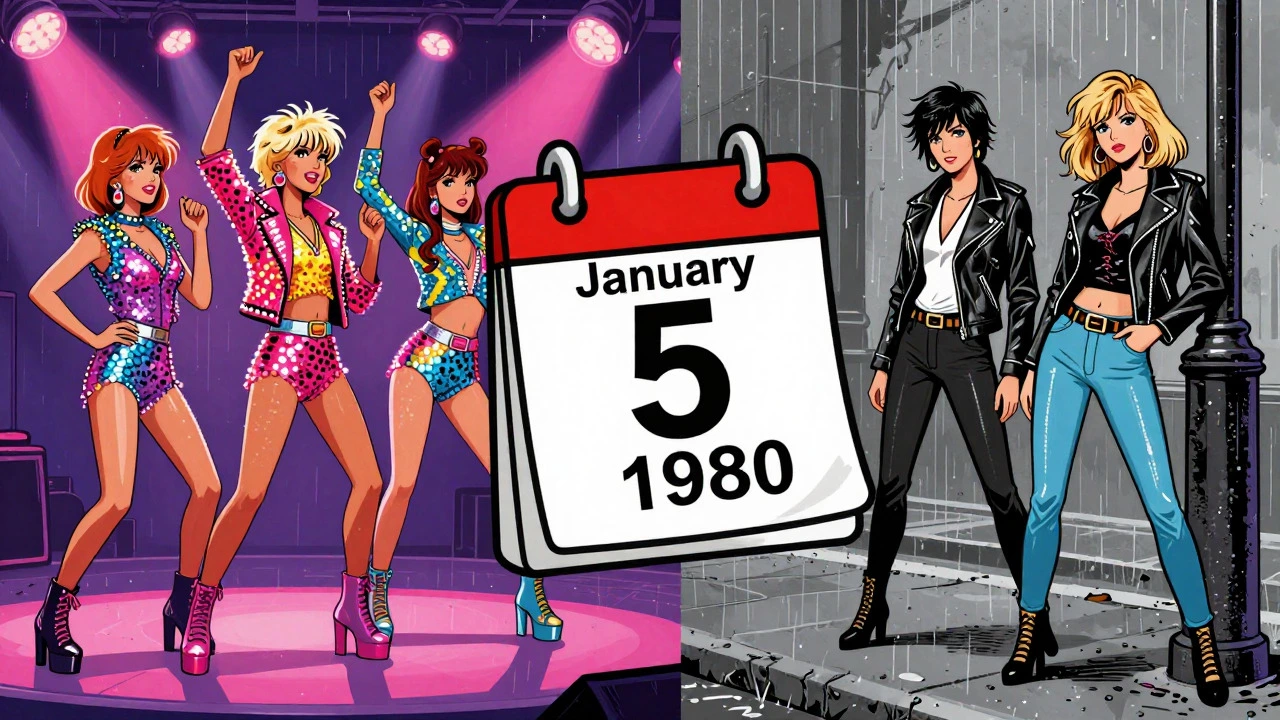

Picture it: January 5, 1980. In the United States, KC and the Sunshine Band is an American disco group known for hits like 'Please Don't Go' holding down the top spot on the Billboard Hot 100 is the standard singles chart in the United States published by Billboard magazine with "Please Don't Go." Meanwhile, across the Atlantic in the United Kingdom, the Pretenders are a British rock band led by Chrissie Hynde are about to take over the UK Singles Chart is the official record chart in the United Kingdom compiled by the Official Charts Company with "Brass in Pocket." This was not just a random Tuesday; it was the start of a decade where music changed faster than the seasons. The 1980s were not just defined by big hair and synthesizers, but by a relentless churn of number-one hits that reshaped how we consume culture.
The Anatomy of a Number-One Hit
To understand the timeline, you first need to understand the machinery. A week-by-week chronicle is more than a list; it is a pulse check on society. When researchers compile these timelines, they rely on specific datasets. For the U.S., the primary source is the Billboard Hot 100, which tracks sales and radio airplay. In the UK, the Official Charts Company is the organization responsible for compiling the UK Singles Chart (and its predecessors) handles the tally. These charts document the title, artist, record label, and the exact duration a song stays at the summit.
Consider the entry data. Each hit gets an ordinal number. "Please Don't Go" by KC and the Sunshine Band is entry number 481 in the comprehensive The Chart Book is a reference publication detailing Billboard chart histories’s Billboard Pop Decade 1980s list. It sat at number one for exactly one week. That brevity is common. Many fans assume every 80s hit was a monster that ruled for months, but the reality is far more chaotic. Short bursts of dominance were the norm, creating a high-turnover environment where new sounds had to fight hard for immediate attention.
1980-1983: The Era of High Turnover
The early 1980s were characterized by rapid changes at the top. In the UK, 1980 saw 24 different number-one singles. Think about that density. With only 52 weeks in a year, that means the average stay at the summit was roughly 2.17 weeks. Songs like "Too Much Too Young" by The Special A.K.A. are the studio side-project of The Specials featuring Rico and "Atomic" by Blondie is an American rock band led by Debbie Harry swapped places quickly. This pattern reflected a fragmented musical landscape. New Wave, post-punk, and synth-pop were all vying for space, preventing any single genre from monopolizing the charts for long periods.
In the U.S., the pattern was similar but slightly less volatile. There were 16 distinct number-one songs in 1980 according to the 80s Music Chart Challenge site. Michael Jackson’s "Rock With You" managed four consecutive weeks at the top starting January 19, 1980, which was considered a significant run at the time. However, even this pop juggernaut could not hold off the incoming tide of diverse styles. The transition from disco to the new electronic sound was happening in real-time, week by week. If you look at the timeline, you see a direct correlation between the rise of MTV later in the decade and the lengthening of chart runs, but in 1980, visual identity mattered less than immediate sonic impact.
| Year | U.S. No. 1 Count (Billboard) | UK No. 1 Count (Official Charts) | Average Weeks per No. 1 (UK) | Key Trend |
|---|---|---|---|---|
| 1980 | 16 | 24 | ~2.17 | High turnover, genre fragmentation |
| 1981 | Data varies | 19 | ~2.74 | Rise of New Romanticism |
| 1982 | Data varies | 21 | ~2.48 | Synth-pop consolidation |
| 1983 | Data varies | 17 | ~3.06 | MTV influence begins |
1984-1985: The Juggernaut Years
Then came the shift. By the mid-decade, certain songs began to defy the short-run trend. In 1984, the UK saw only 14 different number-one singles. This drop in count indicates longer residencies. The standout example is "Two Tribes" by Frankie Goes to Hollywood is a Belgian-British new wave band known for controversial hits. This track spent nine consecutive weeks at number one, the longest run of the entire decade in the UK. Its Cold War-themed lyrics and provocative video made it a cultural phenomenon that transcended mere sales figures. Similarly, "Do They Know It’s Christmas?" by Band Aid is a supergroup formed for charity single recording dominated the charts, eventually becoming the best-selling single of the entire decade in the UK.
In the U.S., the dynamics were shifting too. Airplay became a more significant driver. The Hot 100 Airplay is a Billboard chart tracking radio rotation of singles chart shows us what people were hearing, not just what they were buying. Madonna’s "Like a Virgin" held the airplay number-one spot for five weeks starting December 22, 1984. This separation between sales and airplay reveals a crucial insight: radio stations were beginning to lock into formats, playing fewer songs more often. This created a feedback loop where heavy rotation drove sales, which extended chart runs. The era of the "one-week wonder" was fading, replaced by sustained campaigns.
Regional Divergence: U.S. vs. UK Tastes
If you compare the U.S. and UK timelines side-by-side, the differences are stark. In late July and early August 1985, the U.S. radio airplay chart was dominated by rock-oriented acts. "Shout" by Tears for Fears is an English new wave band, "The Power of Love" by Huey Lewis and the News is an American rock band, and "Money for Nothing" by Dire Straits is a British rock band led by Mark Knopfler each held the top spot for three consecutive weeks. This was a period of intense rock dominance on American radio.
Meanwhile, the UK chart remained obsessed with synth-pop and novelty hits. While Dire Straits might have been huge in the U.S., the UK audience was still reeling from the Frankie Goes to Hollywood wave. This divergence highlights that "global hits" were a myth in the 1980s. A song could be number one in London and unknown in Los Angeles. The lack of instant digital connectivity meant regional tastes developed in isolation. This makes the week-by-week timeline so valuable-it captures these isolated bubbles before the internet homogenized global music consumption.

Data Integrity and Research Challenges
Compiling this timeline is not without its pitfalls. One major challenge is reconciling issue dates. Billboard used Saturday-dated issues, while the UK chart traditionally reported on Saturdays as well, but the exact week-ending definitions can vary slightly between sources. Researchers must normalize these dates to create a unified view. Another issue is re-entries. Some songs left the number-one spot, dropped, and then returned. The Chart Book uses asterisks and special notations to mark these re-entries, which are critical for accurate counting. If you miss a re-entry, your total count of unique number-one songs will be wrong.
Furthermore, the definition of "sales" has evolved. In 1980, physical vinyl and cassette sales were the primary metric. By 1989, CD sales were gaining traction, though they did not fully dominate until the 1990s. This technological shift affected how quickly charts updated. Physical sales data took longer to aggregate than modern digital streams do today. Therefore, the 1980s charts reflect a slower, more deliberate measurement process. Understanding this lag is essential when analyzing why a song might have peaked at a certain time. It wasn't always about sudden viral popularity; it was often about steady accumulation of retail purchases over several weeks.
Cultural Impact and Legacy
Why does this week-by-week detail matter today? Because it provides the context for our current musical nostalgia. The 1980s produced some of the most enduring catalog music in history. When we listen to "Call Me" by Blondie or "Another Brick in the Wall (Part 2)" by Pink Floyd is an English progressive rock band, we are engaging with tracks that were part of this rigorous weekly competition. The timeline shows us that these songs didn't just appear; they survived a gauntlet of competition. They outlasted dozens of other contenders each week.
Moreover, the data reveals the commercial magnitude of these hits. "Don't Stand So Close To Me" by The Police is a British rock band sold an estimated 808,000 copies in the UK in 1980 alone, spending four weeks at number one. This level of specificity allows us to appreciate the economic engine behind the music. It wasn't just art; it was a massive industry. The week-by-week timeline serves as a historical ledger, documenting the peaks and valleys of a decade that defined modern popular music. As we move further away from the 1980s, these precise records become even more vital for historians, journalists, and fans seeking to understand the mechanics of fame in the pre-streaming era.
What was the first number-one song of the 1980s on the Billboard Hot 100?
The first number-one song of the 1980s on the Billboard Hot 100 was "Please Don't Go" by KC and the Sunshine Band, which topped the chart for the week dated January 5, 1980. It held the position for one week.
Which song had the longest run at number one in the UK during the 1980s?
"Two Tribes" by Frankie Goes to Hollywood had the longest run at number one in the UK during the 1980s, staying at the summit for nine consecutive weeks in 1984.
How many different number-one singles were there in the UK in 1980?
There were 24 different number-one singles in the UK in 1980, indicating a very high turnover rate with an average residency of approximately 2.17 weeks per song.
Did the U.S. and UK charts have the same number-one songs in the 1980s?
No, the U.S. and UK charts often had different number-one songs due to divergent regional tastes. For example, rock songs like "Money for Nothing" by Dire Straits dominated U.S. airplay in 1985, while the UK chart featured more synth-pop and novelty hits like those by Frankie Goes to Hollywood.
What is the significance of the Hot 100 Airplay chart in this timeline?
The Hot 100 Airplay chart tracks radio rotation rather than sales. It reveals that by the mid-1980s, radio stations were locking into formats, leading to longer chart runs for heavily rotated songs like Madonna's "Like a Virgin," even if their sales performance varied.
Who was the best-selling artist in the UK in the 1980s based on number-one singles?
Band Aid's "Do They Know It’s Christmas?" was the best-selling single of the entire 1980s in the UK. Other top sellers included Frankie Goes to Hollywood's "Relax" and Stevie Wonder's "I Just Called to Say I Love You."
How did the average length of a number-one stay change during the decade?
The average length increased over the decade. In 1980, the UK average was about 2.17 weeks due to high turnover. By 1984, with only 14 number-one singles, the average rose to roughly 3.7 weeks, reflecting the rise of longer-running hits and the influence of MTV.