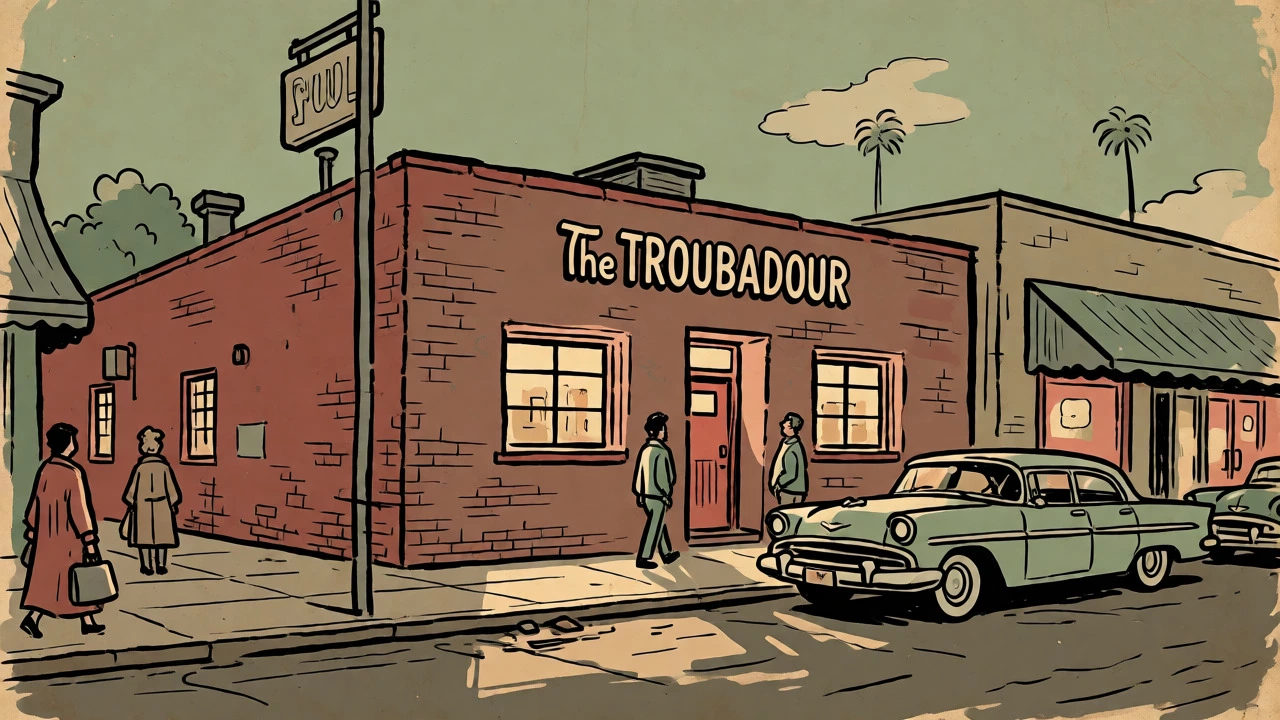

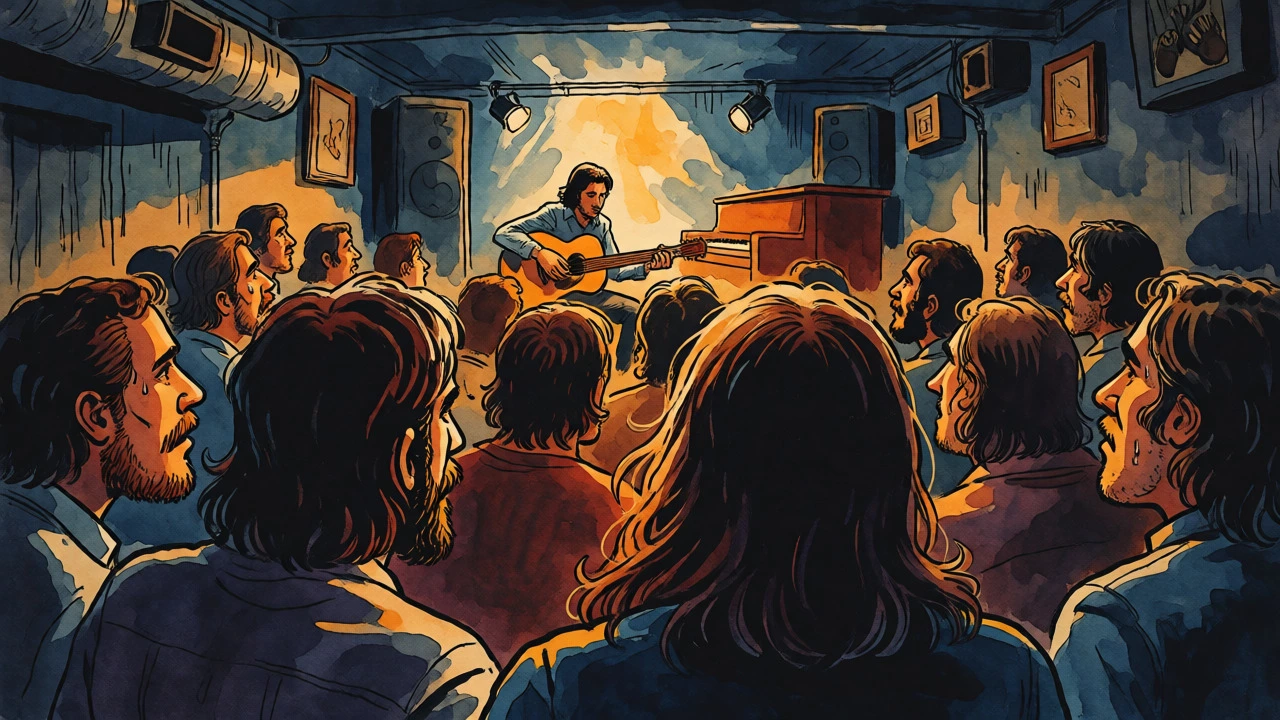
Imagine walking into a room that holds barely 400 people. The air smells faintly of stale beer and old wood. You’re close enough to see the sweat on the performer’s forehead, close enough to hear the slight tremor in their voice before they hit the high note. This isn’t a stadium concert with pyrotechnics and video screens. It’s The Troubadour, a legendary live-music nightclub in West Hollywood that served as the primary incubator for the singer-songwriter movement. For decades, this unassuming spot on Santa Monica Boulevard did something rare: it turned unknown poets with guitars into global superstars.
If you’ve ever wondered where James Taylor found his confidence or how Elton John conquered America, the answer often starts here. The story of the Troubadour isn’t just about music; it’s about a specific cultural moment when personal, confessional songwriting took center stage. Let’s look at how one man’s vision created a space where artists could actually be heard.
Doug Weston and the Birth of the Modern Troubadour
Back in 1957, Los Angeles wasn’t exactly known as the heart of folk music. But Alexander Douglas “Doug” Weston had a hunch. He opened a coffeehouse called The Troubadour, initially located on La Cienega Boulevard, with a simple idea: give talented people a place to play original material without the pressure of selling out a massive arena. Weston moved the club to its current location at 9081 Santa Monica Boulevard in 1961, and that’s where the magic really started.
Weston was an eccentric character. Locals knew him by his wild hair and his signature green corduroy suit, which earned him the nickname “Jolly Green Giant.” But don’t let the costume fool you. He had a sharp eye for talent. Unlike big promoters who only booked acts with proven radio hits, Weston booked people he believed in. He called them “modern-day troubadours,” linking back to medieval storytellers. His booking philosophy was risky but revolutionary. He gave chances to artists who were raw, unpolished, and often broke.
This approach created a unique ecosystem. The club became less of a business transaction and more of a social hub. Musicians didn’t just come to perform; they came to hang out. They met producers, managers, and other artists. It was a networking machine disguised as a bar. If you played well, word spread fast because everyone in the industry seemed to be in the audience.
The Golden Age of the Singer-Songwriter
The late 1960s and early 1970s marked the peak of the Troubadour’s influence. This was the era of Laurel Canyon, where folk-rock evolved into something deeply personal. Artists like Joni Mitchell and Carole King weren’t just writing songs; they were sharing diaries set to music. The small size of the Troubadour forced a level of intimacy that larger venues couldn’t match. There was no hiding behind a wall of sound. If your lyrics were weak, the audience knew immediately.
Consider the career of James Taylor. Before he was a household name, he was a struggling British expat trying to make it in L.A. He played the Troubadour repeatedly, refining his gentle, acoustic style. Then there was Carole King. In 1970, she shared a historic engagement with Taylor. At the time, King was known mostly as a songwriter for other people. Seeing her step up to the piano and sing her own compositions changed perceptions. It signaled a shift from the “Brill Building” model, where writers stayed behind the scenes, to the era of the artist-performer.
Other legends followed suit. Jackson Browne, Linda Ronstadt, Kris Kristofferson, and Randy Newman all cut their teeth on this stage. The venue became a testing ground. If a song worked here, it usually worked everywhere else. The proximity allowed for spontaneous collaborations. One night you might see Neil Young jamming with someone unexpected. These moments built reputations faster than any marketing campaign could.
The Night Elton John Changed Everything
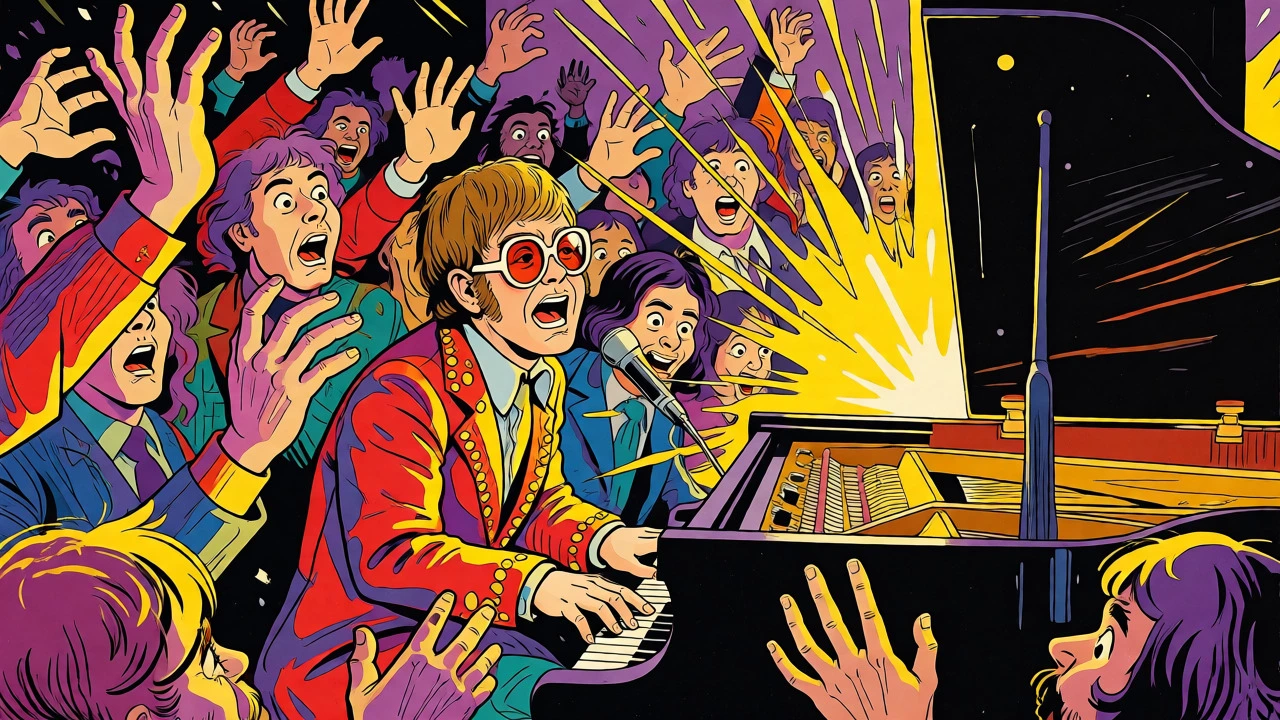
If there is one single event that defines the Troubadour’s legacy, it’s August 25, 1970. That’s the date Elton John made his first United States appearance. He wasn’t famous in America yet. He had released two albums in the UK, but neither had made a significant splash across the Atlantic. Doug Weston booked him anyway, scheduling eight shows over six nights.
The reaction was instantaneous. Word of mouth spread through Hollywood like wildfire. By the second night, the line around the block was impossible to ignore. Industry heavyweights showed up, expecting a novelty act and leaving convinced they’d witnessed a star being born. Neil Diamond famously introduced Elton during one of these sets. Within months, Elton John went from a promising pianist to a global icon. This debut proved that the Troubadour could still launch careers in the rock era, not just the folk era.
| Artist | Year/Era | Significance |
|---|---|---|
| Elton John | 1970 | First US shows; launched international stardom |
| James Taylor & Carole King | 1970 | Symbolized rise of the singer-songwriter as performer |
| Eagles (Henley & Frey) | Late 1960s | Members met and formed the band within the scene |
| Tom Waits | Early 1970s | Discovered during amateur night performances |
| Metallica | 1980s | Early appearances during the thrash metal boom |
Beyond Folk: Comedy and Rock Evolution
While we associate the club with ballads, it wasn’t a museum piece. The Troubadour adapted to the times. In the 1980s, when heavy metal exploded in Southern California, the club pivoted. Bands like Metallica, Slayer, and Guns N’ Roses played there. The same intimacy that helped Joni Mitchell connect with audiences now amplified the raw energy of punk and metal. A small room makes loud music feel dangerous and immediate.
The venue also served as a cradle for stand-up comedy. Richard Pryor, Steve Martin, and Cheech & Chong performed there. This cross-pollination mattered. Comedians and musicians shared the same audience, creating a culture of wit and observation that influenced both groups. Tom Waits, for instance, brought a theatrical, comedic sensibility to his music that fit perfectly in this environment. Lou Adler, a major producer, reportedly discovered Cheech & Chong here, showing how the club functioned as a talent scout’s office.
Survival, Struggle, and Legacy
Not every chapter was smooth. After the glory days of the 1970s, the club faced decline. The music industry consolidated, and large promoters began dominating bookings. Smaller clubs struggled to compete. Doug Weston died in 1999, marking the end of an era. Critics sometimes argue that the mythology around the Troubadour is exaggerated, noting that other venues also contributed to the singer-songwriter boom. They point out that focusing solely on this one club ignores the broader network of L.A. studios and radio stations.
However, the club’s resilience speaks volumes. It survived the grunge explosion of the 90s, hosting bands like Pearl Jam and Radiohead before they filled arenas. It weathered the digital revolution of the 2000s. Even the COVID-19 pandemic, which threatened to shut down live music entirely, couldn’t kill it. In 2020, the venue launched a GoFundMe campaign to stay afloat, reminding fans of its historical importance. Today, it continues to book diverse acts, from Billie Eilish to Chappell Roan, proving that the formula still works.
The real lesson from the Troubadour isn’t just about nostalgia. It’s about the power of context. Music doesn’t exist in a vacuum. It needs a room, an audience, and a community to thrive. By providing a safe space for experimentation, Doug Weston helped create a genre that defined a generation. The walls may have faded paint, but the echoes of those early performances still resonate.
Why is The Troubadour considered so important to music history?
It provided an intimate platform for emerging artists to test original material and build reputations before achieving commercial success, effectively launching the careers of many key singer-songwriters.
Who founded The Troubadour?
Alexander Douglas “Doug” Weston founded the club in 1957 as a coffeehouse, moving it to its current Santa Monica Boulevard location in 1961.
What was Elton John’s connection to The Troubadour?
Elton John made his first U.S. performance there in August 1970. The positive reception from these eight shows transformed him from a relatively unknown British artist into an international star.
Did The Troubadour only host folk musicians?
No. While famous for folk and singer-songwriters, it hosted rock, jazz, heavy metal (like Metallica), alternative rock, and stand-up comedy throughout its history.
Is The Troubadour still open today?
Yes, as of November 2026, it remains an active live-music venue in West Hollywood, continuing to book both established and emerging artists.