
Think you know hip-hop? If your mental image is just a rapper in a studio or a Spotify playlist, you’re missing three-quarters of the story. Hip-hop isn't just music; it's a complete cultural ecosystem that emerged from the Bronx in the early 1970s. It’s built on four distinct pillars that work together like legs on a stool: DJing, MCing, B-boying, and Graffiti. Without any one of these, the culture collapses into something else entirely-usually just "rap," which is only one piece of the puzzle.
This distinction matters because treating hip-hop as merely a genre flattens its history. It ignores the visual artists painting subway cars, the dancers spinning on cardboard, and the DJs manipulating vinyl to create new sounds. These four elements didn't just happen in isolation; they were interconnected responses to urban decay, poverty, and a lack of resources in New York City. Understanding them gives you the full picture of how a neighborhood movement became a global phenomenon. Here is what each element actually is, where it came from, and why it still defines the culture today.
DJing: The Sonic Foundation
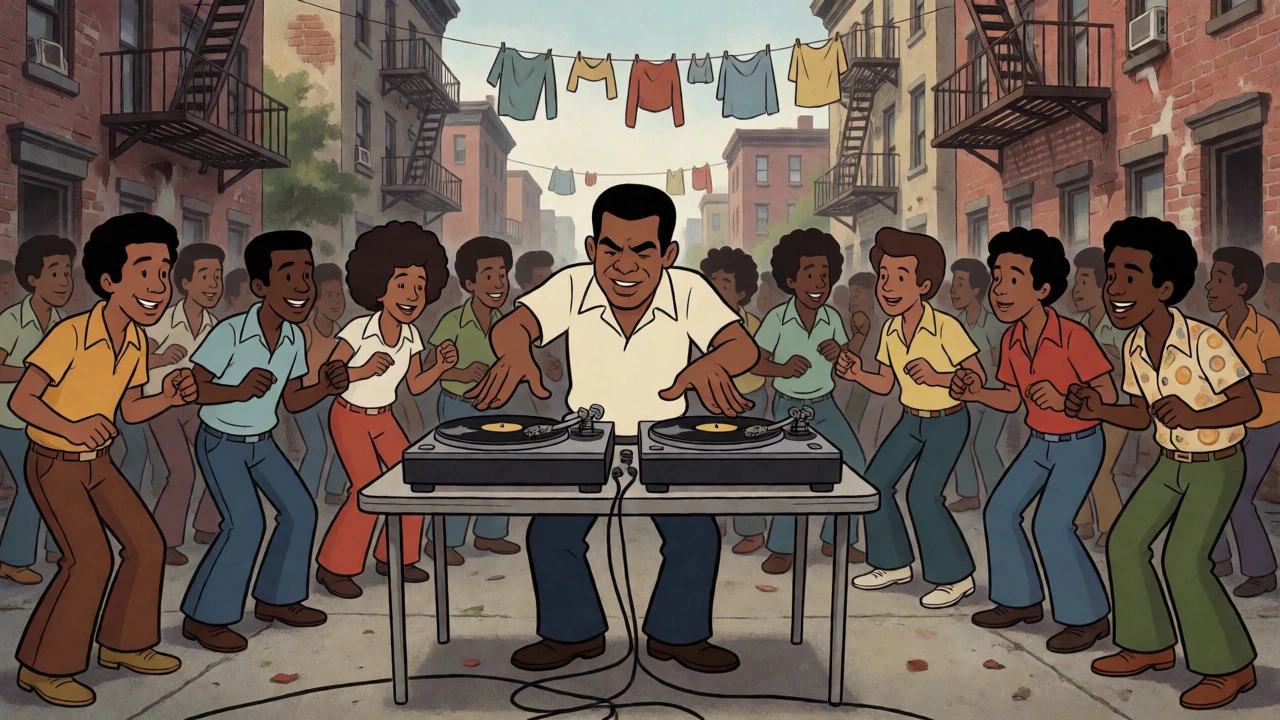
Before there was rap, there was the DJ. In the beginning, the DJ wasn't just playing songs; they were the architect of the party. This element, often called turntablism, started with Clive "DJ Kool Herc" Campbell at a block party at 1520 Sedgwick Avenue on August 11, 1973. Herc noticed that crowds danced hardest during the instrumental "breaks" of funk records-the short, percussive sections without lyrics. To keep people moving, he used two copies of the same record on two turntables, switching back and forth to extend that break indefinitely.
This technique, known as the "Merry-Go-Round," created a continuous loop of rhythm. It shifted the focus from the song itself to the beat itself. Grandmaster Flash later refined this by using headphones to cue up the next track perfectly, allowing for seamless transitions. Scratching, another key technique, involves moving the vinyl back and forth under the needle to create rhythmic percussion. This wasn't just technical skill; it was an act of reclaiming control over technology. In a time when many Black and Latino youth had limited access to expensive instruments, the turntable became their instrument. The DJ sets the mood, controls the energy, and provides the canvas upon which the other elements perform.
MCing: The Voice of the Street
While the DJ laid down the beats, the Master of Ceremonies (MC) filled the silence. Initially, MCs were hype men. Their job was simple: announce the DJ, shout out friends, and keep the crowd engaged between tracks. They used call-and-response patterns rooted in African American oral traditions, similar to church sermons or field hollers. But soon, the rhymes got more complex. Instead of just saying "Put your hands in the air," MCs began telling stories, bragging about their skills, and commenting on social issues.
The evolution from hype man to poet happened fast. By the late 1970s, groups like Grandmaster Flash and the Furious Five were delivering intricate verses over those extended breaks. The release of Sugarhill Gang’s "Rapper’s Delight" in 1979 brought this style to national radio, but the real magic happened live in parks and community centers. MCing requires breath control, timing, and lyrical dexterity. It’s not just talking over music; it’s rhythmic speech that locks into the beat. Today, while commercial rap dominates charts, the core skill remains the same: using words as both percussion and narrative to connect with an audience.
B-Boying: Dance as Resistance
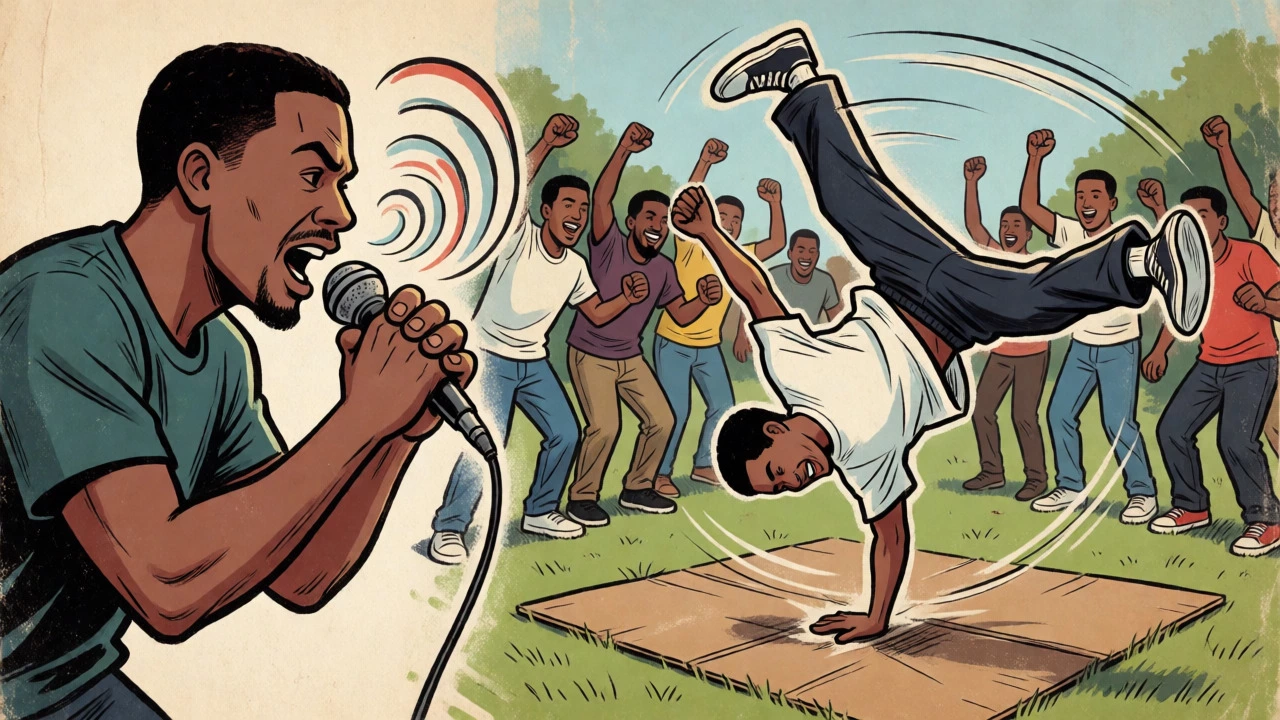
When the DJ extended the break, the dancers went wild. They called themselves B-boys and B-girls (short for break-boys and break-girls). This dance style, known as breaking or b-boying, is acrobatic, athletic, and deeply expressive. It consists of four main components: toprock (standing footwork), downrock (floor moves), power moves (spins and flips), and freezes (holding a pose).
Breaking wasn't just about showing off; it was a way to channel energy and resolve conflict. In neighborhoods plagued by gang violence, dance battles offered an alternative to fighting. Crews would face off in circles, taking turns to show their best moves. The winner wasn't decided by judges initially, but by the crowd’s reaction. Philosopher Cornel West described this bodily expression as "postural semantics," meaning the body communicates social meaning and resistance. Breaking requires immense physical strength and creativity. It transformed the street corner into a stage, proving that art doesn't need a museum or a theater-it can happen on concrete.
Graffiti: Visual Identity
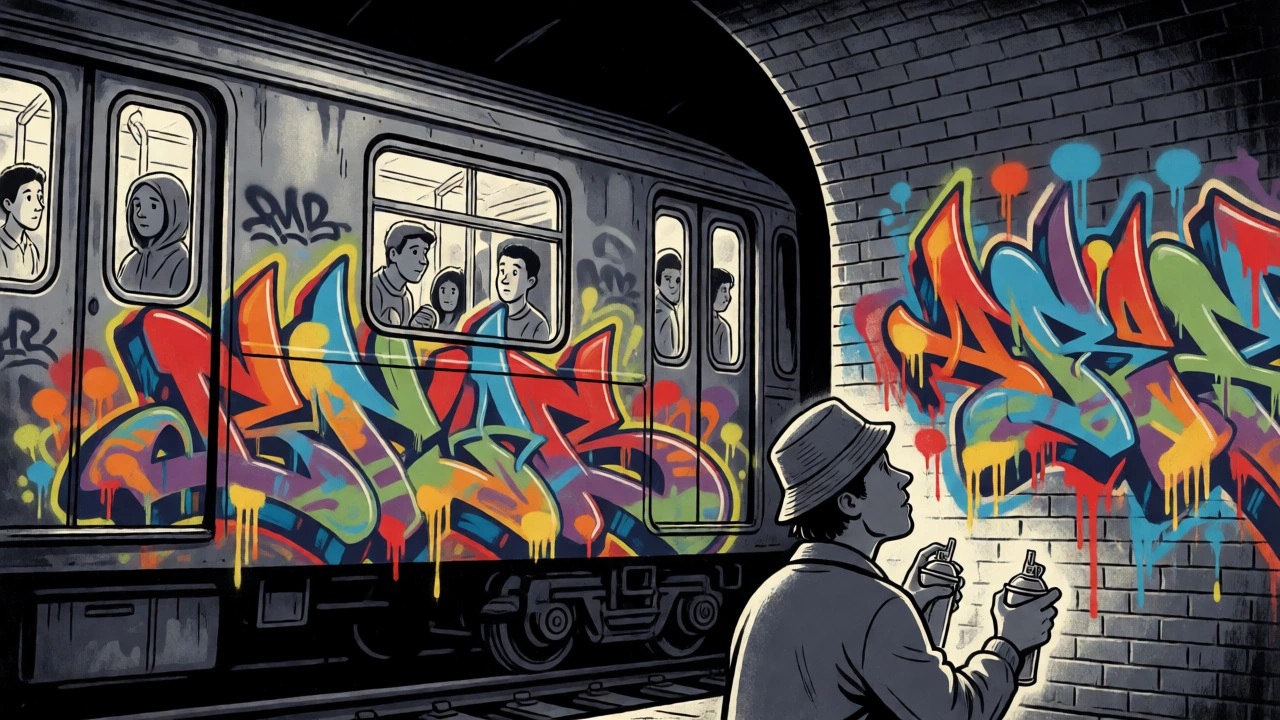
If DJing is sound and MCing is word, graffiti is image. Often dismissed as vandalism, graffiti writing is the visual backbone of hip-hop. It started in the late 1960s with writers like Taki 183 tagging their names on subway cars. The goal was visibility. In a city that often ignored marginalized communities, spray paint allowed young people to say, "I exist. I am here." Writers developed elaborate styles, turning letters into colorful, interlocking designs called "pieces."
Graffiti spread through the subway system, effectively turning trains into moving galleries that traveled across all five boroughs. This helped spread hip-hop aesthetics beyond the Bronx. While authorities cracked down hard, labeling it illegal destruction of property, the art form gained legitimacy in the 1980s as it entered galleries. Artists like Jean-Michel Basquiat and Keith Haring bridged the gap between street art and high art. Graffiti claims space. It transforms blank walls into canvases, asserting ownership over the urban environment. It’s controversial, yes, but it’s also the most visible reminder that hip-hop is a culture of creation, not just consumption.
| Element | Primary Medium | Core Skill | Cultural Function |
|---|---|---|---|
| DJing | Turntables/Mixer | Beatmatching & Scratching | Provides the musical foundation and event structure |
| MCing | Voice/Lyrics | Rhythm & Rhyme Scheme | Delivers narrative, commentary, and crowd engagement |
| B-Boying | Body/Movement | Footwork & Power Moves | Expresses physical prowess and resolves conflict through battle |
| Graffiti | Spray Paint/Walls | Lettering & Composition | Claims public space and provides visual identity |
Why the Four Elements Still Matter
You might wonder if this framework is outdated. After all, most people discover hip-hop through streaming services, hearing only the vocal track. But the four-element model remains vital for understanding authenticity and history. Afrika Bambaataa, a pioneer from the Universal Zulu Nation, codified these four pillars in the late 1970s to give the culture structure and purpose. He argued that knowing all four elements creates a well-rounded individual who respects the whole culture, not just the commercial product.
Institutions are catching up too. Breaking was included in the Paris 2024 Olympics, validating B-boying as a competitive sport. Schools now use the four elements to teach literacy and history, recognizing that hip-hop is a legitimate academic subject. Even outside of art, the concepts apply elsewhere. Facilitators use "MCing" as a metaphor for guiding conversation, and "DJing" for managing flow. The elements aren't static relics; they are active tools for understanding how communities create meaning. Whether you're a casual listener or a dedicated practitioner, acknowledging all four parts prevents you from reducing a rich, multi-dimensional culture to a single dimension.
What is the difference between hip-hop and rap?
Rap is a specific musical style involving rhythmic spoken delivery of rhymes, which is just one component of hip-hop. Hip-hop is the broader cultural movement that includes rap (MCing), but also DJing, B-boying (breaking), and graffiti writing. You can have rap without hip-hop culture, but hip-hop always includes rap as one of its four pillars.
Who coined the term "four elements of hip-hop"?
Afrika Bambaataa, a pioneering DJ and founder of the Universal Zulu Nation, is widely credited with articulating and popularizing the concept of the four elements (DJing, MCing, B-boying, and Graffiti) in the late 1970s and early 1980s to define the scope of the emerging culture.
Is beatboxing considered a fifth element of hip-hop?
Some practitioners and scholars argue that beatboxing should be recognized as a fifth element, or sometimes replace graffiti in certain contexts. However, the traditional canonical definition established by pioneers like Afrika Bambaataa strictly lists the original four: DJing, MCing, B-boying, and Graffiti. Beatboxing is generally viewed as a vocal percussion technique closely related to DJing and MCing.
Why is graffiti considered part of hip-hop if it's illegal?
Graffiti is considered part of hip-hop because it shares the same roots, timeline, and demographic origins as the other elements. It emerged from the same Bronx neighborhoods and served a similar function of claiming visibility and identity for marginalized youth. Despite legal challenges and perceptions of vandalism, it is celebrated within the culture as a legitimate form of artistic expression and visual communication.
Can you learn all four elements of hip-hop?
Yes, many enthusiasts aim to become "complete" hip-hop heads by studying all four elements. While few master every discipline professionally, learning the basics of DJing, writing bars, basic breaking moves, and graffiti lettering provides a holistic appreciation of the culture. Many schools and workshops now offer integrated curricula covering all four aspects.


