
Close your eyes and think about the biggest hits from 1985. What do you hear? Probably a snare drum that sounds like a whip crack in a cathedral, a bright electric piano playing chords that change every two bars, and a melody so catchy it sticks in your head for days. This wasn't accidental. The making of a 1980s pop hit was a precise industrial process combining specific songwriting formulas, groundbreaking studio technology, and a new visual medium that changed how we consumed music forever.
If you want to understand why songs by artists like Prince, Duran Duran, and Phil Collins dominated the charts, you have to look past the lyrics and examine the machinery behind them. It was an era where the studio itself became an instrument, and promotion shifted from radio-only to a global visual spectacle. Here is exactly how those records were built, from the first chord to the final airplay rotation.
The Songwriting Formula: Harmony Over Loops
Modern pop often relies on static loops-a single chord progression repeating for minutes at a time. 1980s pop songwriting is a compositional style defined by active harmonic movement, frequent chord changes, and modulation rather than repetitive loops. In the 80s, if the harmony didn't move, the listener got bored. Producers and writers used complex triads, adding seventh and ninth chords to create tension and color. They modulated keys frequently, lifting the energy of the song just when you thought it had settled.
The secret sauce was voice leading. Writers ensured the highest note in the backing chords never duplicated the vocal melody. If they did, it sounded bland. By keeping the vocal line independent of the chord tones, they created a rich texture that felt expensive and polished. Transitions were key too. A bass moving up a major third at the end of a bar provided a sense of forward motion, pulling the listener inevitably toward the chorus.
Structure was rigid but effective. Verse-pre-chorus-chorus forms were standard, but the pre-chorus was treated as a critical build-up zone. It introduced new rhythmic patterns or higher vocal registers to prepare the ear for the release of the main hook. Bridges offered a complete harmonic shift before returning to the final, often extended, chorus. This architecture ensured the main hook was exposed multiple times, maximizing memorability.
Gated Reverb: The Sound of the Decade
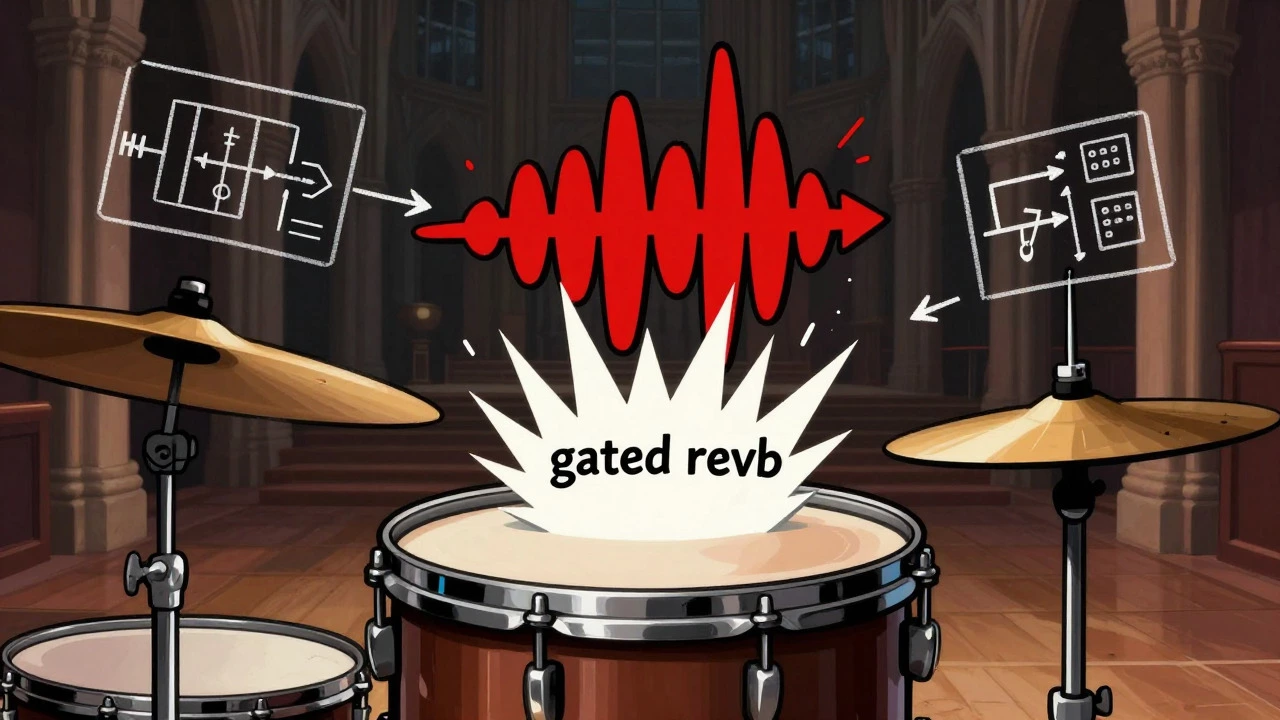
You cannot talk about 80s production without mentioning gated reverb is a signal processing technique that creates a massive, abrupt decay on drums, typically achieved by routing a reverberant signal through a noise gate triggered by the dry drum hit. This effect defines the sonic identity of the era. It makes a snare drum sound huge, powerful, and artificially spacious, yet completely controlled. Unlike natural room reverb, which trails off slowly and muddies the mix, gated reverb cuts off abruptly after about half a second.
The origin story is legendary. Producer Hugh Padgham accidentally left a talkback microphone on while recording Phil Collins’ drums for Peter Gabriel’s third album in 1979. The mic picked up the room’s natural reverb, which was then compressed and passed through a noise gate. The result was a thick, punchy ambience that decayed instantly. Padgham liked it, kept it, and soon it was everywhere. While Phil Collins’ "In The Air Tonight" (1981) is often cited as the first famous use, the technique was already being refined in studios across London and Los Angeles.
Technically, it works like this:
- Close Mics: Capture the initial transient attack of the drum.
- Ambience Mics: Record the reflections in a very live room.
- Digital Reverb: Process the ambience through a unit like the AMS RMX16.
- Compression: Boost the quiet reverb tail.
- Noise Gate: Triggered by the close mic, it opens for the hit and slams shut after ~0.5 seconds, cutting the tail dead.
This created a "whip-crack" envelope. Engineers could tune the hold time precisely, ensuring the reverb added power without cluttering the frequency spectrum. It allowed drums to sit loudly in a dense mix with synthesizers and guitars, providing clarity and impact simultaneously.
Key Instruments and Digital Tools
The palette of sounds available to producers exploded in the 80s thanks to digital sampling and synthesis. Fairlight CMI is an early digital sampler and synthesizer that introduced iconic sounds like the "orchestra hit" and enabled realistic orchestral emulation in pop music. Its high price tag meant only top-tier studios owned one, but its samples appeared on countless hits. The "orchestra hit"-a short, stabbing chord sample-became a staple for emphasizing transitions or ending phrases.
Drum machines also revolutionized rhythm. The LinnDrum, particularly the LM-1 model, provided sampled acoustic drum sounds that were tighter and more consistent than any human performance. Prince used the Linn LM-1 on tracks like "I Would Die 4 U," layering these samples with artificial reverb and gating to create his signature percussive drive. Don Henley’s "Boys of Summer" and Frankie Goes To Hollywood’s "Relax" both relied heavily on the Linn’s crisp snares and kicks.
For keyboards, the Yamaha DX7 dominated. Its FM synthesis produced bright, glassy electric piano and bell tones that cut through mixes effortlessly. These instruments allowed producers to fill out the mid-range frequencies without the warmth of analog synths, contributing to the clean, sharp aesthetic of 80s pop. Modern producers recreating this sound often use software emulations of the Fairlight and DX7 to access these specific timbres without the vintage hardware costs.
| Technology | Primary Function | Signature Sound | Notable Users |
|---|---|---|---|
| Fairlight CMI | Digital Sampling | Orchestra Hit, Realistic Strings | Peter Gabriel, Kate Bush |
| LinnDrum (LM-1) | Sampled Drum Machine | Crisp, Tight Acoustic Drums | Prince, Michael Jackson |
| Yamaha DX7 | FM Synthesis | Bright Electric Pianos, Bells | Jan Hammer, Toto |
| AMS RMX16 | Digital Reverb | Gated Ambience, Hall Effects | Phil Collins, Bruce Springsteen |
The Visual Turn: MTV and Promotion
Production alone didn’t make a hit; exposure did. The launch of MTV in 1981 changed the game entirely. Before this, radio was king. Now, image mattered as much as audio. Bands like Duran Duran understood this immediately. Their videos were cinematic, stylish, and narrative-driven, making them essential viewing for the network. This visual component became a core part of the promotion strategy for any aspiring pop superstar.
Labels invested heavily in video budgets because they knew a compelling clip could break an artist globally overnight. Artists had to be visually charismatic. Fashion, choreography, and set design became integral to the song’s identity. The synergy between the audio hook and the visual motif reinforced memory retention. When you saw the video repeatedly, the song stuck deeper into your subconscious.
Radio programming also evolved. Programmers sought songs with clear, identifiable hooks that worked well in short clips. The 3-minute format became strict. Intros were shortened, verses were condensed, and choruses were placed earlier. This structural tightening was driven by the need to grab attention quickly in a crowded media landscape.
Recreating the Sound Today
Many modern producers look back at the 80s with nostalgia, trying to capture that specific energy. However, simply slapping a reverb plugin on a snare isn’t enough. You need to understand the interplay between the dry signal and the wet tail. Start with a clean, transient-heavy snare sample. Add a hall-type reverb with a long decay. Then, insert a noise gate after the reverb. Set the threshold so the gate closes quickly after the initial hit. Experiment with the hold time-around 400 to 600 milliseconds usually works best.
For harmonies, avoid static loops. Write progressions that move. Use secondary dominants and modal interchange to add surprise. Keep the vocal melody distinct from the chord voicings. Layer synth pads underneath but keep them subtle, letting the bright leads and gated drums take the foreground. Remember, the goal is clarity and impact, not density.
Why It Still Matters
The techniques developed in the 1980s established many norms still used today. The emphasis on a strong, memorable hook remains central to pop success. The use of digital processing to shape space and time is now standard practice. While the specific sounds like gated reverb may feel dated to some, the principles behind them-creating contrast, maintaining clarity, and driving forward momentum-are timeless. Understanding this era gives you a toolkit for crafting songs that resonate emotionally and technically, bridging the gap between retro aesthetics and modern production standards.
What is gated reverb and how does it work?
Gated reverb is a production technique where a drum signal is sent through a reverb unit to create a large ambient sound, which is then processed through a noise gate. The gate is triggered by the original dry drum hit, allowing the reverb to swell briefly before being cut off abruptly. This creates a powerful, punchy sound with no muddy tail, characteristic of 1980s pop music.
Who invented gated reverb?
Producer Hugh Padgham is credited with discovering the sound accidentally in 1979 while recording Phil Collins' drums for Peter Gabriel's album. He left a talkback microphone on, which captured the room's reverb, compressed it, and passed it through a noise gate, creating the distinctive sharp decay.
What instruments defined the 1980s pop sound?
Key instruments included the Fairlight CMI sampler (known for the "orchestra hit"), the LinnDrum drum machine (for tight, sampled acoustic drums), and the Yamaha DX7 synthesizer (for bright FM electric pianos). Digital reverbs like the AMS RMX16 were also crucial for creating the era's signature spatial effects.
How did MTV change pop music promotion?
MTV shifted the focus from audio-only to visual storytelling. Artists needed to be visually appealing and invest in high-quality music videos. This made image and fashion integral to an artist's brand, and videos became a primary driver for radio play and chart success, breaking international acts like Duran Duran in the US market.
What makes 80s songwriting different from modern pop?
80s pop songwriting emphasized active harmonic movement, frequent chord changes, and modulation. Unlike modern pop, which often uses static loops, 80s songs featured complex progressions with transitional chords and careful voice leading to ensure the vocal melody remained distinct from the backing harmony.