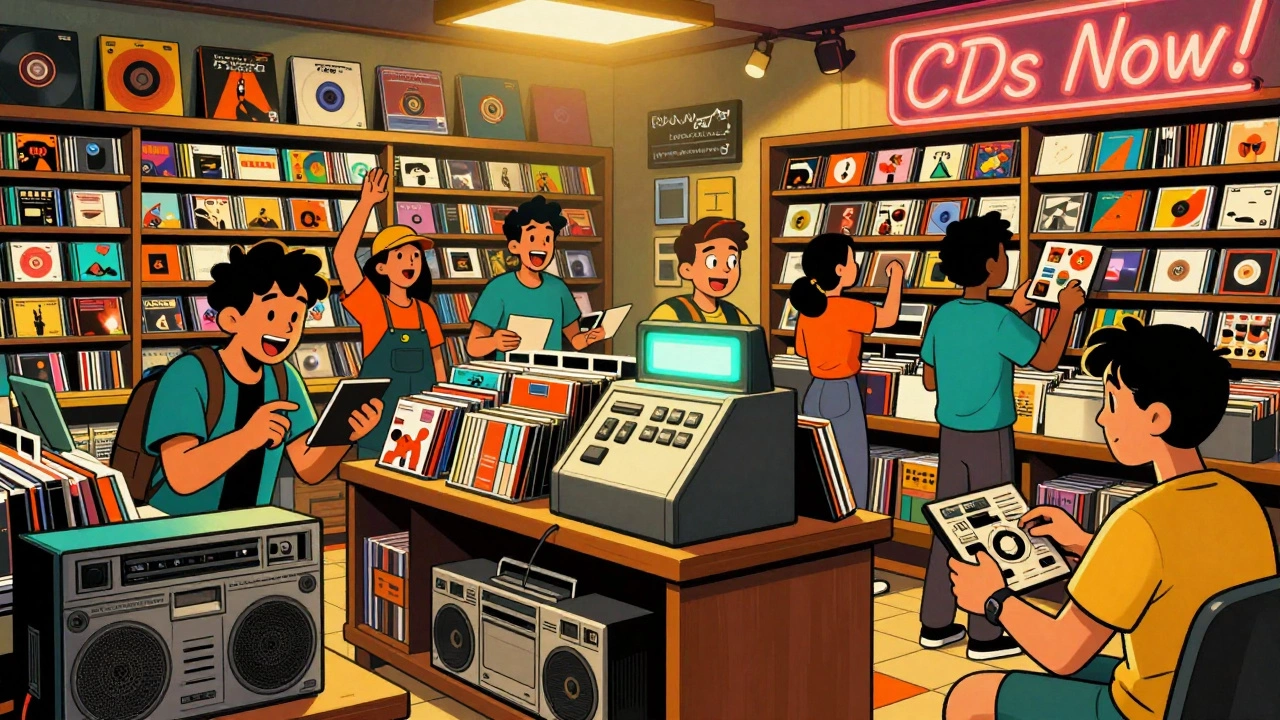

The 1990s weren’t just about flannel shirts and dial-up internet-they were the golden age of physical music sales. For the first time in history, CDs became the dominant way people bought music. By 1997, nearly a billion CDs were sold in the U.S. alone. In 2000, that number peaked at 942.5 million units, and revenue hit $13.2 billion. That’s more money made from music in one year than any year before or since. This wasn’t a slow rise. It was a explosion.
How CDs Took Over
CDs didn’t start strong. In 1983, they made up just 0.5% of music sales. But by 1988, they outsold vinyl records in the U.S. For the first time, people were choosing digital sound over crackling needles and warped records. Then came 1992-CDs passed cassette tapes. The cassette had been king for a decade, but it couldn’t compete. CDs didn’t skip. They didn’t tangle. You could skip straight to track 7 without rewinding. And the sound? Crisp, clear, and noise-free.
Manufacturers didn’t just make better discs-they made them everywhere. Big retail chains like Tower Records, Sam Goody, and later Target and Walmart put CDs front and center. Shelves were packed. Display stands glowed under store lights. Buying a CD became a ritual: pick the album, scan the barcode, hand over cash, walk out with a plastic jewel case in hand. It felt like ownership. You weren’t renting music-you owned it.
Why People Bought So Many
People didn’t just buy CDs because they were better. They bought them because they had to. If you loved music, you bought albums. There was no Spotify. No Apple Music. No YouTube. If you wanted to listen to Nirvana, Pearl Jam, or Mariah Carey, you had to buy the whole album-even if you only liked one song. That’s how the industry made money. Each album cost $14.99 on average. A fan buying five albums a year spent over $70. That’s more than most people spent on streaming subscriptions today.
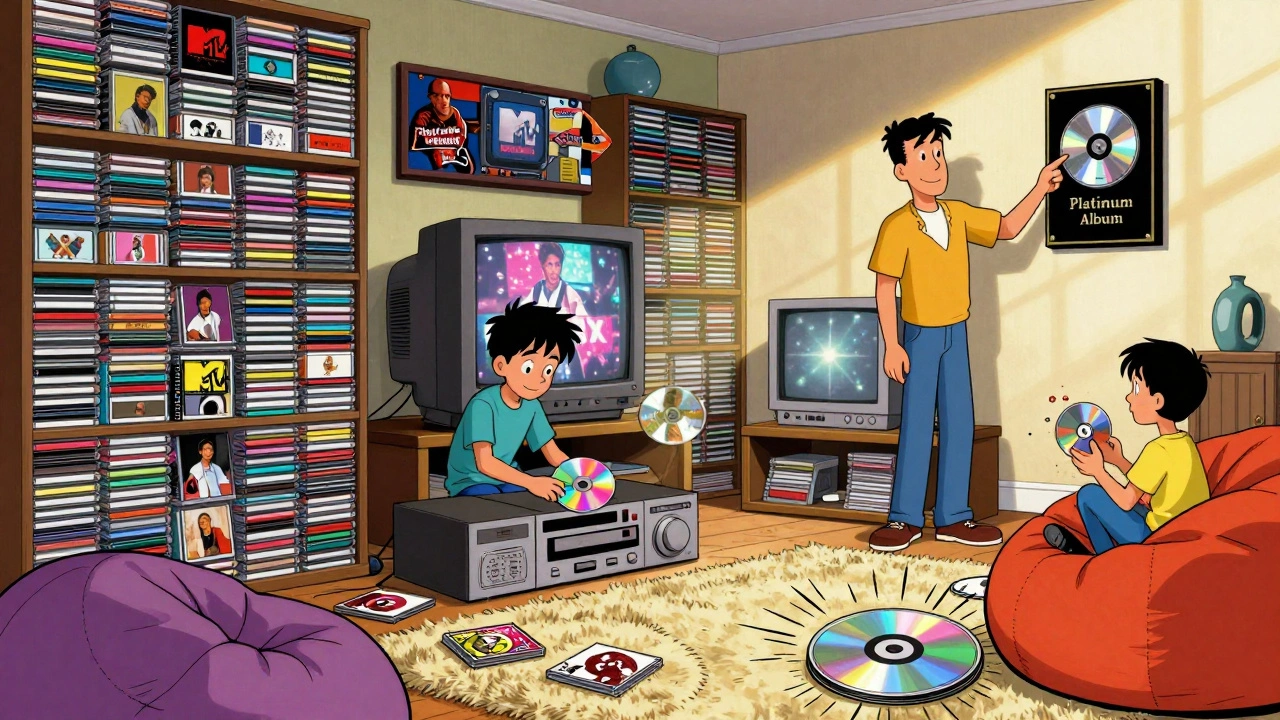
And the selection? Unbelievable. The 1990s had some of the most iconic albums ever released: Nevermind, The Chronic, Back in Black reissues, OK Computer, The Miseducation of Lauryn Hill. You didn’t just listen to these-you collected them. People built walls of CDs. They organized them by artist, by year, by color. CDs weren’t just music. They were trophies.
The Numbers That Shocked the Industry
By 1999, the U.S. was selling 770 million CDs. The next year, it hit 942.5 million. That’s over 3 CDs sold every second, 24 hours a day. Worldwide, over 30 billion CDs had been sold by 2004. That’s more than 4 CDs for every person on Earth at the time. The format was everywhere-in cars, in home stereos, in portable Discmans. The technology was so reliable that even people who didn’t care about sound quality bought CDs just because they didn’t break like cassettes.
Record labels were rolling in cash. Artists got bigger advances. Record stores thrived. Music videos on MTV drove sales. A single hit single could push an entire album to platinum status. The system worked perfectly-until it didn’t.
The Crack in the Disc
The first warning sign came in 1999. Napster launched. Suddenly, you could download songs for free. Not just one song. All of them. Within months, millions of teens were swapping entire albums in minutes. The music industry called it theft. But for kids who couldn’t afford $15 albums, it was liberation.
Then came the iPod in 2001. Suddenly, you didn’t need to carry 10 CDs to listen to music on the go. You could carry 1,000 songs in your pocket. And by 2003, iTunes let you buy songs individually for 99 cents. Why buy a whole album when you could just get the one song you liked?
CD sales started falling in 2001. By 2007, they’d dropped nearly in half. By 2010, sales were down 50% from the peak. In 2022, the U.S. sold just 34.4 million CDs-down 96% from 2000. The format that once ruled the world became a relic.
What Survived-and What Didn’t
CDs didn’t vanish. They changed. Today, CDs are mostly bought by collectors, older fans, or people who want something tangible. In 2021, CD sales jumped for the first time in 20 years. Why? Because Taylor Swift re-released her old albums. Adele dropped a new one. BTS fans bought physical copies to support their idols. These weren’t casual purchases. They were acts of devotion.
But here’s the twist: vinyl is growing faster. In 2022, vinyl sales outpaced CD sales in the U.S. for the first time since 1988. Why? Because vinyl feels like a ritual. It’s large. It’s warm. It comes with artwork you can hold. CDs? They’re small. Plastic. Easy to lose. You don’t display a CD. You store it.
CDs still sell. In 2023, the U.S. sold 37 million. The UK sold over 10 million. But they’re not for everyone. They’re for people who care enough to pay more-for a deluxe edition, a colored disc, a booklet with handwritten notes. That’s the new CD market: not mass, but meaningful.
The Real Legacy
The 1990s CD boom didn’t just sell music. It changed how we valued it. Back then, music had a price tag. You paid for it. You treasured it. You didn’t just stream it. You owned it. Today, you can access every song ever made for $10 a month. But do you value it more? Or less?
The CD was a technological marvel. It was durable. It was portable. It sounded better than anything before it. But its greatest achievement? It made music feel like a purchase, not a privilege. People didn’t just listen to CDs-they collected them, shared them, fought over them. That emotional connection is gone now. And maybe that’s why, even in decline, CDs still matter.
Why did CD sales peak in 2000 and not earlier?
CD sales peaked in 2000 because that’s when the market reached saturation. By then, nearly every household had a CD player. Retail chains had optimized distribution. Artists were releasing their biggest albums. The format had no competition-cassettes were dead, vinyl was niche, and digital was still years away. The perfect storm of technology, availability, and consumer demand hit its highest point in 2000.
How much did a CD cost in the 1990s?
In the 1990s, a new CD typically cost between $12.99 and $16.99. Premium releases, like box sets or special editions, could go for $20 or more. That’s roughly $25 in today’s money when adjusted for inflation. People paid that price because there was no alternative-no streaming, no downloads, no rentals.
Did cassette tapes disappear completely after CDs took over?
Cassette tapes didn’t vanish overnight, but they dropped off sharply after 1992. By 1995, cassette sales were down 60% from their 1990 peak. They stuck around in cars and cheap players for a few more years, but by 2000, they were nearly extinct in mainstream retail. The last major cassette release in the U.S. was in 2006, and production stopped entirely by 2010.
Why did vinyl come back but CDs didn’t?
Vinyl came back because it’s tactile and nostalgic. People enjoy the ritual: pulling the record out, placing the needle, flipping sides. It’s art you can hang on a wall. CDs? They’re small, fragile, and forgettable. You don’t display a CD. You store it in a drawer. Vinyl feels special. CDs feel outdated. That emotional difference is why vinyl sales are growing and CD sales are barely hanging on.
Are CDs still being made today?
Yes, but not like before. Major artists still release CDs-especially for special editions, tour bundles, or fan club exclusives. Labels like Sony, Universal, and independent shops keep producing them. In 2023, over 37 million CDs were sold in the U.S., mostly to dedicated fans. They’re no longer mainstream, but they’re not dead. Just niche.
What Comes Next?
The CD boom taught us that people will pay for ownership-when they believe it’s worth it. Today’s music industry is built on access, not ownership. You don’t buy songs-you rent them. But as the vinyl revival shows, there’s still room for physical connection. Maybe CDs won’t come back as a mass format. But for those who remember the weight of a new album in their hands, they’ll always have a place.


