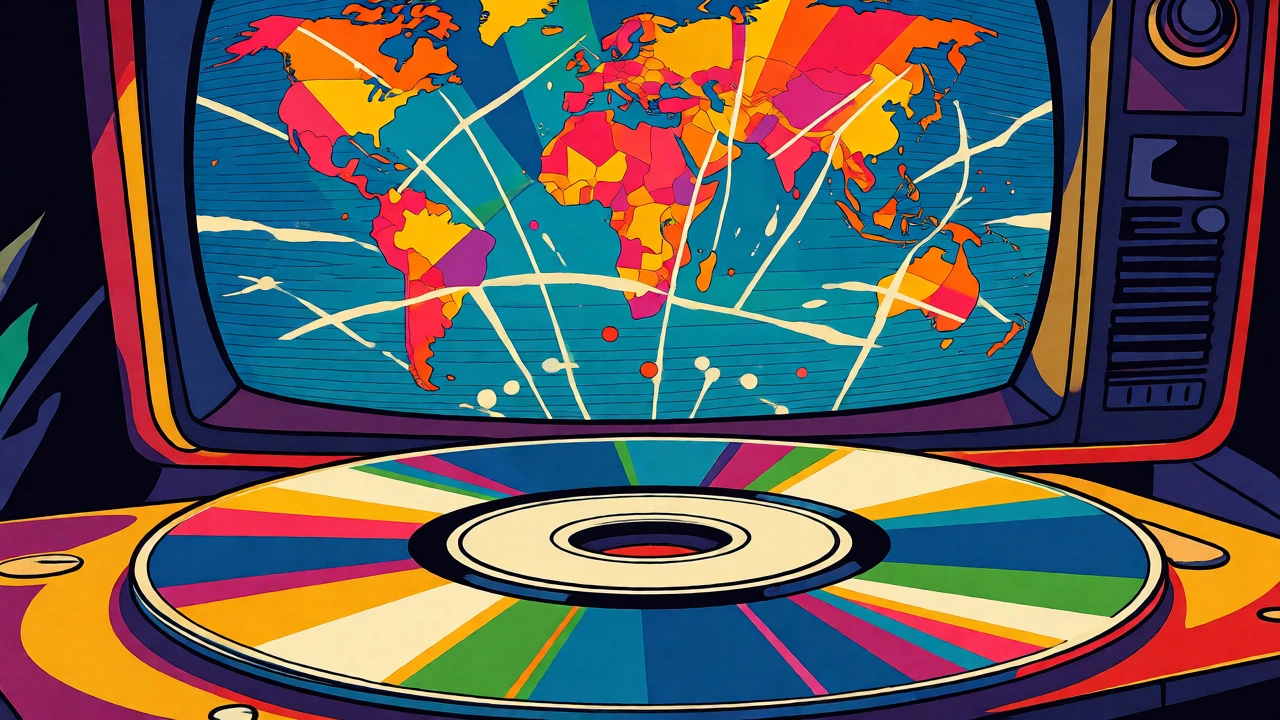

Did you know that Backstreet Boys were a massive hit in Europe before they even had a top-ten single in the United States? It sounds counterintuitive today, where an American breakout usually means instant global fame. But in the 1990s, teen pop didn’t just spill over borders like water; it was carefully engineered to cross them. This wasn’t just about exporting American culture. It was a complex dance of multinational label strategies, selective language translations, and logistical marvels that turned local idols into global brands.
If you think 1990s globalization meant everyone listened to the same English-language hits, you’re missing half the story. Research covering over 30,000 chart positions across nine Western countries shows something surprising: domestic artists actually became more popular during this era, whether they sang in English or their native tongue. The real shift wasn’t uniform taste, but rather intensified transnational circulation. Labels figured out how to move product faster and wider than ever before, using a mix of universal branding and targeted localization.
The Infrastructure of Global Fame
You can’t have a global tour without global distribution. The engine driving this expansion was the Compact Disc (CD). Developed by Philips and Sony and launched commercially in 1983, the CD revitalized a stagnant music market. By the mid-1990s, global audio-media sales had tripled since 1985 as consumers ditched vinyl and cassettes for digital clarity. Five major groups-Universal/PolyGram, Sony Music Entertainment, EMI, Warner Music, and Bertelsmann Music-controlled over 80% of these sales. This consolidation meant a single decision in a boardroom could push a record into dozens of countries simultaneously.
Then there was television. MTV wasn’t just a channel; it was a distribution network. Launched in Europe in 1987 with 1.6 million subscribers, MTV expanded aggressively. By the mid-1990s, reports claimed it reached approximately 270 million households in over 125 countries. Crucially, MTV adopted a "think globally, act locally" strategy. They launched regional feeds like MTV Asia-Pacific in Singapore (1994) and MTV Mandarin (1995). This allowed English-language acts to remain visible while giving regional stars a platform, creating a "glocal" ecosystem rather than a one-way street.
Language Versions: More Than Just Translation
Recording songs in multiple languages wasn’t new, but the 1990s industrialized it. Take Backstreet Boys again. After conquering Spain and Mexico, they recorded "I’ll Never Break Your Heart" as "Nunca Te Haré Llorar" and "Anywhere for You" as "Donde Quieras Yo Iré." These weren’t afterthoughts; they were strategic moves recorded in Zürich to capitalize on specific market success. Howie Dorough’s Puerto Rican heritage and Spanish fluency helped drive this internal catalyst. The US CD editions even included Spanglish and instrumental variants, proving that localization could be part of the core product packaging.
| Artist | Primary Strategy | Language Adaptation | Key Market Focus |
|---|---|---|---|
| Backstreet Boys | Sequential Release & Dedicated Recording | Official Spanish recordings (e.g., "Nunca Te Haré Llorar") | Europe first, then Latin America & Asia |
| Spice Girls | Visual Branding & Slogan Export | Minimal translation; relied on "Girl Power" imagery | UK, Europe, North America, South Africa |
| Britney Spears | Standardized English Product | Fan translations; no official multilingual masters | Global via radio/video standardization |
| H.O.T. / CLON | Regional Idol Format Exchange | Korean/Mandarin/Japanese exchanges | East & Southeast Asia |
Not every act followed this path. Britney Spears’s launch was fundamentally English-language. Jive Records released "…Baby One More Time" to US radio in September 1998, and her promotion relied on shopping-mall performances and video rotation. While fan translations circulated online, Spears didn’t officially record commercial Spanish versions. This distinction matters: fan effort isn’t the same as corporate strategy. NSYNC also had later adaptations like "Te Voy Amar," but their 1990s model leaned heavily on North American touring power rather than extensive multilingual catalogs.

Touring: Converting Visibility into Revenue
Seeing is believing, and buying is earning. The Spiceworld Tour exemplifies how mediated visibility converts to cash. Starting in Dublin in February 1998, the tour covered the UK, continental Europe, and North America. BBC reports cite 97 shows and roughly $60 million in US revenue, though other accounts suggest higher totals depending on accounting methods. The key takeaway? They didn’t go everywhere. Their "world" tour skipped much of Asia and South America initially, focusing on affluent markets with strong cable TV penetration and arena infrastructure.
Touring also served as diplomatic soft power. In 1997-1998, the Spice Girls visited South Africa and met President Nelson Mandela. These weren’t just concerts; they were media events that sold the "Girl Power" brand without needing to translate lyrics. Visual identity bridged the language gap. When Geri Halliwell left the group in May 1998 due to exhaustion, it highlighted the human cost of this relentless global schedule. Yet, the model worked: synchronized video exposure plus physical presence created a tangible community that records alone couldn’t achieve.
The Asian Counter-Current
Western narratives often ignore the parallel rise of Asian idol pop. This wasn’t just passive consumption of Western exports. Oxford’s history of K-pop notes that CLON’s 1997 album release in Taiwan marked an early success beyond Korea, while H.O.T. toured China. This first wave of the Korean Wave reached Japan, China, and Southeast Asia. Meanwhile, Japanese pop surged too. Hikaru Utada’s 1999 hit "Automatic" became a signature song, and Taiwanese performer Vivian Hsu’s group Black Biscuits achieved hits in both Japanese and Mandarin.
These cases prove that language switching wasn’t just a concession by Anglo-American labels. Asian performers actively crossed borders using multilingual repertoires and neighboring-market networks. The flow was multidirectional. A teenager in Manila might listen to a Korean group singing in English, then watch a Japanese solo artist sing in Japanese, all on the same regional MTV feed.
Limits of the Model
Was this true globalization? Not exactly. The system had clear weaknesses. Cultural asymmetry remained dominant; English was still the default commercial language for the biggest acts. Translations were selective, not comprehensive. Tour coverage concentrated on wealthy nations with existing infrastructure, leaving vast regions underserved. Furthermore, published attendance numbers often conflicted because promoters used different definitions of "gross."
By the late 1990s, the model began destabilizing. MP3 compression and peer-to-peer networks shifted music sharing from enthusiast hobby to mass practice. While this hurt physical sales, it validated the underlying strategy: global branding combined with local relevance. The 1990s laid the groundwork for the digitally networked fandom we see today. The infrastructure built then-multinational label coordination, regional media feeds, and the expectation of international accessibility-remains the foundation of modern pop economics.
Frequently Asked Questions
Why did Backstreet Boys become famous in Europe before the US?
Their debut single, "We’ve Got It Goin’ On," was released in Europe in 1995 and gained traction there first. US radio stations were slower to pick up the track. The label leveraged this European momentum to build hype before launching fully in the American market, demonstrating a sequential release strategy common among multinational labels at the time.
Did Britney Spears record songs in Spanish?
No, Britney Spears did not officially record or commercially release Spanish-language versions of her major hits during the 1990s. While fan translations circulated online and lyrics were sometimes localized in print media, her primary releases remained in English. Her global success relied on standardized English products and visual branding rather than linguistic adaptation.
How did MTV help teen pop go global?
MTV provided a unified visual platform that transcended language barriers. By expanding into regional feeds like MTV Europe, MTV Brazil, and MTV Asia, it ensured consistent video exposure for American acts while also promoting local talent. This "glocal" approach helped create a shared youth culture across borders, making visual branding as important as lyrical content.
Were 1990s teen pop tours truly worldwide?
Most major tours focused on North America, Europe, and parts of Asia or Latin America, rather than literally every continent. For example, the Spice Girls’ Spiceworld Tour covered the UK, Europe, and North America, with special appearances elsewhere like South Africa. True global touring required significant infrastructure, which limited full-world runs to only the largest acts.
Did non-Western teen pop influence the 1990s global scene?
Yes, significantly. Acts like CLON and H.O.T. from Korea, along with Japanese and Taiwanese performers, built massive regional followings. This early wave of Asian pop demonstrated that idol formats could succeed outside the West, laying the groundwork for the later global explosion of K-pop. These markets exchanged music through regional networks, creating a multidirectional flow of pop culture.