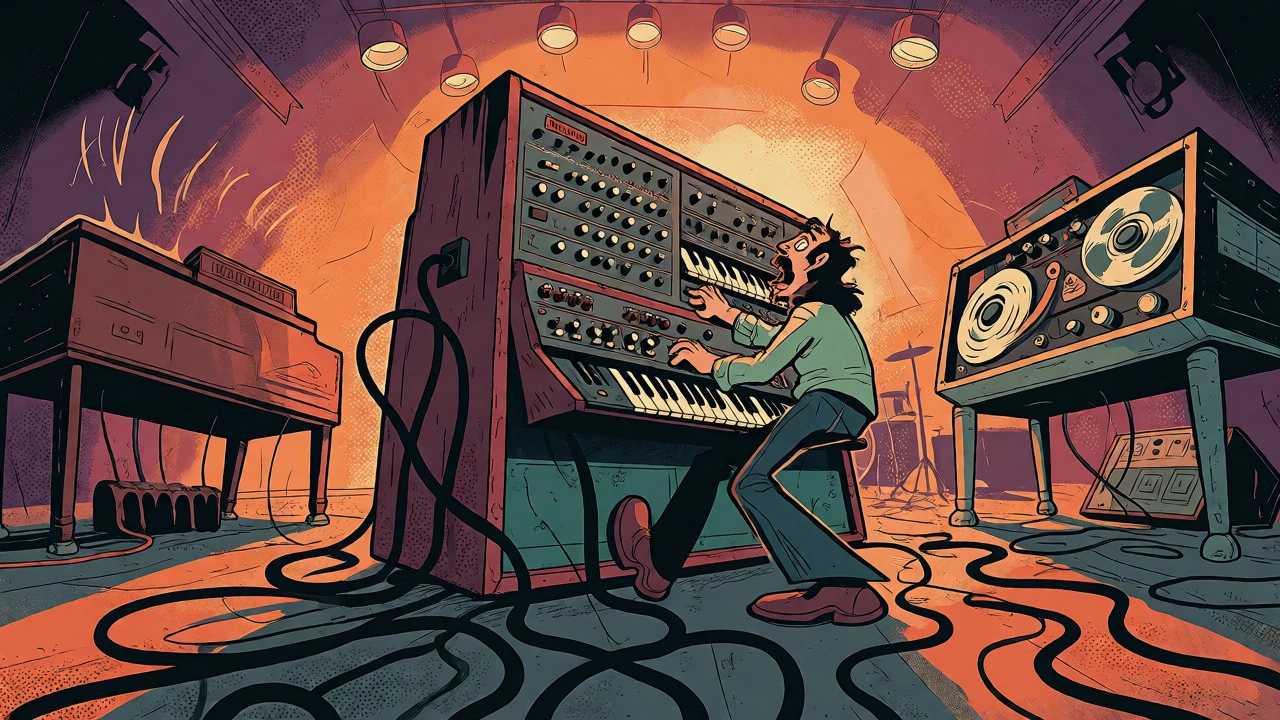

Imagine standing on a stage in 1973. You are not holding a guitar. You are surrounded by a wall of wood and metal, cables snaking across the floor like vines. To your left sits a Hammond organ, humming with potential. To your right, a Mellotron, its tape heads waiting to trigger ghostly choirs. But in front of you is something new, something strange: a Minimoog portable analog synthesizer that revolutionized live performance by allowing musicians to create entirely new sounds in real time. This wasn't just an instrument; it was a declaration of war against the standard rock setup.
Progressive rock didn't just adopt synthesizers; it used them to break the rules. Before the 1970s, keyboards were often background texture or classical piano solos. By the mid-70s, they had become lead voices, orchestrators, and noise machines. If you want to understand why bands like Yes, Genesis, and Emerson, Lake & Palmer sounded so different from everyone else, you have to look at the specific tools they used. It wasn't magic. It was voltage-controlled oscillators, fragile tape strips, and a lot of patience.
The Rise of the Portable Synthesizer
Early electronic instruments were monsters. The original modular Moog systems filled entire rooms. They cost as much as a house and took hours to patch together before you could play a single note. For a touring band, this was a nightmare. You couldn't exactly throw a modular system in the back of a van and hope it survived the trip to Cleveland.
The game changed in 1970 when Robert Moog released the Minimoog Model D. This was the first synthesizer designed for the stage. It had a keyboard you could actually play, knobs you could tweak while performing, and it fit into a road case. Suddenly, keyboardists weren't just pressing buttons; they were sculpting sound live. The Minimoog was monophonic, meaning it could only play one note at a time. At first glance, this seems like a limitation. In progressive rock, it became a feature. It forced players to think melodically, creating fast, aggressive leads that cut through the mix like a laser.
Keith Emerson of Emerson, Lake & Palmer proved this point better than anyone. He didn't just use the Moog; he wrestled with it. He treated the synthesizer like a guitar, bending notes, sliding down pitch wheels, and creating screaming feedback loops. His performances turned the synthesizer from a novelty into a rock star instrument. Before Emerson, synths were experimental. After him, they were essential.
The Mellotron: A Fake Orchestra That Sounded Real
If the Minimoog was about raw, electric power, the Mellotron was about orchestral illusion. Developed in Birmingham, England, the Mellotron wasn't technically a synthesizer. It didn't generate sound electronically. Instead, it played back pre-recorded tapes. Each key triggered a strip of magnetic tape containing a recorded flute, violin, cello, or choir voice.
Bands like King Crimson and Genesis loved the Mellotron because it allowed a four-piece rock band to sound like a symphony orchestra. Tony Banks of Genesis used it to create lush string sections behind his piano work. Rick Wakeman of Yes used it for epic choral backgrounds. But the Mellotron was temperamental. The tapes stretched over time, causing the pitch to drift. If you held a chord too long, the tape would run out, and the sound would simply stop. Mechanical noise from the tape heads added a gritty, lo-fi character that many producers later tried to replicate digitally.
The fragility of the Mellotron became part of its charm. When a choir pad wavered slightly out of tune during a live show, it felt human. It felt alive. Modern digital samplers can mimic the Mellotron's sound perfectly, but they often miss the anxiety of knowing the tape might snap any second. That tension contributed to the emotional weight of 1970s prog ballads.
ARP Instruments: The Alternative Voice
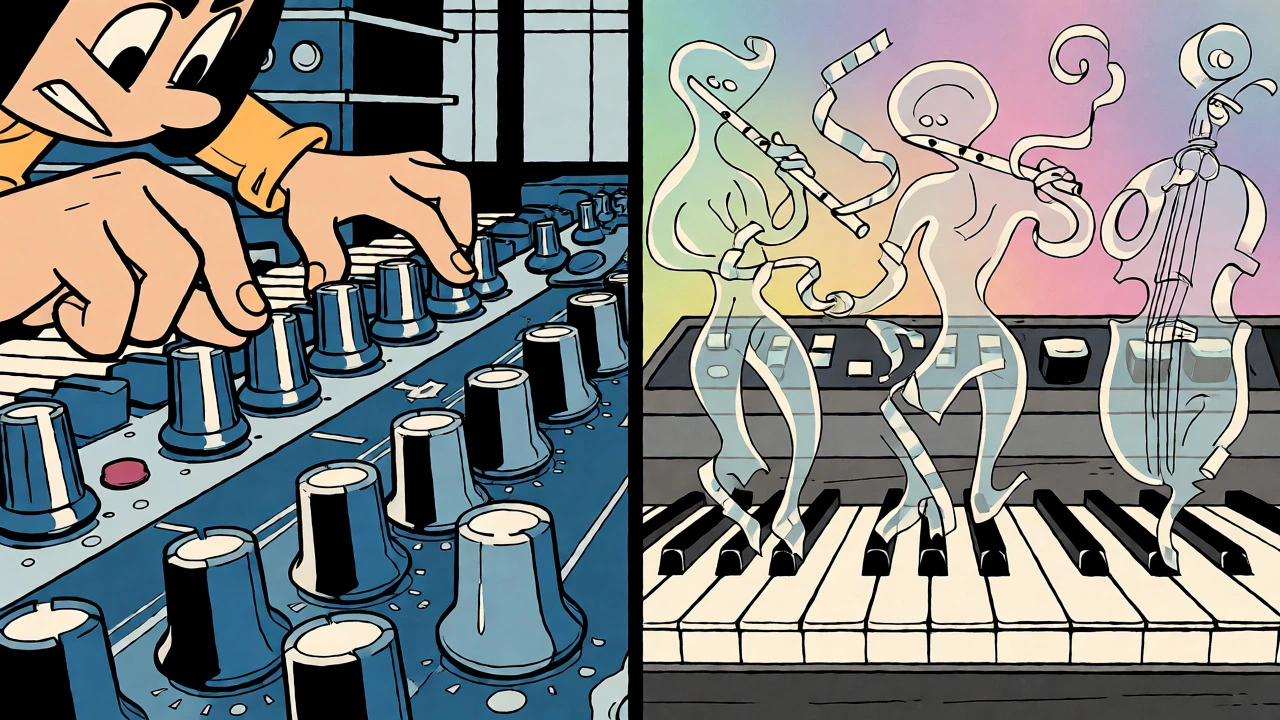
While Moog dominated the headlines, ARP Instruments offered a compelling alternative. Founded by Alan R. Pearlman, ARP created instruments that were often easier to use and sounded distinctively different. The ARP Odyssey, released in 1972, became a staple for keyboardists who wanted more control without the complexity of a full modular system.
Why choose an ARP over a Moog? It came down to filter character. Moog filters were famous for their warm, smooth low-pass response. ARP filters were sharper, more resonant, and sometimes harsher. This made ARPs ideal for creating metallic, robotic, or piercing sounds. Tony Banks relied heavily on the ARP Pro Soloist, a preset-based instrument that gave him instant access to brass and string tones. He didn't need to spend twenty minutes tweaking knobs to get a good sound; he needed to play a complex composition quickly. The ARP provided reliability and immediacy.
Other ARP models, like the 2600, bridged the gap between modular flexibility and performance convenience. Many studio engineers preferred ARP units for their stability. While Moogs were notorious for going out of tune as they warmed up, ARPs tended to hold their pitch better. This practical advantage meant that if you were recording an album in London, you might see an ARP rack next to the Moog, each doing what it did best.
The Wall of Keyboards: Visual and Sonic Impact
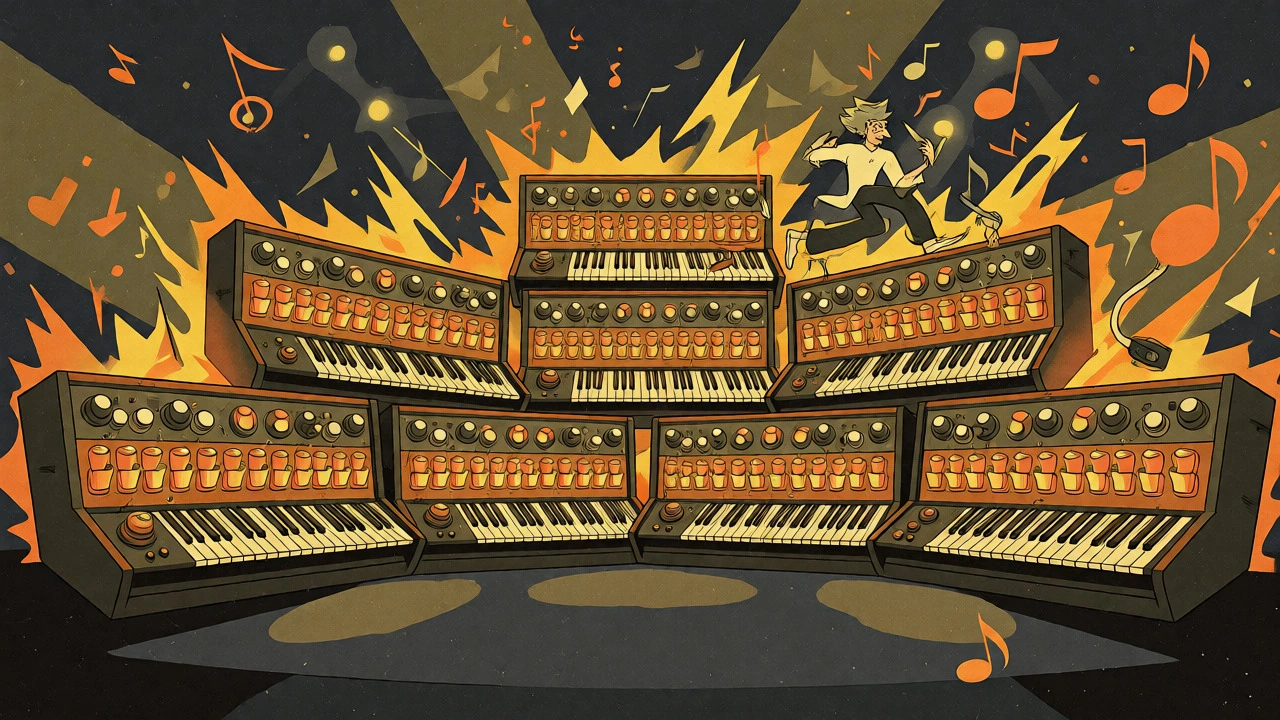
By 1974, the image of the progressive rock keyboardist was iconic. Think of Rick Wakeman sitting behind six Minimoogs. It looked excessive, almost absurd. But there was a method to the madness. Because these instruments were monophonic or limited in polyphony, switching between them was faster than reprogramming a single unit. One Minimoog might be set for a bass tone, another for a lead solo, and a third for a special effect. During a live performance, Wakeman could jump from one to the other seamlessly.
This "wall of keyboards" also served a visual purpose. Progressive rock was theatrical. The sheer size of the rig signaled that the music inside was complex and ambitious. It separated prog bands from the three-guitar setups of hard rock or the simple piano bars of folk-rock. Audiences saw the technology and expected something extraordinary. And usually, they got it.
| Instrument | Sound Generation Method | Polyphony | Key Characteristic | Notable User |
|---|---|---|---|---|
| Minimoog Model D | Analog Voltage-Controlled Oscillators | Monophonic | Warm, fat leads; expressive pitch bends | Rick Wakeman, Keith Emerson |
| Mellotron Mark II/IV | Pre-recorded Magnetic Tape | Polyphonic (limited) | Orchestral textures; unstable tuning | Tony Banks, Mike Pinder |
| ARP Odyssey | Analog Voltage-Controlled Oscillators | Duophonic | Sharp, resonant filters; stable tuning | Gilbert O'Sullivan, Todd Rundgren |
| Hammond B3 Organ | Tone Wheels + Leslie Speaker | Polyphonic | Sustained harmonic mass; percussive attack | Jon Lord, Greg Lake |
Sound Design Techniques: From Noise to Music
How did these machines actually make the sounds we associate with prog rock? Most 1970s synthesizers used subtractive synthesis. Imagine a block of marble (the raw waveform). You start with a harmonically rich wave, like a sawtooth. Then, you use a filter to carve away frequencies, leaving only the shape you want. Envelope generators controlled how the sound evolved over time-how fast it started, how long it lasted, and how it faded.
Prog keyboardists exploited every parameter. They used slow modulation to make drones breathe. They used fast modulation to create metallic clangs. They layered noise generators to simulate wind or explosions. Sequencers, though primitive by today's standards, allowed for repetitive, hypnotic pulses that drove songs forward. These weren't just presets loaded from memory; they were sounds built from scratch, often in the middle of a song.
The limitations drove creativity. Since you couldn't play chords easily on a Minimoog, you learned to arpeggiate rapidly. Since the Mellotron ran out of tape, you learned to write shorter phrases. Since the instruments drifted out of tune, you embraced the dissonance. These constraints became the signature style of the genre. Today, when we hear a synth lead that slides smoothly between notes, we are hearing the legacy of a musician fighting against a stiff pitch wheel in 1972.
Legacy and Modern Relevance
Did progressive rock invent synthesizers? No. But it did make them mainstream. Before prog, synthesizers were largely confined to academic labs and avant-garde studios. Bands like Yes and ELP brought them to stadiums. They proved that electronic instruments could convey emotion, drama, and virtuosity just as effectively as guitars or pianos.
Modern software emulations try to capture the magic of these old machines. Plugins recreate the Minimoog's ladder filter and the Mellotron's tape hiss. But there is still a demand for the real thing. Original Minimoogs sell for thousands of dollars. Restored Mellotrons are prized possessions. Why? Because the imperfections are part of the art. The slight wobble of a tape, the warmth of an analog oscillator, the physical act of turning a knob-these things connect the listener to the moment of creation.
For musicians today, studying this era isn't just nostalgia. It's a masterclass in sound design. It teaches you that technology is not just about having the most features; it's about how you use what you have. The 1970s prog keyboardists didn't have MIDI. They didn't have automation. They had electricity, creativity, and a willingness to fail. That combination produced some of the most distinctive sounds in music history.
What is the difference between a synthesizer and a Mellotron?
A synthesizer generates sound electronically using oscillators and filters, allowing for infinite timbral possibilities. A Mellotron plays back pre-recorded magnetic tapes of acoustic instruments. Synthesizers create new sounds; Mellotrons replay existing ones.
Why were early synthesizers monophonic?
Early analog synthesizers like the Minimoog were monophonic because generating multiple stable pitches simultaneously required complex circuitry that was expensive and prone to drifting out of tune. Monophony kept costs down and ensured pitch stability, which was crucial for live performance.
Which synthesizer is most associated with Keith Emerson?
Keith Emerson is most closely associated with the Moog synthesizer, particularly the large modular systems and later the Minimoog. He pioneered the use of the synthesizer as a virtuosic lead instrument in rock music, famously wrestling with it onstage.
What problems did the Mellotron have?
The Mellotron suffered from tape stretch, which caused pitch instability over time. It also had a limited note duration because the tape strips were finite in length. Mechanical noise from the tape heads and heavy weight made it difficult to transport and maintain.
Did progressive rock bands use digital synthesizers?
Most progressive rock bands in the 1970s used analog synthesizers. Digital synthesizers began appearing in the late 1970s and early 1980s, marking a shift in sound design away from the warm, organic textures of the earlier decade toward cleaner, more precise tones.